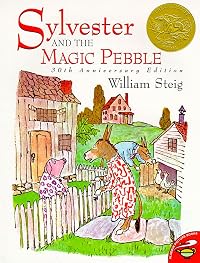
Sylvester and the Magic Pebble
by William Steig
On This Page
Description
In a moment of fright, Sylvester the donkey asks his magic pebble to turn him into a rock but then can not hold the pebble to wish himself back to normal again.Tags
Recommendations







Member Recommendations
Member Reviews
When Sylvester finds a beautiful red pebble one day, the rock-collecting donkey is delighted. When that pebble turns out to be a magical stone that grants wishes, he is even more overjoyed, and rushes home to share the largess with his loving parents. Unfortunately, a chance encounter with a lion on his way, and a hastily made wish, see him transformed into an inanimate stone, with little prospect of ever being released from his self-inflicted enchantment. As Sylvester's parents begin their long search for him, he sits quietly in the meadow, unable to move. Will he ever become a donkey again, or be reunited with his parents...?
Apparently this charming picture-book - first published in 1969, and awarded a Caldecott Medal in 1970 - has show more been challenged in at least eleven states! Why you ask? Because its tale of a donkey who accidentally wishes himself into a stone, thereby causing grief to his loving parents, and to himself, is too disturbing for youngsters? No! Because it contains magic in the first place, and that might give impressionable young readers the 'wrong' idea? Again, no! This one was challenged because the police officers in the story - the helpful police officers who comfort Sylvester's parents, and try to help them find their son - are depicted as pigs! Of course, there's also a housewife depicted as a pig, but housewives aren't quite as organized as the police, who began challenging Sylvester and the Magic Pebble in 1977, in Indiana. That sound you hear is me rolling my eyes...
In any case, I'm glad I finally had a chance to read this classic of the picture-book genre, as I think it really is delightful, with an engrossing tale that treats childhood with the respect it deserves - no, children aren't all sweetness and light, and yes, they experience dark realities - and expressive artwork that captures both the humor and terror of Sylvester's predicament. show less
Apparently this charming picture-book - first published in 1969, and awarded a Caldecott Medal in 1970 - has show more been challenged in at least eleven states! Why you ask? Because its tale of a donkey who accidentally wishes himself into a stone, thereby causing grief to his loving parents, and to himself, is too disturbing for youngsters? No! Because it contains magic in the first place, and that might give impressionable young readers the 'wrong' idea? Again, no! This one was challenged because the police officers in the story - the helpful police officers who comfort Sylvester's parents, and try to help them find their son - are depicted as pigs! Of course, there's also a housewife depicted as a pig, but housewives aren't quite as organized as the police, who began challenging Sylvester and the Magic Pebble in 1977, in Indiana. That sound you hear is me rolling my eyes...
In any case, I'm glad I finally had a chance to read this classic of the picture-book genre, as I think it really is delightful, with an engrossing tale that treats childhood with the respect it deserves - no, children aren't all sweetness and light, and yes, they experience dark realities - and expressive artwork that captures both the humor and terror of Sylvester's predicament. show less
Sylvester, a young donkey, finds a magic red pebble that grants him any wish he desires while holding it. Elated, he takes it home, but runs into a lion on the way back. After making a wish that he were a rock to avoid the lion, he realizes that he can no longer hold the pebble – and so he cannot make a wish to be back to himself. As his parents go frantic waiting for him to return, they gradually accept that their son is not returning. After a year, they go on a picnic and find the magic pebble right where Sylvester the Rock is sitting in a field. Sylvester’s parents make a wish that their son was back, and Sylvester is returned! They keep the pebble in a safe, but do not use it, because being a family again is all they ever show more wanted.
The best children’s books are just a little bit scary, and just a little bit sad. Sylvester and the Magic Pebble showcases this admirably: when Sylvester is turned into a rock and unable to wish himself back, his parents are frantic with worry. Unlike some children’s books, where the plot conflict would be resolved immediately, his parents do not immediately get their son back, but instead, wait a year and mourn Sylvester’s disappearance before he is turned back. For a children’s book, it is just the right amount of scary – what if Sylvester never comes back? – but ends with a happy note. Steig’s themes of family being more important than possessions is an important one that makes this a cherished classic.
The illustrations of the animals are simplistic, but the scenery scenes are gorgeously rendered, particularly when Sylvester, as a rock, sees the passing of the seasons. Readers are treated to a nighttime scene with glittering stars and blue mountains, fall leaves painted in scarlets and oranges and golds, a bare winter scene covered in snow, and a cheerful springtime scene with orange and blue trees and purple flowers in a green meadow.
The illustrations are also not afraid to add some humor, even if it was quite controversial at the time it was published. For instance, the police are portrayed as pigs – a joke which may fly over the heads of younger readers, but which will surely make any adults raise an eyebrow. In another scene, when Sylvester makes the rain stop with his wish, two ducks in the pond behind him look to the sky quite confused at the sudden cessation of rain.
Sylvester and the Magic Pebble may not seem like much at first glance, but there is a reason why it has endured as a childhood classic: its themes of family being more important than anything one could wish for, the brilliantly rendered and humorous illustrations, and just a touch of scariness that things may not be okay in the end, are all deliciously exciting to children, as well as adults. show less
The best children’s books are just a little bit scary, and just a little bit sad. Sylvester and the Magic Pebble showcases this admirably: when Sylvester is turned into a rock and unable to wish himself back, his parents are frantic with worry. Unlike some children’s books, where the plot conflict would be resolved immediately, his parents do not immediately get their son back, but instead, wait a year and mourn Sylvester’s disappearance before he is turned back. For a children’s book, it is just the right amount of scary – what if Sylvester never comes back? – but ends with a happy note. Steig’s themes of family being more important than possessions is an important one that makes this a cherished classic.
The illustrations of the animals are simplistic, but the scenery scenes are gorgeously rendered, particularly when Sylvester, as a rock, sees the passing of the seasons. Readers are treated to a nighttime scene with glittering stars and blue mountains, fall leaves painted in scarlets and oranges and golds, a bare winter scene covered in snow, and a cheerful springtime scene with orange and blue trees and purple flowers in a green meadow.
The illustrations are also not afraid to add some humor, even if it was quite controversial at the time it was published. For instance, the police are portrayed as pigs – a joke which may fly over the heads of younger readers, but which will surely make any adults raise an eyebrow. In another scene, when Sylvester makes the rain stop with his wish, two ducks in the pond behind him look to the sky quite confused at the sudden cessation of rain.
Sylvester and the Magic Pebble may not seem like much at first glance, but there is a reason why it has endured as a childhood classic: its themes of family being more important than anything one could wish for, the brilliantly rendered and humorous illustrations, and just a touch of scariness that things may not be okay in the end, are all deliciously exciting to children, as well as adults. show less
While collecting rocks one day, Sylvester the donkey, finds a magic pebble that grants wishes. On his way home from the water Sylvester finds himself face-to-face with a lion and in a panic he wishes to be turned into a rock. A year goes by and both Sylvester and his parents lose hope that they will ever be reunited. By happenstance, his father places the magical pebble on the rock that was Sylvester and he is able to wish himself into a donkey again. The family is reunited. They lock away the pebble, realizing that all they need is each other. This was a very sad tale with a happy ending. I liked that the book dealt with sadness, loss and hopelessness. I think these are feelings that children do not get to talk about in the classroom, show more but feelings they experience never the less. I would use this story as a mentor text for personification. show less
Banned Book Week 2017. This year I'm reading a few picture books that have been challenged for their content, this one apparently because the police are portrayed as pigs. That seems pretty innocuous or at best a gentle, lazy jab in a gentle, lazy story.
I'm torn in deciding if this story is a simple variation on [b:The Monkey's Paw|8779896|The Monkey's Paw|W.W. Jacobs|https://images.gr-assets.com/books/1348984485s/8779896.jpg|47306975], a fable about the grief of parents' who have lost a child and hope to one day be reunited in the afterlife, or a Christian allegory with miracles, Roman lions, and a spring resurrection. I mostly settle on too silly to matter and absolutely too silly to take offense.
I'm torn in deciding if this story is a simple variation on [b:The Monkey's Paw|8779896|The Monkey's Paw|W.W. Jacobs|https://images.gr-assets.com/books/1348984485s/8779896.jpg|47306975], a fable about the grief of parents' who have lost a child and hope to one day be reunited in the afterlife, or a Christian allegory with miracles, Roman lions, and a spring resurrection. I mostly settle on too silly to matter and absolutely too silly to take offense.
A lovely story about a pebble-collector who finds a beautiful magic red pebble but also discovers that some things you already have are better than what you wish for.
I like pebble-collectors. My mother used to collect them from her woods. She'd take a walk and she'd pick up a pretty pebble or unusual small rock and hold it in her hand while she'd think of something she was grateful for. She'd then bring it home and put her "gratitude rock" in a homemade yucca basket I made for her.
When she died, the basket was full.
I like pebble-collectors. My mother used to collect them from her woods. She'd take a walk and she'd pick up a pretty pebble or unusual small rock and hold it in her hand while she'd think of something she was grateful for. She'd then bring it home and put her "gratitude rock" in a homemade yucca basket I made for her.
When she died, the basket was full.
I liked this book for many reasons. One reason being I liked how the author personified the main character. This made the story more believable and easy to relate to. The illustrations also deserve the award it has received. They help enhance the language of the text. At the end when Sylvester turns back into a donkey his parent's reactions make sense. You can clearly see their happiness for being reunited with their son. The author also, uses figurative language which makes the text challenging. Children should be challenged while they are reading. This book can also be an introduction to figurative language. This is a great story to share with young children. It teaches them to be grateful for the things they have. Sylvester wanted show more more for himself and his family. But, he realized he had everything he already needed. show less
While I love all of William Steig’s picture books, Sylvester and the Magic Pebble was my favorite as a child and remains my top choice. After finding a magic pebble that grants wishes, Sylvester the young donkey is so frightened by a lion that he accidently wishes himself into a rock to hide. As a rock, Sylvester is no longer able to hold the wishing pebble in his hand to grant further wishes, and thus his family thinks he has disappeared for many months until they serendipitously sit on Sylvester (the rock) while picnicking, spot the magic pebble, and place it on the rock. After a joy filled reunion, the family puts the magic pebble in a safe as they have all they could have wished for in returning to one another.
I am fond of this show more story for many reasons, primarily because of Steig’s whimsical illustrations, which use abundant color and pattern. I also appreciate his use of language in that he chooses unique and perhaps even challenging words children might not be familiar with. Because the magical plot is fairly simple and the animal characters are humanized and engaging, Steig seems to recognize there is no need to dumb down his word choices and he writes for all reading levels alike. For example, the rain “ceases” rather than stopping and Sylvester gets both “perplexed and bewildered”. The language can also be rather visually metaphorical such as when the spring flowers “show their young faces” rather than simply blooming. This book is a wonderful story that young readers become involved in because they want to know how the mystery resolves itself. The underlying message, that the only true thing worth wishing for is one’s loved ones, is also an important message a young reader will enjoy and connect with. show less
I am fond of this show more story for many reasons, primarily because of Steig’s whimsical illustrations, which use abundant color and pattern. I also appreciate his use of language in that he chooses unique and perhaps even challenging words children might not be familiar with. Because the magical plot is fairly simple and the animal characters are humanized and engaging, Steig seems to recognize there is no need to dumb down his word choices and he writes for all reading levels alike. For example, the rain “ceases” rather than stopping and Sylvester gets both “perplexed and bewildered”. The language can also be rather visually metaphorical such as when the spring flowers “show their young faces” rather than simply blooming. This book is a wonderful story that young readers become involved in because they want to know how the mystery resolves itself. The underlying message, that the only true thing worth wishing for is one’s loved ones, is also an important message a young reader will enjoy and connect with. show less
Members
- Recently Added By
Lists

Caldecott Medal Books
91 works; 15 members

1001 Children's Books You Must Read Before You Grow Up
774 works; 100 members
Favorite Childhood Books
1,651 works; 519 members

Best Children's Books You've Read
197 works; 75 members

Mensa for Kids Excellence in Reading Award Program (Grades K-3)
64 works; 6 members
Honey For a Child's Heart
1,152 works; 25 members

Picture Book Library
49 works; 7 members

Banned Books Week 2014
268 works; 63 members

Sonlight Books
1,487 works; 25 members

Rocks (recc titles)
14 works; 2 members

Reading Rainbow
193 works; 10 members

ELED 460 Book List
61 works; 1 member

Recommended Reading List
219 works; 1 member
Favorite Picture and Board Books
480 works; 1 member

Written and Illustrated By
805 works; 1 member

1960s
281 works; 16 members
Before Austen Comes Aesop
318 works; 9 members

Banned or Challenged Books
402 works; 43 members

EGBERTINA'S List of childhood books worthy of merit or unspeakable delight
155 works; 7 members

4th Grade Books
312 works; 5 members
Author Information

73+ Works 31,469 Members
William Steig was born in Brooklyn, New York, on November 14, 1907, and spent his childhood in the Bronx. Steig found an outlet for his talent by creating cartoons for the high school newspaper. After high school graduation, Steig spent two years at City College, three years at the National Academy, and five days at the Yale School of Fine Arts show more before dropping out. During his early days as a free-lance artist, he supplemented his income with work in advertising, although he intensely disliked it. He illustrated for the The New Yorker, beginning in 1930. During the 1940s, Steig's creativity found a more agreeable outlet when he began carving figurines in wood; his sculptures are on display as part of the collection in the historic home of Franklin D. Roosevelt in Hyde Park, New York, and in several museums in New England. In 1967, Bob Kraus, a fellow cartoonist at The New Yorker, was in the process of organizing Windmill Books, an imprint for Harper & Row. Kraus suggested that Steig try writing and illustrating a book for a young audience. The result was Steig's letter-puzzle book entitled C D B!, published in 1968. Roland the Minstrel Pig, was published the same year. With his very next title, Sylvester and the Magic Pebble, he won the Caldecott Medal. The Amazing Bone was also a Caldecott Honor Book.In 1972, Steig published his first children's novel, Dominic, which won the Christopher Award. Abel's Island followed and was a Newberry Honor Book. William Steig died in October 3, 2003 in Boston Massachusettes. (Bowker Author Biography) show less
Some Editions
Awards and Honors
Awards
Distinctions
Notable Lists
Work Relationships
Is contained in
Has the adaptation
Has as a teacher's guide
Common Knowledge
- Original title
- Sylvester and the Magic Pebble
- Original publication date
- 1969
- People/Characters
- Sylvester Duncan; Mrs. Duncan; Mr. Duncan
- Related movies
- Sylvester and the Magic Pebble (1993 | IMDb)
- Dedication
- To Maggie, Lucy, and Jemmy
- First words
- Sylvester Duncan lived with his mother and father at Acorn Road in Oatsdale.
- Quotations
- How he wanted to shout, "Mother! Father! It's me, Sylvester, I'm right here!" But he couldn't talk. He had no voice. He was stone-dumb.
- Last words
- (Click to show. Warning: May contain spoilers.)They all had all that they wanted.
- Original language
- English
- Canonical DDC/MDS
- 813.54
Classifications
Statistics
- Members
- 7,681
- Popularity
- 1,487
- Reviews
- 249
- Rating
- (4.15)
- Languages
- 9 — Chinese, English, French, German, Italian, Japanese, Portuguese, Spanish, Swedish
- Media
- Paper, Audiobook, Ebook
- ISBNs
- 122
- UPCs
- 1
- ASINs
- 25