On This Page
Description
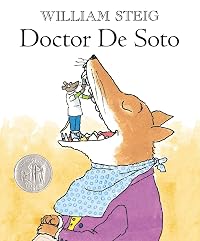
Dr. De Soto, a mouse dentist, copes with the toothaches of various animals except those with a taste for mice, until the day a fox comes to him in great pain.Tags
Recommendations















Member Recommendations
Member Reviews
In a story that is strongly reminiscent of the Aesopic fable concerning the wolf and the crane, murine dentist Dr. De Soto agrees to go against his standing policy, which states that he will not treat dangerous animals (like cats!), and accept a fox as a patient. Correctly interpreting his vulpine patient's desire to eat him, and his assistant (his wife, Mrs. De Soto), the good dentist is torn between his duty as a medical practitioner and his desire to remain in one piece. Fortunately, creative thinking, and a little cunning, allow the mice to outfox the fox, and escape unscathed.
Atypically, Dr. De Soto was chosen as a Newbery Honor Book in 1983 - "atypically" because the Newbery is a writer's award, and is usually given to longer show more works, rather than to picture-books - but although I found the story engaging, and appreciated the interactions of text and image, I can't say that I thought this was a particularly award-worthy title. Still, I did enjoy it, and was charmed by Dr. and Mrs. De Soto, and their sangfroid in the face of danger. Seeing the "little guys" triumph is always fun, especially when the narrative and artwork are so full of humor. show less
Atypically, Dr. De Soto was chosen as a Newbery Honor Book in 1983 - "atypically" because the Newbery is a writer's award, and is usually given to longer show more works, rather than to picture-books - but although I found the story engaging, and appreciated the interactions of text and image, I can't say that I thought this was a particularly award-worthy title. Still, I did enjoy it, and was charmed by Dr. and Mrs. De Soto, and their sangfroid in the face of danger. Seeing the "little guys" triumph is always fun, especially when the narrative and artwork are so full of humor. show less
Steig explores class distinction through the metaphor of anthropomorphized animals, and specifically through a dentist mouse. Since Dr. De Soto is so small he can easily work on larger animals' teeth, but there are certain perils due to his mousey nature. Dr. De Soto has to ban cats and other natural predators from his practice because the temptation of him working near their teeth is just too much. But when a fox with a toothache begs for help Dr De Soto can't help but take pity on him. Thankfully he has some tricks up his sleeve, so the fox goes home with an empty stomach along with his fixed tooth. Steig's careful plotting and clever dialogue make this book a classic for readers of any age.
Retelling: Dr. De Soto was an excellent dentist who compensated for the fact that he was a mouse using his exceptional ingenuity and problem solving skills. When a fox came to his door, hungry and hurting, Dr. De Soto and his wife were faced with a new problem: How to help the fox without being eaten.
Thoughts and Feelings: I admire Dr. De Soto for helping a patient he knew might harm him, but also for taking extra, thoughtful precautions given the his special circumstances. This book reminds me of the Hippocratic oath and the ethical practice of medicine, only with "animals" replacing all "human beings."
Thoughts and Feelings: I admire Dr. De Soto for helping a patient he knew might harm him, but also for taking extra, thoughtful precautions given the his special circumstances. This book reminds me of the Hippocratic oath and the ethical practice of medicine, only with "animals" replacing all "human beings."
My first and only foray into plagiarism was carried out when I ripped this plot off COMPLETELY (instead of a mouse I used a squirrel) at the age of 8ish and won a story contest that took me to a young writer's conference at the University of Iowa. Though I really didn't know any better, I am now ashamed, and would like to relinquish my award if I still had it or knew to whom or where to send it. I gave this five stars, because it's the only book that ever got me anything cool.
Another creepy Steig book. If foxes and mice both wear clothes and talk and live in the same civilized society, then if the fox is contemplating eating the mouse, that is cannibalism in my mind. Either way, a fun read.
A hoot. A bit simple/simplistic, but still some of Steig's vocabulary, and some of his subtle humor and insights. For example, the fox wonders if it would be "shabby" to eat the mice. And the wife is willing to give the fox the benefit of the doubt... Steig always does think of women as the more tender sex.
I thought this book was incredibly smart and funny. It's about Dr. Desoto, a mouse dentist, and his wife, his assistant. They treat a variety of animals and he's a well known dentist, however, they refuse to treat dangerous animals. One day, a fox comes in with a terrible toothache and they debate about whether or not to treat him. They decide to let him in and they extract his tooth but see that he is tempted to eat them. He needs to come back the next day to get his new tooth and they formulate a plan. After the fox has his work done, they offer him a new treatment that will prevent toothaches forever. He agrees and they paint his teeth with glue so he can't open his mouth for a day or two. They outfox the fox. It's a really cute book show more and the illustrations are great. I love how William Steig uses animals as characters and he is abl eto give them so much personality. show less
Members
- Recently Added By
Lists

Best Newbery Honor Books
258 works; 33 members

1001 Children's Books You Must Read Before You Grow Up
774 works; 101 members

EEK! A Mouse ::: Best Children's Books
95 works; 13 members

my children books reading list-from 100 great books
101 works; 7 members
Honey For a Child's Heart
1,152 works; 25 members

Rabbit and Fox Story Books For Children
139 works; 7 members

Newbery Honor Books By year - II - 1981-2035
143 works; 4 members

National Book Award winners
65 works; 11 members
SYES Library Wishlist
1,080 works; 4 members

Early Picture Books
467 works; 9 members

Recommended Reading List
219 works; 1 member

Favorite Picture Books
479 works; 160 members
Author Information

73+ Works 31,510 Members
William Steig was born in Brooklyn, New York, on November 14, 1907, and spent his childhood in the Bronx. Steig found an outlet for his talent by creating cartoons for the high school newspaper. After high school graduation, Steig spent two years at City College, three years at the National Academy, and five days at the Yale School of Fine Arts show more before dropping out. During his early days as a free-lance artist, he supplemented his income with work in advertising, although he intensely disliked it. He illustrated for the The New Yorker, beginning in 1930. During the 1940s, Steig's creativity found a more agreeable outlet when he began carving figurines in wood; his sculptures are on display as part of the collection in the historic home of Franklin D. Roosevelt in Hyde Park, New York, and in several museums in New England. In 1967, Bob Kraus, a fellow cartoonist at The New Yorker, was in the process of organizing Windmill Books, an imprint for Harper & Row. Kraus suggested that Steig try writing and illustrating a book for a young audience. The result was Steig's letter-puzzle book entitled C D B!, published in 1968. Roland the Minstrel Pig, was published the same year. With his very next title, Sylvester and the Magic Pebble, he won the Caldecott Medal. The Amazing Bone was also a Caldecott Honor Book.In 1972, Steig published his first children's novel, Dominic, which won the Christopher Award. Abel's Island followed and was a Newberry Honor Book. William Steig died in October 3, 2003 in Boston Massachusettes. (Bowker Author Biography) show less
Awards and Honors
Awards
Series

Work Relationships
Common Knowledge
- Canonical title*
- Доктор Де Сото
- Original publication date
- 1982
- Related movies
- Doctor DeSoto (1984 | IMDb)
- Original language
- English
*Some information comes from Common Knowledge in other languages. Click "Edit" for more information.
Classifications
Statistics
- Members
- 4,328
- Popularity
- 3,500
- Reviews
- 67
- Rating
- (4.11)
- Languages
- 13 — Afrikaans, Catalan, Chinese, Dutch, English, French, German, Italian, Korean, Portuguese, Russian, Spanish, Swedish
- Media
- Paper, Audiobook, Ebook
- ISBNs
- 97
- UPCs
- 2
- ASINs
- 21