

Pascual Ferry
Author of Ender's Game: Battle School
About the Author
Works by Pascual Ferry
The New Avengers (Vol. 1) #24: New Avengers: Disassembled, Part 4 (2006) — Illustrator — 6 copies, 1 review
Adam Strange #1 of 8 — Illustrator — 3 copies
Adam Strange #8 of 8 - Showdown — Illustrator; Illustrator — 2 copies
Adam Strange #6 of 8 - Video Violence — Illustrator — 2 copies
Adam Strange #4 of 8 - Who Are ... — Illustrator — 2 copies
Adam Strange #5 of 8 - On the Run — Illustrator — 2 copies
Ender's Game: Battle School 3 — Illustrator — 2 copies
Adam Strange #7 of 8 - Battle Planet — Illustrator — 2 copies
Associated Works
All-New X-Men, Vol. 1: Yesterday's X-Men (2013) — Illustrator, some editions — 291 copies, 19 reviews
Guardians of the Galaxy by Abnett & Lanning: The Complete Collection Volume 2 (2014) — Illustrator — 80 copies, 2 reviews
True Believers: Deadpool Variants #1 — Illustrator — 1 copy
Tagged
Common Knowledge
- Canonical name
- Ferry, Pascual
- Legal name
- Arroyo, Pascual Ferrándiz
- Other names
- Ferry, Pasqual
Ferry, Paschalis
Ferry, Pascal - Birthdate
- 1961-03-24
- Gender
- male
- Nationality
- Spain
- Birthplace
- Barcelona, Spain
- Associated Place (for map)
- Barcelona, Spain
Members
Reviews

Access a version of the below that includes illustrations on my blog in two parts here and here.
In the first story here, Return to Krypton, the sterile Krypton of John Byrne's Man of Steel reboot is revealed to be an illusion, and the "true" Krypton is something closer to the Krypton that we saw in the comics of the Silver Age; Jor-El created fake data about Krypton for Kal-El so that he wouldn't miss his home. It's a little convoluted-- retconning a retcon always is, I suppose-- and show more probably doesn't really track with the details of Man of Steel, which I remember really liking, though it's been over a decade since I've read it. In that story, people on Krypton no longer bore children, so baby Kal-El was sent to Earth in a "birthing matrix," and thus literally born in Kansas. Return to Krypton makes it clear that Lara bore Kal-El in her body, and then he was placed in the birthing matrix to be sent to Earth, so the story maintains some details of Man of Steel while ignoring its spirit.
Superman learns much of this from a message Jor-El left in his rocket in a crystal. Then, with the help of Professor Hamilton and John Henry Irons, he is able to use thought projection to make an image of Krypton in the Phantom Zone, into which he and Lois travel to see what the planet was "really" like before it was destroyed; the story is ambiguous about whether Clark and Lois actually traveled to Krypton of the past, or if only to a recreation of it. Clark is able to hang out with his parents briefly, but soon events get crazy: he helps Jor-El adjust Krypton's orbit so it won't be destroyed, but this drains his powers so Lara has to rescue him in a rocket, but space travel is against the law, so General Zod comes to arrest Jor-El and Lara, but they all go on the run, and Zod gets angry and deposes the Kryptonian leadership because he blames their complacency for the crisis, and then all of a sudden Jor-El has been made president in a counter-revolution. Whoa.
It's action-packed (particularly part three, Man of Steel #111), which is the big weakness of it all: I feel like this story should have had more emotional weight. This is momentous! But most of the story is spent 1) massaging the continuity to the preferred form of the 2000s writers, and 2) making things explode again and again. The human story gets lost in the middle of it all. I know this is a superhero comic, but I feel like there must have been a way to balance them better than they were.
One thing I do like about these comics is their emphasis on narration. Three of the five issues use narration: the prologue is Pa Kent, while parts one and three are narrated by Lois. This keeps some emphasis on character, and I particularly liked the focus on Lois, who I think could otherwise have very easily gotten lost in the shuffle.
As for the retcons... I dunno. The Stevil2001 criterion for judging retcons is that The new thing must be at least as interesting, if not more interesting, as the old thing being replaced. I did like Byrne's Man of Steel, especially its vision of Krypton, but I'm open to stories about other forms of Krypton being told. But based on this tale, this new old version of Krypton doesn't have more to offer, but I also believe it could. Weirdly, the story indicates Superman might actually have changed Kryptonian history (wouldn't that have wiped him from existence) and kind of hints that the Man of Steel Krypton still exists. I guess I'll see if either of these ideas are picked up in Adventures going forward.
My feelings about the sequel, Return to Krypton II, are more straightforwardly negative. It seems to me that both of these storylines threw away a potentially emotionally powerful premise in favor of a combination of empty action sequences and unnecessarily complicated continuity "fixes." In this story, the Jor-El of the Phantom Zone duplicate of Krypton manages to travel from the Zone into the real world, seeking Superman's help in pushing back against a tide of fundamentalist Kryptonian zealots who don't like Jor-El's new enlightened age. Honestly, for a supposed utopia, Krypton seems like a giant shithole, perpetually on the verge of complete social collapse at the drop of a hat. They ally themselves with General Zod's lackies against the zealots, trying to save Jor-El's wife and baby Kal-El before it's too late. It just all seems like pointless action sequences.
Then in the end, we finally get an explanation for this Krypton. I thought when reading the original Return to Krypton that all this was intended to retcon away John Byrne's Man of Steel vision of a sterile Krypton; that story claimed Jor-El presented a lie of a sterile Krypton to Kal-El so that he wouldn't feel so sad about his dead homeworld. This story rewrites that, so that we learn that after the Imperiex War (I think), Brainiac 13 time-travelled to pre-destruction Krypton (which really was the sterile world John Bryne showed us) and tried to kill Jor-El to stop Superman from being born. He failed, but made off with Jor-El's diaries and the Eradicator Matrix (I guess this is related to one-time Superman villain "the Eradicator," a.k.a. the Cyborg Superman, but I don't know enough to know), which he used in concert to make a fake Krypton as a trap for Superman. Only since Jor-El was a weirdo, his diaries recorded not the actuality of Krypton, but his dreamed, ideal Krypton. So this Krypton is a real place, a planet in the Phantom Zone, but it is not the real Krypton. Phew.
It's not an explanation that convinces. Why would Jor-El dream up a Krypton where the government is a fascist dictatorship that suppresses dissent with lethal force, and where psychotic fundamentalists lurk in every corner? Like, dream up an actual utopia, dude!
And why did Return II even need to retcon the retcon? This was published in Sept. 2002; exactly one year later, Superman: Birthright would begin publication, removing Byrne inventions like the birthing matrix from continuity just as the first Return seemed like it was going to. By the time Return II came out, editor Eddie Berganza had to have known those changes were coming, so I just don't even get why this story-- which retcons the retcon of a retcon-- even exists.
And if you subtract the continuity jiggery-pokery, there's nothing here worth discussing. None of the five Super title crossovers published during Joe Casey's run on Adventures were exactly great, but Return to Krypton II is definitely the worst of them.
(Incidentally, all of these retcons would themselves be retconned! In Superman: Infinite Crisis we're told that Kal-El's backstory changed because of Superboy-Prime punching at the edge of reality, and thus not because of any of these shenanigans.)
I did like that Krypto was in it, I guess, but Superman is not always a good dog-owner. show less
In the first story here, Return to Krypton, the sterile Krypton of John Byrne's Man of Steel reboot is revealed to be an illusion, and the "true" Krypton is something closer to the Krypton that we saw in the comics of the Silver Age; Jor-El created fake data about Krypton for Kal-El so that he wouldn't miss his home. It's a little convoluted-- retconning a retcon always is, I suppose-- and show more probably doesn't really track with the details of Man of Steel, which I remember really liking, though it's been over a decade since I've read it. In that story, people on Krypton no longer bore children, so baby Kal-El was sent to Earth in a "birthing matrix," and thus literally born in Kansas. Return to Krypton makes it clear that Lara bore Kal-El in her body, and then he was placed in the birthing matrix to be sent to Earth, so the story maintains some details of Man of Steel while ignoring its spirit.
Superman learns much of this from a message Jor-El left in his rocket in a crystal. Then, with the help of Professor Hamilton and John Henry Irons, he is able to use thought projection to make an image of Krypton in the Phantom Zone, into which he and Lois travel to see what the planet was "really" like before it was destroyed; the story is ambiguous about whether Clark and Lois actually traveled to Krypton of the past, or if only to a recreation of it. Clark is able to hang out with his parents briefly, but soon events get crazy: he helps Jor-El adjust Krypton's orbit so it won't be destroyed, but this drains his powers so Lara has to rescue him in a rocket, but space travel is against the law, so General Zod comes to arrest Jor-El and Lara, but they all go on the run, and Zod gets angry and deposes the Kryptonian leadership because he blames their complacency for the crisis, and then all of a sudden Jor-El has been made president in a counter-revolution. Whoa.
It's action-packed (particularly part three, Man of Steel #111), which is the big weakness of it all: I feel like this story should have had more emotional weight. This is momentous! But most of the story is spent 1) massaging the continuity to the preferred form of the 2000s writers, and 2) making things explode again and again. The human story gets lost in the middle of it all. I know this is a superhero comic, but I feel like there must have been a way to balance them better than they were.
One thing I do like about these comics is their emphasis on narration. Three of the five issues use narration: the prologue is Pa Kent, while parts one and three are narrated by Lois. This keeps some emphasis on character, and I particularly liked the focus on Lois, who I think could otherwise have very easily gotten lost in the shuffle.
As for the retcons... I dunno. The Stevil2001 criterion for judging retcons is that The new thing must be at least as interesting, if not more interesting, as the old thing being replaced. I did like Byrne's Man of Steel, especially its vision of Krypton, but I'm open to stories about other forms of Krypton being told. But based on this tale, this new old version of Krypton doesn't have more to offer, but I also believe it could. Weirdly, the story indicates Superman might actually have changed Kryptonian history (wouldn't that have wiped him from existence) and kind of hints that the Man of Steel Krypton still exists. I guess I'll see if either of these ideas are picked up in Adventures going forward.
My feelings about the sequel, Return to Krypton II, are more straightforwardly negative. It seems to me that both of these storylines threw away a potentially emotionally powerful premise in favor of a combination of empty action sequences and unnecessarily complicated continuity "fixes." In this story, the Jor-El of the Phantom Zone duplicate of Krypton manages to travel from the Zone into the real world, seeking Superman's help in pushing back against a tide of fundamentalist Kryptonian zealots who don't like Jor-El's new enlightened age. Honestly, for a supposed utopia, Krypton seems like a giant shithole, perpetually on the verge of complete social collapse at the drop of a hat. They ally themselves with General Zod's lackies against the zealots, trying to save Jor-El's wife and baby Kal-El before it's too late. It just all seems like pointless action sequences.
Then in the end, we finally get an explanation for this Krypton. I thought when reading the original Return to Krypton that all this was intended to retcon away John Byrne's Man of Steel vision of a sterile Krypton; that story claimed Jor-El presented a lie of a sterile Krypton to Kal-El so that he wouldn't feel so sad about his dead homeworld. This story rewrites that, so that we learn that after the Imperiex War (I think), Brainiac 13 time-travelled to pre-destruction Krypton (which really was the sterile world John Bryne showed us) and tried to kill Jor-El to stop Superman from being born. He failed, but made off with Jor-El's diaries and the Eradicator Matrix (I guess this is related to one-time Superman villain "the Eradicator," a.k.a. the Cyborg Superman, but I don't know enough to know), which he used in concert to make a fake Krypton as a trap for Superman. Only since Jor-El was a weirdo, his diaries recorded not the actuality of Krypton, but his dreamed, ideal Krypton. So this Krypton is a real place, a planet in the Phantom Zone, but it is not the real Krypton. Phew.
It's not an explanation that convinces. Why would Jor-El dream up a Krypton where the government is a fascist dictatorship that suppresses dissent with lethal force, and where psychotic fundamentalists lurk in every corner? Like, dream up an actual utopia, dude!
And why did Return II even need to retcon the retcon? This was published in Sept. 2002; exactly one year later, Superman: Birthright would begin publication, removing Byrne inventions like the birthing matrix from continuity just as the first Return seemed like it was going to. By the time Return II came out, editor Eddie Berganza had to have known those changes were coming, so I just don't even get why this story-- which retcons the retcon of a retcon-- even exists.
And if you subtract the continuity jiggery-pokery, there's nothing here worth discussing. None of the five Super title crossovers published during Joe Casey's run on Adventures were exactly great, but Return to Krypton II is definitely the worst of them.
(Incidentally, all of these retcons would themselves be retconned! In Superman: Infinite Crisis we're told that Kal-El's backstory changed because of Superboy-Prime punching at the edge of reality, and thus not because of any of these shenanigans.)
I did like that Krypto was in it, I guess, but Superman is not always a good dog-owner. show less

It was hinted at, specifically in Avengers Prime, that having Asgard on Earth would have negative consequences. Now it’s time to pay the piper. When Asgard left its former place, the hole it created allowed a race of beings from a dying universe to break into this one. They begin to rampage across the nine realms, slaughtering all before them.
In addition to the inevitable battle against the World Eaters, two other critical events happen in this collection: the resurrection of Odin and the show more resurrection of Loki. To re-establish Thor’s role in the Marvel Universe, Odin needs to be ruling Asgard so Thor doesn't have to (Balder is an ineffectual king) and Thor needs someone to keep him on his toes. The resurrection of Loki as a child is even more original than having him come back in Sif’s body as a woman. This Loki is not just in a different body, he is different – back to what he was when Thor knew and loved him as a child. While some might balk at the idea that Thor would willingly bring Loki back, I thought it was perfectly in keeping with the character. Loki and Thor have defined each other since the beginning. This Kid Loki is a brilliant idea that has so much potential for future storylines. Plus, seeing Thor interact with Loki as an older, wiser brother - that Loki loves - is something new (that continues in Journey into Mystery).
The book does lag somewhat with too much metaphysical technobabble “world tree, blah, blah” but the underlying story is very good and there are a lot of well-done action sequences. Overall, this was an excellent book that sets the stage for Fraction’s new Thor series. Highly recommended. show less
In addition to the inevitable battle against the World Eaters, two other critical events happen in this collection: the resurrection of Odin and the show more resurrection of Loki. To re-establish Thor’s role in the Marvel Universe, Odin needs to be ruling Asgard so Thor doesn't have to (Balder is an ineffectual king) and Thor needs someone to keep him on his toes. The resurrection of Loki as a child is even more original than having him come back in Sif’s body as a woman. This Loki is not just in a different body, he is different – back to what he was when Thor knew and loved him as a child. While some might balk at the idea that Thor would willingly bring Loki back, I thought it was perfectly in keeping with the character. Loki and Thor have defined each other since the beginning. This Kid Loki is a brilliant idea that has so much potential for future storylines. Plus, seeing Thor interact with Loki as an older, wiser brother - that Loki loves - is something new (that continues in Journey into Mystery).
The book does lag somewhat with too much metaphysical technobabble “world tree, blah, blah” but the underlying story is very good and there are a lot of well-done action sequences. Overall, this was an excellent book that sets the stage for Fraction’s new Thor series. Highly recommended. show less

Access a version of the below that includes illustrations on my blog.
After R.E.B.E.L.S. concluded in 1996, DC's space heroes lay fallow for about a decade, minus the occasional cameo here or there. From Omega Men in 1983 to R.E.B.E.L.S., DC had built up a vast outer-space mythos that was largely going unused, except for cameos in Green Lantern tales. DC finally ended that trend in 2004 with Adam Strange: Planet Heist, a story that reinvented space adventurer Adam Strange-- but in a much show more funner way than Man of Two Worlds.
When Planet Heist opens, Adam is pretty sad: he thinks his adopted planet and family are dead. But soon evidence appears that they might still be alive when bounty hunters try to kill Adam in his Gotham apartment, and he begins an interstellar journey to prove his family is still alive, one that brings him into contact with characters from Hawkman, Omega Men, L.E.G.I.O.N./R.E.B.E.L.S., and even The Darkstars. (Somehow, Bob the Galactic Bum is the only of the 1980s/90s DC space series to go unreferenced.) It's in this "grand tour of the DC space mythos" element that the book really succeeds: DC has a number of fun and interesting space properties, and Planet Heist doesn't just revive Adam Strange for the 2000s, but provides tantalizing hints of many other series, creating a feeling of a Star Warsesque realized galaxy. As someone who had read all the stuff being referenced, it was fun to see old friends like Vril Dox, Doc of the Omega Men, and even Ferrin Colos used in new and exciting ways, and old settings like Maltus, but Diggle writes in such a way that I think you'd enjoy this even if you hadn't read all the stories being referenced: instead you'd be eager to go out and read them. (Similar to how I got into DC's space heroes to begin with through the references in Jim Starlin's Mystery in Space.)
Pascal Ferry's artwork is energetic and bold, perfect for a book about outer-space adventures. There's not a lot of gratuitous detail work; Ferry sticks to simple, iconic designs, redesigning almost every character in the book-- to their benefit. Dave McCaig does wonderful work on colors, too, knowing when to go for subdued and gloomy, and when to go for bright and shiny. The final battle is a thing of glory, with everyone coming together against the bad guys in a real powerhouse that is fun to read and watch.
Diggle writes a good mystery, too, with some neat sci-fi concepts to explain what's going on and why throughout the series. Pocket universes, Omega Events, matter transportation-- what else could you want? Planet Heist is DC's space comics as they should be, and it's no wonder it sparked off a five-year run of space-set miniseries (Rann-Thanagar War, Mystery in Space, an Omega Men revival, Countdown to Adventure, Rann-Thanagar Holy War, Strange Adventures) that eventually culminated in a revival of R.E.B.E.L.S., DC's first space heroes ongoing in over a decade.
Continuity Notes:
After R.E.B.E.L.S. concluded in 1996, DC's space heroes lay fallow for about a decade, minus the occasional cameo here or there. From Omega Men in 1983 to R.E.B.E.L.S., DC had built up a vast outer-space mythos that was largely going unused, except for cameos in Green Lantern tales. DC finally ended that trend in 2004 with Adam Strange: Planet Heist, a story that reinvented space adventurer Adam Strange-- but in a much show more funner way than Man of Two Worlds.
When Planet Heist opens, Adam is pretty sad: he thinks his adopted planet and family are dead. But soon evidence appears that they might still be alive when bounty hunters try to kill Adam in his Gotham apartment, and he begins an interstellar journey to prove his family is still alive, one that brings him into contact with characters from Hawkman, Omega Men, L.E.G.I.O.N./R.E.B.E.L.S., and even The Darkstars. (Somehow, Bob the Galactic Bum is the only of the 1980s/90s DC space series to go unreferenced.) It's in this "grand tour of the DC space mythos" element that the book really succeeds: DC has a number of fun and interesting space properties, and Planet Heist doesn't just revive Adam Strange for the 2000s, but provides tantalizing hints of many other series, creating a feeling of a Star Warsesque realized galaxy. As someone who had read all the stuff being referenced, it was fun to see old friends like Vril Dox, Doc of the Omega Men, and even Ferrin Colos used in new and exciting ways, and old settings like Maltus, but Diggle writes in such a way that I think you'd enjoy this even if you hadn't read all the stories being referenced: instead you'd be eager to go out and read them. (Similar to how I got into DC's space heroes to begin with through the references in Jim Starlin's Mystery in Space.)
Pascal Ferry's artwork is energetic and bold, perfect for a book about outer-space adventures. There's not a lot of gratuitous detail work; Ferry sticks to simple, iconic designs, redesigning almost every character in the book-- to their benefit. Dave McCaig does wonderful work on colors, too, knowing when to go for subdued and gloomy, and when to go for bright and shiny. The final battle is a thing of glory, with everyone coming together against the bad guys in a real powerhouse that is fun to read and watch.
Diggle writes a good mystery, too, with some neat sci-fi concepts to explain what's going on and why throughout the series. Pocket universes, Omega Events, matter transportation-- what else could you want? Planet Heist is DC's space comics as they should be, and it's no wonder it sparked off a five-year run of space-set miniseries (Rann-Thanagar War, Mystery in Space, an Omega Men revival, Countdown to Adventure, Rann-Thanagar Holy War, Strange Adventures) that eventually culminated in a revival of R.E.B.E.L.S., DC's first space heroes ongoing in over a decade.
Continuity Notes:
- I was amused to note that this book almost entirely ignores The Man of Two Worlds, claiming that Adam and Alanna's daughter was born without incident. But then one of Sardath's clones turns up, a concept introduced in Man of Two Worlds! (Adam narrates his own backstory, though, so maybe he's just simplifying it/glossing over the darkest elements of it. Telling an already skeptical cop your wife died once probably doesn't help your case.)
- When R.E.B.E.L.S. ended, Vril Dox went into retirement to raise his son and garden, and handed L.E.G.I.O.N. over to Captain Comet. Now, Dox is back in charge, all of his agents are robots, and none of the other characters from L.E.G.I.O.N. are anywhere to be seen. I don't know if this story is told anywhere, or if we just have to accept it's happened in the decade of space history we've missed!
- Seriously, when I called Darkstars a "forgotten" comic book, I'd've never guessed the return of Ferrin Colos would be a splash page in a comic book ten years later. What a punch-the-air moment!
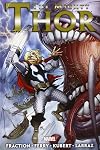
I thought the first Volume of Fraction’s Thor was a solid start to the series. This second volume kicks it into high gear.
When Thor died to stop the Serpent during Fear Itself, a God of Thunder rose in his place: Tanarus. Only Loki realizes that he isn’t right. He doesn’t remember Thor’s name, but he knows Tanarus is not his brother. Though the story never explicitly says how he knows, it makes sense that the Trickster God of Lies, and master of magic, would sense the wrongness. The show more All Mothers have taken their place as rulers of Asgardia, but Karnilla, Queen of the Norns, plots to bring them down. As Loki fights to remember his brother with the help of the Silver Surfer, Thor must fight to survive the demogorge.
The various threads of this story all come together in a very satisfying conclusion. There is the usual action and humor, and a climactic final battle, but the story draws a reader in with a strong tale of true heroism. Overall, an excellent read and highly recommended! show less
When Thor died to stop the Serpent during Fear Itself, a God of Thunder rose in his place: Tanarus. Only Loki realizes that he isn’t right. He doesn’t remember Thor’s name, but he knows Tanarus is not his brother. Though the story never explicitly says how he knows, it makes sense that the Trickster God of Lies, and master of magic, would sense the wrongness. The show more All Mothers have taken their place as rulers of Asgardia, but Karnilla, Queen of the Norns, plots to bring them down. As Loki fights to remember his brother with the help of the Silver Surfer, Thor must fight to survive the demogorge.
The various threads of this story all come together in a very satisfying conclusion. There is the usual action and humor, and a climactic final battle, but the story draws a reader in with a strong tale of true heroism. Overall, an excellent read and highly recommended! show less
Lists
Awards

You May Also Like
Associated Authors
Statistics
- Works
- 38
- Also by
- 29
- Members
- 1,009
- Popularity
- #25,560
- Rating
- 3.8
- Reviews
- 26
- ISBNs
- 45
- Languages
- 6