
Melissa Iwai
Author of Soup Day
Works by Melissa Iwai
A Garden for Lili 2 copies
Associated Works
Thirty Minutes Over Oregon: A Japanese Pilot's World War II Story (2018) — Illustrator — 121 copies, 4 reviews
Tagged
Common Knowledge
There is no Common Knowledge data for this author yet. You can help.
Members
Reviews
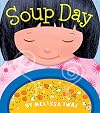
This book by Melissa Iwai makes me want to make a big pot of soup. The step by step process of making soup from chopping the vegetables to waiting for the soup to cook brings this book to life. I like how the author used "Sssssss" to describe the sounds the broth makes when pouring into the pot. I also enjoyed how she refers to the parsley as confetti. The illustrations of the different vegetable shapes and the different varieties of pasta are great visuals. The author ends the book with a show more recipe for snowy day vegetable soup. This book reminds me of Campell's soup commercials! This is a great mentor book with the onomatopeias, step by step process of making soup, and shape and alphabet concepts. show less
Maybe I should have posted this one yesterday because I love, love, love it. And I don't even like soup. I mean, I've tried to like soup, and I love the idea of soup, but somehow it never works for me. Anyways.
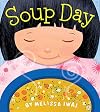
I want to hug this book. It is so warm and comfy, but sturdy too. It is not precisely a board book, but its pages are sturdier and stiffer than normal picturebooks, kind of a thin cardboard. The simple text is bold and marches strongly across the collaged and colorful illustrations.
On show more a snowy day, it is soup day. Counting up to six, a little girl and her mother pick out vegetables. Coming home, the vegetables get cut into different shapes. The vegetables cook in the pot and the little girl and her mother play together. Then it's time to add noodles and spices, clean up toys, and Daddy's home and it's soup time!
A recipe for soup is included in the back of the book. There are several reasons I like this story, apart from the endearing text and illustrations. First, I'm pleased to see the depiction of an Asian girl with Caucasian parents. Even in our fairly small, homogeneous community there are quite a few adopted Chinese girls and I have not found many stories that portray these children naturally, without making a huge issue of their adoption. Second, I really like the inclusion of concepts. This is a perfect toddler book and concepts are always good in books for little ones. They like to pause and count and identify. Third...I just really like all the elements together in this book.
Verdict: It's like really good soup - lots of different parts making one yummy whole! show less
I want to hug this book. It is so warm and comfy, but sturdy too. It is not precisely a board book, but its pages are sturdier and stiffer than normal picturebooks, kind of a thin cardboard. The simple text is bold and marches strongly across the collaged and colorful illustrations.
On show more a snowy day, it is soup day. Counting up to six, a little girl and her mother pick out vegetables. Coming home, the vegetables get cut into different shapes. The vegetables cook in the pot and the little girl and her mother play together. Then it's time to add noodles and spices, clean up toys, and Daddy's home and it's soup time!
A recipe for soup is included in the back of the book. There are several reasons I like this story, apart from the endearing text and illustrations. First, I'm pleased to see the depiction of an Asian girl with Caucasian parents. Even in our fairly small, homogeneous community there are quite a few adopted Chinese girls and I have not found many stories that portray these children naturally, without making a huge issue of their adoption. Second, I really like the inclusion of concepts. This is a perfect toddler book and concepts are always good in books for little ones. They like to pause and count and identify. Third...I just really like all the elements together in this book.
Verdict: It's like really good soup - lots of different parts making one yummy whole! show less
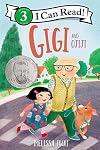
Gigi is excited for her grandfather to come from Japan to live with them; she is proud of her Japanese words and has made a drawing as a present for him. But after their first interaction at the airport, Gigi is afraid he doesn't like her. Her mother fills in the space in the cultural and language gaps: how sometimes he laughs when he doesn't know what to say, and how Japanese people usually bow rather than hug. With Mom there to bridge the gaps, Gigi regains her enthusiasm for her show more Ojiji.
Here's an early reader that reads just like a picture book - and that's a huge compliment.
See also: Mango, Abuela, and Me by Meg Medina show less
Here's an early reader that reads just like a picture book - and that's a huge compliment.
See also: Mango, Abuela, and Me by Meg Medina show less
Gigi is very excited about picking her grandfather up from the airport and anticipating all the fun things they'll do together. However, she is disappointed when some cultural differences make her think her grandfather doesn't like the same things she does and maybe doesn't even care about her at all.
This is a very sweet book about a grandfather and grandchild. Gigi goes through many emotions from excitement to sadness, and she is appropriately comforted by her mother who explains some of show more the cultural norms that are new to Gigi so she understands her grandfather better. Gigi is allowed to express her emotions but is given explanations as to why the things she observed didn't necessarily translate to what she thought.
The book is great for diverse families and communities (and for those that need to see that!), with Gigi's father being white, her mother being Japanese-American, and her grandfather being Japanese. It's nice to see not only more Asian-American protagonists, but also those with mixed heritage, as that is often the case for many families. A handful of basic Japanese words are sprinkled into the text.
The gentle illustrations fit the tone of the book perfectly and help to convey parts of the story, both by supporting and supplementing the text. Speaking of text, it is generally kept straightforward enough for beginning readers to tackle this book on their own or with some guidance. show less
This is a very sweet book about a grandfather and grandchild. Gigi goes through many emotions from excitement to sadness, and she is appropriately comforted by her mother who explains some of show more the cultural norms that are new to Gigi so she understands her grandfather better. Gigi is allowed to express her emotions but is given explanations as to why the things she observed didn't necessarily translate to what she thought.
The book is great for diverse families and communities (and for those that need to see that!), with Gigi's father being white, her mother being Japanese-American, and her grandfather being Japanese. It's nice to see not only more Asian-American protagonists, but also those with mixed heritage, as that is often the case for many families. A handful of basic Japanese words are sprinkled into the text.
The gentle illustrations fit the tone of the book perfectly and help to convey parts of the story, both by supporting and supplementing the text. Speaking of text, it is generally kept straightforward enough for beginning readers to tackle this book on their own or with some guidance. show less
Lists
Awards


You May Also Like


Associated Authors
Statistics
- Works
- 12
- Also by
- 8
- Members
- 945
- Popularity
- #27,197
- Rating
- 3.9
- Reviews
- 52
- ISBNs
- 33