
Eden Collinsworth
Author of What the Ermine Saw: The Extraordinary Journey of Leonardo da Vinci's Most Mysterious Portrait
Works by Eden Collinsworth
What the Ermine Saw: The Extraordinary Journey of Leonardo da Vinci's Most Mysterious Portrait (2022) 74 copies, 3 reviews
I Stand Corrected: How Teaching Western Manners in China Became Its Own Unforgettable Lesson (2014) 39 copies, 4 reviews
The Improbable Victoria Woodhull: Suffrage, Free Love, and the First Woman to Run for President (2025) 31 copies, 2 reviews
Tagged
Common Knowledge
- Gender
- female
- Education
- Bennington College
- Places of residence
- New York, New York, USA
- Associated Place (for map)
- New York, USA
Members
Reviews
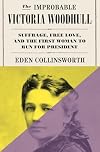
The Improbable Victoria Woodhull: Suffrage, Free Love, and the First Woman to Run for President by Eden Collinsworth
Fictional Quotes Recycled as History
Eden Collinsworth’s The Improbable Victoria Woodhull offers vivid storytelling, but many of its most striking “quotes” cannot be traced to archives or Woodhull’s own writings. Instead, they appear to be lifted from James Brough’s 1980 novel The Vixens: A Biography of Victoria and Tennessee Claflin, a work that Kirkus Reviews at the time identified as fiction.
Examples include:
• “Amazing child clairvoyants” — not a phrase used in show more 19th-century newspapers, court testimony, or memoirs. It originates in The Vixens (p. 49).
• “It’s like someone tightening an iron band around my chest” — also verbatim from The Vixens, where it appears as invented dialogue.
• A Buck Claflin “quote” in Collinsworth (p. 34) that is remarkably similar to one in Brough (pp. 72–73). It does not come from contemporary sources.
Taken together, these examples show a pattern of fictional dialogue recycled as biography. Today’s Kirkus Reviews describes Collinsworth’s book as “A zesty biography of a colorful woman in the raucous Gilded Age.” By contrast, their 1980 review of The Vixens was blunt: “Appalling — not a biography but a kind of slangy screenplay, based on history but padded with reams of imaginary dialogue that ranges from vulgar to excruciating.”
While Collinsworth’s prose is lively, it misleads readers into thinking they are reading actual quotes from Victoria and her family when they are in fact reading novelistic inventions.
For librarians, teachers, and researchers seeking a reliable, document-based biography, The Improbable Victoria Woodhull is problematic. While Collinsworth did utilize some archives, she completely missed the most important one at SIU in Carbondale. She also is seemingly unaware of the most recent Woodhull scholarship by organizations such as Woodhull Rising. Those wanting a fact-grounded account should instead consult works rooted in primary sources, such as court records, family papers, and contemporary journalism. Collinsworth may be a capable stylist, but she is a poor historian. show less
Eden Collinsworth’s The Improbable Victoria Woodhull offers vivid storytelling, but many of its most striking “quotes” cannot be traced to archives or Woodhull’s own writings. Instead, they appear to be lifted from James Brough’s 1980 novel The Vixens: A Biography of Victoria and Tennessee Claflin, a work that Kirkus Reviews at the time identified as fiction.
Examples include:
• “Amazing child clairvoyants” — not a phrase used in show more 19th-century newspapers, court testimony, or memoirs. It originates in The Vixens (p. 49).
• “It’s like someone tightening an iron band around my chest” — also verbatim from The Vixens, where it appears as invented dialogue.
• A Buck Claflin “quote” in Collinsworth (p. 34) that is remarkably similar to one in Brough (pp. 72–73). It does not come from contemporary sources.
Taken together, these examples show a pattern of fictional dialogue recycled as biography. Today’s Kirkus Reviews describes Collinsworth’s book as “A zesty biography of a colorful woman in the raucous Gilded Age.” By contrast, their 1980 review of The Vixens was blunt: “Appalling — not a biography but a kind of slangy screenplay, based on history but padded with reams of imaginary dialogue that ranges from vulgar to excruciating.”
While Collinsworth’s prose is lively, it misleads readers into thinking they are reading actual quotes from Victoria and her family when they are in fact reading novelistic inventions.
For librarians, teachers, and researchers seeking a reliable, document-based biography, The Improbable Victoria Woodhull is problematic. While Collinsworth did utilize some archives, she completely missed the most important one at SIU in Carbondale. She also is seemingly unaware of the most recent Woodhull scholarship by organizations such as Woodhull Rising. Those wanting a fact-grounded account should instead consult works rooted in primary sources, such as court records, family papers, and contemporary journalism. Collinsworth may be a capable stylist, but she is a poor historian. show less
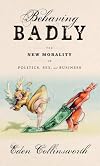
In many instances, Behaving Badly: The New Morality in Politics, Sex, and Business reads like one of those cautionary stories told by grandparents around the world about the decline in society and how things were so much better in their day. Eden Collinsworth is admittedly somewhat of a technophobe so it makes sense that for someone who remains confused about the prolific use of social media would express displeasure at the rampant use of technology and how it has changed or is changing show more social mores. For all her bias however, she does an admirable job of obtaining information directly from experts and presents a fair picture of changing morality in areas of finance, business, sex, robotics, and the like.
Ms. Collinsworth stresses multiple times the difference between morality and ethics. Ethics are the constraints and rules provided by external sources that dictate behavior, while morality is an individual’s internal guidelines about right and wrong that help a person decide what to do. While the two are often used interchangeably, they are two different concepts. Behaving Badly is all about morality, which is tricky because what may seem black and white for one person may be more a gray area for someone else. Just like no one person reads the same book, no one person will view any situation in the same light.
Throughout Ms. Collinsworth’ year-long journey, she tackles some fairly big topics and interviews an impressive array of people. For her foray into the morality surrounding monogamy in marriage, she interviews the founder of Ashley Madison. Her research regarding morality in business has her meeting with the editor of the Financial Times and the main whistleblower of the Olympus scandal in Japan. She talks about social media and their constant online presence skewing our children’s perception of themselves. She even talks about the future with ideas like artificial intelligence and DNA selection as part of the decision to have a child. What she uncovers may not be as shocking to readers as she finds it, but she does raise many good questions that have kept me thinking about my own morality to such issues. One of the best questions she raises is the idea of whether technology allows us to behave in a way that we never would have previously considered – like actively seeking to have an affair, cyber-bullying, manipulating your online image, contractual agreements and the breaking of them, and so forth.
One of the most chilling sections of the entire book was the discussion on computers and robots and what that could mean for the future. The fact that scientists like Elon Musk, Stephen Hawking, and Bill Gates, and thousands of other scientists are part of a petition that warns about autonomous weapons systems (in which the military is heavily investing) and artificial intelligence that will someday make human thinking obsolete is the stuff of nightmares. After these chapters, the importance of books like Ms. Collinsworth becomes crystal-clear.
While Ms. Collinsworth does not find the answers she seeks regarding morality in the twenty-first century, she poses pertinent questions that we should all be asking ourselves regarding technology and what its use means for our future. She also has some great points to make about the casualness of sex in today’s younger generations, how globalization is blurring the lines of business moral codes, and how easily it is to sway someone’s belief system with today’s hypermedia. As we head into the great unknown with one the most morally corrupt presidents we have ever had, what that means for society remains to be seen but Behaving Badly provides you with a great starting point for the discussion that we all need to have about our collective morality and what we want it to be after he leaves office. show less
Ms. Collinsworth stresses multiple times the difference between morality and ethics. Ethics are the constraints and rules provided by external sources that dictate behavior, while morality is an individual’s internal guidelines about right and wrong that help a person decide what to do. While the two are often used interchangeably, they are two different concepts. Behaving Badly is all about morality, which is tricky because what may seem black and white for one person may be more a gray area for someone else. Just like no one person reads the same book, no one person will view any situation in the same light.
Throughout Ms. Collinsworth’ year-long journey, she tackles some fairly big topics and interviews an impressive array of people. For her foray into the morality surrounding monogamy in marriage, she interviews the founder of Ashley Madison. Her research regarding morality in business has her meeting with the editor of the Financial Times and the main whistleblower of the Olympus scandal in Japan. She talks about social media and their constant online presence skewing our children’s perception of themselves. She even talks about the future with ideas like artificial intelligence and DNA selection as part of the decision to have a child. What she uncovers may not be as shocking to readers as she finds it, but she does raise many good questions that have kept me thinking about my own morality to such issues. One of the best questions she raises is the idea of whether technology allows us to behave in a way that we never would have previously considered – like actively seeking to have an affair, cyber-bullying, manipulating your online image, contractual agreements and the breaking of them, and so forth.
One of the most chilling sections of the entire book was the discussion on computers and robots and what that could mean for the future. The fact that scientists like Elon Musk, Stephen Hawking, and Bill Gates, and thousands of other scientists are part of a petition that warns about autonomous weapons systems (in which the military is heavily investing) and artificial intelligence that will someday make human thinking obsolete is the stuff of nightmares. After these chapters, the importance of books like Ms. Collinsworth becomes crystal-clear.
While Ms. Collinsworth does not find the answers she seeks regarding morality in the twenty-first century, she poses pertinent questions that we should all be asking ourselves regarding technology and what its use means for our future. She also has some great points to make about the casualness of sex in today’s younger generations, how globalization is blurring the lines of business moral codes, and how easily it is to sway someone’s belief system with today’s hypermedia. As we head into the great unknown with one the most morally corrupt presidents we have ever had, what that means for society remains to be seen but Behaving Badly provides you with a great starting point for the discussion that we all need to have about our collective morality and what we want it to be after he leaves office. show less
What the Ermine Saw: The Extraordinary Journey of Leonardo da Vinci's Most Mysterious Portrait by Eden Collinsworth
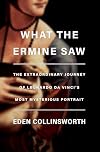
The teenager turns her head toward something we can’t see. She is lovely but modestly dressed. She holds a white ermine, almost cuddling an animal known to be fierce and aggressive. Leonardo Da Vinci was commissioned to paint the portrait of Cecilia Gallerani, mistress of his patron the Duke of Milan. There are only four portraits of women known to be by Da Vinci. Like his Mona Lisa, he kept Lady with Ermine for years, changing it several times. He added the ermine, changed its size and show more color. It finally was hung in the Duke’s room…Until he married, when his wife sent the mistress, her child, and the painting out of the house.
In What the Ermine Saw, Eden Collingsworth traces the history of the painting across time as it descended down through the family who took it to Poland. The painting survived conflict and two world wars, narrowly escaping the bombing that destroyed Dresden (and provoked Kurt Vonnegut to write Slaughterhouse Five). It hung in a private museum and in the home of the Nazi who systemically eradicated Polish culture, burning books and murdering thousands and sending millions to concentration camps.
I was totally immersed in this book, the tumultuous history fascinating. I had never considered how wondrous that works of cherished works of Western art survived at all.
I received a free egalley from the publisher through NetGalley. My review is fair and unbiased. show less
In What the Ermine Saw, Eden Collingsworth traces the history of the painting across time as it descended down through the family who took it to Poland. The painting survived conflict and two world wars, narrowly escaping the bombing that destroyed Dresden (and provoked Kurt Vonnegut to write Slaughterhouse Five). It hung in a private museum and in the home of the Nazi who systemically eradicated Polish culture, burning books and murdering thousands and sending millions to concentration camps.
I was totally immersed in this book, the tumultuous history fascinating. I had never considered how wondrous that works of cherished works of Western art survived at all.
I received a free egalley from the publisher through NetGalley. My review is fair and unbiased. show less
I stand corrected : how teaching Western manners in China became its own unforgettable lesson by Eden Collinsworth
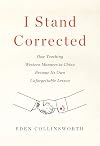
"A fascinating fusion of memoir, manners, and cultural history from a successful businesswoman well-versed in the unique challenges of working in contemporary China. During the course of her long and successful business career, no country has fascinated Eden Collinsworth more than China. After numerous business experiences that might best be called "unusual" by Western standards, she had a crucial insight: despite the growing status of China as a world economy and the unprecedented range of show more Chinese investments overseas, businessmen in mainland China--well-educated and speaking English--were fundamentally uncomfortable in the company of their Western counterparts. This realization spawned a Western etiquette guide for Chinese businessmen, which went on to be a huge best seller in China and formed the basis for new curriculum supported by the Chinese Ministry of Education. In I Stand Corrected, Collinsworth tells the story of the year she spent writing that book, creating a counterpart that both explains Chinese practices and reveals much about our own Western culture. She explores topics including the non-negotiable issue of personal hygiene; the rules of the handshake; making sense of foreigners; and that which is considered universally rude. She also scrutinizes some of the Western etiquette that has guided her own business career, one which has unfolded in predominately male company. At the same time, I Stand Corrected is a retrospective journey, a wry but self-effacing reflection on the peripatetic career she led while single-handedly raising her son. Like all parents, she didn't always have answers, and here she details the many, often ludicrous, attempts to strike a balance that was right for both of them" show less
Lists
Awards

You May Also Like


Statistics
- Works
- 5
- Members
- 222
- Popularity
- #100,928
- Rating
- 3.6
- Reviews
- 12
- ISBNs
- 18