
Ross King (1) (1962–)
Author of Brunelleschi's Dome: How a Renaissance Genius Reinvented Architecture
For other authors named Ross King, see the disambiguation page.
About the Author
Ross King is the award-winning and bestselling author of Brunelleschi's Dome, Michelangelo and the Popes Ceiling, The Judgment of Paris, Mad Enchantment, Leonardo and the Last Supper, and Machiavelli: Philosopher of Power, among other books. He and his wife live in Woodstock, Great Britain.
Works by Ross King
Brunelleschi's Dome: How a Renaissance Genius Reinvented Architecture (2000) 3,294 copies, 75 reviews
The Judgment of Paris: The Revolutionary Decade That Gave the World Impressionism (2006) 1,216 copies, 26 reviews
The Shortest History of Italy: 3,000 Years from the Romans to the Renaissance to a Modern Republic―A Retelling for Our Times (2024) 71 copies
The Fantasia of Leonardo da Vinci: His Riddles, Jests, Fables, and Bestiary (2010) 15 copies, 1 review
Associated Works
Tagged
Common Knowledge
- Canonical name
- King, Ross
- Legal name
- King, Ross W. A.
- Birthdate
- 1962-07-16
- Gender
- male
- Education
- York University (Ph.D|1992)
University of Regina (BA|1984|MA|1986) - Occupations
- historian
novelist - Organizations
- University College London
- Awards and honors
- Governor General's Award (2006, 2012)
RBC Taylor Prize (2017)
Book Sense Nonfiction Book of the Year (2000) - Relationships
- King, Melanie (wife)
- Nationality
- Canada
- Birthplace
- Estevan, Saskatchewan, Canada
- Places of residence
- Estevan, Saskatchewan, Canada
Oxford, Oxfordshire, England, UK
Woodstock, Oxfordshire, England, UK
Members
Reviews

Human beings have been painting since they first figured how to create pigments in caves. For every painter, there’s a unique way to painting something, but the world of 19th century France didn’t see it that way. They had strict rules for what was considered good painting and what didn’t pass muster. Ross King’s Judgment of Paris recounts the ten years that led to the first modern schism in the art world. On one side was the Salon de Paris, championed by Ernest Messonier, and the show more other were the Impressionists, founded by a scrappy, radical artist known as Eduard Manet.
The Judgment of Paris chronicles the parallel lives of Messonier and Manet to show how one railed against change and how the other helped to show the world a different way to look at itself. Manet’s movement started with treating everyday people as grand subjects for paintings. Up until then, the Salon de Paris standardized the techniques and subjects allowed for what was considered “high art” and the common folk were considered declasse. Manet, along with Gustave Courbet and Claude Monet, decided that, after having been rejected time and time again by the Salon de Paris, that they should establish their own Salon—the Salon des Refuses (The Salon of the Refused).
While this could be considered a tad petulent, it allowed the public to see the new movement in art. Instead of allowing line, contour, and historical grandiosity dominate the picture, the Impressionists focused on light, color, and atmosphere. Nowadays, this seems rather trivial, but in the 1860s, this was enough to cause a public outrage.
King’s writing is fun and moves along at a decent clip, much in the current style of history-as-a-novel. There are times where he gets very involved in the details of Parisian living, but its add atmosphere to help flesh out the intricate art happenings. Also, it’s a good way to get in backdoor info on the French authors Zola, Hugo, and Baudelaire. My only gripe about the book is that it needed more color illustrations. King’s descriptions are one thing, but having the paintings at hand really helps to get the history across.
Also, I used to consider myself fairly knowledgable about art and art history. Once, on a family vacation to Rome, my parent gave me my own day to plan out and go to whatever I wanted. I chose to do a walking tour of the city to find many of the public sculptures of Gian Bernini and end the day at the Vatican Pinacoteca to view Caravaggio’s Entombment of Christ (it was stunning). Until this book, I had never heard of Messonier or his fight againt the Impressionist movement. I guess you really do learn something new every day. show less
The Judgment of Paris chronicles the parallel lives of Messonier and Manet to show how one railed against change and how the other helped to show the world a different way to look at itself. Manet’s movement started with treating everyday people as grand subjects for paintings. Up until then, the Salon de Paris standardized the techniques and subjects allowed for what was considered “high art” and the common folk were considered declasse. Manet, along with Gustave Courbet and Claude Monet, decided that, after having been rejected time and time again by the Salon de Paris, that they should establish their own Salon—the Salon des Refuses (The Salon of the Refused).
While this could be considered a tad petulent, it allowed the public to see the new movement in art. Instead of allowing line, contour, and historical grandiosity dominate the picture, the Impressionists focused on light, color, and atmosphere. Nowadays, this seems rather trivial, but in the 1860s, this was enough to cause a public outrage.
King’s writing is fun and moves along at a decent clip, much in the current style of history-as-a-novel. There are times where he gets very involved in the details of Parisian living, but its add atmosphere to help flesh out the intricate art happenings. Also, it’s a good way to get in backdoor info on the French authors Zola, Hugo, and Baudelaire. My only gripe about the book is that it needed more color illustrations. King’s descriptions are one thing, but having the paintings at hand really helps to get the history across.
Also, I used to consider myself fairly knowledgable about art and art history. Once, on a family vacation to Rome, my parent gave me my own day to plan out and go to whatever I wanted. I chose to do a walking tour of the city to find many of the public sculptures of Gian Bernini and end the day at the Vatican Pinacoteca to view Caravaggio’s Entombment of Christ (it was stunning). Until this book, I had never heard of Messonier or his fight againt the Impressionist movement. I guess you really do learn something new every day. show less

There is never a dull moment in this story about late 1400s Italy - a hotbed of sodomy and syphilis as well as the birthplace of magnificent art and architecture - and the circumstances by which Leonardo da Vinci came to paint “The Last Supper.” This painting, avers King, which is arguably the most famous painting in the world, “is now 80 percent by the restorers and 20 percent by Leonardo.”
Leonardo was born in 1452 near Vinci, a hamlet sixty miles west of Florence. He was born out show more of wedlock, and so was not permitted by the laws at that time to go into the family business of being a notary. His illegitimacy also barred him from the legal profession or the university. His father could have arranged to have the situation fixed, but the author observes that “for unknown reasons he never legitimized him.”
However, the plus side was that Leonardo’s status freed him for more creative pursuits.
When he was 13 or 14 Leonardo began an apprenticeship in Florence with the goldsmith, painter, and sculptor Andrea del Verrocchio. This was about the time Verrocchio began working for the ruling Medici family. Leonardo stayed in Verrocchio’s workshop for at least six or seven years, “learning the trade secrets essential to a painter and sculptor.”
Leonardo went to Milan at age 30. Although he was astonishingly gifted at drawing and painting, his real loves were engineering and architecture. He had hopes, inter alia, of “inventing and constructing fearsome war machines such as chariots, cannons, and catapults.”
Alas, it was his art that earned him a living, and he began doing jobs for Lodovico Sforza, the ruler of Milan, mainly because Florence’s two greatest sculptors, Andrea del Verrocchio and Antonio del Pollaiuolo, were both busy on other projects. Lodovico was especially into staging spectacles, and he often used Leonardo to help with the costumes and sets for his extravaganzas.
King comments:
“By the age of 42 - in an era when life expectancy was only forty - Leonardo had produced only a few scattered paintings, a bizarre-looking music instrument, some ephemeral decorations for masques and festivals and many hundreds of pages of notes and drawings for studies he had not yet published, or for inventions he had not yet built. There was clearly a stark gulf between his ambitions and his accomplishments. Everyone who met him, or who saw his works, was dazzled by his obvious and undeniable brilliance. But too often his ambitions had been curtailed or frustrated.”
In his private notes, however, Leonardo recorded that he was just getting started, writing, “I wish to work miracles.” He finally got his chance, although not in the way he anticipated. In late 1494 or early 1495 he received a commission to paint the Last Supper on the wall of the refectory (the room used for communal meals) of Santa Maria Delle Grazie, a Dominican convent in Milan to which Lodovico had ties.
King tells us a lot about the Dominicans, who, along with the Franciscans, were the most active religious order in Italy. He also writes about other portrayals of the Last Supper in Florence, at least some of which Leonardo would have been familiar with. In particular, the Last Supper was a popular depiction in convent and monastery refectories.
King observes:
“A Last Supper was never an easy proposition, even on spacious refectory walls. The artist had somehow to fit around a table thirteen separate figures through whom he would illustrate either the moment when Christ instituted the Eucharist or announced, to general incomprehension, that one of the number would betray him.”
The painting was intended to be a fresco, but Leonardo did not have expertise in that technique, about which King provides details. He was, on the other hand, fascinated by the possibilities of working with oil paint, still not widely used at that time. For this commission he insisted on using oils, which he also mixed with tempera. By the summer of 1497 or at the latest the spring of 1498 Leonardo had finished The Last Supper:
“The result was 450 square feet of pigment and plaster, and a work of art utterly unlike anything ever seen before - and something unquestionably superior to the efforts of even the greatest masters of the previous century.”
Leonardo had four versions of the Last Supper to guide him - one from each of the four Gospels. The details of the supper differed slightly in each account. In particular, John’s version of the Last Supper makes no mention of the institution of the Eucharist.
Dominican art was often meant to reinforce doctrinal issues. One such issue in which the Dominicans, as the church’s spiritual enforcers, took an acute interest was transubstantiation. This doctrine was established in 1215 in the opening creed of the Fourth Lateran Council, which stated that the body and and blood of Christ “are truly contained in the sacrament of the altar under the forms of bread and wine . . .”
(Thus) Leonardo’s Last Supper was created . . . for a band of Dominican friars who ritually commemorated Christ’s sacrifice through the celebration of the Eucharist.
John’s Gospel, in addition to omitting the Eucharist, also differs in having John, called “the disciple whom Jesus loved most,” reclining on Christ’s bosom. On this point, Leonardo also did not follow the Gospel of John, but rather used the disciple John as part of another seminal aspect of the supper, when Christ announced one of the group would betray him.
Leonardo had spent his life trying to show emotions through drawings of facial expressions and hand gestures, and depicting people in the act of speaking or listening. It was one of his preoccupations, along with linear perspective and with finding the best chemical composition of colors and their juxtapositions in art. In a treatise he wrote on painting he claimed the artist had “two principal things to paint: that is, man and the intention of his mind. The first is easy; the second difficult, because it has to be represented by gestures and movements of the parts of the body.”
Part of the distinctiveness of The Last Supper is due to the perfection of these artistic techniques in his painting, revealing Leonardo’s “astounding powers of observation and unsurpassed understanding of light, movement, and anatomy.” King writes:
“Above all, it possessed more lifelike details...than anything ever created in two dimensions. An entirely new moment in the history of art had been inaugurated. . . . Art historians identify it as the beginning of the period they used to call the High Renaissance…. Leonardo had effected a quantum shift in art, a deluge that swept all before it.”
Alas, we only know of its greatness indirectly. The painting began disintegrating within twenty years of its completion. Over the years, the painting suffered from the paint’s defective adhesion to the wall; dampness, humidity, steam, smoke, soot from the convent, and the resulting mold; flooding, invasions, looting, and later even bombing in wartime. The refectory in which it was painted became a stable for Napoleon’s troops in 1796. The soldiers scratched out the apostles’ eyes and lobbed rocks at the painting. (Fortunately, the mural began some eight feet above the ground.)
By 1726 the work had become so dim and illegible that the friars began hiring restorers, some of whom were untalented frauds.
Fortunately Leonardo’s student Giampietrino (probably Giovanni Pietro Rizzoli) did a faithful copy in about 1520.
In 1977 the latest campaign for restoration began, taking a total of twenty-two years to complete before the unveiling in May 1999. Giampietrino’s work was used as a guide.
Aside from da Vinci’s work, King also includes many fascinating details about Leonardo’s personal life and about the social and political atmosphere in Europe in his time. For example, Leonardo, who was gay, had to pick up and leave town several times for “scandals,” even though homosexuality was common at the time. The author notes, interestingly, that “in the fifteenth century, Florentines were so well-known for homosexuality that the German word for sodomite was Florenzer.” The historical and religious context for the work is what gives this account so much piquancy and appeal.
Color plates are included.
Evaluation: I found this book to be so riveting I determined to move on to the author’s other works that combine stories of the origin and background of great art with riveting details of the times, such as the positively reviewed Michelangelo and the Pope’s Ceiling. show less
Leonardo was born in 1452 near Vinci, a hamlet sixty miles west of Florence. He was born out show more of wedlock, and so was not permitted by the laws at that time to go into the family business of being a notary. His illegitimacy also barred him from the legal profession or the university. His father could have arranged to have the situation fixed, but the author observes that “for unknown reasons he never legitimized him.”
However, the plus side was that Leonardo’s status freed him for more creative pursuits.
When he was 13 or 14 Leonardo began an apprenticeship in Florence with the goldsmith, painter, and sculptor Andrea del Verrocchio. This was about the time Verrocchio began working for the ruling Medici family. Leonardo stayed in Verrocchio’s workshop for at least six or seven years, “learning the trade secrets essential to a painter and sculptor.”
Leonardo went to Milan at age 30. Although he was astonishingly gifted at drawing and painting, his real loves were engineering and architecture. He had hopes, inter alia, of “inventing and constructing fearsome war machines such as chariots, cannons, and catapults.”
Alas, it was his art that earned him a living, and he began doing jobs for Lodovico Sforza, the ruler of Milan, mainly because Florence’s two greatest sculptors, Andrea del Verrocchio and Antonio del Pollaiuolo, were both busy on other projects. Lodovico was especially into staging spectacles, and he often used Leonardo to help with the costumes and sets for his extravaganzas.
King comments:
“By the age of 42 - in an era when life expectancy was only forty - Leonardo had produced only a few scattered paintings, a bizarre-looking music instrument, some ephemeral decorations for masques and festivals and many hundreds of pages of notes and drawings for studies he had not yet published, or for inventions he had not yet built. There was clearly a stark gulf between his ambitions and his accomplishments. Everyone who met him, or who saw his works, was dazzled by his obvious and undeniable brilliance. But too often his ambitions had been curtailed or frustrated.”
In his private notes, however, Leonardo recorded that he was just getting started, writing, “I wish to work miracles.” He finally got his chance, although not in the way he anticipated. In late 1494 or early 1495 he received a commission to paint the Last Supper on the wall of the refectory (the room used for communal meals) of Santa Maria Delle Grazie, a Dominican convent in Milan to which Lodovico had ties.
King tells us a lot about the Dominicans, who, along with the Franciscans, were the most active religious order in Italy. He also writes about other portrayals of the Last Supper in Florence, at least some of which Leonardo would have been familiar with. In particular, the Last Supper was a popular depiction in convent and monastery refectories.
King observes:
“A Last Supper was never an easy proposition, even on spacious refectory walls. The artist had somehow to fit around a table thirteen separate figures through whom he would illustrate either the moment when Christ instituted the Eucharist or announced, to general incomprehension, that one of the number would betray him.”
The painting was intended to be a fresco, but Leonardo did not have expertise in that technique, about which King provides details. He was, on the other hand, fascinated by the possibilities of working with oil paint, still not widely used at that time. For this commission he insisted on using oils, which he also mixed with tempera. By the summer of 1497 or at the latest the spring of 1498 Leonardo had finished The Last Supper:
“The result was 450 square feet of pigment and plaster, and a work of art utterly unlike anything ever seen before - and something unquestionably superior to the efforts of even the greatest masters of the previous century.”
Leonardo had four versions of the Last Supper to guide him - one from each of the four Gospels. The details of the supper differed slightly in each account. In particular, John’s version of the Last Supper makes no mention of the institution of the Eucharist.
Dominican art was often meant to reinforce doctrinal issues. One such issue in which the Dominicans, as the church’s spiritual enforcers, took an acute interest was transubstantiation. This doctrine was established in 1215 in the opening creed of the Fourth Lateran Council, which stated that the body and and blood of Christ “are truly contained in the sacrament of the altar under the forms of bread and wine . . .”
(Thus) Leonardo’s Last Supper was created . . . for a band of Dominican friars who ritually commemorated Christ’s sacrifice through the celebration of the Eucharist.
John’s Gospel, in addition to omitting the Eucharist, also differs in having John, called “the disciple whom Jesus loved most,” reclining on Christ’s bosom. On this point, Leonardo also did not follow the Gospel of John, but rather used the disciple John as part of another seminal aspect of the supper, when Christ announced one of the group would betray him.
Leonardo had spent his life trying to show emotions through drawings of facial expressions and hand gestures, and depicting people in the act of speaking or listening. It was one of his preoccupations, along with linear perspective and with finding the best chemical composition of colors and their juxtapositions in art. In a treatise he wrote on painting he claimed the artist had “two principal things to paint: that is, man and the intention of his mind. The first is easy; the second difficult, because it has to be represented by gestures and movements of the parts of the body.”
Part of the distinctiveness of The Last Supper is due to the perfection of these artistic techniques in his painting, revealing Leonardo’s “astounding powers of observation and unsurpassed understanding of light, movement, and anatomy.” King writes:
“Above all, it possessed more lifelike details...than anything ever created in two dimensions. An entirely new moment in the history of art had been inaugurated. . . . Art historians identify it as the beginning of the period they used to call the High Renaissance…. Leonardo had effected a quantum shift in art, a deluge that swept all before it.”
Alas, we only know of its greatness indirectly. The painting began disintegrating within twenty years of its completion. Over the years, the painting suffered from the paint’s defective adhesion to the wall; dampness, humidity, steam, smoke, soot from the convent, and the resulting mold; flooding, invasions, looting, and later even bombing in wartime. The refectory in which it was painted became a stable for Napoleon’s troops in 1796. The soldiers scratched out the apostles’ eyes and lobbed rocks at the painting. (Fortunately, the mural began some eight feet above the ground.)
By 1726 the work had become so dim and illegible that the friars began hiring restorers, some of whom were untalented frauds.
Fortunately Leonardo’s student Giampietrino (probably Giovanni Pietro Rizzoli) did a faithful copy in about 1520.
In 1977 the latest campaign for restoration began, taking a total of twenty-two years to complete before the unveiling in May 1999. Giampietrino’s work was used as a guide.
Aside from da Vinci’s work, King also includes many fascinating details about Leonardo’s personal life and about the social and political atmosphere in Europe in his time. For example, Leonardo, who was gay, had to pick up and leave town several times for “scandals,” even though homosexuality was common at the time. The author notes, interestingly, that “in the fifteenth century, Florentines were so well-known for homosexuality that the German word for sodomite was Florenzer.” The historical and religious context for the work is what gives this account so much piquancy and appeal.
Color plates are included.
Evaluation: I found this book to be so riveting I determined to move on to the author’s other works that combine stories of the origin and background of great art with riveting details of the times, such as the positively reviewed Michelangelo and the Pope’s Ceiling. show less
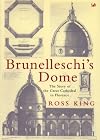
What an unexpected little treat this was. An account of the building of the dome of the cathedral of Santa Maria del Fiore in Florence. Begun in 1296 and completed in 1436, the dome itself took nearly a quarter of a century to construct, and even when it was initially designed regarded as potentially impossible to construct, the original designers essentially shrugging their shoulders and hoping God would provide. Provision came in the form of bad-tempered genius Filippo Brunelleschi, master show more goldsmith, whose years spent treasure-hunting the ruins of Ancient Rome equipped him with the ideas and inspiration which would ultimately not only pull of an amazing feat of engineering, but also do it without the wooden structure that normally provided 'centring' while domes were being erected. Along the way, he came up with a few minor inventions that would turn out to be decades ahead of their time, and nobody's quite sure how he did it. This is to say nothing of the ravages of the plague, warfare, professional and political rivalry (with dueling sonnets) the odd disaster and even a spell in prison. It's an epic of human ingenuity. You'd almost say folly, but the end result has endured in its beauty and splendour and made important contributions to the world of art and science, and stands testimony to what humanity can achieve with time, genius, money and an army of workers. The dome endures, but alas, the sonnets are lost. show less
If you're an architecture buff, this is an obvious pick. But it's also full of interesting history about Florence, the birth of the Renaissance, and a cast of Brunelleschi contemporaries: Donatella, Ghiberti, various d'Medicis. King's narrative focuses on Brunelleschi's most famous feat, the construction of the great domed Cathedral of Florence, but also explores how Brunelleschi's accomplishments influenced later Renaissance masters such as DaVinci and Michelangelo.
Obviously challenging to show more piece together an accurate psychological history of someone who lived 600 years ago, but King's depiction feels authentic. He portrays Brunelleschi as an eccentric, not particularly likeable genius - petty, jealous, paranoid, endlessly self-promoting. But you can get away with being eccentric when you promise the moon - in this case, constructing the biggest dome in the world without the use of any central scaffolding - and then deliver! While it's clear that Brunelleschi was a gifted artist, there's also a suggestion that at least part of his genius was having the good sense to leverage information he gathered on long sojourns among the ruins of ancient Rome (ex: the geometric principles of Roman architecture, the techniques of perspective employed by Roman artists) to inform some of his most spectacular feats of engineering, including not just his famous dome but also radical new approaches to hoists, scaffolding, architectural rendering, and transportation.
Having read this, my lingering impression is astonishment. Astonishment that the silk merchant guild that commissioned the magnificent Cathedral of Santa Maria del Fiori took a chance on a young artist with no building chops. Astonishment that people seemed so willing to put up with Filippo's eccentricities and annoyances (refusing to play nicely with others, breaking promises, overcommitting himself). Astonishment that in spite of so much historical turmoil, the Cathedral was built at all. Most of all, astonishment that I enjoyed this, given how much of it was devoted to architectural minutiae!
My one recommendation to potential readers: definitely don't do this one as an audiobook! I did, and regret that I didn't have pictures or photos to help me visualize King's descriptions of art and architecture. But as soon as I was done, I spent a lovely half hour on the internet staring a pictures and developing a new, more informed appreciation of Renaissance Florence and Brunelleschi's genius! show less
Obviously challenging to show more piece together an accurate psychological history of someone who lived 600 years ago, but King's depiction feels authentic. He portrays Brunelleschi as an eccentric, not particularly likeable genius - petty, jealous, paranoid, endlessly self-promoting. But you can get away with being eccentric when you promise the moon - in this case, constructing the biggest dome in the world without the use of any central scaffolding - and then deliver! While it's clear that Brunelleschi was a gifted artist, there's also a suggestion that at least part of his genius was having the good sense to leverage information he gathered on long sojourns among the ruins of ancient Rome (ex: the geometric principles of Roman architecture, the techniques of perspective employed by Roman artists) to inform some of his most spectacular feats of engineering, including not just his famous dome but also radical new approaches to hoists, scaffolding, architectural rendering, and transportation.
Having read this, my lingering impression is astonishment. Astonishment that the silk merchant guild that commissioned the magnificent Cathedral of Santa Maria del Fiori took a chance on a young artist with no building chops. Astonishment that people seemed so willing to put up with Filippo's eccentricities and annoyances (refusing to play nicely with others, breaking promises, overcommitting himself). Astonishment that in spite of so much historical turmoil, the Cathedral was built at all. Most of all, astonishment that I enjoyed this, given how much of it was devoted to architectural minutiae!
My one recommendation to potential readers: definitely don't do this one as an audiobook! I did, and regret that I didn't have pictures or photos to help me visualize King's descriptions of art and architecture. But as soon as I was done, I spent a lovely half hour on the internet staring a pictures and developing a new, more informed appreciation of Renaissance Florence and Brunelleschi's genius! show less
Lists
Best Biographies (1)
On Books (1)
Awards


You May Also Like


Associated Authors
Statistics
- Works
- 16
- Also by
- 2
- Members
- 11,243
- Popularity
- #2,096
- Rating
- 3.8
- Reviews
- 215
- ISBNs
- 268
- Languages
- 16
- Favorited
- 11