
Pascal Alixe
Author of Marvel 1602: Fantastick Four
Series
Works by Pascal Alixe
Moby Dick #1 (of 6) (Marvel Illustrated) — Illustrator — 2 copies
Moby Dick #2 (of 6) (Marvel Illustrated) — Illustrator — 1 copy
Moby Dick #3 (of 6) (Marvel Illustrated) — Illustrator — 1 copy
Moby Dick #5 (of 6) (Marvel Illustrated) — Illustrator — 1 copy
Associated Works
Tagged
Common Knowledge
- Canonical name
- Alixe, Pascal
- Gender
- male
- Nationality
- France
- Associated Place (for map)
- France
Members
Reviews

Despite how much I enjoyed the two Legion of Super-Heroes deluxe editions DC released over the past few years (The Great Darkness Saga and The Curse), Legion Lost largely flitted by without my notice-- until I found the hardcover in a used bookstore for half-price.
Legion Lost technically stars a different version of the Legion than the one in The Great Darkness Saga and The Curse, but this is largely the same cast of characters, just thrust into a different situation, and it's pretty easy to show more go from the one to the other without being confused; everyone just has new, "hip" codenames, and there's no babies. Legion Lost opens with nine Legionnaires waking to find themselves trapped in a completely different part of the universe, with no apparent way home. And this isn't the bright, shiny world of the United Planets; it's a rough, dark corner of space, where might makes right. Basically, it's Star Trek: Voyager with superheroes.
Each chapter of Legion Lost is told from the perspective of a different character. The story starts with Shikari, a native of this region of space, stumbling across the Legion while fleeing her pursuers; her unfamiliarity with the Legion and familiarity with the locals adds to our disorientation, as she doesn't explain her reference point, and our own reference points have become alien. The best part of this chapter is definitely when Shikari finds a recording of Element Lad from who knows how long ago: he put the others into hibernation and lived alone until he died! It's a haunting message from the past, and lets you know how bad things are before the story even starts.
From there, we move from Legionnaire to Legionnaire. My favorites were definitely Monstress-- the one-time sheltered elite turned hulking brute by a gene bomb-- who operates as the heart of the team, and Saturn Girl-- the team's telepathic leader, who finds herself pushed to the limit keeping the team together under these circumstances. She does some terrible things, perhaps, but I loved her all the better for it. She might be my favorite Legionnaire overall.
The pushing to darker places works really well: Legion Lost shows what the Legion of Super-Heroes is by showing us what it isn't and what it could be. It's Star Trek: Voyager with superheroes, yes, but it's also Voyager done right. You never got the sense that Janeway and her crew were tested by their ideals like you do the Legion here, in the darkest of places.
The art, by the team of Olivier Coipel, Pascal Alixe, and Andy Lanning, is scratchy in a way that just reeks of the 1990s to me, but is also perfect for the story, really representing the dark places the team finds itself. Also the colors by Tom MacCraw really make the darkness come alive, even if the Legion itself is wearing fluorescent spandex.
I finished my review of The Curse stating I'd become a fan of that particular incarnation of the Legion of Super-Heroes; I think we can safely state that now I'm a fan of the Legion full-stop. Some more of the Abnett/Lanning Legion comics are being collected next year, and if they're half as good as this, they'll be fantastic. show less
Legion Lost technically stars a different version of the Legion than the one in The Great Darkness Saga and The Curse, but this is largely the same cast of characters, just thrust into a different situation, and it's pretty easy to show more go from the one to the other without being confused; everyone just has new, "hip" codenames, and there's no babies. Legion Lost opens with nine Legionnaires waking to find themselves trapped in a completely different part of the universe, with no apparent way home. And this isn't the bright, shiny world of the United Planets; it's a rough, dark corner of space, where might makes right. Basically, it's Star Trek: Voyager with superheroes.
Each chapter of Legion Lost is told from the perspective of a different character. The story starts with Shikari, a native of this region of space, stumbling across the Legion while fleeing her pursuers; her unfamiliarity with the Legion and familiarity with the locals adds to our disorientation, as she doesn't explain her reference point, and our own reference points have become alien. The best part of this chapter is definitely when Shikari finds a recording of Element Lad from who knows how long ago: he put the others into hibernation and lived alone until he died! It's a haunting message from the past, and lets you know how bad things are before the story even starts.
From there, we move from Legionnaire to Legionnaire. My favorites were definitely Monstress-- the one-time sheltered elite turned hulking brute by a gene bomb-- who operates as the heart of the team, and Saturn Girl-- the team's telepathic leader, who finds herself pushed to the limit keeping the team together under these circumstances. She does some terrible things, perhaps, but I loved her all the better for it. She might be my favorite Legionnaire overall.
The pushing to darker places works really well: Legion Lost shows what the Legion of Super-Heroes is by showing us what it isn't and what it could be. It's Star Trek: Voyager with superheroes, yes, but it's also Voyager done right. You never got the sense that Janeway and her crew were tested by their ideals like you do the Legion here, in the darkest of places.
The art, by the team of Olivier Coipel, Pascal Alixe, and Andy Lanning, is scratchy in a way that just reeks of the 1990s to me, but is also perfect for the story, really representing the dark places the team finds itself. Also the colors by Tom MacCraw really make the darkness come alive, even if the Legion itself is wearing fluorescent spandex.
I finished my review of The Curse stating I'd become a fan of that particular incarnation of the Legion of Super-Heroes; I think we can safely state that now I'm a fan of the Legion full-stop. Some more of the Abnett/Lanning Legion comics are being collected next year, and if they're half as good as this, they'll be fantastic. show less

Astonishing. First issues of the first volume of this arc made me quit reading the Legion after 25 years. Glad I finally finished both volumes as they’re better than expected.
Still not the optimistic & hopeful future I want with my LSH (at least not until the end) but a good story with intriguing takes on the characters
Alas, making a favorite character & morphing him into villainy, while well done & understandable, saddened me a lot.
Still not the optimistic & hopeful future I want with my LSH (at least not until the end) but a good story with intriguing takes on the characters
Alas, making a favorite character & morphing him into villainy, while well done & understandable, saddened me a lot.
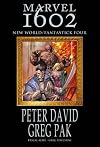
After rereading the first volume of Marvel 1602, I turned to the next volume which has the Fantastic Four, ptui, on the cover and a change of artists and writers. In fact, the first half of this trade takes up almost exactly where Gaiman’s series left off – mere days after that, so far as I can tell, though our younger characters seem to have aged seven or eight years (judging from Peter’s face and some, ahem, overhead shots of Ms. Dare). It’s more jokey and silly than Gaiman’s show more solemn run, but the transition is fairly smooth. I especially liked some of the ways these characters diverge from their present-day incarnations; the Hulk is a great example.
I turned to the second half with some trepidation; in fact, the Fantastic Four arc was readable, though not particularly riveting. I was hoping Dr. Doom would stomp around making megalomaniac speeches and being eeevil, but even he was toned down for once. I’m not sure why the Fantastic Four come out of retirement to pursue him on a fairly simple trip to a semi-mythical country where Doom hopes to restore his cover-boy looks. Yes, he will try to subjugate and corrupt wherever he goes, but they knew that before they retired, and this isn’t much more than an evil trip to the plastic surgeon.
The inclusion of Shakespeare in this arc was annoying. I don’t think writers should drag old Will, or any other historical figures, into their fictions if they don’t have anything to do with them besides crack some weak jokes. Compare Gaiman’s use of Shakespeare in the Sandman series; Gaiman uses the bard’s familiar face and stories to talk about dreams, art, fathers and sons, and renunciation. These themes are central to Sandman. Here, Shakespeare is used for lame comic relief, 'getting his ideas' from travelling around with the Fantastick Four. Groan. show less
I turned to the second half with some trepidation; in fact, the Fantastic Four arc was readable, though not particularly riveting. I was hoping Dr. Doom would stomp around making megalomaniac speeches and being eeevil, but even he was toned down for once. I’m not sure why the Fantastic Four come out of retirement to pursue him on a fairly simple trip to a semi-mythical country where Doom hopes to restore his cover-boy looks. Yes, he will try to subjugate and corrupt wherever he goes, but they knew that before they retired, and this isn’t much more than an evil trip to the plastic surgeon.
The inclusion of Shakespeare in this arc was annoying. I don’t think writers should drag old Will, or any other historical figures, into their fictions if they don’t have anything to do with them besides crack some weak jokes. Compare Gaiman’s use of Shakespeare in the Sandman series; Gaiman uses the bard’s familiar face and stories to talk about dreams, art, fathers and sons, and renunciation. These themes are central to Sandman. Here, Shakespeare is used for lame comic relief, 'getting his ideas' from travelling around with the Fantastick Four. Groan. show less

Imitation may be the sincerest form of flattery, but at least make your facts work.
Peter David brings me two of my favorite things together: Marvel 1602, and the Fantastic Four. But, like anybody following in the footsteps of their superior (Gaiman), he had a tough act to follow.
My major complaint deals with Shakespeare, who is introduced as King Jame's official playwright, only Shakespeare isn't any good at writing plays, which baffles me as for why he's actually writing plays to begin show more with. Doctor Doom kidnaps him, claiming that Cervantes was busy. But still, didn't anyone think to kidnap Francis Bacon? Shakespeare and Cervantes weren't the only people putting pen to parchment back then, and I'm sure that since Shakespeare wasn't considered to be a good playwright, even if Cervantes was busy, Doom could have found some other person to chronicle their journey.
But that's just my qualm with an otherwise good story.
Doom and the Four Who Are Frightening team up to a journey to the edge of the world. The Four Who Are Fantastick learn of this and follow them. They end up in Atlantis, ruled by Namor.
There is a power struggle for Namor's trident, and a lot of stuff happens, forcing the Frightening and the Fantastick to forge a temporarily alliance to get out of there alive.
While nowhere as good as the original Marvel 1602, it is still a worthy continuation of the series, and as long as Marvel makes 'em, I'll buy 'em. And you should too, especially if you're a fan of Marvel's ever-popular What If? series. show less
Peter David brings me two of my favorite things together: Marvel 1602, and the Fantastic Four. But, like anybody following in the footsteps of their superior (Gaiman), he had a tough act to follow.
My major complaint deals with Shakespeare, who is introduced as King Jame's official playwright, only Shakespeare isn't any good at writing plays, which baffles me as for why he's actually writing plays to begin show more with. Doctor Doom kidnaps him, claiming that Cervantes was busy. But still, didn't anyone think to kidnap Francis Bacon? Shakespeare and Cervantes weren't the only people putting pen to parchment back then, and I'm sure that since Shakespeare wasn't considered to be a good playwright, even if Cervantes was busy, Doom could have found some other person to chronicle their journey.
But that's just my qualm with an otherwise good story.
Doom and the Four Who Are Frightening team up to a journey to the edge of the world. The Four Who Are Fantastick learn of this and follow them. They end up in Atlantis, ruled by Namor.
There is a power struggle for Namor's trident, and a lot of stuff happens, forcing the Frightening and the Fantastick to forge a temporarily alliance to get out of there alive.
While nowhere as good as the original Marvel 1602, it is still a worthy continuation of the series, and as long as Marvel makes 'em, I'll buy 'em. And you should too, especially if you're a fan of Marvel's ever-popular What If? series. show less
Lists
You May Also Like
Associated Authors
Statistics
- Works
- 22
- Also by
- 6
- Members
- 383
- Popularity
- #63,100
- Rating
- 3.5
- Reviews
- 11
- ISBNs
- 16
- Languages
- 3