
Jean-Antoine-Nicolas de Caritat Condorcet (1743–1794)
Author of Outlines of an Historical View of the Progress of the Human Mind
About the Author
Disambiguation Notice:
This is the second time I'm entering this biography. Please do not delete it again. Thank you!
Image credit: Wikipédia France
Works by Jean-Antoine-Nicolas de Caritat Condorcet
The life of Voltaire 4 copies
Declaration des droits 3 copies
Essai sur l'application de l'analyse à la probabilité des décisions rendues à la pluralité des voix (2017) 2 copies
Éloges des académiciens de l'Académie royale des sciences mort depuis 1666, jusqu'en 1699 (1968) 2 copies
Dichiarare i diritti, costituire i poteri. Un inedito sulla dichiarazione dei diritti dell'uomo (2011) 2 copies
Adresse aux Bataves 2 copies
Avis aux Espagnols 2 copies
frammento sull'atlantide 1 copy
Bosquejo de un cuadro histórico de los progresos del espíritu humano y otros textos (Spanish Edition) (1997) 1 copy
Sull'istruzione pubblica 1 copy
Escritos pedagógicos 1 copy
Discours aux americains 1 copy
Éloge de M. D'Alembert : lu dans l'assemblée publique de l'Académie des sciences, le 21 avril 1784 1 copy
Éloge de M. Fontaine 1 copy
Associated Works
Tagged
Common Knowledge
- Other names
- Condorcet, Nicolas de
Caritat, Marie Jean Antoine Nicolas de, Marquis de Condorcet
Condorcet, Marquis de
Caritat, Marie-Jean-Antoine-Nicolas de
Condorcet
Condorcet, Jean-Antoine-Nicolas de Caritat - Birthdate
- 1743-09-17
- Date of death
- 1794-03-28
- Gender
- male
- Education
- Collège de Navarre
- Occupations
- philosopher
mathematician
revolutionary
writer
aristocrat - Organizations
- Académie française (1782)
- Awards and honors
- Académie française (1782)
Pantheon, Paris, France - Relationships
- Condorcet, Sophie de (wife)
- Short biography
- Nicolas de Condorcet, marquis de Condorcet, was born to an ancient aristocratic family in Ribemont, France. He was educated at the Jesuit college in Reims and at the College of Navarre in Paris. In 1765, he published his first work on mathematics, launching his career as a mathematician. He was elected in 1769 to the Royal Academy of Sciences, to which he contributed papers on mathematical and other subjects. Condorcet worked with and befriended many scientists, including Leonhard Euler and Benjamin Franklin. He was a protégé of the French philosopher and mathematician Jean Le Rond d'Alembert and took an active role in the preparation of the Encyclopédie. He was elected to the Académie française in 1782 and became a member of other European academies. In 1786 he married Sophie de Grouchy, with whom he formed a remarkable intellectual as well as a romantic partnership. They shared the same deeply-held democratic convictions and an optimistic view of human nature. Sophie's salon at the Hôtel des Monnaies was one of the most famous of the time, attracting foreign dignitaries and intellectuals such as Thomas Jefferson and Thomas Paine. Condorcet's views favoring women's suffrage, opposing slavery, and promoting equal rights and free public education for all, were unique even during the Enlightenment. At the outbreak of the French Revolution, which the Condorcets greeted with enthusiasm, he took a leading role. He was elected to represent Paris in the Legislative Assembly and became its secretary. Condorcet was one of the first to call for France to become a republic, and in August 1792, he drew up the declaration justifying the suspension of the king and the summoning of the National Convention. In the convention, he represented the département of Aisne. He drafted a new Constitution, representing the more moderate political wing, but it was rejected. At the trial of King Louis XVI, Condorcet voted against the death penalty and spoke out against it. His independent attitude became dangerous as the political winds shifted and Robespierre rose to power. Condorcet's political opponents issued a warrant for his arrest in 1793. While in hiding, he wrote the work for which is best-known today, Esquisse d'un tableau historique des progrès de l'esprit humain (Sketch for a Historical Picture of the Progress of the Human Spirit). In 1794, Condorcet left his hiding place and attempted to flee. He was arrested and imprisoned, and then found dead in his cell. His Esquisse was published in 1795 by his wife. Nearly 200 years later, Condorcet was symbolically interred in the Panthéon in Paris.
- Nationality
- France
- Birthplace
- Aisne, France
- Places of residence
- Reims, France
Paris, France - Place of death
- Paris, France
- Burial location
- Panthéon, Paris, France
- Disambiguation notice
- This is the second time I'm entering this biography. Please do not delete it again. Thank you!
- Associated Place (for map)
- Paris, France
Members
Reviews
Esquisse d'un tableau historique des progrès de l'esprit humain, suivi de "Fragment sur l'Atlantide" by Jean-Antoine-Nicolas de Caritat Condorcet
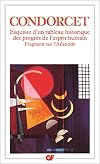
One of the most eloquent & historically important formulations of the idea of continuous progression - or 'perfectibility' - for the human race. All credibly based on growing collective knowledge, & on the well-coordinated interaction between scientific research & public education. Condorcet played an essential role, both intellectually & politically, during the French revolution. Outlawed by the extreme revolutionaries, Condorcet wrote this book in hiding, only a few weeks before his very show more mysterious death in a jail. show less
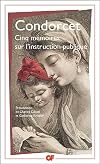
Historically the root manifest for free & universal public education, duly coordinated with science, discovery & invention. Condorcet was a father - if not *the* father - of later European radical movements (think Lloyd George & Clemenceau) & during the early days of the French revolution, a key political actor in his own right.
Lettres d'un citoyen des Etats-Unis, a un Francais, sur les affaires presentes by Jean-Antoine-Nicolas de Caritat Condorcet

... I send you also two little pamphlets of the Marquis de Condorcet, wherein is the most judicious statement I have seen of the great questions which agitate the nation at present ... (TJ to James Madison, 31 July 1788)
http://lcweb2.loc.gov/cgi-bin/ampage?collId=rbc3&fileName=rbc0001_2007jeffca...
http://lcweb2.loc.gov/cgi-bin/ampage?collId=rbc3&fileName=rbc0001_2007jeffca...
Outlines of an historical view of the progress of the human mind by Jean-Antoine-Nicolas de Caritat Condorcet
"This book is more learned and entertaining than The Sophiometer of John Stewart, the pedestrian traveler, which I received from him in England three days ago: but not much more solid." (Inscribed on half-title, dated 14 August 1811).
Lists
You May Also Like


Associated Authors
Statistics
- Works
- 63
- Also by
- 3
- Members
- 298
- Popularity
- #78,714
- Rating
- 3.5
- Reviews
- 8
- ISBNs
- 62
- Languages
- 10

