
Heather Amery
Author of The Usborne First Thousand Words in Spanish
About the Author
Series
Works by Heather Amery
Looking At...Tyrannosaurus Rex: A Dinosaur from the Cretaceous Period (The New Dinosaur Collection) (1993) 73 copies
Looking At...Stegosaurus: A Dinosaur from the Jurassic Period (The New Dinosaur Collection) (1993) 71 copies, 1 review
Looking At...Brachiosaurus: A Dinosaur from the Jurassic Period (The New Dinosaur Collection) (1993) 33 copies
Looking At...Protoceratops: A Dinosaur from the Cretaceous Period (The New Dinosaur Collection) (1993) 28 copies
Looking At...Velociraptor: A Dinosaur from the Cretaceous Period (The New Dinosaur Collection) (1994) 26 copies
Looking At...Plesiosaurus: A Marine Reptile from the Jurassic Period (New Dinosaur Collection) (1995) 25 copies
Knowhow Omnibus: Spycraft / Detection/ Jokes and Tricks / Batteries and Magnets / Fishing / Experiments (Knowhow) (Know How Books) (v. 2) (1998) 9 copies
Knowhow Omnibus: Paper / Action Games and Toys / Print and Paint / Puppets / Flying Models (Knowhow) (Know How Books) (v. 1) (1992) 4 copies
Mine første tusen ord 3 copies
Játékszabályok : A világ sportjainak képes enciklopédiája : Több mint 150 egyéni és csapatsport 2500 ábrával illusztrált bemutatása (1994) 2 copies
Poppy and Sam's Book and 3 Jigsaws: Tractors: Poppy and Sam Tractors (Farmyard Tales Poppy and Sam) (2022) 1 copy
Princess Stories 1 copy
Kísérletek 1 copy
Koko perheen Raamattu 1 copy
Les Preunmié Mille Mots 1 copy
Rusya Ilk Bin Sozcuk 1 copy
Sova i tält 1 copy
Cenerentola 1 copy
Usborne Farmyard Tales Poppy and Sam Series Collection 20 Books Box Set By Heather Amery (2022) 1 copy
První tisíc anglických slov 1 copy
Gundersen, Amery Og Cartwright Mine Forste Tusen ORD Nordic language book-(the first thousand words) (1979) 1 copy
Veo, Veo El Zoo 1 copy
Tagged
Common Knowledge
- Canonical name
- Amery, Heather
- Birthdate
- 20th Century
- Gender
- female
- Birthplace
- UK
- Map Location
- UK
Members
Reviews

Wonderful resource. Lots of vocabulary, of course, but clearly organized around specific day-to-day scenes. These words are functional, useful, and clear. I liked that the book included not just nouns, but also verbs and adjectives. I like that the words were listed alphabetically in the back. I especially like that the pronunciation guides, which are by nature imprecise, were relegated to the back of the book where they belong, and not kept in the main section where they could be show more distracting and misleading. My only criticism is that some words were given only in plural form. I would have liked to see the singular as well. I think children might like this book, and I certainly think they could learn a lot from it. The pictures are interesting and relevant to children, and the pictures build on each other very well. That is, the later images in the book incorporate items featured in earlier vocabulary sections, giving a very natural way for children to review as they go. The ducks to look for in each picture make the reading experience into a hide-and-seek game. Charming. show less

I think the format is generally a pretty strong one, and this is a reasonable example. It covers a good range of topics briefly, so there's something for a variety of interests without getting too specific and while staying short. The illustrations are attractive and pretty easy to identify, either in isolation or in the context of the larger images that show items in use.
That being said, there are a couple of obvious weaknesses. One is that the book shows scenes that look distinctly show more Western, and I imagine were originally designed for European languages. As a result, culturally speaking it's pretty easy to identify what's there, but it may not be the most useful selection - things like shops, schools and homes will have some differences that aren't noted here, and more importantly, this means appropriate vocabulary is missed out. The most obvious example is furniture, which is entirely Western, with no sign of futon, kotatsu, rice cooker, Japanese-style rooms, Japanese bath, shoe porch and so on. This isn't a huge problem for study at home, but makes it significantly less useful as a reference or vocab-expander for travellers. That's a shame, as a pictorial reference is the best way to look up items you can't otherwise identify! Neither a dictionary nor the internet are much help in that regard.
Secondly, I assume this is to keep things simple, but the book doesn't include any kanji. Again, this makes it substantially less helpful for anyone going to Japan or studying Japanese who might need to read anything whatsoever. You can pick up the word to speak, but if you actually want to learn it you'll need to go and look it up and learn the kanji independently, which greatly increases the work involved. I'm sorry, but omitting kanji from a book on Japanese is basically inexcusable in my view.
At least one word - "erebeta" - is transcribed wrongly as "erbta" for no obvious reason. This doesn't seem to be part of any systematic approach, someone just forgot the vowels.
I'll probably find this useful, but the drawbacks above are hefty enough that I'd seriously recommend people to look into alternatives in the hope of finding something better. show less
That being said, there are a couple of obvious weaknesses. One is that the book shows scenes that look distinctly show more Western, and I imagine were originally designed for European languages. As a result, culturally speaking it's pretty easy to identify what's there, but it may not be the most useful selection - things like shops, schools and homes will have some differences that aren't noted here, and more importantly, this means appropriate vocabulary is missed out. The most obvious example is furniture, which is entirely Western, with no sign of futon, kotatsu, rice cooker, Japanese-style rooms, Japanese bath, shoe porch and so on. This isn't a huge problem for study at home, but makes it significantly less useful as a reference or vocab-expander for travellers. That's a shame, as a pictorial reference is the best way to look up items you can't otherwise identify! Neither a dictionary nor the internet are much help in that regard.
Secondly, I assume this is to keep things simple, but the book doesn't include any kanji. Again, this makes it substantially less helpful for anyone going to Japan or studying Japanese who might need to read anything whatsoever. You can pick up the word to speak, but if you actually want to learn it you'll need to go and look it up and learn the kanji independently, which greatly increases the work involved. I'm sorry, but omitting kanji from a book on Japanese is basically inexcusable in my view.
At least one word - "erebeta" - is transcribed wrongly as "erbta" for no obvious reason. This doesn't seem to be part of any systematic approach, someone just forgot the vowels.
I'll probably find this useful, but the drawbacks above are hefty enough that I'd seriously recommend people to look into alternatives in the hope of finding something better. show less

I enjoyed this. I think it would be fun and informative for any child trying to pick up German. I was greatly impressed with the pronunciation guide in the back, which described the "ü" sound (which does not exist in English), clearly and succinctly.
The Usborne First Thousand Words in Spanish: With Easy Pronunciation Guide (First Picture Book) (Spanish and English Edition) by Heather Amery
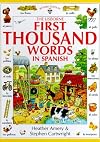
A great little book, perfect for beginners. The illustrations make it easier to remember so much vocabulary and, the fact each page or double page focus on a specific topic (e.g. park, home, hospital, food etc) greatly facilitates learning. At least that's a book focusing on vocabulary we use on a day to day basis -not something purely for school or tourists!
Lists
Awards

You May Also Like


Associated Authors
Statistics
- Works
- 338
- Members
- 22,115
- Popularity
- #967
- Rating
- 3.8
- Reviews
- 86
- ISBNs
- 1,555
- Languages
- 29
- Favorited
- 2