
Conn Iggulden
Author of The Dangerous Book for Boys
About the Author
Conn Iggulden is a British fiction writer, born in 1971. He studied at English at the University of London. Iggulden headed the English Department at St. Gregory's Roman Catholic School in London and taught English there for seven years. He left teaching to write his first novel, The Gates of Rome. show more Iggulden has also co-authored the #1 New York Times bestseller, "The Dangerous Book for Boys". His title Trinity is the second of the series of books covering the Wars of the Roses, when the English noble families were at war with each other. Book 4, Ravenspur: Rise of the Tudors, was released in May 2016 show less
Series
Works by Conn Iggulden
DANGEROUS AND DARING GIFT SET FOR BOYS AND GIRLS, CONTAINING : The Dangerous Book for Boys, the Daring Book for Girls (2007) 237 copies, 4 reviews
Emperor Series (The Gates of Rome, The Death of Kings, The Field of Swords, The Gods of War, & The Blood of Gods) (2013) 37 copies
Conqueror Series (Wolf of the Plains, Lords of the Bow, Bones of the Hills, Empire of Silver, Conqueror) (2012) 22 copies
Nero: The Sunday Times Bestseller, an Epic Tale of Ancient Rome’s Most Notorious Emperor (2025) 6 copies
Emperor Series: The Gates of Rome, The Death of Kings, The Field of Swords, The Gods of War (2011) 6 copies
The Forged in Rome: An Epic Tale of Power, Ambition and Survival in Ancient Rome from the Sunday Times bestseller (2025) 4 copies
Forged in Rome 4 copies
Genghis 2 copies
Conn Iggulden Wars of the Roses Series 4 Books Collection Set (Stormbird, Trinity, Ravenspur, Bloodline) (2020) 2 copies
Trinity 2 copies
Genghis:Birth of an Empire 2 copies
Empire of Salt Series 3 Books Collection Set by C. F. Iggulden (Darien, Shiang, The Sword Saint [Hardcover]) (2019) 1 copy
PERANDORI 1 - PORTAT E ROMËS 1 copy
Et rike av sl̜v 1 copy
Emperor, the blood of gods 1 copy
The Blood of Gods 1 copy
Darien 1 copy
Shiang 1 copy
The Sword Saint 1 copy
The Lady is a Screamer 1 copy
Athenian 1 copy
Conn Iggulden Conqueror & Emperor 10 Books Collection Pack Set (The Gods of War, Wolf of the Plains, Conqueror, Lords of the Bow, Empire of Silver, Bones of the Hills,The Field of… (2014) — Author — 1 copy
Keisari. Rooman portit 1 copy
Sværdenes mark 1 copy
Nero: Nero, Book 1 1 copy
Neron tom 1 1 copy
Suolan valtakunta Darien 1 copy
[EoS-03] The Sword Saint 1 copy
Associated Works
Tagged
Common Knowledge
- Birthdate
- 1971-01-01
- Gender
- male
- Education
- University of London (BA) (English)
Merchant Taylors' School, London
St Martin's School, Northwood - Occupations
- English teacher
novelist - Relationships
- Iggulden, Hal (brother)
- Short biography
- Despite finding time to write historical novels and The Dangerous Book for Boys, Conn Iggulden is in some ways better known as a trainer of Tollins. His Tollin troupe, "Small and Mighty," are famous in Tasmania, where they often play to packed houses. "It used to be just a hobby," he says, "but when you've seen a display of Tollin synchronized flying, you realize it's your life's work. Also, they can be transported in shoe boxes, so it's pretty cheap to get around."
- Nationality
- UK
- Birthplace
- London, England, UK
- Places of residence
- Hertfordshire, England, UK
- Associated Place (for map)
- England, UK
Members
Reviews
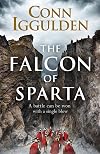
I was mesmerized from the outset by this loose construction of the Battle of Cunaxa and the journey to the Black Sea with Xenophon leading Greek mercenaries and baggage train. The Anabasis is still the best recounting of this, in Xenophon's own words. The story first covers the author's interpretation of WHY Cyrus is rebelling against his brother, the Great King, Artaxerxes; details of Xenophon's background in Athens; and the muster of Greeks in Sardis. After the battle in which Cyrus is show more slain and the betrayal of all the Greek generals where they are murdered in cold blood, the novel slows its pace until Xenophon is chosen to lead everyone. He displays a natural leadership ability. With this trek, the story picks up again. Xenophon and his unofficial second-in-command, the Spartan, Chrisophus, chivvy the people along towards their goal, overcoming many obstacles along the way--Persian army tailing them to the end of their empire, extreme weather, exciting fight with one of the mountain tribes.
Author's style has improved a thousand fold since his clunky Roman trilogy! Thinking about the title, I opined the "Falcon of Sparta" most likely was the Spartan, Clearchus, chief general from Sardis through Cunaxa to his demise. Cyrus' banner had been marked with a falcon. I thought the backstories fit in nicely and gave some background and rounding out of Cyrus' and Xenophon's characters.
Highly recommended. show less
Author's style has improved a thousand fold since his clunky Roman trilogy! Thinking about the title, I opined the "Falcon of Sparta" most likely was the Spartan, Clearchus, chief general from Sardis through Cunaxa to his demise. Cyrus' banner had been marked with a falcon. I thought the backstories fit in nicely and gave some background and rounding out of Cyrus' and Xenophon's characters.
Highly recommended. show less
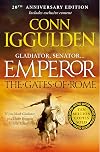
It takes a peculiar kind of confidence to attempt a novel set in a period, and whose protagonist, has already received a spectacular treatment in fiction.
Unfortunately, this author's confidence is sadly misplaced. Indeed, one has to wonder what the publisher was thinking when it brazenly describes this in the book's blurb as "The Ultimate Rome Story". Colleen McCullough this is not. If one hopes to read this book to gain insights into life in ancient Rome, or indeed the life of Gaius Julius show more Caesar in particular, one will be sorely disappointed ... as one will be if one merely expects a well-written, tightly plotted action story set in a time long ago.
This is hardly the first book in which I have lost count of the number of sentences that I had to re-read, usually several times, to try to discern what information the author was actually intending to convey, but that never makes the annoyance any the less.
The tenor of the book was well represented by the first few pages (I kept hoping for improvement; it never came), in which, apart from the Roman names, the action as described [the relevance of which to the plot never became clear, at least to me] might as well have occurred in medieval England as in first century Rome. It was impossible not to contrast this with the first few pages of McCullough's "First Man in Rome", in which one is instantly taken to a time and place one could never mistake as being anything other than ancient Rome.
One final, but, I think, telling point (spoiler ahead, so don't keep reading if you intend to read this book). The final words of the novel seem to suggest strongly that Caesar's childhood playmate and best friend in this book, named merely as "Marcus" throughout the book, is actually Marcus Brutus -- the Brutus who would later take part in the assassination of Caesar. This is quite a surprise, as the real Brutus was adopted by his uncle, not Caesar's father; and, even more tellingly, Brutus was some fifteen years Caesar's junior. The author does not deign to address this point in "Historical Note" at the end of the book -- a note in which he, perhaps less surprisingly, also does not mention McCullough's work.
I have given this book two stars, but only because I reserve one-star ratings for books that I can't finish. This one was rather like watching a slowly unfolding accident that should never have happened... I kept thinking that it would have to improve, and that I must just be missing some basic piece of brilliance that explained why the publishers thought this a worthwhile addition to the territory covered by McCullough. So I made it to the end (and the bizarre revelation of Marcus' identity); but I certainly don't intend to subject myself to any of the sequels. show less
Unfortunately, this author's confidence is sadly misplaced. Indeed, one has to wonder what the publisher was thinking when it brazenly describes this in the book's blurb as "The Ultimate Rome Story". Colleen McCullough this is not. If one hopes to read this book to gain insights into life in ancient Rome, or indeed the life of Gaius Julius show more Caesar in particular, one will be sorely disappointed ... as one will be if one merely expects a well-written, tightly plotted action story set in a time long ago.
This is hardly the first book in which I have lost count of the number of sentences that I had to re-read, usually several times, to try to discern what information the author was actually intending to convey, but that never makes the annoyance any the less.
The tenor of the book was well represented by the first few pages (I kept hoping for improvement; it never came), in which, apart from the Roman names, the action as described [the relevance of which to the plot never became clear, at least to me] might as well have occurred in medieval England as in first century Rome. It was impossible not to contrast this with the first few pages of McCullough's "First Man in Rome", in which one is instantly taken to a time and place one could never mistake as being anything other than ancient Rome.
One final, but, I think, telling point (spoiler ahead, so don't keep reading if you intend to read this book). The final words of the novel seem to suggest strongly that Caesar's childhood playmate and best friend in this book, named merely as "Marcus" throughout the book, is actually Marcus Brutus -- the Brutus who would later take part in the assassination of Caesar. This is quite a surprise, as the real Brutus was adopted by his uncle, not Caesar's father; and, even more tellingly, Brutus was some fifteen years Caesar's junior. The author does not deign to address this point in "Historical Note" at the end of the book -- a note in which he, perhaps less surprisingly, also does not mention McCullough's work.
I have given this book two stars, but only because I reserve one-star ratings for books that I can't finish. This one was rather like watching a slowly unfolding accident that should never have happened... I kept thinking that it would have to improve, and that I must just be missing some basic piece of brilliance that explained why the publishers thought this a worthwhile addition to the territory covered by McCullough. So I made it to the end (and the bizarre revelation of Marcus' identity); but I certainly don't intend to subject myself to any of the sequels. show less
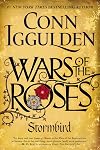
History rarely presents a neat narrative, and the Wars of the Roses are about as messy as it gets. Multiple royal houses battling for the throne of England in the 15th century; social unrest caused in part by the hardships imposed by the Hundred Years’ War; buckets of Richards and Henrys to keep track of—it’s a hell of a jumble.
But the bloody, backstabbing complexity offers excellent source material for storytellers up to the challenge of sorting through it; George R. R. Martin mined show more the period for inspiration while planning his fantasy series A Song of Ice and Fire (commonly known by the title of its first entry, A Game of Thrones). Conn Iggulden sets himself a tougher task by attempting a historical-fiction version, which he begins with Wars of the Roses: Stormbird.
Stormbird starts slowly, largely because Iggulden sets his prologue in 1377, 66 years before the main events of the story. We see Edward III on his deathbed and hear his attending sons drop hints about the coming succession crisis. Historically speaking, this may well be the proper point to begin unraveling the threads, but it makes for a choppy opening once Iggulden skips ahead to 1443 and leaves behind the characters we just began to know.
The story picks up as Iggulden portrays the machinations behind a secret truce between Henry VI, the current King of England, and Charles VII, King of France and Henry’s uncle. In exchange for peace and a bride, Henry quietly relinquishes his claim to the provinces of Maine and Anjou, French territories captured by his predecessors during earlier stages of the Hundred Years' War. The catch: English families living in Maine and Anjou have to leave their homes. Many refuse, and bitter fighting in Maine eventually destroys the peace.
To explain how Henry, a mentally infirm ruler, brokered such a deal, Iggulden invents a calculating spymaster, Derry Brewer. Iggulden also creates an archer, Thomas Woodchurch, who leads the resistance in Maine before joining Jack Cade’s peasant rebellion in England. Margaret of Anjou, Henry’s French bride, features as well, as do other scheming nobles, such as Richard Plantagenet, Duke of York and aspirant to Henry’s throne.
In other words, there’s a lot going on.
But Iggulden directs the chaos skillfully, managing to make us root for several members of the upper and lower classes rather than a single, central protagonist. I occasionally tripped over Iggulden’s use of third-person omniscient, however—he mostly sticks with one point of view per scene, but sometimes hops in and out of another character’s head; I would have preferred an entirely fixed camera or one that roamed more consistently. I also thought the torturing and execution of a Jewish moneylender was an unnecessary tangent.
Even so, I liked Stormbird on balance, and I’m curious to see how Iggulden navigates the rest of the Wars of the Roses now that he’s set them up so entertainingly.
(For more reviews like this one, see www.nickwisseman.com) show less
But the bloody, backstabbing complexity offers excellent source material for storytellers up to the challenge of sorting through it; George R. R. Martin mined show more the period for inspiration while planning his fantasy series A Song of Ice and Fire (commonly known by the title of its first entry, A Game of Thrones). Conn Iggulden sets himself a tougher task by attempting a historical-fiction version, which he begins with Wars of the Roses: Stormbird.
Stormbird starts slowly, largely because Iggulden sets his prologue in 1377, 66 years before the main events of the story. We see Edward III on his deathbed and hear his attending sons drop hints about the coming succession crisis. Historically speaking, this may well be the proper point to begin unraveling the threads, but it makes for a choppy opening once Iggulden skips ahead to 1443 and leaves behind the characters we just began to know.
The story picks up as Iggulden portrays the machinations behind a secret truce between Henry VI, the current King of England, and Charles VII, King of France and Henry’s uncle. In exchange for peace and a bride, Henry quietly relinquishes his claim to the provinces of Maine and Anjou, French territories captured by his predecessors during earlier stages of the Hundred Years' War. The catch: English families living in Maine and Anjou have to leave their homes. Many refuse, and bitter fighting in Maine eventually destroys the peace.
To explain how Henry, a mentally infirm ruler, brokered such a deal, Iggulden invents a calculating spymaster, Derry Brewer. Iggulden also creates an archer, Thomas Woodchurch, who leads the resistance in Maine before joining Jack Cade’s peasant rebellion in England. Margaret of Anjou, Henry’s French bride, features as well, as do other scheming nobles, such as Richard Plantagenet, Duke of York and aspirant to Henry’s throne.
In other words, there’s a lot going on.
But Iggulden directs the chaos skillfully, managing to make us root for several members of the upper and lower classes rather than a single, central protagonist. I occasionally tripped over Iggulden’s use of third-person omniscient, however—he mostly sticks with one point of view per scene, but sometimes hops in and out of another character’s head; I would have preferred an entirely fixed camera or one that roamed more consistently. I also thought the torturing and execution of a Jewish moneylender was an unnecessary tangent.
Even so, I liked Stormbird on balance, and I’m curious to see how Iggulden navigates the rest of the Wars of the Roses now that he’s set them up so entertainingly.
(For more reviews like this one, see www.nickwisseman.com) show less
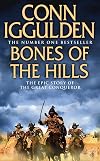
Having lived in Central Asia for 3 years, I was disappointed with Bones of the Hills. While the battle descriptions and drama between Genghis and his sons was well written and compelling, this book was far more fantasy and less historical fiction. Describing the Turkic and Persian people of Central Asia as "Arabs" was not only inaccurate, it was unnecessary. Would the reader really be turned off if the "souks" of Central Asia had been written as "bazaars" as they are known in Turkic and show more Persian. Labeling all the people and rulers of Central Asia as "Arabs" bothered me every time. It was as if you wrote a book about Scotland, and the author labeled the people living there as Irish or English. Berbers and Bedouins don't live in Central Asia, they live thousands of miles away in North Africa. For me the draw of historical fiction is to educate and entertain at the same time, this novel did little of both. A missed opportunity... show less
Lists
Awards


You May Also Like


Associated Authors
Statistics
- Works
- 98
- Also by
- 1
- Members
- 23,856
- Popularity
- #880
- Rating
- 3.9
- Reviews
- 512
- ISBNs
- 954
- Languages
- 25
- Favorited
- 47
