
Janny Scott
Author of A Singular Woman: The Untold Story of Barack Obama's Mother
Works by Janny Scott
Associated Works
Tagged
Common Knowledge
- Gender
- female
- Occupations
- journalist
- Organizations
- The New York Times
Members
Reviews
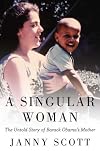
Janny Scott takes on the task of illuminating the life of a most unusual woman whose life was much more than the "white woman from Kansas" description of the President's political campaign.
The book begins in a linear fashion, tracing the roots of Stanley Ann Dunham's heritage. The narrative begins to wander from the linear as Ann's parents move from Kansas, to California, to the Pacific Northwest and finally to Hawaii. Once the story entered Ann's adult life as she entered college and her show more first marriage, the narrative became more looping than linear. I struggled with the looping of the narrative and wished for a timeline and a chart of people through the moves back and forth between Hawaii and Indonesia, and various points throughout the Pacific archipelago that Ann studied. But as the narrative entered the last third of the book, I began to realize that the looping in the narrative was very characteristic of S. Ann Dunham's life. It was time to let go of the lists and just absorb the story of this remarkable woman's life.
The author spent a great deal of time, travel, and effort to trace the path and interview the people who could shed light on a very full and somewhat chaotic life. What emerges is a fascinating portrait of a woman who lived life on her own terms, often at the edge of economic security. One of the things I appreciate most about this book, is that despite the subtitle, we see that S. Ann Dunham was much more than Barack Obama's mother: the President's personal reflections on his mother are saved for the epilogue.
I almost gave up on this one in the middle, but am glad I stuck with it. There's a lot to digest when one reaches the end of the story. show less
The book begins in a linear fashion, tracing the roots of Stanley Ann Dunham's heritage. The narrative begins to wander from the linear as Ann's parents move from Kansas, to California, to the Pacific Northwest and finally to Hawaii. Once the story entered Ann's adult life as she entered college and her show more first marriage, the narrative became more looping than linear. I struggled with the looping of the narrative and wished for a timeline and a chart of people through the moves back and forth between Hawaii and Indonesia, and various points throughout the Pacific archipelago that Ann studied. But as the narrative entered the last third of the book, I began to realize that the looping in the narrative was very characteristic of S. Ann Dunham's life. It was time to let go of the lists and just absorb the story of this remarkable woman's life.
The author spent a great deal of time, travel, and effort to trace the path and interview the people who could shed light on a very full and somewhat chaotic life. What emerges is a fascinating portrait of a woman who lived life on her own terms, often at the edge of economic security. One of the things I appreciate most about this book, is that despite the subtitle, we see that S. Ann Dunham was much more than Barack Obama's mother: the President's personal reflections on his mother are saved for the epilogue.
I almost gave up on this one in the middle, but am glad I stuck with it. There's a lot to digest when one reaches the end of the story. show less
It makes sense that the author is an NYT writer; this felt a little like investigative reporting. I was sold on the Tracy Lord angle, but what sucked me in was the exploration of family history, legacy, fortune, and misfortune. It's fascinating how incredible wealth can tie people into toxic relationship patterns and family dynamics and keep them captive against their real needs. Also, how hard it is for children to really know their parents, especially when muffled by so much wealth and show more baggage, and how much more free people can be among newcomers than those who are closest to them. show less
WHAT AN APT title: A Singular Woman, a biography of Stanley Ann Dunham, the mother of Barack Obama. Janny Scott has given us a detailed, concise overview of Dunham's formative childhood, her career, and her character: taken together they provide a portrait not only of the woman, but of one important aspect of the times she flourished in, roughly the mid-sixties to the end of the century.
Brought up peripatetically — her father alternated between salesman and student, moving his household show more from El Dorado (Kansas) to Berkeley to Wichita to Ponca City (Oklahoma) to Seattle during her grammar-school years — Dunham went to high school on Mercer Island, a suburb of Seattle; then moved with her parents to Honolulu, where she attended college, majoring in anthropology.
Scott's biography begins wisely with a full portrait of Dunham's mother, née Madelyn Payne, and even of her mother, Leona McCurry. Indeed one of the unstated subtexts of the book is the persistence of the maternal strain through these generations, the power and influence of the character traits, the "values," formed and transmitted through the maternal side of the family. This gives considerable insight into the personally held values informing President Obama's political agenda: indeed, an important aspect of Scott's book is its identification of the liberal agenda of contemporary social democracy with the timeless values of communitarian society.
The subtitle of the book seems at first unfortunate, purely a marketing ploy: but it reveals the immediate journalistic value of Scott's achievement, which began in the first place with an article she wrote for the New York Times during the 2008 presidential campaign.
But the lasting value of her book will be its double portrait of Dunham herself and the unique moment of her career: Indonesia (and specifically Java), roughly 1970-2000, where she first pursued anthropological field-work, concentrating on small village industry (metalworking, basketry, ceramics, textiles); later worked with NGOs administering microbanking activities.
If the belligerent aspects of the twentieth century could be set aside, another side of it could be seen with greater clarity: its flowering of the intercultural encounters that had begun with the voyages of the fifteenth century, had gone wrong with European colonialism, had further deteriorated with global commercial exploitation, and had reached a climax with World War II. Janny Scott depicts the best possible view of this encounter, when the humanistic aspirations of cultural anthropology join village pragmatism to modern but local technology, whether physical or — as in the case of microfinance — administrative.
Further, her description not only of Ann Dunham but of her parents reveals the presence, during that moment — from the mid-sixties on — of a personal attitude, or orientation, that may be held by only a minority but that has nevertheless significant implications for the future of our society: an attitude that the dollar is not important for itself but as a means of living, working, and effecting personal and societal progress and justice.
Ann Dunham made a number of decisions most would find unwise or rash — if, that is, they were "decisions" in any useful sense of the word. She was apparently swept off her feet by her first romance, with a foreign student from Kenya who she met in Honolulu: the result was her son Barack and her first marriage.
Later, a similar romance led to her second marriage, to Lolo Soetoro, who she met at an "Indonesian Night" reception at the East-West Center, also in Honolulu. Intercultural encounter can be literally generative: this produced her second child, her daughter Maya, now, since her marriage to a Chinese-Canadian, Maya Soetoro-Ng.
Neither of Dunham's marriages worked out in the conventional sense: Obama senior left Honolulu for graduate work on the East Coast, then returned to Kenya; Lolo Soetoro, after his and Dunham's divorce, ultimately remarried an Indonesian woman with whom he had apparently been long involved. Scott's treatment of these narratives is matter-of-fact, illuminating, and sympathetic. In fact the marriages did work out; they worked themselves out, or the partners out of the marriages. Dunham was meant to follow her own way, to pursue her interests and her work.
A Singular Woman is I think a uniquely American story; but America is divided. The liberal side of Kansas; Berkeley and Honolulu; the liberal arts; the world of international NGOs form Blue American: Red America — ironic that a color once associated with Communism now characterizes conservative Republicanism — will hardly approve Ann Dunham's "decisions."
The book has its production problems. There is no index, though the pages teem with people, places, institutions, and ideas. The photographs are for the most part badly reproduced and far too small on the page.
Scott narrates the book as a journalist, not a scholar. This is mostly a good thing: the prose moves forward with considerable momentum, even though outcomes are telegraphed; and the vagueness or, more often, ambiguities of her sources are met honestly with the author's own voice present in her accounts. The tone is often conversational, as friends, lovers, associates of Dunham's step forward either in person or through allusion to offer insights into the motives and interests of this remarkable and, yes, singular woman. show less
Brought up peripatetically — her father alternated between salesman and student, moving his household show more from El Dorado (Kansas) to Berkeley to Wichita to Ponca City (Oklahoma) to Seattle during her grammar-school years — Dunham went to high school on Mercer Island, a suburb of Seattle; then moved with her parents to Honolulu, where she attended college, majoring in anthropology.
Scott's biography begins wisely with a full portrait of Dunham's mother, née Madelyn Payne, and even of her mother, Leona McCurry. Indeed one of the unstated subtexts of the book is the persistence of the maternal strain through these generations, the power and influence of the character traits, the "values," formed and transmitted through the maternal side of the family. This gives considerable insight into the personally held values informing President Obama's political agenda: indeed, an important aspect of Scott's book is its identification of the liberal agenda of contemporary social democracy with the timeless values of communitarian society.
The subtitle of the book seems at first unfortunate, purely a marketing ploy: but it reveals the immediate journalistic value of Scott's achievement, which began in the first place with an article she wrote for the New York Times during the 2008 presidential campaign.
But the lasting value of her book will be its double portrait of Dunham herself and the unique moment of her career: Indonesia (and specifically Java), roughly 1970-2000, where she first pursued anthropological field-work, concentrating on small village industry (metalworking, basketry, ceramics, textiles); later worked with NGOs administering microbanking activities.
If the belligerent aspects of the twentieth century could be set aside, another side of it could be seen with greater clarity: its flowering of the intercultural encounters that had begun with the voyages of the fifteenth century, had gone wrong with European colonialism, had further deteriorated with global commercial exploitation, and had reached a climax with World War II. Janny Scott depicts the best possible view of this encounter, when the humanistic aspirations of cultural anthropology join village pragmatism to modern but local technology, whether physical or — as in the case of microfinance — administrative.
Further, her description not only of Ann Dunham but of her parents reveals the presence, during that moment — from the mid-sixties on — of a personal attitude, or orientation, that may be held by only a minority but that has nevertheless significant implications for the future of our society: an attitude that the dollar is not important for itself but as a means of living, working, and effecting personal and societal progress and justice.
Ann Dunham made a number of decisions most would find unwise or rash — if, that is, they were "decisions" in any useful sense of the word. She was apparently swept off her feet by her first romance, with a foreign student from Kenya who she met in Honolulu: the result was her son Barack and her first marriage.
Later, a similar romance led to her second marriage, to Lolo Soetoro, who she met at an "Indonesian Night" reception at the East-West Center, also in Honolulu. Intercultural encounter can be literally generative: this produced her second child, her daughter Maya, now, since her marriage to a Chinese-Canadian, Maya Soetoro-Ng.
Neither of Dunham's marriages worked out in the conventional sense: Obama senior left Honolulu for graduate work on the East Coast, then returned to Kenya; Lolo Soetoro, after his and Dunham's divorce, ultimately remarried an Indonesian woman with whom he had apparently been long involved. Scott's treatment of these narratives is matter-of-fact, illuminating, and sympathetic. In fact the marriages did work out; they worked themselves out, or the partners out of the marriages. Dunham was meant to follow her own way, to pursue her interests and her work.
A Singular Woman is I think a uniquely American story; but America is divided. The liberal side of Kansas; Berkeley and Honolulu; the liberal arts; the world of international NGOs form Blue American: Red America — ironic that a color once associated with Communism now characterizes conservative Republicanism — will hardly approve Ann Dunham's "decisions."
The book has its production problems. There is no index, though the pages teem with people, places, institutions, and ideas. The photographs are for the most part badly reproduced and far too small on the page.
Scott narrates the book as a journalist, not a scholar. This is mostly a good thing: the prose moves forward with considerable momentum, even though outcomes are telegraphed; and the vagueness or, more often, ambiguities of her sources are met honestly with the author's own voice present in her accounts. The tone is often conversational, as friends, lovers, associates of Dunham's step forward either in person or through allusion to offer insights into the motives and interests of this remarkable and, yes, singular woman. show less
What struck me as I began to read "A Singular Woman" was the feeling that I had known her. Of course, I hadn't, but there were so many similar young women attending UW-Madison in the mid-1960s. Many of them dated and married Asian, Latino and African men. Some of them came from small, mid-western towns and hadn't ever spoken to a "person of color" let alone had an opportunity to pursue a relationship with them.
This was a generation of women who broke with tradition in many ways with regard show more to pursuing an advanced education and career beyond formal education, traveling and immersing themselves in foreign cultures, and breaking with traditional child-rearing practices. Ann Dunham was truly a part of this generation, and this book is a solid introduction to her life. show less
This was a generation of women who broke with tradition in many ways with regard show more to pursuing an advanced education and career beyond formal education, traveling and immersing themselves in foreign cultures, and breaking with traditional child-rearing practices. Ann Dunham was truly a part of this generation, and this book is a solid introduction to her life. show less
Lists
Awards


You May Also Like


Associated Authors
Statistics
- Works
- 2
- Also by
- 1
- Members
- 401
- Popularity
- #60,557
- Rating
- 3.8
- Reviews
- 16
- ISBNs
- 15