
Rafael Albuquerque
Author of Batman Volume 1: The Court of Owls
About the Author
Image credit: Mike Jara Photography
Series
Works by Rafael Albuquerque
The Joker 80th Anniversary 100-Page Super Spectacular (2020) #1 (Batman (2016-)) (2020) — Author; Illustrator — 15 copies
Batgirl (2016-) #6 1 copy
Prodigy. #3 — Illustrator — 1 copy
Prodigy. #4 — Illustrator — 1 copy
Prodigy. #2 — Illustrator — 1 copy
Prodigy. #1 — Illustrator — 1 copy
Huck Vol. 1 1 copy
Tune 8 01 1 copy
Associated Works
John Constantine, Hellblazer Vol. 06: Bloodlines (2013) — Cover artist, some editions — 149 copies, 1 review
Absolute Superman, Vol. 1: Last Dust of Krypton (2025) — Illustrator, some editions — 101 copies, 1 review
Absolute Martian Manhunter, Vol. 1: Martian Vision (2025) — Illustrator, some editions — 96 copies, 1 review
Femme Magnifique: 50 Magnificent Women who Changed the World (2018) — Contributor — 62 copies, 2 reviews
The Human Target by Tom King and Greg Smallwood: The Deluxe Edition (2025) — Illustrator — 19 copies
Earthdivers, Vol. 3: 1776 (2024) — Illustrator, some editions; Cover artist, some editions — 17 copies, 4 reviews
Gotham Academy #15 — Illustrator — 5 copies
Tagged
Common Knowledge
Members
Reviews
Batman (2011-2016) Vol. 1: The Court of Owls (Batman Graphic Novel) (English Edition) by Scott Snyder
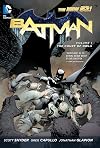
I’m coming into this with very little knowledge of any recent Batman plot points, characters, and story arcs so perhaps my view is naive - but I thought this was excellent!
I was somewhat familiar with the whole Court of Owls premise from the TV show Gotham, but I think it’s all done much better here. It’s unsettling to see how badly Batman is roughed up (physically and mentally) by them in their underground layer, and the fact that it’s only going to get worse is blowing my mind. show more What a great cliffhanger ending for this first volume!
The art is also detailed and brutal, and does some fun things with layouts and panel formats. I tore through these first few issues in a single sitting, and I’m already reserving the next few from the library. Great stuff! show less
I was somewhat familiar with the whole Court of Owls premise from the TV show Gotham, but I think it’s all done much better here. It’s unsettling to see how badly Batman is roughed up (physically and mentally) by them in their underground layer, and the fact that it’s only going to get worse is blowing my mind. show more What a great cliffhanger ending for this first volume!
The art is also detailed and brutal, and does some fun things with layouts and panel formats. I tore through these first few issues in a single sitting, and I’m already reserving the next few from the library. Great stuff! show less
As usual, Scott Snyder's American Vampire continues to kick ass with its gritty, unique take on the vampire mythos.
In this collection, we're given two complete story lines and the teaser for a third. In the first two, there's a return to some of my favorite characters in the series. While I enjoy how Snyder continues to branch out by exploring different time periods in American history, as well as the humans and vampires that inhabit them, the characters of Skinner Sweet, Pearl Jones, and show more Felicia Book will always be my favorites.
In the first story, Felicia Book is reluctantly drawn back into The Vassals of the Morning Star when a vampiric threat targets her son. But this isn't just any vampire; this is Dracula, the Carpathian king who has lain dormant in the VMS stronghold until freed by the Russians. Of the two stories, this was my favorite as we witness Snyder seamlessly blend the Dracula myth into the world of American Vampire. My one complaint, however, is that the ending is abrupt and somewhat anti-climatic, but this gives me hope that maybe this story isn't as finished as Felicia believes.
The second story returns to Pearl Jones, the vampire whose husband, Henry, hangs between life and death after the events in volume 4. In an attempt to save him (and in a story line that somewhat mirrors that of Felicia Book), Pearl agrees to work for the VMS hunting down vampires who may be hiding in the homes of the Hollywood elite (giving an ironic twist to the "Red Scare" of the time period). This is not an easy decision for Pearl as she must team up with the ruthless, sadistic vampire who turned her--Skinner Sweet. Witnessing Pearl grapple with her feelings for Henry and coming to terms with his mortality is one of the strengths of this arc.
Finally, we have the third story, which does little more than return us to Abilena Book, mother of Felicia, and a new threat known only as The Gray Trader. Because this issue was published before American Vampire went on hiatus, we'll have to wait for its return in March 2014 to know precisely what this threat is, but there's no doubt that Abilena hasn't settled into old age and she's ready to rumble.
Overall, this is a strong collection and I continue to be impressed with Snyder's ability to weave all of these arcs into a story that moves the vampire out of the tired European conventions and into a story as vast and open to possibilities as the American West.
Cross posted at This Insignificant Cinder show less
In this collection, we're given two complete story lines and the teaser for a third. In the first two, there's a return to some of my favorite characters in the series. While I enjoy how Snyder continues to branch out by exploring different time periods in American history, as well as the humans and vampires that inhabit them, the characters of Skinner Sweet, Pearl Jones, and show more Felicia Book will always be my favorites.
In the first story, Felicia Book is reluctantly drawn back into The Vassals of the Morning Star when a vampiric threat targets her son. But this isn't just any vampire; this is Dracula, the Carpathian king who has lain dormant in the VMS stronghold until freed by the Russians. Of the two stories, this was my favorite as we witness Snyder seamlessly blend the Dracula myth into the world of American Vampire. My one complaint, however, is that the ending is abrupt and somewhat anti-climatic, but this gives me hope that maybe this story isn't as finished as Felicia believes.
The second story returns to Pearl Jones, the vampire whose husband, Henry, hangs between life and death after the events in volume 4. In an attempt to save him (and in a story line that somewhat mirrors that of Felicia Book), Pearl agrees to work for the VMS hunting down vampires who may be hiding in the homes of the Hollywood elite (giving an ironic twist to the "Red Scare" of the time period). This is not an easy decision for Pearl as she must team up with the ruthless, sadistic vampire who turned her--Skinner Sweet. Witnessing Pearl grapple with her feelings for Henry and coming to terms with his mortality is one of the strengths of this arc.
Finally, we have the third story, which does little more than return us to Abilena Book, mother of Felicia, and a new threat known only as The Gray Trader. Because this issue was published before American Vampire went on hiatus, we'll have to wait for its return in March 2014 to know precisely what this threat is, but there's no doubt that Abilena hasn't settled into old age and she's ready to rumble.
Overall, this is a strong collection and I continue to be impressed with Snyder's ability to weave all of these arcs into a story that moves the vampire out of the tired European conventions and into a story as vast and open to possibilities as the American West.
Cross posted at This Insignificant Cinder show less
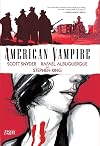
I am going to start including graphic novels here because THAT'S WHY.
Well, this was good. I'm not exactly in the market for vampire fiction, certainly not vampire comics. Never heard of Scott Snyder, and Stephen King's name didn't do much to increase my interest. This hearks back to Vertigo's horror roots, of course, though they're a pretty diverse line nowadays, but you rarely get a Vertigo title without a dark and violent edge.
Two parallel stories of vampirism, one in the Wild West, the show more other in 1930s Hollywod. The older story is about the birth of a new breed of vampire, an outlaw desperado, and the later storyline is about another, newer version of the breed and her battle with the older class of European vamp that inadvertently created her. It's a cracking read, with great art, makes excellent use of its' setting and promises to deliver a lot more in future volumes. Excellent. show less
Well, this was good. I'm not exactly in the market for vampire fiction, certainly not vampire comics. Never heard of Scott Snyder, and Stephen King's name didn't do much to increase my interest. This hearks back to Vertigo's horror roots, of course, though they're a pretty diverse line nowadays, but you rarely get a Vertigo title without a dark and violent edge.
Two parallel stories of vampirism, one in the Wild West, the show more other in 1930s Hollywod. The older story is about the birth of a new breed of vampire, an outlaw desperado, and the later storyline is about another, newer version of the breed and her battle with the older class of European vamp that inadvertently created her. It's a cracking read, with great art, makes excellent use of its' setting and promises to deliver a lot more in future volumes. Excellent. show less

Access a version of the below that includes illustrations on my blog.
Yesssss. Blue Beetle is still the quintessential teen superhero book, as John Rogers shows all lesser writers how to balance character, humor, superheroics, and teen angst. Road Trip ended on a cliffhanger, with Blue Beetle making first contact with the alien Reach, responsible for the creation of his mysterious scarab; Reach for the Stars follows that up with a series of standalone one-issue stories, as Jaime tries to show more convince others that the Reach isn't what it seems. I wish more writers followed Rogers's approach: his done-in-ones are perfect at balancing individual story and character beats with the ongoing plots and narratives of the series, meaning that this slim volume feels like it does more than many fatter comic collections.
The book features a lot of tie-ins to the larger DC universe, with appearances by Guy Gardner and Ultra-Humanite, Superman and Livewire, Traci 13 (the Architects did keep their promise in Architecture & Mortality and fold her into the post-52 universe), Bruce Wayne/Batman, Lobo and the Teen Titans, and Giganta (not sure how her operating as a mercenary here fits with her being a professor at Ivy University in The All New Atom, but maybe I'll find out). These are well-done crowd-pleasers: who doesn't like Paco and Brenda quibbling over the belly shirts all the female members of the Titans wear?
But where John Rogers and his collaborators always excel are the moments of character. A real highlight is a story where Jaime must stop a storm-creating supervillain from devastating a coastal Mexican community. His suit lets him know how many life-signs are active in the community, leading to this devastating page. But Jaime doesn't crumble; he starts thinking smart, and works out a solution to save everyone still alive with a minimum of violence, and ends the issue in a tender moment with his father.
Similarly, one could easily groan over another appearance of Eclipso (not really a favorite of mine after suffering through its appearance in Day of Vengeance and Team 7), but Rogers turns it into something special, with a series of great character moments for Jaime and Paco. Jaime gets his flirt on with Traci 13, but still has some realistic awkwardness, and triumphs through his desire to not be a superhero. But he's a hero nonetheless, and that's what makes him great. (Plus John Rogers gets in a nice tribute to the Dibnys. I miss you, Elongated Man!)
I know this series doesn't run forever, but it really seems like it could, and it deserves to.
Blue Beetle: « Previous in sequence | Next in sequence » show less
Yesssss. Blue Beetle is still the quintessential teen superhero book, as John Rogers shows all lesser writers how to balance character, humor, superheroics, and teen angst. Road Trip ended on a cliffhanger, with Blue Beetle making first contact with the alien Reach, responsible for the creation of his mysterious scarab; Reach for the Stars follows that up with a series of standalone one-issue stories, as Jaime tries to show more convince others that the Reach isn't what it seems. I wish more writers followed Rogers's approach: his done-in-ones are perfect at balancing individual story and character beats with the ongoing plots and narratives of the series, meaning that this slim volume feels like it does more than many fatter comic collections.
The book features a lot of tie-ins to the larger DC universe, with appearances by Guy Gardner and Ultra-Humanite, Superman and Livewire, Traci 13 (the Architects did keep their promise in Architecture & Mortality and fold her into the post-52 universe), Bruce Wayne/Batman, Lobo and the Teen Titans, and Giganta (not sure how her operating as a mercenary here fits with her being a professor at Ivy University in The All New Atom, but maybe I'll find out). These are well-done crowd-pleasers: who doesn't like Paco and Brenda quibbling over the belly shirts all the female members of the Titans wear?
But where John Rogers and his collaborators always excel are the moments of character. A real highlight is a story where Jaime must stop a storm-creating supervillain from devastating a coastal Mexican community. His suit lets him know how many life-signs are active in the community, leading to this devastating page. But Jaime doesn't crumble; he starts thinking smart, and works out a solution to save everyone still alive with a minimum of violence, and ends the issue in a tender moment with his father.
Similarly, one could easily groan over another appearance of Eclipso (not really a favorite of mine after suffering through its appearance in Day of Vengeance and Team 7), but Rogers turns it into something special, with a series of great character moments for Jaime and Paco. Jaime gets his flirt on with Traci 13, but still has some realistic awkwardness, and triumphs through his desire to not be a superhero. But he's a hero nonetheless, and that's what makes him great. (Plus John Rogers gets in a nice tribute to the Dibnys. I miss you, Elongated Man!)
I know this series doesn't run forever, but it really seems like it could, and it deserves to.
Blue Beetle: « Previous in sequence | Next in sequence » show less
Lists
Awards


You May Also Like
Associated Authors
Statistics
- Works
- 46
- Also by
- 37
- Members
- 4,517
- Popularity
- #5,553
- Rating
- 3.9
- Reviews
- 177
- ISBNs
- 119
- Languages
- 11
- Favorited
- 1