

Ken Smith (15) (1947–)
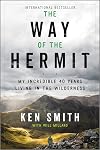
Author of The Way of the Hermit: My Incredible 40 Years Living in the Wilderness
For other authors named Ken Smith, see the disambiguation page.
Works by Ken Smith
Associated Works
Tagged
Common Knowledge
- Birthdate
- 1947-10-28
- Gender
- male
- Nationality
- Scotland
- Birthplace
- Derbyshire, England, UK
- Associated Place (for map)
- Scotland
Members
Reviews
As a solitudinarian by inclination, books like this are always attractive to me. And I sure enjoyed this one.
Ken Smith doesn't dislike people. He has friends, family, happily chats up strangers, hitchhikes, hosts visitors. His first winter on his own in the Scottish Highlands is spent in a publicly accessible bothy, a basic shelter cabin available to hikers and ramblers and park visitors, where he might end up sharing spartan quarters with partyers, other trekkers, drunks, etc. But it was show more the price to be paid for free shelter and a woodstove in the wintertime!
Smith's charm is that he cheerfully, willingly, and with amazing hardihood, pays any sort of price to live exactly as he chooses. He grows or forages most of his food, brews his own beer and wine (proud to say that there is very little that grows in those hills that he hasn't tried to make wine from... with mixed success). He hand-builds his cabin from scratch, alone, with hand tools, heated with wood he gathers or chops (he used to record his wood-chopping totals, remembering one fall day he cut 167 logs). He hauls water from the stream or the lake. No running water, no electricity, no vehicle. If he can't pick up a ride by thumb, he walks...twenty-five miles one way... to shop. He enjoys winter because he doesn't have to spend so many hours in the garden, and has more time to sit by the stove. Yes, he's very often cold, wet, endangered (a massive storm dropped 100-foot trees on his meek little roof), sometimes sick (has survived two strokes and colon cancer). This is not a particularly philosophical or intellectual inquiry into solitude or hermits, but just a clear-eyed, honest picture of what it's actually LIKE to live as he does, and he cannot imagine living any other way. While he admits to rather enjoying television during a hospitalization, the noise drove him crazy. He reads, he keeps a detailed journal. He has traveled (on foot, alone, deep into the Yukon territories in Canada and Alaska, with a knife, a fishing rod, a tarp, a sleeping bag, and more or less the clothes he stood up in), but the shores of Lake Treig are home.
There are chapters devoted to the birds, the wild creatures (the pine martens are especially funny), the weather, to hunting and fishing, with musings on the ethics and fairness and respect each requires. While many have been enraptured by [book:Into The Wild|40514274], and that callow young man's suicidally romantic wander into death, I thought he was an idiot. I much prefer Ken Smith's wise, humble devotion to his place, his work, and his chosen life, and wish him more years yet (he is 75 now) to live it. show less
Ken Smith doesn't dislike people. He has friends, family, happily chats up strangers, hitchhikes, hosts visitors. His first winter on his own in the Scottish Highlands is spent in a publicly accessible bothy, a basic shelter cabin available to hikers and ramblers and park visitors, where he might end up sharing spartan quarters with partyers, other trekkers, drunks, etc. But it was show more the price to be paid for free shelter and a woodstove in the wintertime!
Smith's charm is that he cheerfully, willingly, and with amazing hardihood, pays any sort of price to live exactly as he chooses. He grows or forages most of his food, brews his own beer and wine (proud to say that there is very little that grows in those hills that he hasn't tried to make wine from... with mixed success). He hand-builds his cabin from scratch, alone, with hand tools, heated with wood he gathers or chops (he used to record his wood-chopping totals, remembering one fall day he cut 167 logs). He hauls water from the stream or the lake. No running water, no electricity, no vehicle. If he can't pick up a ride by thumb, he walks...twenty-five miles one way... to shop. He enjoys winter because he doesn't have to spend so many hours in the garden, and has more time to sit by the stove. Yes, he's very often cold, wet, endangered (a massive storm dropped 100-foot trees on his meek little roof), sometimes sick (has survived two strokes and colon cancer). This is not a particularly philosophical or intellectual inquiry into solitude or hermits, but just a clear-eyed, honest picture of what it's actually LIKE to live as he does, and he cannot imagine living any other way. While he admits to rather enjoying television during a hospitalization, the noise drove him crazy. He reads, he keeps a detailed journal. He has traveled (on foot, alone, deep into the Yukon territories in Canada and Alaska, with a knife, a fishing rod, a tarp, a sleeping bag, and more or less the clothes he stood up in), but the shores of Lake Treig are home.
There are chapters devoted to the birds, the wild creatures (the pine martens are especially funny), the weather, to hunting and fishing, with musings on the ethics and fairness and respect each requires. While many have been enraptured by [book:Into The Wild|40514274], and that callow young man's suicidally romantic wander into death, I thought he was an idiot. I much prefer Ken Smith's wise, humble devotion to his place, his work, and his chosen life, and wish him more years yet (he is 75 now) to live it. show less
Ken Smith is a remarkable man. That term somehow seems hollow to describe him because living the life he’s led, “remarkable” sounds much too highfalutin for a guy like Ken. He would probably agree. I listened to the audio version of Smith’s book, and I’m glad I did because the narrator, Dean Williamson, does such a wonderful job telling Smith’s story. I will say, listening to Ken Smith’s hermit life story made me wonder if living this way, where almost all of one’s efforts show more are directed at simply surviving, is worth it. Of course, Ken Smith couldn’t live any other way, and the average reader might be inclined to be jealous of Smith because of his ability to “get back to nature.” Anyone considering such a move need only listen to Smith’s story to quickly come out of your fantasy and come back down to earth. Without giving away any spoilers, I will say that some of the challenges of Ken’s later life were painful to listen to, although he survived every one of them, and apparently is alive to this day in his late 70s. “The Way of the Hermit” was a thoroughly enjoyable book, and I would encourage anyone considering picking it up to consider listening to the audio version. It is a real treat. show less
The Way of the Hermit tells the story of Ken Smith. While the title may sound like it belongs to a philosophical treatise, the book is really the autobiography of a recluse, with some practical advice for living off the grid thrown in.
It’s a well written story, told in a conversational style, and co-authored by BBC commentator Will Millard. The book chronicles the journey Ken Smith took from working class roots in the village of Whatstandwell, England to his life off the grid in a remote show more cottage on Loch Treig in Scotland, north of Glasgow.
In 1963, at the age of 15 Smith got his first job. It went like this - his parents got a sheepdog. With the tiny home he shared with his parents, brothers and sister, a dog was the last thing Smith thought they needed, and not something he wanted to share the tiny home with. The dog was the thing that spurred the teenager to start looking for a job that would take him away from home, and he found it in the Forestry Commission planting trees in northern Scotland. That first job embodied Smith’s love for the outdoors. From there he took a job in a nursery in Scotland planting trees before being convinced by his brother to return home and take a job in the building trades.
It was back home, in the neighboring town of Ripley were, in 1974, Smith’s life was completely upended. After a night out he was walking toward home when he was set upon by a gang of youths, shoved through the window of the local bakery and beaten senseless. He was left, he says, “in a crumpled puddle of blood and glass”.
Somehow, he made it home. Though he had several cuts and bruises and a headache, he believed the injuries were superficial. But the headache grew worse, and, trying to rise out of bed three days later he collapsed onto the floor, unable to move or speak. Rushed to the hospital, he lost consciousness and lay in a coma for 23 days. After four brain operations and dedicated physical therapy from the hospital nurses he eventually regained his memory, restored the ability to talk and to write, and learned to walk again. He was in the hospital for 49 days and out of work for 10 months.
Following his recovery his mother died of a heart attack. At 31, Smith decided it was time to leave it all behind, at least for a while. This time he headed to Canada. From May through early winter he and his friend Roy camped and wandered around the Canadian Rockies. He returned home only to learn that his father had passed away in his absence.
Depressed and despondent, Smith spent three and a half years working construction before he set off once again, this time alone, for the Canadian backwoods. All of his remote travel was deepening his experience as an outdoorsman and sharpening his ability to fend for himself and survive on his own in the wild. It was preparing him for his next step - finding his place in the woods of northern Scotland.
After returning home from Canada again Smith decided to strike out to find a place he could call his own in a remote area of the UK. Being familiar with the Scottish highlands from his early jobs he naturally headed in that direction.
He eventually found himself at Loch Treig, a long, narrow glacial lake, and he felt at home. He no longer felt the need to wander. “One late summer’s day”, he says, “I stood on the banks of Treig and I just knew that this was it. This was the place.”
It was here, in a small patch of woods off the lake, and after arranging a deal (and a job helping with deer hunts) with the owner of the large estate on which the woods sat, that Smith built a cabin and settled down. Nine miles from the nearest neighbor and completely off the grid, he made his home.
The rest of the story is full of Smith’s advice on building a cabin by hand, on creating a garden and setting it up to sustain a person (though he does not wholly depend on his garden), and on all the various plants he’s managed to make “wine” from.
By the book’s end Smith is in his 70s struggling with health issues and again in need of hospital stays, this time from a battle with cancer, from which he recovers.
Throughout his life Smith has kept journals and taken photos to chronicle his life. He draws on these to tell his story. In the early 2020’s he somehow came to the attention of a Lizzie McKenzie, who put together a documentary film about him that aired on BBC Scotland. From there this book was born. Originally published last year in the UK, the book is now available in the States.
There’s enough left out that one wonders. Why was he set upon by that gang? Why was his reaction to run away from everything? Why are the snippets of writing from his diary so different than the writing style of the book - how much is his and how much Millard’s? But it’s a good read and an interesting life story, and whether such questions matter is really up to each reader to decide for themselves.
RATING: Four Stars ⭐⭐⭐⭐ - An easy to read and interesting biography of a working-class man whose life took a turn after a nasty incident, and who became a hermit. I read an advanced review copy provided through NetGalley and Harlequin Trade Publishing, the book’s publisher. show less
It’s a well written story, told in a conversational style, and co-authored by BBC commentator Will Millard. The book chronicles the journey Ken Smith took from working class roots in the village of Whatstandwell, England to his life off the grid in a remote show more cottage on Loch Treig in Scotland, north of Glasgow.
In 1963, at the age of 15 Smith got his first job. It went like this - his parents got a sheepdog. With the tiny home he shared with his parents, brothers and sister, a dog was the last thing Smith thought they needed, and not something he wanted to share the tiny home with. The dog was the thing that spurred the teenager to start looking for a job that would take him away from home, and he found it in the Forestry Commission planting trees in northern Scotland. That first job embodied Smith’s love for the outdoors. From there he took a job in a nursery in Scotland planting trees before being convinced by his brother to return home and take a job in the building trades.
It was back home, in the neighboring town of Ripley were, in 1974, Smith’s life was completely upended. After a night out he was walking toward home when he was set upon by a gang of youths, shoved through the window of the local bakery and beaten senseless. He was left, he says, “in a crumpled puddle of blood and glass”.
Somehow, he made it home. Though he had several cuts and bruises and a headache, he believed the injuries were superficial. But the headache grew worse, and, trying to rise out of bed three days later he collapsed onto the floor, unable to move or speak. Rushed to the hospital, he lost consciousness and lay in a coma for 23 days. After four brain operations and dedicated physical therapy from the hospital nurses he eventually regained his memory, restored the ability to talk and to write, and learned to walk again. He was in the hospital for 49 days and out of work for 10 months.
Following his recovery his mother died of a heart attack. At 31, Smith decided it was time to leave it all behind, at least for a while. This time he headed to Canada. From May through early winter he and his friend Roy camped and wandered around the Canadian Rockies. He returned home only to learn that his father had passed away in his absence.
Depressed and despondent, Smith spent three and a half years working construction before he set off once again, this time alone, for the Canadian backwoods. All of his remote travel was deepening his experience as an outdoorsman and sharpening his ability to fend for himself and survive on his own in the wild. It was preparing him for his next step - finding his place in the woods of northern Scotland.
After returning home from Canada again Smith decided to strike out to find a place he could call his own in a remote area of the UK. Being familiar with the Scottish highlands from his early jobs he naturally headed in that direction.
He eventually found himself at Loch Treig, a long, narrow glacial lake, and he felt at home. He no longer felt the need to wander. “One late summer’s day”, he says, “I stood on the banks of Treig and I just knew that this was it. This was the place.”
It was here, in a small patch of woods off the lake, and after arranging a deal (and a job helping with deer hunts) with the owner of the large estate on which the woods sat, that Smith built a cabin and settled down. Nine miles from the nearest neighbor and completely off the grid, he made his home.
The rest of the story is full of Smith’s advice on building a cabin by hand, on creating a garden and setting it up to sustain a person (though he does not wholly depend on his garden), and on all the various plants he’s managed to make “wine” from.
By the book’s end Smith is in his 70s struggling with health issues and again in need of hospital stays, this time from a battle with cancer, from which he recovers.
Throughout his life Smith has kept journals and taken photos to chronicle his life. He draws on these to tell his story. In the early 2020’s he somehow came to the attention of a Lizzie McKenzie, who put together a documentary film about him that aired on BBC Scotland. From there this book was born. Originally published last year in the UK, the book is now available in the States.
There’s enough left out that one wonders. Why was he set upon by that gang? Why was his reaction to run away from everything? Why are the snippets of writing from his diary so different than the writing style of the book - how much is his and how much Millard’s? But it’s a good read and an interesting life story, and whether such questions matter is really up to each reader to decide for themselves.
RATING: Four Stars ⭐⭐⭐⭐ - An easy to read and interesting biography of a working-class man whose life took a turn after a nasty incident, and who became a hermit. I read an advanced review copy provided through NetGalley and Harlequin Trade Publishing, the book’s publisher. show less
I thoroughly enjoyed this memoir. A unique individual charts an unconventional lifestyle and makes it happen. Brilliant. Thanks, Ken, for sharing this with the world. There are more than a few parallels to my own life, so I am sure that enhanced my appreciation. If you want an honest account of one person's life, warts and all, you found it.
Statistics
- Works
- 1
- Also by
- 1
- Members
- 105
- Popularity
- #183,190
- Rating
- 4.2
- Reviews
- 4
- ISBNs
- 193
- Languages
- 1