
Lee Sullivan
Author of Rivers of London, Vol. 1: Body Work
About the Author
Image credit: Lee Sullivan
Series
Works by Lee Sullivan
Transformers 238: Survival Run / The Interplanetary Wrestling Championship! (part three) (1989) — Illustrator — 1 copy, 1 review
Transformers 214: Guess Who the Mecannibals Are Having for Dinner? part two / The Fall and Rise of the Decepticon Empire! (part two) (1989) — Illustrator — 1 copy, 1 review
Transformers 213: Guess Who the Mecannibals Are Having for Dinner? part one / The Fall and Rise of the Decepticon Empire! (part one) (1989) — Illustrator — 1 copy, 1 review
Transformers 204: Time Wars (part six: When All have Fallen...) (1989) — Illustrator — 1 copy, 1 review
The Transformers 187: Space Pirates! (part six: The End of the World!) (1988) — Illustrator — 1 copy, 1 review
The Transformers 186: Space Pirates! (part five: The Awakening!) (1988) — Illustrator — 1 copy, 1 review
Associated Works
Transformers: Tales from the Beast Wars: Reaching the Omega Point (2000) — Illustrator — 3 copies, 1 review
Transformers 200: Time Wars (part two: The Ravages of Time!) (1989) — Cover artist — 2 copies, 1 review
Transformers 236: Deathbringer part two / The Interplanetary Wrestling Championship! (part one) (1989) — Cover artist — 1 copy, 1 review
Transformers 218: Recipe for Disaster! part two / Race With The Devil (part four) (1989) — Cover artist — 1 copy, 1 review
The Transformers 134: Headhunt part two / Broken Glass! (part one) (1987) — Cover artist — 1 copy, 1 review
The Transformers 131: Worlds Apart! (part two: Scorponok's Sting!) / Ring of Hate! (part two) (1987) — Cover artist — 1 copy, 1 review
The Transformers 137: Ladies Night part one / Broken Glass! (part four) (1987) — Cover artist — 1 copy, 1 review
The Transformers 140: Used Autobots part two / Love and Steel! (part three) (1987) — Cover artist — 1 copy, 1 review
The Transformers 141: Child's Play part one / Love and Steel! (part four) (1987) — Cover artist — 1 copy, 1 review
Tagged
Common Knowledge
There is no Common Knowledge data for this author yet. You can help.
Members
Reviews
Liberation of the Daleks: Collected Comic Strips from the Pages of Doctor Who Magazine by Alan Barnes

Access a version of the below that includes illustrations on my blog.
It's DWM's longest story! By issue count, at least; I think The Glorious Dead still has it beat out by approximately ten pages. Picking up from the end of The Power of the Doctor, this leads right into Destination: Skaro... though I am unconvinced that its events really could squeeze into the sixty minutes the Doctor states have passed between the two stories in Destination: Skaro. I am pretty sure it took me longer than show more sixty minutes to read it!
It's a bit bonkers, and it's not very deep, but it is fun. One of Alan Barnes's strengths as a writer has always been rearranging pop culture iconography in interesting ways: here the Daleks attack the World Cup Final in 1966, only it turns out that it's all a simulation from the future, an amusement park where people go to experience Dalek wars... and the park enslaves real Daleks to make it all work. When the Doctor escapes from the simulation, he brings real Daleks with him.
It's not very deep, but it is deep enough; the story does some fun stuff with the disjunction between how we perceive Daleks as viewers (fun, goofy) and how they function in the narrative of Doctor Who (purveyors of genocide); probably the best of the many strong cliffhangers is the one where a bunch of tourists began chanting "EXTERMINATE," hoping to be exterminated! As you would, of course. It casts a lens on Doctor Who's own story, but also reflects the way that, say, Nazis come across in real pop culture. Alan Barnes amps it up as the story proceeds by even bringing in the TV Century 21 Daleks, contrasting their even more goofy iconography with the brutality of the "actual" Daleks.
It does give a feeling of being made up as it went along. Mostly I don't mind this (so does, say, the original Star Beast) but it does seem like the whole story could have ended with part eight but keeps going with a whole new subplot.
Lee Sullivan does a great job with Daleks of course, but all throughout; he captures new series Daleks, classic series Daleks, TV21 Daleks, all of them. James Offredi matches him on coloring with some good work, especially on the TV21 stuff.
If you thought this would be a deep plunge into the mysteries of the fourteenth Doctor (and I can see why you might have, though the story itself discards this pretty quickly), this isn't it. But it is a solid piece of DWM fun.
Other Notes:
It's DWM's longest story! By issue count, at least; I think The Glorious Dead still has it beat out by approximately ten pages. Picking up from the end of The Power of the Doctor, this leads right into Destination: Skaro... though I am unconvinced that its events really could squeeze into the sixty minutes the Doctor states have passed between the two stories in Destination: Skaro. I am pretty sure it took me longer than show more sixty minutes to read it!
It's a bit bonkers, and it's not very deep, but it is fun. One of Alan Barnes's strengths as a writer has always been rearranging pop culture iconography in interesting ways: here the Daleks attack the World Cup Final in 1966, only it turns out that it's all a simulation from the future, an amusement park where people go to experience Dalek wars... and the park enslaves real Daleks to make it all work. When the Doctor escapes from the simulation, he brings real Daleks with him.
It's not very deep, but it is deep enough; the story does some fun stuff with the disjunction between how we perceive Daleks as viewers (fun, goofy) and how they function in the narrative of Doctor Who (purveyors of genocide); probably the best of the many strong cliffhangers is the one where a bunch of tourists began chanting "EXTERMINATE," hoping to be exterminated! As you would, of course. It casts a lens on Doctor Who's own story, but also reflects the way that, say, Nazis come across in real pop culture. Alan Barnes amps it up as the story proceeds by even bringing in the TV Century 21 Daleks, contrasting their even more goofy iconography with the brutality of the "actual" Daleks.
It does give a feeling of being made up as it went along. Mostly I don't mind this (so does, say, the original Star Beast) but it does seem like the whole story could have ended with part eight but keeps going with a whole new subplot.
Lee Sullivan does a great job with Daleks of course, but all throughout; he captures new series Daleks, classic series Daleks, TV21 Daleks, all of them. James Offredi matches him on coloring with some good work, especially on the TV21 stuff.
If you thought this would be a deep plunge into the mysteries of the fourteenth Doctor (and I can see why you might have, though the story itself discards this pretty quickly), this isn't it. But it is a solid piece of DWM fun.
Other Notes:
- For those of us who keep track of such things, these fourteen strips tie Alan Barnes for the twelfth-longest run as writer of the DWM strip with Steve Parkhouse (#86-99), and tie Lee Sullivan for seventh as artist with David A Roach (#451-64). For total written, it moves Barnes from fifth to third (at 41 strips, a bit below Steve Parkhouse's total of 46), and Lee Sullivan from eighth to seventh (at 44 strips). But I believe there's more to come after this for both, so their numbers will move even further up.
- This is Barnes's first contribution to the main strip since #380, a gap of 204 strips! This would place him in second for largest gap (if we discount the returns for issue #500), behind John Tomlinson's record of 210... except that Lee Sullivan makes his first contribution since #317, setting a new record of 267!
- I'm given to understand that the conceit of TV Century 21 was that it was a news magazine from one century after its time of publication. Because of that, the humorless pedants of the Tardis wiki have counted all sorts of weird stuff as "valid" because it was printed in TV21 alongside the Dalek strips. Like, they'll count Thunderbirds... but (up until recently) not Scream of the Shalka or Death Comes to Time!? Anyway, if they are paying attention to Liberation, they need to take all that stuff back out, because Barnes establishes the TV21 comic strips are an in-universe 21st-century children's fiction.
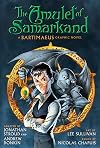
I very much enjoyed this book--I listened to the audiobook version and the narrator had the most wonderful voice. The character of Bartimaeus was the chief joy of the book for me--arrogant and cheeky and sly, as a demon should be, with a personality as big as his notion of his own wonderfulness. I didn't like the main human character, Nathaniel, as much, but have hopes that he might improve (that is, become less whiny and self-pitying) in later books.

Access a version of the below that includes illustrations on my blog.
I think at the time, this surely must have been an abrupt transition. From the dangerous and moody seventh Doctor in #211, straight into the fourth Doctor and Romana gadding about in #212. Ace and Bernice are gone without a word; the strip of course has had to write out TV companions before (i.e., Peri) but usually at least says something about it. We get nothing like that this time. For me, though, it reads a little less show more abruptly because of where I included The Age of Chaos, which caps off the VNA era with The Last Word and eases us into the "past Doctor" stuff with Under Pressure and The Age of Chaos itself; plus, in publication order, Bringer of Darkness opens this volume, which is sort of a second Doctor story in a seventh Doctor style, giving another transitional point.
Unfortunately, the backmatter doesn't include anything from Gary Russell, who was strip editor at the time, and thus the one responsible for the sudden, unprecedented change in the DWM comics format. No longer is the strip one ongoing story; it's now a nostalgia tour. Thankfully, Gareth Roberts does explain a bit in his notes on The Lunar Strangers: there was no longer a television programme to follow, and so the mag became a celebration of Doctor Who's history, driven in part by the VHS range, which randomly dipped into the show's history, "So he was going to follow a similarly randomised pattern in DWM." I'm not sure this would have been my choice, but it has a good logic behind it.
First, it makes sense to uncouple from the NAs: why should one range of tie-ins be beholden to another, when the other clearly doesn't care about this one? Had the strip kept following the books, Ace would have had to disappear again around the time of #223, and then two new companions would have appeared out of nowhere in #227. But if you're going to uncouple, it makes sense to do so in a strong, distinctive way: continuing to do seventh Doctor adventures, just without Benny and "Spacefleet" Ace I think would have raised questions as to why the strip wasn't consistent with the NAs (a range the mag promoted every month with the preludes!) if it was featuring the same characters. Going into the show's past gives a clear reason for the strip to be unconnected to the novels, even if I don't like the loss of the strip's ongoing nature.
Bringer of Darkness
This is a neat little story, very effectively done. We begin our "past Doctor" adventures with the second Doctor, Jamie, and Victoria, and the story follows on from The Evil of the Daleks in having the Doctor investigate if he really did kill off all the Daleks or if he needs to finish the job, and in examining Victoria's emotional reactions to the Daleks, who killed her father; Victoria narrates the story in retrospect from some time shortly after she leaves the TARDIS. Add the dark, moody art of Martin Geraghty, and it all works rather well: a story with some darkness, but also some emotional depth, and it does a neat job of foreshadowing the NAs in a plausible, interesting way. (This came out during Emperor of the Daleks!, so arguably at the height of DWM's VNA era.)
Victims
The fourth Doctor and second Romana investigate murders on a world known for its high fashion. The best part of this is the repartee between the Doctor and Romana; Abnett captures season 17 perfectly in that regard. No, strike that; the best part is the joke about the Doctor trying on Colin Baker's coat, which made me laugh out loud. The story is a bit darker than a real season 17 story, which works; what works less well is that it's kind of a mystery... but it has exactly one suspect, who turns out to have done it. I felt like it fizzled out by the end despite a strong start. Colin Andrew does a reasonable Tom Baker, but his Lalla Ward likeness is very inconsistent; if you're going to go for this retro/nostalgia approach, though, I think you need artists who are good at likenesses.
The Lunar Strangers
The very first page of this one is genius, stuff only the DWM comic could do: cows in spacesuits on the moon. Nothing else here quite lives up to that. The evil space cows' evil plan didn't strike me as wholly plausible, even by the standards of reading about the plans of evil space cows, and I didn't buy the human base administrator's actions either; it turns out she's been pretending, but 1) a good fake-out needs to be plausible, and 2) if she was suspicious, she could have just locked up the evil space cows and every subsequent problem would have been avoided! Gareth Roberts does capture the voices of the fifth Doctor, Tegan, and Turlough well, though, and Martin Geraghty draws a good evil space cow, even if I struggled to distinguish the two.
Food for Thought
In his notes, Nicholas Briggs says this wasn't his first comic strip, but it was his last. We can be thankful for this, I guess, because it feels like a first attempt, full of awkward, confusing transitions and unclear action, though perhaps a good artist could have saved the script somewhat. At least Briggs correctly notes that the characterization for Polly is downright awful.
Change of Mind
This third Doctor and Liz Shaw story is, I believe, Kate Orman's only comics work, though I gather one of the characters here recurs from her novels. She has a good handle on Liz; the throughline of the Doctor trying to figure out why Liz left (this is set some time later) works very well. It has some good set pieces, such as where the Doctor and Liz use a sit-in to distract the villain, and the climax. Unfortunately, there are two mysterious men in long coats, and as Orman herself points out, some sequences are hard to follow the action of.
This leads me on to a different point: there are three different writers in this volume who were new to comics (essentially, as far as I can tell) in Roberts, Briggs, and Orman; contrast this against Dan Abnett, by this point highly experienced, and Warwick Scott Gray, gradually amassing a body of quality DWM work. For most of its run, the strip has been written by experienced comics writers from outside the Doctor Who world, but that's been slowly changing since the late 1980s. We've seen fan writers with little comics experience come aboard before, of course (e.g., Paul Cornell, Marc Platt), but this is the first volume where I've read a couple strips and thought to myself that the writers were clearly inexperienced comics writers. Orman mentions making mistakes of the medium: but addressing this kind of mistake the exact thing an editor ought to have been on top of! My inference would be that, say, John Freeman and Richard Starkings knew how to nurture a new comics writer in a way that Gary Russell does not. Which, if you've read any of Gary Russell's comics work, is entirely to be expected.
Land of the Blind
Thankfully, the volume closes out as strongly as it opens, with another well put together second Doctor story (this time with Jamie and Zoe) from Scott Gray, now paired with Lee Sullivan. This is a clever, inventive story about a city cut off from the outside universe, with some neat turns, good villains, and one really good joke. You could have stuck this in the Dave Gibbons era and no one would have batted an eye: not crazy ambitious, but the exact kind of thing the strip ought to be doing. I breezed through it in the best of ways.
Stray Observations:
I think at the time, this surely must have been an abrupt transition. From the dangerous and moody seventh Doctor in #211, straight into the fourth Doctor and Romana gadding about in #212. Ace and Bernice are gone without a word; the strip of course has had to write out TV companions before (i.e., Peri) but usually at least says something about it. We get nothing like that this time. For me, though, it reads a little less show more abruptly because of where I included The Age of Chaos, which caps off the VNA era with The Last Word and eases us into the "past Doctor" stuff with Under Pressure and The Age of Chaos itself; plus, in publication order, Bringer of Darkness opens this volume, which is sort of a second Doctor story in a seventh Doctor style, giving another transitional point.
Unfortunately, the backmatter doesn't include anything from Gary Russell, who was strip editor at the time, and thus the one responsible for the sudden, unprecedented change in the DWM comics format. No longer is the strip one ongoing story; it's now a nostalgia tour. Thankfully, Gareth Roberts does explain a bit in his notes on The Lunar Strangers: there was no longer a television programme to follow, and so the mag became a celebration of Doctor Who's history, driven in part by the VHS range, which randomly dipped into the show's history, "So he was going to follow a similarly randomised pattern in DWM." I'm not sure this would have been my choice, but it has a good logic behind it.
First, it makes sense to uncouple from the NAs: why should one range of tie-ins be beholden to another, when the other clearly doesn't care about this one? Had the strip kept following the books, Ace would have had to disappear again around the time of #223, and then two new companions would have appeared out of nowhere in #227. But if you're going to uncouple, it makes sense to do so in a strong, distinctive way: continuing to do seventh Doctor adventures, just without Benny and "Spacefleet" Ace I think would have raised questions as to why the strip wasn't consistent with the NAs (a range the mag promoted every month with the preludes!) if it was featuring the same characters. Going into the show's past gives a clear reason for the strip to be unconnected to the novels, even if I don't like the loss of the strip's ongoing nature.
Bringer of Darkness
This is a neat little story, very effectively done. We begin our "past Doctor" adventures with the second Doctor, Jamie, and Victoria, and the story follows on from The Evil of the Daleks in having the Doctor investigate if he really did kill off all the Daleks or if he needs to finish the job, and in examining Victoria's emotional reactions to the Daleks, who killed her father; Victoria narrates the story in retrospect from some time shortly after she leaves the TARDIS. Add the dark, moody art of Martin Geraghty, and it all works rather well: a story with some darkness, but also some emotional depth, and it does a neat job of foreshadowing the NAs in a plausible, interesting way. (This came out during Emperor of the Daleks!, so arguably at the height of DWM's VNA era.)
Victims
The fourth Doctor and second Romana investigate murders on a world known for its high fashion. The best part of this is the repartee between the Doctor and Romana; Abnett captures season 17 perfectly in that regard. No, strike that; the best part is the joke about the Doctor trying on Colin Baker's coat, which made me laugh out loud. The story is a bit darker than a real season 17 story, which works; what works less well is that it's kind of a mystery... but it has exactly one suspect, who turns out to have done it. I felt like it fizzled out by the end despite a strong start. Colin Andrew does a reasonable Tom Baker, but his Lalla Ward likeness is very inconsistent; if you're going to go for this retro/nostalgia approach, though, I think you need artists who are good at likenesses.
The Lunar Strangers
The very first page of this one is genius, stuff only the DWM comic could do: cows in spacesuits on the moon. Nothing else here quite lives up to that. The evil space cows' evil plan didn't strike me as wholly plausible, even by the standards of reading about the plans of evil space cows, and I didn't buy the human base administrator's actions either; it turns out she's been pretending, but 1) a good fake-out needs to be plausible, and 2) if she was suspicious, she could have just locked up the evil space cows and every subsequent problem would have been avoided! Gareth Roberts does capture the voices of the fifth Doctor, Tegan, and Turlough well, though, and Martin Geraghty draws a good evil space cow, even if I struggled to distinguish the two.
Food for Thought
In his notes, Nicholas Briggs says this wasn't his first comic strip, but it was his last. We can be thankful for this, I guess, because it feels like a first attempt, full of awkward, confusing transitions and unclear action, though perhaps a good artist could have saved the script somewhat. At least Briggs correctly notes that the characterization for Polly is downright awful.
Change of Mind
This third Doctor and Liz Shaw story is, I believe, Kate Orman's only comics work, though I gather one of the characters here recurs from her novels. She has a good handle on Liz; the throughline of the Doctor trying to figure out why Liz left (this is set some time later) works very well. It has some good set pieces, such as where the Doctor and Liz use a sit-in to distract the villain, and the climax. Unfortunately, there are two mysterious men in long coats, and as Orman herself points out, some sequences are hard to follow the action of.
This leads me on to a different point: there are three different writers in this volume who were new to comics (essentially, as far as I can tell) in Roberts, Briggs, and Orman; contrast this against Dan Abnett, by this point highly experienced, and Warwick Scott Gray, gradually amassing a body of quality DWM work. For most of its run, the strip has been written by experienced comics writers from outside the Doctor Who world, but that's been slowly changing since the late 1980s. We've seen fan writers with little comics experience come aboard before, of course (e.g., Paul Cornell, Marc Platt), but this is the first volume where I've read a couple strips and thought to myself that the writers were clearly inexperienced comics writers. Orman mentions making mistakes of the medium: but addressing this kind of mistake the exact thing an editor ought to have been on top of! My inference would be that, say, John Freeman and Richard Starkings knew how to nurture a new comics writer in a way that Gary Russell does not. Which, if you've read any of Gary Russell's comics work, is entirely to be expected.
Land of the Blind
Thankfully, the volume closes out as strongly as it opens, with another well put together second Doctor story (this time with Jamie and Zoe) from Scott Gray, now paired with Lee Sullivan. This is a clever, inventive story about a city cut off from the outside universe, with some neat turns, good villains, and one really good joke. You could have stuck this in the Dave Gibbons era and no one would have batted an eye: not crazy ambitious, but the exact kind of thing the strip ought to be doing. I breezed through it in the best of ways.
Stray Observations:
- Surely the story should have been called Fashion Victims. It's so obvious it boggles my mind that it's not.
- After a pretty substantial run on the writing roster, Dan Abnett finally exits the Doctor Who Magazine comic strip. It's not his final Doctor Who work; he also wrote a couple Big Finish audio dramas and the Christmas novel The Silent Stars Go by. He has also been a pretty prolific writer in American comics. My favorite comics work by him is the excellent Legion Lost, but he's also the kind of writer who will reliably churn out tie-in issues to crappy "events," so I've actually read quite a lot by him, with things like Flashpoint and Convergence. Oh, and he also invented something called "Guardians of the Galaxy"!
- Enid Orc has got to be a pseudonym, yes? But for who...
- I always like to imagine what my hypothetical knows-Doctor Who-only-from-the-comics reader is thinking. In this volume, it's "Who the heck are Romana, Tegan, and Turlough? Where are Sharon and Gus?"
- It is not clear to me what comics Nicholas Briggs has written other than Food for Thought; not Doctor Who ones at any rate. You may have heard of him, though, for going on to voice the Daleks on tv, and for writing a couple Big Finish audio dramas. (I have 79 releases written or co-written by him, according to iTunes!)
- A hard-bitten space freighter captain going, "I ain't waitin' up here to get what's due! I don't care what the hell's goin' on down there! We're goin' in now, or we'll frazz the atmosphere!" (about which another character thinks "...hell's going on down there...") is surely one of the most Nick Briggs pieces of dialogue to ever Nick Briggs. I'm sure he put his heart and soul into it.
- How do they decide who gets cover credit on these collections, anyway? Poor Colin Andrew contributes to more strips than anyone else in this volume (he draws six of them) but is shut out by Scott Gray (writes four), Lee Sullivan (draws three), Gareth Roberts (draws three), Martin Geraghty (draws four), and Dan Abnett (writes three). Well, I'm sure it's about who is famous, either to comicdom at large, or to Who fans, but it does seem unfair.

Access a version of the below that includes illustrations on my blog.
Normally, it seems to me, that the DWM strip transforms pretty slowly. When Steve Moore first took over for Mills & Wagner, he wrote one last Mills & Wagneresque epic, and of course Dave Gibbons stayed on art. When Steve Parkhouse took over from Moore, his early stories were done-in-one-or-twos with little stings at the end, like the majority of Moore's, only more downbeat, even though soon enough he was writing big Time show more Lord epics, and he also had the benefit of Gibbons continuing. When the artists began changing during the fifth Doctor era, the writing stayed the same, and when Parkhouse left, the artist stayed the same, and so on. Parkhouse and Ridgway is very different from Mills & Wagner and Gibbons, but there was no sharp demarcation between them.
But the strips collected in The Good Soldier mark, I would argue, one of the more abrupt transitions in DWM history. Most of the McCoy-era strips so far have felt "kiddie" or disposable, or both, even if you discount the ones originally published in or intended for The Incredible Hulk Presents. Suddenly at the beginning of this volume, the strips feel denser, making more use of the way the comics medium had evolved as of the early 1990s. They feel more like the tv show, too; not the tv show as it had been some time ago (I feel like some of the McCoy strips-- Claws of the Klathi! for example-- were trying to emulate Tom Baker stories), but as it was in its last two years on screen. This is especially true in the characterization of the Doctor. Plus the strips suddenly become interested in creating a continuity; there are lots of references to both recent strip adventures (something the strip did a lot in the Parkhouse/McKenzie era, but which had largely vanished since) and recent tv adventures (something the strip has never really bothered to do before).
This era is the one and only time that the DWM strip was the main source for ongoing Doctor Who adventures. The tv show was seemingly over, the Virgin New Adventures had not yet debuted. If you wanted new Doctor Who, this was it! Never again would the comics be at the forefront like this. (Of course, it has acted like it was the only form of Doctor Who going before, and would do so again, but for a brief moment, that was actually true.)
Scream of the Silent
I actually have no idea how many prose stories DWM has run over the years. It could be hundreds; it could be none up until now. (The Tardis wiki lacks a handy category for them.) If there have been some, none have ever been collected in the DWM graphic novels. That said, I have never really cared for the prose Transformers UK stories I have read; something about them just doesn't work for me. It's like they're not really prose stories at all, but transcriptions of comic strips, not really making use of the medium they're supposedly designed for. They are sparse on interiority and on visuals, just lots of dialogue. Scream of the Silent is no exception; I very easily lost track of what was going on here and why it mattered. I am not entirely sure it all hangs together, but maybe it does and the story just doesn't interest me enough to figure it out. There is a nice Lee Sullivan picture of the seventh Doctor looking in a mirror and seeing the first; it doesn't much have anything to do with anything, though, and I assume the moment was put into the story because it was originally published in an anniversary special issue.
Teenage Kicks!
This, on the other hand, is a prose story by a prose writer, and it feels like it. This short story was published in the first-ever DWM issue with no comic strip, no even a rerun or backup. It features Ace, who rejoined the Doctor (after her sojourn in the Cretaceous) in a story published in the previous issue (which for some reason is not collected until the next graphic novel). This is kind of a weird story; the Doctor takes Ace to confront some gang members she used to run with, and also there are aliens. It felt to me like Cornell was trying to do more than the space allotted really allowed for... but Freeman, say, was probably trying to do much less! Cornell, of course, has a great handle on the character of Ace, and a great prose style, and I really enjoyed reading this, and I'm glad DWM has made Cornell's first Doctor Who prose fiction more readily available.
Fellow Travellers
As I mentioned above, suddenly the tone and style of the DWM strip is all different. It's atmospheric, with interesting and unusual cuts; there's narration boxes with internal narration from Ace. As confirmed by the backmatter, it's a clear indication of influence from Alan Moore; for the first time, we're obviously reading comics written and illustrated by someone who has read Watchmen. I occasionally found some of the transitions here tough to follow (Cartmel was a first-time comic scripter), but I really enjoyed this. Clever twists, good engagement with cultural issues, strong characterization for Ace, spooky atmosphere, nice pop culture references. This feels like it came out of the same Doctor Who universe as Ghost-Light and Survival (which is, in my book at least, a good thing)-- but playing to the strengths of the comics form, not tv.
Darkness, Falling / Distractions
These are two three-page stories setting up the "epic" Mark of Mandragora which followed. The first is a brief horror vignette about a UNIT soldier dying, with a one-page Brigadier cameo; the second is about the Doctor and Ace in the TARDIS, realizing that the Mandragora Helix is behind it all, and that it's infected the TARDIS. These are okay; as I'll get to in a moment, I found Mark a bit disappointing, and I think I would have liked these more if they were leading up to something more epic and satisfying than they actually were. Together, they total six pages, less than the normal length of a single issue's worth of comics, which feels a bit cheap, though I guess that matters less in a collected edition than it would have at the time. Lee Sullivan, though, does an excellent job with things like the futuristic cityscape, the secondary console room, and the time vortex-- plus he really nails likenesses. Surely one of DWM's best art finds.
The Mark of Mandragora
I wanted to like this, and for the first three parts I did. Like the tv show did before it was cancelled, it feels very "now"; I like the attempts at near-future slang ("child") and fashion, and I like our new UNIT commander, Muriel Frost. There's some great stuff here in terms of ideas and art, especially the scene where the TARDIS merges with Earth, and so the Doctor and Ace running down a corridor suddenly find themselves crashing into Frost in a London nightclub. I also really liked the bit where the Doctor and Ace whiteout, thinking they've lost. It's got good stakes to it, and a good sense of threat. It all comes crashing down in the resolution, though, as the Doctor wins without even doing anything! This would almost work, because the Doctor has to sacrifice the TARDIS... except of course the TARDIS is back right away, so the Doctor wins with no cost and no cleverness.
Party Animals
The Doctor (with Ace) finally makes it to Maruthea for Bojaxx's birthday party. Everyone who's everyone is there, so mostly what follows is a series of cameos. Some are from the DWM universe: Beep the Meep, Abslom Daak and the Star Tigers, Ivan Asimoff, the Freefall Warriors, Death's Head, and the little penguins John Ridgway liked to draw are among the ones I noticed. Many are from outside it: Sapphire and Steel, Worf, Emma Peel, and Bart Simpson! I was going to put Captain Britain in the second group, but I guess he technically goes in the first. (I don't think he ever met the Doctor, but I am sure they have mutual acquaintances.)
The big appearance is from a future Doctor, based on the Doctor performed by Nick Briggs in the Audio/Visual fan audios, which Gary Russell worked on himself. They bicker a little bit, and then leave. Like, why? I appreciate that in this era, DWM was pulling its history together again, but I have no idea what the point of this was, and art aside, I didn't find much to like about it.
The Chameleon Factor
I found this one pretty inexplicable, to be honest. Ace and the Doctor climb a tree in the TARDIS; a new console room comes into existence; the Doctor gets his ring back. Okay, but why is this a story as opposed to part of a story?
Seaside Rendezvous
The Doctor and Ace encounter an Ogri (from The Stones of Blood) on the beach. It's all rather pointless. Because I jump around in the book on account of reading the strips in publication order, I actually missed the first page, showing the ship in the nineteenth century, until I got confused by what Paul Cornell was talking about in the backmatter. It's funny, I haven't got on with any of Cornell's DWM strips so far, but he's gone on to have one of the most successful comics careers of anyone working on the mag in this era, and I absolutely love most of his work for Marvel.
The Good Soldier
The Mondasian Cybermen make an initial foray of Earth in the 1950s, scooping up a bit of desert outside Los Vegas with a diner, some soldiers, and the Doctor and Ace on it! I didn't totally get the Mondasian plan here (why did they scoop up the Earth?) and found the resolution, like the one to The Mark of Mandragora a little easy (though nowhere near as bad). But the rest was great. Awesome visuals of the type Doctor Who could largely only do in comics, great characterization, some thematic complexity, and yet another strong artistic turn from Mike Collins. Again, it shows some influence from comics outside the strip with some collage panels when Ace's mind accesses the Cyber computer network and some good use of narration boxes. (I am pretty sure DWM will never have a consistent artist again like it did in the early days, but alternating between Collins and Sullivan pretty much is, and it's much better than the hodgepodge approach of the last couple volumes. It really does give a unified feel to the proceedings when the writers are always changing.)
A Glitch in Time
This is a throwback to that kind of DWM done-in-one I often don't like, the ominous sci-fi story. But actually this one had a pretty fun concept and some good art. Instead of saving the twist for the end, it has twists throughout, which in my mind is much more interesting, and I wish more writers of short sf realized that.
Stray Observations:
Normally, it seems to me, that the DWM strip transforms pretty slowly. When Steve Moore first took over for Mills & Wagner, he wrote one last Mills & Wagneresque epic, and of course Dave Gibbons stayed on art. When Steve Parkhouse took over from Moore, his early stories were done-in-one-or-twos with little stings at the end, like the majority of Moore's, only more downbeat, even though soon enough he was writing big Time show more Lord epics, and he also had the benefit of Gibbons continuing. When the artists began changing during the fifth Doctor era, the writing stayed the same, and when Parkhouse left, the artist stayed the same, and so on. Parkhouse and Ridgway is very different from Mills & Wagner and Gibbons, but there was no sharp demarcation between them.
But the strips collected in The Good Soldier mark, I would argue, one of the more abrupt transitions in DWM history. Most of the McCoy-era strips so far have felt "kiddie" or disposable, or both, even if you discount the ones originally published in or intended for The Incredible Hulk Presents. Suddenly at the beginning of this volume, the strips feel denser, making more use of the way the comics medium had evolved as of the early 1990s. They feel more like the tv show, too; not the tv show as it had been some time ago (I feel like some of the McCoy strips-- Claws of the Klathi! for example-- were trying to emulate Tom Baker stories), but as it was in its last two years on screen. This is especially true in the characterization of the Doctor. Plus the strips suddenly become interested in creating a continuity; there are lots of references to both recent strip adventures (something the strip did a lot in the Parkhouse/McKenzie era, but which had largely vanished since) and recent tv adventures (something the strip has never really bothered to do before).
This era is the one and only time that the DWM strip was the main source for ongoing Doctor Who adventures. The tv show was seemingly over, the Virgin New Adventures had not yet debuted. If you wanted new Doctor Who, this was it! Never again would the comics be at the forefront like this. (Of course, it has acted like it was the only form of Doctor Who going before, and would do so again, but for a brief moment, that was actually true.)
Scream of the Silent
I actually have no idea how many prose stories DWM has run over the years. It could be hundreds; it could be none up until now. (The Tardis wiki lacks a handy category for them.) If there have been some, none have ever been collected in the DWM graphic novels. That said, I have never really cared for the prose Transformers UK stories I have read; something about them just doesn't work for me. It's like they're not really prose stories at all, but transcriptions of comic strips, not really making use of the medium they're supposedly designed for. They are sparse on interiority and on visuals, just lots of dialogue. Scream of the Silent is no exception; I very easily lost track of what was going on here and why it mattered. I am not entirely sure it all hangs together, but maybe it does and the story just doesn't interest me enough to figure it out. There is a nice Lee Sullivan picture of the seventh Doctor looking in a mirror and seeing the first; it doesn't much have anything to do with anything, though, and I assume the moment was put into the story because it was originally published in an anniversary special issue.
Teenage Kicks!
This, on the other hand, is a prose story by a prose writer, and it feels like it. This short story was published in the first-ever DWM issue with no comic strip, no even a rerun or backup. It features Ace, who rejoined the Doctor (after her sojourn in the Cretaceous) in a story published in the previous issue (which for some reason is not collected until the next graphic novel). This is kind of a weird story; the Doctor takes Ace to confront some gang members she used to run with, and also there are aliens. It felt to me like Cornell was trying to do more than the space allotted really allowed for... but Freeman, say, was probably trying to do much less! Cornell, of course, has a great handle on the character of Ace, and a great prose style, and I really enjoyed reading this, and I'm glad DWM has made Cornell's first Doctor Who prose fiction more readily available.
Fellow Travellers
As I mentioned above, suddenly the tone and style of the DWM strip is all different. It's atmospheric, with interesting and unusual cuts; there's narration boxes with internal narration from Ace. As confirmed by the backmatter, it's a clear indication of influence from Alan Moore; for the first time, we're obviously reading comics written and illustrated by someone who has read Watchmen. I occasionally found some of the transitions here tough to follow (Cartmel was a first-time comic scripter), but I really enjoyed this. Clever twists, good engagement with cultural issues, strong characterization for Ace, spooky atmosphere, nice pop culture references. This feels like it came out of the same Doctor Who universe as Ghost-Light and Survival (which is, in my book at least, a good thing)-- but playing to the strengths of the comics form, not tv.
Darkness, Falling / Distractions
These are two three-page stories setting up the "epic" Mark of Mandragora which followed. The first is a brief horror vignette about a UNIT soldier dying, with a one-page Brigadier cameo; the second is about the Doctor and Ace in the TARDIS, realizing that the Mandragora Helix is behind it all, and that it's infected the TARDIS. These are okay; as I'll get to in a moment, I found Mark a bit disappointing, and I think I would have liked these more if they were leading up to something more epic and satisfying than they actually were. Together, they total six pages, less than the normal length of a single issue's worth of comics, which feels a bit cheap, though I guess that matters less in a collected edition than it would have at the time. Lee Sullivan, though, does an excellent job with things like the futuristic cityscape, the secondary console room, and the time vortex-- plus he really nails likenesses. Surely one of DWM's best art finds.
The Mark of Mandragora
I wanted to like this, and for the first three parts I did. Like the tv show did before it was cancelled, it feels very "now"; I like the attempts at near-future slang ("child") and fashion, and I like our new UNIT commander, Muriel Frost. There's some great stuff here in terms of ideas and art, especially the scene where the TARDIS merges with Earth, and so the Doctor and Ace running down a corridor suddenly find themselves crashing into Frost in a London nightclub. I also really liked the bit where the Doctor and Ace whiteout, thinking they've lost. It's got good stakes to it, and a good sense of threat. It all comes crashing down in the resolution, though, as the Doctor wins without even doing anything! This would almost work, because the Doctor has to sacrifice the TARDIS... except of course the TARDIS is back right away, so the Doctor wins with no cost and no cleverness.
Party Animals
The Doctor (with Ace) finally makes it to Maruthea for Bojaxx's birthday party. Everyone who's everyone is there, so mostly what follows is a series of cameos. Some are from the DWM universe: Beep the Meep, Abslom Daak and the Star Tigers, Ivan Asimoff, the Freefall Warriors, Death's Head, and the little penguins John Ridgway liked to draw are among the ones I noticed. Many are from outside it: Sapphire and Steel, Worf, Emma Peel, and Bart Simpson! I was going to put Captain Britain in the second group, but I guess he technically goes in the first. (I don't think he ever met the Doctor, but I am sure they have mutual acquaintances.)
The big appearance is from a future Doctor, based on the Doctor performed by Nick Briggs in the Audio/Visual fan audios, which Gary Russell worked on himself. They bicker a little bit, and then leave. Like, why? I appreciate that in this era, DWM was pulling its history together again, but I have no idea what the point of this was, and art aside, I didn't find much to like about it.
The Chameleon Factor
I found this one pretty inexplicable, to be honest. Ace and the Doctor climb a tree in the TARDIS; a new console room comes into existence; the Doctor gets his ring back. Okay, but why is this a story as opposed to part of a story?
Seaside Rendezvous
The Doctor and Ace encounter an Ogri (from The Stones of Blood) on the beach. It's all rather pointless. Because I jump around in the book on account of reading the strips in publication order, I actually missed the first page, showing the ship in the nineteenth century, until I got confused by what Paul Cornell was talking about in the backmatter. It's funny, I haven't got on with any of Cornell's DWM strips so far, but he's gone on to have one of the most successful comics careers of anyone working on the mag in this era, and I absolutely love most of his work for Marvel.
The Good Soldier
The Mondasian Cybermen make an initial foray of Earth in the 1950s, scooping up a bit of desert outside Los Vegas with a diner, some soldiers, and the Doctor and Ace on it! I didn't totally get the Mondasian plan here (why did they scoop up the Earth?) and found the resolution, like the one to The Mark of Mandragora a little easy (though nowhere near as bad). But the rest was great. Awesome visuals of the type Doctor Who could largely only do in comics, great characterization, some thematic complexity, and yet another strong artistic turn from Mike Collins. Again, it shows some influence from comics outside the strip with some collage panels when Ace's mind accesses the Cyber computer network and some good use of narration boxes. (I am pretty sure DWM will never have a consistent artist again like it did in the early days, but alternating between Collins and Sullivan pretty much is, and it's much better than the hodgepodge approach of the last couple volumes. It really does give a unified feel to the proceedings when the writers are always changing.)
A Glitch in Time
This is a throwback to that kind of DWM done-in-one I often don't like, the ominous sci-fi story. But actually this one had a pretty fun concept and some good art. Instead of saving the twist for the end, it has twists throughout, which in my mind is much more interesting, and I wish more writers of short sf realized that.
Stray Observations:
- The Tardis wiki claims that Fellow Travellers is when the strip began intertwining its continuity with the NAs... but this surely is not true given the NAs didn't begin publication for another eight months!
- Fellow Travellers is the debut of Smithwood Manor, the so-called "house on Allen Road" used as a base and a refuge by the seventh Doctor and companions in many NAs.
- "Glib" is the pseudonym of Gary Gilbert, who had a prolific run as a letterer on Marvel UK's Transformers title. According to the paratext in The Transformers Classics UK, "Glib" was a nickname his wife gave him based on his name, but there was a joke that it stood for "Greatest Letterer In Britain," which caused fellow Transformers letterer Gordon Robson to one-up him by adopting the pseudonym "GLOP" for "Greatest Letterer On the Planet."
- Given the reference to Battlefield in Mark of Mandragora (which takes place a couple years later, in 1999), it bothered me that there was no explanation for why Alistair is back on active duty and why Bambera is not present.
- Darkness, Falling draws together a lot of the recent continuity of the strip, and weaves it into the tv show. The Doctor says, "Something's been troubling me for weeks.... Recently, I haven't been able to take take [sic] the TARDIS away from Earth. Whilst there, we've met creatures and forces that never should have appeared on its surface—at any time! Those Kalik butchers I told you about, Morgaine, even the Hitchers..." The explicit references here are to Train-Flight, Battlefield, and Fellow Travellers. So this would seem to indicate that all of Season 26 (where the TARDIS is Earthbound) takes place recently, and that the Doctor's solo travels in recent strips also take place in such a range. (Train-Flight and Doctor Conkeror! were the first inklings we had the Doctor knew something was up, and there's also hint of in in Teenage Kicks!) And maybe the Doctor is listing those enemies chronologically? On the other hand, most of the pre-Train-Flight strips or the IHP strips can't go within this gap because the Doctor isn't stuck on Earth in those.
- In Party Animals, the Doctor finally makes it to Maruthea, where he's been trying to go since Echoes of the Mogor!, way back in DWM #143. It took him thirty issues to get there! That said, it hasn't been brought up since Nemesis of the Daleks (#152, twenty issues prior), so maybe he gave up for a bit after that.
- With both those things in mind, I might suggest the following sequence (though I'm sure there are some wrinkles here I've failed to account for):
- DWM #130-56 / IHP #1-12 / DW25AS: The Doctor travels with Frobisher, Olla, and then by himself, trying to reach Maruthea. (Probably during Mel's tv tenure, if we care about this; there's no evidence that Mel exists in DWMland!)
- Season 25: The Doctor meets and travels with Ace.
- The Doctor drops Ace off in the Cretaceous.
- DWM #159-62: The Doctor travels by himself again, and begins to have inklings that the Mandragora Helix is affecting his life. The TARDIS stops being able to land anywhere other than Earth. He then picks Ace up again.
- Season 26: The Doctor continues to travel with Ace, only making Earth landings.
- DWM #163-73: The Doctor encounters more effects of the Helix, confronts and defeats it, and then finally reaches Maruthea.
- The exact sequence doesn't really matter; what I like here is how the strip is not only weaving its own events together again, but it also has the audacity to claim that things that happened on screen are part of its continuity, too. Similarly, The Mark of Mandragora cites both the events of Invaders from Gantac! and Battlefield as being so big that the public has become aware of unearthly threats. Plus there's a small cameo from Magog, the villain of DWM's very first story, The Iron Legion! Since Parkhouse left, the strip hasn't really used its own history much, so it's nice to see that back in play again.
- The Mark of Mandragora establishes that Foreign Hazard Duty began as a UNIT off-shoot; once UNIT went public, it needed a top-secret branch to take care of stuff.
- This volume contains the only DWM work of Mark Farmer, who would go on to the kind of career where I couldn't point to a specific title and tell you he did something amazing, but where I do know that whenever I see his name, I am going to see solid, dependable work. Future work that sticks out to me includes Batman: Year Two, the Alan Davis Killraven revival, Paul Cornell's Wisdom, and Justice League Detroit.
- In the backmatter, Gary Russell says that Bonjaxx is a Dæmon who originally appeared in a backup strip from DWM #49. I haven't read this because it hasn't been collected; the Tardis wiki claims that story features Azal from The Dæmons, however.
- Russell also says, "writing comic strips is darned difficult. So many people think, 'Oh, I can knock one of those out,' but they can't. I'm a prime example of that." Despite his self-professed lack of ability, he would go on to write several more DWM strips and an IDW miniseries!
- The Doctor says he and Ace need a holiday at the end of The Chameleon Factor, which links nicely into Cornell's own Seaside Rendezvous, where they are on holiday. Surely this is intentional? I guess it could also lead into The Good Soldier, though.
- Seaside Rendezvous is the only DWM work of Gary Frank who, like Mark Farmer, would go on to a career as a solid artist in American comics. He illustrated the first-ever Birds of Prey story, for example, and he even teamed up again with Paul Cornell during his Action Comics run. The story's inker, Stephen Baskerville, would do no more Doctor Who work, but did ink a million Transformers strips for Marvel UK, and also went on to do some for IDW.
- In the backmatter, Mike Collins says the convertible that the Doctor and Ace drive in The Good Soldier is the TARDIS. Am I just dense, because I totally failed to notice this if so! I thought it was just a car with some Doctor enhancements; when does the strip establish it to be the TARDIS? Rereading the first page, I can kind of see it, but I assumed that Ace's comment in a narration box ("I'm not sure I like the TARDIS looking this way") was something she said earlier, in the recently reconfigured TARDIS.
Lists
Awards


You May Also Like
Associated Authors
Statistics
- Works
- 47
- Also by
- 54
- Members
- 2,143
- Popularity
- #12,001
- Rating
- 3.7
- Reviews
- 130
- ISBNs
- 57
- Languages
- 2