
About the Author
Image credit: U. S. Senate Historical Office
Works by Tom Daschle
Like No Other Time: The 107th Congress and the Two Years That Changed America Forever (2003) 99 copies, 2 reviews
Crisis Point: Why We Must - and How We Can - Overcome Our Broken Politics in Washington and Across America (2016) 34 copies, 1 review
Getting It Done: How Obama and Congress Finally Broke the Stalemate to Make Way for Health Care Reform (2010) 14 copies, 1 review
Tagged
Common Knowledge
- Legal name
- Daschle, Thomas Andrew
- Birthdate
- 1947-12-09
- Gender
- male
- Education
- South Dakota State University (BS|Political Science|1969)
- Occupations
- politician
congressional aide - Organizations
- United States Air Force
United States House of Representatives
United States Senate - Nationality
- USA
- Birthplace
- Aberdeen, South Dakota, USA
- Associated Place (for map)
- South Dakota, USA
Members
Reviews
Crisis Point: Why We Must – and How We Can – Overcome Our Broken Politics in Washington and Across America by Trent Lott
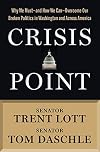
This seems like a timely read with with the way politics are currently and as broken as Washington is. This book is written by two former Senators and was published in 2016. It is even more relevant in today's political environment. Lott and Daschle spend the first part of the book talking about history and how our Congress came to be so dysfunctional. They talk about how it used to work and bipartisan bills would pass. Government is not meant to agree, but they are meant to compromise. show more Something I think our current Congress members have forgotten. Lott and Daschle have some bipartisan solutions to the issues too.
A national primary day, all states vote in primaries on the same day, or regional primaries if not a single.
Change voting day from Tuesday to the weekend.
Develop an electronic voting system.
Limit campaign length, fixed starting point a few months out from the election.
Limit leadership PACs to the top 3 leaders on each side.
Transparency in super PAC donations
5 day work week in Congress
Have senate and house in same schedule, 3 weeks on, 1 week off
Senators limited to serving on 1 major and 1 minor committee
Bills posted a minimum of 3 days in advance of vote
Return to the requirement that a Senator hold the floor in person to filibuster
Abolish dual tracking
Require a member to come to the floor to announce a hold
Require a year of national service (military, civilian, or volunteer through nonprofits or religious institutions) when between ages 18-28.
Student debt forgiveness for national service as an incentive.
Reimplement mandatory civics classes in high schools.
Private sector provide for service-sabbatical opportunities.
All of those ideas seem reasonable and good starting points to make our government function again. They end the book with the following, “It is not only within our power to change things, it is our duty: we must work and fight for it.†It is not out government official alone who have to change the way they function, it is our duty as citizens to advocate and ask, and yes even sacrifice our personal wants, to evoke change that is best for out country instead of just for ourselves.
*Opinions expressed are solely my own and do not express the views or opinions of the US Government. None of the ideas expressed in this blog post are shared, supported, or endorsed in any manner by my employer.
For additional reviews please see my blog at www.adventuresofabibliophile.blogspot.com show less
A national primary day, all states vote in primaries on the same day, or regional primaries if not a single.
Change voting day from Tuesday to the weekend.
Develop an electronic voting system.
Limit campaign length, fixed starting point a few months out from the election.
Limit leadership PACs to the top 3 leaders on each side.
Transparency in super PAC donations
5 day work week in Congress
Have senate and house in same schedule, 3 weeks on, 1 week off
Senators limited to serving on 1 major and 1 minor committee
Bills posted a minimum of 3 days in advance of vote
Return to the requirement that a Senator hold the floor in person to filibuster
Abolish dual tracking
Require a member to come to the floor to announce a hold
Require a year of national service (military, civilian, or volunteer through nonprofits or religious institutions) when between ages 18-28.
Student debt forgiveness for national service as an incentive.
Reimplement mandatory civics classes in high schools.
Private sector provide for service-sabbatical opportunities.
All of those ideas seem reasonable and good starting points to make our government function again. They end the book with the following, “It is not only within our power to change things, it is our duty: we must work and fight for it.†It is not out government official alone who have to change the way they function, it is our duty as citizens to advocate and ask, and yes even sacrifice our personal wants, to evoke change that is best for out country instead of just for ourselves.
*Opinions expressed are solely my own and do not express the views or opinions of the US Government. None of the ideas expressed in this blog post are shared, supported, or endorsed in any manner by my employer.
For additional reviews please see my blog at www.adventuresofabibliophile.blogspot.com show less
It's difficult for me to be objective about this issue.
It is not difficult for me to be pessimistic about this issue.
I truly get the feeling that the people who realize just how complicated this issue is are exceedingly rare. And this is what leads to my pessimism.
And yet, I don't question in the least that the system is broken. In fact, I often can be heard telling people just that.
And perhaps it'll take someone or some ones willfully ignoring the depth of the complexity of the situation to show more fashion a workable solution. Because, god knows, it certainly seems an insurmountable problem to most who pay attention to the details.
With his thin book, Daschle can't be accused of getting mired down in details. It is a superficial look at the problem. The anecdotes he trots out to illustrate his points are compelling on the surface but frustrating in their omissions. Omissions which are not obvious to most but will strike those who work in the industry.
Daschle's basic idea is that a board akin to the Federal Reserve Board should be set up to manage health care decisions, just as the Fed manages interest rate decisions. Given the current financial crisis, the suggestion that anything should be modeled after the Fed is a bit unfortunate. And yet, the reasoning behind his approach seems sound. A board of qualified individuals in position to make difficult and painful decisions, insulated from political pressures but with transparency so there is trust and buy-in.
It does seem utopian. I don't much trust utopian . . .
It's a scary time to be in the industry and to be trying to make decisions with long-term repercussions when the premises upon which those decisions must be based have their foundations in shifting sand.
I'm just going to hang on tight for a wild ride. show less
It is not difficult for me to be pessimistic about this issue.
I truly get the feeling that the people who realize just how complicated this issue is are exceedingly rare. And this is what leads to my pessimism.
And yet, I don't question in the least that the system is broken. In fact, I often can be heard telling people just that.
And perhaps it'll take someone or some ones willfully ignoring the depth of the complexity of the situation to show more fashion a workable solution. Because, god knows, it certainly seems an insurmountable problem to most who pay attention to the details.
With his thin book, Daschle can't be accused of getting mired down in details. It is a superficial look at the problem. The anecdotes he trots out to illustrate his points are compelling on the surface but frustrating in their omissions. Omissions which are not obvious to most but will strike those who work in the industry.
Daschle's basic idea is that a board akin to the Federal Reserve Board should be set up to manage health care decisions, just as the Fed manages interest rate decisions. Given the current financial crisis, the suggestion that anything should be modeled after the Fed is a bit unfortunate. And yet, the reasoning behind his approach seems sound. A board of qualified individuals in position to make difficult and painful decisions, insulated from political pressures but with transparency so there is trust and buy-in.
It does seem utopian. I don't much trust utopian . . .
It's a scary time to be in the industry and to be trying to make decisions with long-term repercussions when the premises upon which those decisions must be based have their foundations in shifting sand.
I'm just going to hang on tight for a wild ride. show less
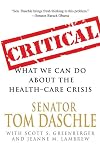
In reading Sen. Tom Daschle's book Critical on our health care system and his high level proposal for health care reform, I found some interesting concepts and quotes to pass on. Critical was published in 2008, by Daschle, a nominee to head Health and Human Services, and a long time advocate for universal health care.
First, Daschle outlines the history of health care in this country, from President Truman's time to the present. When discussing the 1993 attempt by the Clinton administration, show more he cites studies that showed that when told major features of the bill, 76% of people said it had "great appeal" or "some appeal". But when told it was Clinton's proposal, that number dropped to just over 50%.This is interesting, and a way that all of us should consider our political opinions. How much do we disagree with the concept, vs. the presenter of it?
"Neglect is perhaps even more damaging". This after Daschle gives case after case of the cost of health care skyrocketing and death of patients, when they ignore things and often endure great pain and hardship, because the cost is too high.
His central premise, is that Congress does not have the professional technical expertise to handle health care. In similar situations, they have handed it off to an independent body. Daschle's major proposal is to set up a Health Advisory Board, similar to the Federal Reserve Board. This Board would be nonpartisan, insulated from political pressure. It would be set up similar to the Fed, in that there would be a board of governors consisting of economic experts, technical experts, clinicians, researchers, etc, who have the expertise to make decisions. There would also be regional boards and staff of analysts.
This probably sounds like "just another government agency", but when you read the depth of Daschle's book-- and the history of the Federal Reserve Board--it makes much sense. Congress is too beholden to political pressures and special interests, to be able to make nonbiased opinions--much less laws-- about health care. They also do not have the technical expertise.
Daschle believes in universal coverage, but also believes that there are many out of control costs. He makes a strong case for how we don't use technology to our advantage. At the time of his writing, 5% of doctors offices use electronic charts, electronic prescriptions (hence reducing drug interaction issues), tranmission of electronic lab results, etc. He estimates the cost at $76 billion/year, in our $1.23 trillion/year system. Hardly earth shattering, but not chump change, either.
He also discusses how health care has become increasingly high tech-- but it is not always needed. We use very expensive diagnostic tests, when often the older equipment is just as good. This is an example of where he wants the Board to weigh in on what would be paid for. If a newer technology is not necessarily better, just newer and being pushed, then payment for the test would not be mandatory.
On a related note, doctors often do not keep up with the latest studies. They are getting their information from the salespeople who have a vested interest. Other countries have governmental agencies which provide information on new technologies. Daschle also suggests that clinical trials should not just include efficacy testing, but testing to determine which treatment is better. show less
First, Daschle outlines the history of health care in this country, from President Truman's time to the present. When discussing the 1993 attempt by the Clinton administration, show more he cites studies that showed that when told major features of the bill, 76% of people said it had "great appeal" or "some appeal". But when told it was Clinton's proposal, that number dropped to just over 50%.This is interesting, and a way that all of us should consider our political opinions. How much do we disagree with the concept, vs. the presenter of it?
"Neglect is perhaps even more damaging". This after Daschle gives case after case of the cost of health care skyrocketing and death of patients, when they ignore things and often endure great pain and hardship, because the cost is too high.
His central premise, is that Congress does not have the professional technical expertise to handle health care. In similar situations, they have handed it off to an independent body. Daschle's major proposal is to set up a Health Advisory Board, similar to the Federal Reserve Board. This Board would be nonpartisan, insulated from political pressure. It would be set up similar to the Fed, in that there would be a board of governors consisting of economic experts, technical experts, clinicians, researchers, etc, who have the expertise to make decisions. There would also be regional boards and staff of analysts.
This probably sounds like "just another government agency", but when you read the depth of Daschle's book-- and the history of the Federal Reserve Board--it makes much sense. Congress is too beholden to political pressures and special interests, to be able to make nonbiased opinions--much less laws-- about health care. They also do not have the technical expertise.
Daschle believes in universal coverage, but also believes that there are many out of control costs. He makes a strong case for how we don't use technology to our advantage. At the time of his writing, 5% of doctors offices use electronic charts, electronic prescriptions (hence reducing drug interaction issues), tranmission of electronic lab results, etc. He estimates the cost at $76 billion/year, in our $1.23 trillion/year system. Hardly earth shattering, but not chump change, either.
He also discusses how health care has become increasingly high tech-- but it is not always needed. We use very expensive diagnostic tests, when often the older equipment is just as good. This is an example of where he wants the Board to weigh in on what would be paid for. If a newer technology is not necessarily better, just newer and being pushed, then payment for the test would not be mandatory.
On a related note, doctors often do not keep up with the latest studies. They are getting their information from the salespeople who have a vested interest. Other countries have governmental agencies which provide information on new technologies. Daschle also suggests that clinical trials should not just include efficacy testing, but testing to determine which treatment is better. show less
Since Daschle is the newly appointed Secretary of DHHS, a reading of his recently published book is a must for any healthcare professional. Daschle gives a nice summary of failed efforts to date (you just need to set aside some mild partisan hackery that Democrats are the only good guys and competent people in this fight and how Daschle can "reach across the aisle" to Republicans interested in this topic). His overall plan, a combination of creating a Federal Health Board (similar to the show more creation of the Federal Reserve Board for monitary policy) as well as advocating for individual responsibility to carry health insurance, is unique but modeled after other countries as well as building on programs in Massachussets and California.
Daschle's book is a short and pleasant read and, given that he is the new leader, an essential one. show less
Daschle's book is a short and pleasant read and, given that he is the new leader, an essential one. show less
You May Also Like


Associated Authors
Statistics
- Works
- 5
- Members
- 254
- Popularity
- #90,186
- Rating
- 3.2
- Reviews
- 7
- ISBNs
- 18