
About the Author
The author of five books in English and two in Japanese. Through his reporting for The Washington Post, his syndicated weekly column, and his lighthearted commentary from around the world for National Public Radio, he has become one of America's best-known foreign correspondents. Reid lives in show more London. (Publisher Provided) show less
Works by T. R. Reid
The Healing of America: A Global Quest for Better, Cheaper, and Fairer Health Care (2009) 730 copies, 21 reviews
The United States of Europe: The New Superpower and the End of American Supremacy (2004) 491 copies, 6 reviews
Confucius Lives Next Door: What Living in the East Teaches Us About Living in the West (1999) 325 copies, 8 reviews
The Chip : How Two Americans Invented the Microchip and Launched a Revolution (1985) 267 copies, 6 reviews
A Fine Mess: A Global Quest for a Simpler, Fairer, and More Efficient Tax System (2017) 127 copies, 3 reviews
The Great Tokyo Fish Market 2 copies
Cafeína la droga perfecta 1 copy
Stopped Getting Ripped Off 1 copy
Kobe Wakes to a Nightmare 1 copy
Associated Works
National Geographic Magazine 2005 v207 #1 January (2005) — Author, some editions — 28 copies, 1 review
Tagged
Common Knowledge
- Canonical name
- Reid, T. R.
- Legal name
- Reid, Thomas Roy
- Birthdate
- 20th Century
- Gender
- male
- Education
- Princeton University
- Occupations
- journalist
naval officer
author
documentary film correspondent - Organizations
- The Washington Post
- Nationality
- USA
- Places of residence
- Denver, Colorado, USA
- Associated Place (for map)
- Colorado, USA
Members
Reviews
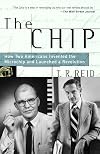
The Chip is a humanistic look at one of the key inventions of the 20th century, the microchip which undergirds every digital change to our life. Thanks to chips, "just put a computer in it" has been a solution to almost every engineering problem, and the cause of a similar number of engineering problems.
In the 1950s, the electronics industry was carrying a blade with no handle. The silicon transistor had opened up vast possibilities by replacing large, power-hungry, and unreliable vacuum show more tubes. But the new solid state circuits were still built the same way, by wiring together discrete components like resistors, capacitors, and transistors, and the labor cost of hand wiring all these components was stalling future growth. Worse, as the complexity of circuits increased, their reliability went way down, a fatal flaw for aerospace and military applications.
Kilby at Texas Instruments and Noyce at Fairchild Semiconductor hit on the key idea at roughly the same time. If you could lay down resistors, capacitors, and wires inside silicon, you could make a circuit as a monolithic unit. Kilby was first by several months, but Noyce figured out how to get the leads between the chip and world laid down, which is a very important step. Doing everything in silicon is counter-intuitive, by raw materials it's comparable to building a boxcar out of solid gold, but the advantage in not having to wire together components is incredible. Cue the digital revolution that we know, though from the perspective of decades on the revolution was slower than we remember. The first few years of production went entirely to the military. The consumer product which blew the world open was the pocket calculator, which came out in 1971, 15 years after the invention of the chip.
Reid follows the rise of Japanese firms in high tech, as well as the divergent careers of Noyce and Kilby. Noyce went on to become the patriarch of Silicon Valley and a billionaire investor. Kilby kept inventing, though never with the same success. He was finally awarded the Nobel Prize in 2000, but neither of the two are household names despite their impact as inventors.
Reid also makes some odd choices in the technical explanations. There's a lot on Boolean algebra and binary logic, which is key to how chips work, and precisely nothing on photolithography, which is key to how they're made. This is an older book, which is beneficial because there's nothing like interviews with your subjects to get the right feeling across, and Noyce and Kilby are no longer available for interviews. show less
In the 1950s, the electronics industry was carrying a blade with no handle. The silicon transistor had opened up vast possibilities by replacing large, power-hungry, and unreliable vacuum show more tubes. But the new solid state circuits were still built the same way, by wiring together discrete components like resistors, capacitors, and transistors, and the labor cost of hand wiring all these components was stalling future growth. Worse, as the complexity of circuits increased, their reliability went way down, a fatal flaw for aerospace and military applications.
Kilby at Texas Instruments and Noyce at Fairchild Semiconductor hit on the key idea at roughly the same time. If you could lay down resistors, capacitors, and wires inside silicon, you could make a circuit as a monolithic unit. Kilby was first by several months, but Noyce figured out how to get the leads between the chip and world laid down, which is a very important step. Doing everything in silicon is counter-intuitive, by raw materials it's comparable to building a boxcar out of solid gold, but the advantage in not having to wire together components is incredible. Cue the digital revolution that we know, though from the perspective of decades on the revolution was slower than we remember. The first few years of production went entirely to the military. The consumer product which blew the world open was the pocket calculator, which came out in 1971, 15 years after the invention of the chip.
Reid follows the rise of Japanese firms in high tech, as well as the divergent careers of Noyce and Kilby. Noyce went on to become the patriarch of Silicon Valley and a billionaire investor. Kilby kept inventing, though never with the same success. He was finally awarded the Nobel Prize in 2000, but neither of the two are household names despite their impact as inventors.
Reid also makes some odd choices in the technical explanations. There's a lot on Boolean algebra and binary logic, which is key to how chips work, and precisely nothing on photolithography, which is key to how they're made. This is an older book, which is beneficial because there's nothing like interviews with your subjects to get the right feeling across, and Noyce and Kilby are no longer available for interviews. show less

I mostly sat out the Great Health Care Debate of '09, largely because, as Reid's book points out, American conversations about health care seem to focus on ideologically charged technicalities, not societal values. For folks like me, who read the paper but still can't get their heads around the issues surrounding national health care policy, "The Healing of America" is a pretty good place to start. Reid's book has a fine hook – he takes the same physical problem to doctors in a variety of show more countries – and the author writes entertainingly about a subject that can sometimes get pretty dry. Reid does a good job of showing national character traits and value systems influence how each of the countries he visits handles health care, and some of his experiences, such as the week he spent in an Ayurvedic spa in India, are even pretty interesting from an anthropological perspective.
In the end, Reid's book isn't about the healing of America; it's about how sick America is, and why. He doesn't propose any specific solution to America's health care mess, but instead hammers home the point that America does health care less efficiently and effectively than just about every other nation in its weight class.Capitalism is an essential part of the American experience, but when it comes to health care, the free market seems to deliver goods more expensively and less efficiently than many supposedly socialist systems do. To his credit, Reid knows that he's writing for an American audience and works to show how health care seems to run against the grain of American assumptions about how everything works. Still, this book might reach across partisan lines, since the rancor and indignation that colored so much of the health care debate a couple of years ago are absent here. What's missing from it, perhaps, is an insurance-free trip through America's own dysfunctional health care system. It might have provided a useful, if saddening, point of comparison to the author's generally satisfactory experiences elsewhere. show less
In the end, Reid's book isn't about the healing of America; it's about how sick America is, and why. He doesn't propose any specific solution to America's health care mess, but instead hammers home the point that America does health care less efficiently and effectively than just about every other nation in its weight class.Capitalism is an essential part of the American experience, but when it comes to health care, the free market seems to deliver goods more expensively and less efficiently than many supposedly socialist systems do. To his credit, Reid knows that he's writing for an American audience and works to show how health care seems to run against the grain of American assumptions about how everything works. Still, this book might reach across partisan lines, since the rancor and indignation that colored so much of the health care debate a couple of years ago are absent here. What's missing from it, perhaps, is an insurance-free trip through America's own dysfunctional health care system. It might have provided a useful, if saddening, point of comparison to the author's generally satisfactory experiences elsewhere. show less

Technophobes might as well move on to the next review. I loved this book. It explained in clear, precise language how innumerable barriers were overcome by innovative and insightfully brilliant individuals to create a device that revolutionized our lives. I've always been fascinated by electronics, built my own radios and earned an amateur radio license in 7th grade, just because the subject and theory of how electrons move around to perform useful functions is intriguing. Reid has captured show more much of that fascination and translated it into a great story.
Before integrated circuits could be produced, the transistor had to be invented. Before that time, switching mechanism, required a vacuum tube to control, amplify and switch the flow of electrons through a circuit. It was the discovery that some semiconductor materials could be doped to have an excess of positive charges or negative charges that provided the breakthrough. A strip of germanium could be doped at each end with differing charges leaving a junction in the middle. The junction worked like a turnstile that could control the flow of current when connected to a battery. Variations in current across these junctions connected in the transistor formation could rectify (prevent current from flowing in both directions) and amplify. That's all that's needed to make a radio (I'm oversimplifying obviously) and hundreds of other devices. Transistors required vastly less current than vacuum tubes, were almost infinitely stable, were cheap and gave off little heat.
But, transistors required thousands of connections to the wires coming in order to make a useful circuit, and as demands for more complex circuitry arose the wiring became infinitely complex. This interconnection problem became a huge barrier that could have prevented the effective utilization of the advantages of the transistor
"You read everything. . . You accumulate all this trivia, and you hope that someday maybe a millionth of it will be useful," remembers Jack Kilby, one of the inventors of the integrated circuit. He also insists that he is not a scientist but an engineer. "A scientist is motivated by knowledge; he basically wants to explain something. An engineer's drive is to solve problems, to make something work. . . . Reid has elegantly interwoven the biographies of Jack Kilby and Robert Noyce. One of the delights of the book was learning how the two inventors thought, how they proceeded, and why they went in the directions they did.
Robert Noyce, founder of Intel, had developed a process to make transistors in arrays on a silicon wafer. They cut apart the transistors and then hired "thousands of women with tweezers to pick them up and try to wire them together. It just seemed so stupid." He, too, realized the tyranny of interconnection numbers. What they both came up with was the "Monolithic Idea." The notion that an entire circuit could be designed and produced on those silicon chips.
Obviously, there is little suspense in the story, but Reid captures and holds our attention. Both men accomplished the same feat at about the same time, approaching it from different directions. Kilby showed how the transistors could be placed on a single wafer and Noyce showed how the chips and circuits could be manufactured. Every transistor radio used the patent Kilby was awarded for his work. In so doing, he turned the future that Orwell had predicted in 1984 on its head. Instead of a monolithic centralization of power in the hands of a few computer elite who controlled all the computing power, "the mass distribution of microelectronics had spawned a massive decentralization of computing power. In the real 1984, millions of ordinary people could match the governmental or corporate computer bit for bit. In the real 1984, the stereotypical computer user had become a Little Brother seated at the keyboard to write his seventh-grade science report."
The social impact was enormous. Slide rules that had been ubiquitous were completely eliminated in just a few years by the handheld calculator that has become so cheap it is often given away in promotions. The Japanese gained virtual control over the memory chip industry because of the way they handled their work force. Americans had a monopoly until the 1973 recession. American companies typically lay off workers to save money during downturns. The Japanese try to keep their work force employed. This meant that when the demand for chips exploded, Americans did not have the capacity to produce enough to meet the demand. The Japanese, having trained workers available, met that demand and were able to produce enough at such a volume to keep the price so low as to inhibit any competition. That and their emphasis on high quality gained them 42% of the world market by 1980. The "Anderson Bombshell" report of 1980 (Anderson was a manager at Hewlett-Packard) that showed that Japanese chips were far more reliable than those made in the United States helped seal their market share.
It took winning the Nobel Prize for Noyce and Kilby to be recognized in the United States (Japan, a nation that honors its engineers, had awarded Noyce and Kilby numerous accolades over the years.) The final irony remains that in "our media-soaked society, with its insatiable appetite for important, or at least interesting, personalities, has somehow managed to overlook a pair of genuine national heroes- two Americans who had a good idea that has improved the daily lot of the world." show less
Before integrated circuits could be produced, the transistor had to be invented. Before that time, switching mechanism, required a vacuum tube to control, amplify and switch the flow of electrons through a circuit. It was the discovery that some semiconductor materials could be doped to have an excess of positive charges or negative charges that provided the breakthrough. A strip of germanium could be doped at each end with differing charges leaving a junction in the middle. The junction worked like a turnstile that could control the flow of current when connected to a battery. Variations in current across these junctions connected in the transistor formation could rectify (prevent current from flowing in both directions) and amplify. That's all that's needed to make a radio (I'm oversimplifying obviously) and hundreds of other devices. Transistors required vastly less current than vacuum tubes, were almost infinitely stable, were cheap and gave off little heat.
But, transistors required thousands of connections to the wires coming in order to make a useful circuit, and as demands for more complex circuitry arose the wiring became infinitely complex. This interconnection problem became a huge barrier that could have prevented the effective utilization of the advantages of the transistor
"You read everything. . . You accumulate all this trivia, and you hope that someday maybe a millionth of it will be useful," remembers Jack Kilby, one of the inventors of the integrated circuit. He also insists that he is not a scientist but an engineer. "A scientist is motivated by knowledge; he basically wants to explain something. An engineer's drive is to solve problems, to make something work. . . . Reid has elegantly interwoven the biographies of Jack Kilby and Robert Noyce. One of the delights of the book was learning how the two inventors thought, how they proceeded, and why they went in the directions they did.
Robert Noyce, founder of Intel, had developed a process to make transistors in arrays on a silicon wafer. They cut apart the transistors and then hired "thousands of women with tweezers to pick them up and try to wire them together. It just seemed so stupid." He, too, realized the tyranny of interconnection numbers. What they both came up with was the "Monolithic Idea." The notion that an entire circuit could be designed and produced on those silicon chips.
Obviously, there is little suspense in the story, but Reid captures and holds our attention. Both men accomplished the same feat at about the same time, approaching it from different directions. Kilby showed how the transistors could be placed on a single wafer and Noyce showed how the chips and circuits could be manufactured. Every transistor radio used the patent Kilby was awarded for his work. In so doing, he turned the future that Orwell had predicted in 1984 on its head. Instead of a monolithic centralization of power in the hands of a few computer elite who controlled all the computing power, "the mass distribution of microelectronics had spawned a massive decentralization of computing power. In the real 1984, millions of ordinary people could match the governmental or corporate computer bit for bit. In the real 1984, the stereotypical computer user had become a Little Brother seated at the keyboard to write his seventh-grade science report."
The social impact was enormous. Slide rules that had been ubiquitous were completely eliminated in just a few years by the handheld calculator that has become so cheap it is often given away in promotions. The Japanese gained virtual control over the memory chip industry because of the way they handled their work force. Americans had a monopoly until the 1973 recession. American companies typically lay off workers to save money during downturns. The Japanese try to keep their work force employed. This meant that when the demand for chips exploded, Americans did not have the capacity to produce enough to meet the demand. The Japanese, having trained workers available, met that demand and were able to produce enough at such a volume to keep the price so low as to inhibit any competition. That and their emphasis on high quality gained them 42% of the world market by 1980. The "Anderson Bombshell" report of 1980 (Anderson was a manager at Hewlett-Packard) that showed that Japanese chips were far more reliable than those made in the United States helped seal their market share.
It took winning the Nobel Prize for Noyce and Kilby to be recognized in the United States (Japan, a nation that honors its engineers, had awarded Noyce and Kilby numerous accolades over the years.) The final irony remains that in "our media-soaked society, with its insatiable appetite for important, or at least interesting, personalities, has somehow managed to overlook a pair of genuine national heroes- two Americans who had a good idea that has improved the daily lot of the world." show less

"On September 11, 2001, some three thousand Americans were killed by terrorists; our country has spent hundreds of billions of dollars to make sure it doesn’t happen again. But that same year, and every year since then, some twenty thousand Americans died because they couldn’t get health care. That doesn’t happen in any other developed country. Hundreds of thousands of Americans go bankrupt every year because of medical bills. That doesn’t happen in any other developed country show more either."
This is probably a book everyone should read. It's a dispassionate look at health care systems throughout the world as Reid travels from one country to another to see how his shoulder would be treated and under what circumstances. To start a couple of basic facts: "most rich countries have better national health statistics—longer life expectancy, lower infant mortality, better recovery rates from major diseases—than the United States does.Yet all the other rich countries spend far less on health care than the United States does. . . .Among the world’s developed nations, the United States stands at or near the bottom in most important rankings of access to and quality of medical care. The Japanese go to the doctor more often than anyone else, yet their system costs only $3,400 per person; in the United States the cost is $7,400 per person annually. In Canada, the nation has decided that to be the most fair, people should have to wait equally. In Britain, the priority is that all health care should be free to everyone.
He begins by identifying the four basic types of mechanisms to pay for health care in the industrialized world. (He discounts the third world since those are all basically pay-as-you-go and available only to the rich.) Conventional wisdom tells us that these other countries depend on "socialized" medicine, yet that is incorrect. Ironically the only pure socialized medical systems exists in Cuba and the United States' VA system which is totally government funded, doctors are paid and employed by the government and veterans pay nothing for its services. Other countries are all a mix of private and public. How they are structured is related to the country's moral fabric.
The four systems are the Bismarck (a mix of public and private as in Japan, Germany, and Switzerland); in the Beveridge model there are no medical bills; rather, medical treatment is a public service, like the fire department or the public library, hospitals and clinics are often owned by the government; some doctors are government employees, but there are also private doctors who collect their fees from the government. These systems tend to have low costs per capita, because the government, as the sole payer, controls what doctors can do and what they can charge. The British system is based on the Beveridge model. Canada's system is the third type, a national insurance plan which has elements of both Bismarck and Beveridge. The providers of health care are private, but the payer is a government-run insurance program that every citizen pays into. The last system is the pay-as-you-go in which there is no insurance and people pay for service out of their own pockets.
The United States has a mix of all. For those under sixty-five is a modified Bismarckian system for those lucky enough to be employed and have an employer-based system. Those over sixty-five have Medicare more similar to the Canadian system, and for many there is only the pay-as-you-go although most municipalities will not refuse treatment for emergencies which simply means the cost is allocated elsewhere, i.e. everyone else. One of the features of the so-called ObamaCare was to eliminate free-loading and have everyone, or most everyone pay for some form of health insurance. For Native Americans, military personnel, and veterans, we’re Britain, or Cuba. "And yet we’re like no other country, because the United States maintains so many separate systems for separate classes of people, and because it relies so heavily on for-profit private insurance plans to pay the bills. All the other countries have settled on one model for everybody, on the theory that this is simpler, cheaper, and fairer. With its fragmented array of providers and payers and overlapping systems, the U.S. health care system doesn’t fit into any of the recognized models."
A common complaint leveled against government health care programs is they ration, yet all systems ration. In this country it's done by insurance companies, in others it's done by ethical committees. Here, the decisions are applied inequality and depend on one's plan (and the quality of one's lawyer.) "made, often in secret, by scores of different insurance companies. One person may get coverage for a potentially life-saving operation, while the next person doesn’t. This may be a boon to the person with the more generous insurance policy, but it’s not particularly fair." Some form of rationing *must* be done in order to reduce costs. "Should the system spend its money to keep a ninety-five-year-old Alzheimer’s patient alive until he’s ninety-six? Should an ailing eighty-four-year-old get the same intensive treatment for breast cancer that is provided to an otherwise healthy forty-four-year-old? Should the health system, or the insurance plan, pay for Viagra? For Botox? In a health care system that offers universal coverage, these decisions tend to be made uniformly for everybody."
The U.S. spends the most on administrative costs and a system that organized everyone into one plan would clearly cut costs. Ironically, the charge that one system would reduce choice is not true. Other countries, in fact, offer patients more choice. Insurance plans in this country have discourage choice by building preferred networks. In most other countries patients can go wherever they want and see whomever they want since the structure for payment is the same throughout the country.
All countries are faced with rising health care costs and all face complaints about their systems. The grass is always greener.... The one constant is complaining. "The American economist Tsung-Mei Cheng has formulated, with tongue only partly in cheek, the Universal Laws of Health Care Systems: 1. “No matter how good the health care in a particular country, people will complain about it.” 2. “No matter how much money is spent on health care, the doctors and hospitals will argue that it is not enough.” 3. “The last reform always failed.”3 Everywhere I went on my global quest, I found that Cheng’s Universal Laws held true. But for all their problems, the other industrialized countries tend to do better than the United States on basic measures of health system performance: coverage, quality, cost control, choice. This was the most surprising and infuriating discovery of my global quest—that the United States of America performs so poorly in this fundamental area of human life. In industry, finance, music, science, arts, academics, athletics,Americans can match or surpass any other country. Why can’t we do that when it comes to health care?"
Read the book for part of the answer. Fascinating, yet ultimately quite depressing. show less
This is probably a book everyone should read. It's a dispassionate look at health care systems throughout the world as Reid travels from one country to another to see how his shoulder would be treated and under what circumstances. To start a couple of basic facts: "most rich countries have better national health statistics—longer life expectancy, lower infant mortality, better recovery rates from major diseases—than the United States does.Yet all the other rich countries spend far less on health care than the United States does. . . .Among the world’s developed nations, the United States stands at or near the bottom in most important rankings of access to and quality of medical care. The Japanese go to the doctor more often than anyone else, yet their system costs only $3,400 per person; in the United States the cost is $7,400 per person annually. In Canada, the nation has decided that to be the most fair, people should have to wait equally. In Britain, the priority is that all health care should be free to everyone.
He begins by identifying the four basic types of mechanisms to pay for health care in the industrialized world. (He discounts the third world since those are all basically pay-as-you-go and available only to the rich.) Conventional wisdom tells us that these other countries depend on "socialized" medicine, yet that is incorrect. Ironically the only pure socialized medical systems exists in Cuba and the United States' VA system which is totally government funded, doctors are paid and employed by the government and veterans pay nothing for its services. Other countries are all a mix of private and public. How they are structured is related to the country's moral fabric.
The four systems are the Bismarck (a mix of public and private as in Japan, Germany, and Switzerland); in the Beveridge model there are no medical bills; rather, medical treatment is a public service, like the fire department or the public library, hospitals and clinics are often owned by the government; some doctors are government employees, but there are also private doctors who collect their fees from the government. These systems tend to have low costs per capita, because the government, as the sole payer, controls what doctors can do and what they can charge. The British system is based on the Beveridge model. Canada's system is the third type, a national insurance plan which has elements of both Bismarck and Beveridge. The providers of health care are private, but the payer is a government-run insurance program that every citizen pays into. The last system is the pay-as-you-go in which there is no insurance and people pay for service out of their own pockets.
The United States has a mix of all. For those under sixty-five is a modified Bismarckian system for those lucky enough to be employed and have an employer-based system. Those over sixty-five have Medicare more similar to the Canadian system, and for many there is only the pay-as-you-go although most municipalities will not refuse treatment for emergencies which simply means the cost is allocated elsewhere, i.e. everyone else. One of the features of the so-called ObamaCare was to eliminate free-loading and have everyone, or most everyone pay for some form of health insurance. For Native Americans, military personnel, and veterans, we’re Britain, or Cuba. "And yet we’re like no other country, because the United States maintains so many separate systems for separate classes of people, and because it relies so heavily on for-profit private insurance plans to pay the bills. All the other countries have settled on one model for everybody, on the theory that this is simpler, cheaper, and fairer. With its fragmented array of providers and payers and overlapping systems, the U.S. health care system doesn’t fit into any of the recognized models."
A common complaint leveled against government health care programs is they ration, yet all systems ration. In this country it's done by insurance companies, in others it's done by ethical committees. Here, the decisions are applied inequality and depend on one's plan (and the quality of one's lawyer.) "made, often in secret, by scores of different insurance companies. One person may get coverage for a potentially life-saving operation, while the next person doesn’t. This may be a boon to the person with the more generous insurance policy, but it’s not particularly fair." Some form of rationing *must* be done in order to reduce costs. "Should the system spend its money to keep a ninety-five-year-old Alzheimer’s patient alive until he’s ninety-six? Should an ailing eighty-four-year-old get the same intensive treatment for breast cancer that is provided to an otherwise healthy forty-four-year-old? Should the health system, or the insurance plan, pay for Viagra? For Botox? In a health care system that offers universal coverage, these decisions tend to be made uniformly for everybody."
The U.S. spends the most on administrative costs and a system that organized everyone into one plan would clearly cut costs. Ironically, the charge that one system would reduce choice is not true. Other countries, in fact, offer patients more choice. Insurance plans in this country have discourage choice by building preferred networks. In most other countries patients can go wherever they want and see whomever they want since the structure for payment is the same throughout the country.
All countries are faced with rising health care costs and all face complaints about their systems. The grass is always greener.... The one constant is complaining. "The American economist Tsung-Mei Cheng has formulated, with tongue only partly in cheek, the Universal Laws of Health Care Systems: 1. “No matter how good the health care in a particular country, people will complain about it.” 2. “No matter how much money is spent on health care, the doctors and hospitals will argue that it is not enough.” 3. “The last reform always failed.”3 Everywhere I went on my global quest, I found that Cheng’s Universal Laws held true. But for all their problems, the other industrialized countries tend to do better than the United States on basic measures of health system performance: coverage, quality, cost control, choice. This was the most surprising and infuriating discovery of my global quest—that the United States of America performs so poorly in this fundamental area of human life. In industry, finance, music, science, arts, academics, athletics,Americans can match or surpass any other country. Why can’t we do that when it comes to health care?"
Read the book for part of the answer. Fascinating, yet ultimately quite depressing. show less
Lists
Awards


You May Also Like


Associated Authors
Statistics
- Works
- 13
- Also by
- 3
- Members
- 1,980
- Popularity
- #12,984
- Rating
- 4.0
- Reviews
- 45
- ISBNs
- 38
- Languages
- 1