
Steven Brill (1) (1950–)
Author of America's Bitter Pill: Money, Politics, Backroom Deals, and the Fight to Fix Our Broken Healthcare System
For other authors named Steven Brill, see the disambiguation page.
About the Author
Steven Brill is a graduate of Yale College and Yale Law School. He founded and ran Court TV, The American Lawyer magazine, and Brill's Content magazine. His articles have appeared in The New Yorker, Time, and The New York Times Magazine. He won the 2014 National Magazine Award for Public Service show more for Time's March 4, 2013, Special Report "Bitter Pill: Why Medical Bills Are Killing Us." He has written several books including The Teamsters, Class Warfare: Inside the Fight to Fix America's Schools, and America's Bitter Pill: Money, Politics, Backroom Deals, and the Fight to Fix Our Broken Healthcare System. (Bowker Author Biography) show less
Works by Steven Brill
America's Bitter Pill: Money, Politics, Backroom Deals, and the Fight to Fix Our Broken Healthcare System (2015) 276 copies, 8 reviews
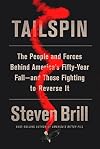
Tailspin: The People and Forces Behind America's Fifty-Year Fall--and Those Fighting to Reverse It (2018) 157 copies, 6 reviews
Associated Works
The Book That Changed My Life: 71 Remarkable Writers Celebrate the Books That Matter Most to Them (2006) — Contributor — 411 copies, 18 reviews
Tagged
Common Knowledge
- Birthdate
- 1950-08-22
- Gender
- male
- Education
- Yale University
- Occupations
- journalist
- Organizations
- The American Lawyer
CourtTV
Brill's Content
Newsweek - Nationality
- USA
- Places of residence
- New York, New York, USA
- Associated Place (for map)
- New York, USA
Members
Reviews
Tailspin: The People and Forces Behind America's Fifty-Year Fall–and Those Fighting to Reverse It by Steven Brill
Why We’re in the Fix We Are
If you’ve been paying attention for the past few years, what Steven Brill tells you in his often times infuriating new book Tailspin will not surprise you. There’s a tremendous and still expanding disparity between the haves and the have-nots. The haves control the levers of government and they work actively to reduce government, because, frankly, government can do little for them; from their viewpoint, it mostly hinders them. The have-nots control nothing. show more They really don’t understand how government and business work. They especially don’t grasp how good government benefits them, and, amazing to many, they support the goals of the haves in their effort to shutdown government.
As a result, the country feels like it’s going to hell in a hand basket, what with crumbling infrastructure, skyrocketing medical costs, lack of meaningful work for many, shortage of affordable housing, spreading poverty, and the like. What Brill shows you is how after the 1960s we began spiraling downward, how almost unnoticed changes contributed, what good intentions morphed into, and how some, a handful, work now to pull us out of our spin. If the book has a weakness, it’s this last part, ways that we can level off, and climb, once again regaining our lofty status as a country that prospers by helping the least of us succeed. Unfortunately, as Brill presents it, the space he gives it, it really seems meager, particularly viewed against the entrenched powers.
Brill begins back in the early 1970s when a few forward thinking universities, among them Yale, actively endeavored to break the American old family network by developing outreach programs designed to accept students based upon merit. Other institutions followed, a culture of meritocracy blossomed, and, lo and behold, these new bright people began pulling up the ladder after them. They went where the money was, becoming lawyers, corporate leaders, bankers, and Wall Street financiers.
On the way up, they revolutionized banking and finance with complicated and dangerous financial instruments. They enlisted lawyers to transform due process into a weapon for besieging and crippling government regulators. They turned free speech on its head to give corporations much more leeway in advertising, dodging marketing regulations, working around product labeling rules, and accumulating and trading in personal data.
With the advent of multiple channels of information, the public no longer operated off of a shared set of facts. Using C-Span, a noble idea, political leaders with the loudest and most conservative voices gained control and moved the country rightward. The myriad of issues well known to us today, from healthcare, to immigration, to a diminished middle class, and to financial speculation, became unsolvable problems, mere pawns for demagoguery.
The first step to reversing descent into accent is understanding how we got here, really getting under the hood for a close inspection of the origins and operating parts of our dysfunction, examining it in its particulars and also from a gestalt view. Here, Brill, as he did with his America’s Bitter Pill on healthcare, does the public a great service. Tailspin is the book that should be on every American’s reading list who truly have an interest in helping America achieve greatness defined in human prosperity and dignity. Too bad many who should read it won’t. show less
If you’ve been paying attention for the past few years, what Steven Brill tells you in his often times infuriating new book Tailspin will not surprise you. There’s a tremendous and still expanding disparity between the haves and the have-nots. The haves control the levers of government and they work actively to reduce government, because, frankly, government can do little for them; from their viewpoint, it mostly hinders them. The have-nots control nothing. show more They really don’t understand how government and business work. They especially don’t grasp how good government benefits them, and, amazing to many, they support the goals of the haves in their effort to shutdown government.
As a result, the country feels like it’s going to hell in a hand basket, what with crumbling infrastructure, skyrocketing medical costs, lack of meaningful work for many, shortage of affordable housing, spreading poverty, and the like. What Brill shows you is how after the 1960s we began spiraling downward, how almost unnoticed changes contributed, what good intentions morphed into, and how some, a handful, work now to pull us out of our spin. If the book has a weakness, it’s this last part, ways that we can level off, and climb, once again regaining our lofty status as a country that prospers by helping the least of us succeed. Unfortunately, as Brill presents it, the space he gives it, it really seems meager, particularly viewed against the entrenched powers.
Brill begins back in the early 1970s when a few forward thinking universities, among them Yale, actively endeavored to break the American old family network by developing outreach programs designed to accept students based upon merit. Other institutions followed, a culture of meritocracy blossomed, and, lo and behold, these new bright people began pulling up the ladder after them. They went where the money was, becoming lawyers, corporate leaders, bankers, and Wall Street financiers.
On the way up, they revolutionized banking and finance with complicated and dangerous financial instruments. They enlisted lawyers to transform due process into a weapon for besieging and crippling government regulators. They turned free speech on its head to give corporations much more leeway in advertising, dodging marketing regulations, working around product labeling rules, and accumulating and trading in personal data.
With the advent of multiple channels of information, the public no longer operated off of a shared set of facts. Using C-Span, a noble idea, political leaders with the loudest and most conservative voices gained control and moved the country rightward. The myriad of issues well known to us today, from healthcare, to immigration, to a diminished middle class, and to financial speculation, became unsolvable problems, mere pawns for demagoguery.
The first step to reversing descent into accent is understanding how we got here, really getting under the hood for a close inspection of the origins and operating parts of our dysfunction, examining it in its particulars and also from a gestalt view. Here, Brill, as he did with his America’s Bitter Pill on healthcare, does the public a great service. Tailspin is the book that should be on every American’s reading list who truly have an interest in helping America achieve greatness defined in human prosperity and dignity. Too bad many who should read it won’t. show less
America's Bitter Pill: Money, Politics, Back-Room Deals, and the Fight to Fix Our Broken Healthcare System by Steven Brill
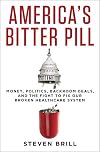
If you want a detailed account of how broken even good ideas get in America’s toxic political culture, bought and paid for by moneyed interests, then I have a book for you! We got health care reform without cost control because it was politically impossible to do otherwise, Brill agrees, even though somehow every other developed nation has managed to do it. I’m not saying he’s wrong, exactly, just that this is not a book to pick up if you want to feel hopeful about the American future.
America's Bitter Pill: Money, Politics, Backroom Deals, and the Fight to Fix Our Broken Healthcare System by Steven Brill
One of the best books I have read on healthcare policy. The majority of the book is a detailed, blow by blow history of Obamacare. Although Brill gives well-deserved credit for Obama's role in bringing it to pass, he also nicely outlines the things Obamacare did not fix (most notably runaway health care costs). On average Obamacare has been a good thing, but Brill also highlights the breakdown of implementation. Although some of the implementation issues were made much more difficult due to show more GOP intransigence, Obama and his team also were largely responsible for many of the major bumps along the road.
At the end of the book Brill recommends a way forward, now that we have Obamacare; a way to fix some of the things Obamacare didn't fix. His suggestion is a market based approach, which I think may have some merit, but it would take a lot more political courage than was seen in Washington during the Obamacare passage and implementation. As long as our political leaders remain beholden to big pharma, medical device manufacturers and insurance companies, the way forward will remain less than certain. show less
At the end of the book Brill recommends a way forward, now that we have Obamacare; a way to fix some of the things Obamacare didn't fix. His suggestion is a market based approach, which I think may have some merit, but it would take a lot more political courage than was seen in Washington during the Obamacare passage and implementation. As long as our political leaders remain beholden to big pharma, medical device manufacturers and insurance companies, the way forward will remain less than certain. show less
America's Bitter Pill: Money, Politics, Backroom Deals, and the Fight to Fix Our Broken Healthcare System by Steven Brill
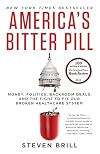
This is a journalistic tour de force, a surprisingly suspenseful chronicle of the long political struggle that shaped Obamacare, the bureaucratic arrogance that almost killed it in the bungled roll out of the health.gov website, and the herculean efforts needed to salvage it. It is a truism that "Laws, like sausages, cease to inspire respect in proportion as we know how they are made." I actually found the opposite to be true in this case. This story of the flawed creation and implementation show more of this law was makes one appreciate it all the more, and the importance of continued effort to get health care reform right, however difficult that process may be. show less
Awards


You May Also Like


Associated Authors
Statistics
- Works
- 10
- Also by
- 2
- Members
- 878
- Popularity
- #29,160
- Rating
- 3.6
- Reviews
- 20
- ISBNs
- 84