
Masamune Shirow
Author of Ghost in the Shell
About the Author
Disambiguation Notice:
Masamune Shirow is the pen name of Ōta Masanori (太田 まさのり) .
Series
Works by Masamune Shirow
The Ghost in the Shell: Fully Compiled (Complete Hardcover Collection) (The Ghost in the Shell Deluxe) (2022) 74 copies
Ghost in the Shell: Stand Alone Complex 2nd Gig Visual Book (Anime Artbook & Reference Guide) (2006) 7 copies
Official Art Collection for the World of Masamune Shirow Exhibition SHIROW MASAMUNE ARTWORKS IN THE SHELL (2025) 4 copies
Intron Depot 7: Barbwire 2 3 copies
Dominion 1 2 copies
Kappa Magazine 2 2 copies
Orion #2 (of 6) 2 copies
Dominion 2 2 copies
The Ghost in the Shell Tribute (The Ghost in the shell, The Ghost in the Shell Tribute) (French Edition) (2020) 2 copies, 1 review
攻殻機動隊(1.5) (ヤングマガジンコミックス) 1 copy
GREASEBERRIES 4 1 copy
GREASEBERRIES ROUGH 1 copy
GREASEBERRIES 3 1 copy
PIECES Gem〈03〉アップルシード下描き集 1 copy
攻殻機動隊(2) (ヤングマガジンコミックス) 1 copy
INTRON DEPOT 11BAILEY BRIDGE 1 copy
アップルシードç·?集編―コミックガイア版 1 copy
Pieces Gem 02 Neuro Hard 1 copy
Black magic Mario M-66 1 copy
Appleseed. The Beginning 1 copy
攻殻機動隊(1) (ヤングマガジンコミックス) 1 copy
Ghost in the Shell 1 copy
Duh u oklopu 1 copy
Dominion 6 1 copy
Dominion 5 1 copy
Dominion 4 1 copy
Dominion 3 1 copy
Kappa Magazine +, n. 127 1 copy
Appleseed. Księga 2. Tom 2. 1 copy
Appleseed. Księga 2. Tom 1. 1 copy
Appleseed. Księga 1. Tom 2. 1 copy
Appleseed. Księga 1. Tom 1. 1 copy
Appleseed, vol. 2 1 copy
Appleseed, vol. 3 1 copy
Appleseed, vol. 4 1 copy
Orion, vol. 1 1 copy
Orion, vol. 2 1 copy
Kappa Magazine, n. 85 1 copy
Kappa Magazine +, n. 126 1 copy
Kappa Magazine +, n. 134 1 copy
[4]: Appleseed. 1 copy
[3]: Appleseed. 1 copy
[2]: Appleseed 1 copy
[1]: Appleseed 1 copy
Black Magic 2 1 copy
Black Magic 1 1 copy
Gundress : The Movie 1 copy
Black Magic M-66 1 copy
Tagged
Common Knowledge
- Canonical name
- Shirow, Masamune
- Birthdate
- 1961-11-23
- Gender
- male
- Education
- Osaka University of Arts (Oil Painting)
- Occupations
- illustrator
writer - Organizations
- Production I.G
- Short biography
- Also has used the following names: Masanori Oota | Masanori Outa | Masamune Shiro | Masamune Shiroo | Masamune Shirou | Masamune Shirow | Masamune Shirô | Masanori Ôta
- Nationality
- Japan
- Birthplace
- Kobe, Hyōgo, Japan
- Disambiguation notice
- Masamune Shirow is the pen name of Ōta Masanori (太田 まさのり) .
- Associated Place (for map)
- Hyōgo, Japan
Members
Reviews
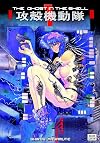
THRESHOLDS OF HUMANNESS
Somewhere around the age of fourteen, I saw The Matrix for the first time. I grew up in a household informed by the spiritual teachings of Gurdjieff and J. G. Bennett, so the core themes around consciousness and awakening were both familiar and intriguing.
A few years later my cousin-in-law was getting rid of some of his old anime VHS tapes, and I learned about The Ghost in the Shell-one of the primary influences for The Matrix. During this era I saw the anime film. show more Only this year did my friend lend me her copy of the original manga.
A FUTURE RECEEDING
The first thing that I'm struck by in reading The Ghost in the Shell in 2020, more than thirty years after it was written, it feels as the the biotech future it describes in the year 2029 is further away than it was in 1989 (maybe this can be said of science fiction in general). Sure, knee replacements work pretty well these days, as do dental implants. And massive amounts of funding are poured into biotech research each year (but more for the sake of solid Return-on-Investment for pharmaceutical intellectual property than for the sake of pushing the envelope in the medical field). And there's certainly a dedicated biohacker subculture. Maybe we're a century away from cyborgs, but not a decade.
SCIENCE FICTION VERSUS SOCIAL FICTION
As I've commented before, I find it discouraging that so much of our fiction invests so much effort into exploring the technological potential of the future-in a way that implicitly assumes that social realities will calcify rather than evolve. Back when The Ghost in the Shell was authored we might have written off the sexism of young, mostly-naked female cyborgs surrounded by fully-clothed ugly old men holding all the power to be the daydreams of an adolescent manga artist (Masamune Shirow was still in his twenties when The Ghost in the Shell came out). But in the era of #MeToo, we can no longer be so dismissive. Female cyborgs like the Major, with large breasts constantly on display, are the image of some adolescent male fantasies, while male cyborgs are black cubes. What does this say about Masamune Shirow's subconscious understanding of the importance of the physical and aesthetic form of the masculine versus the feminine?
THE THRESHOLDS OF HUMANNESS
Science fiction writer Liu Cixin in his Three-Body Problem series notably concludes that the human organism, once fully severed from earth, is no longer human.
The earth is part of our body, part of what makes us human.
This question of humanity and its boundaries is an eternal question of human cultures. We confront it in politics today around abortion rights (when does human life begin?) and gender non-binary rights (how does gender relate to our humanness?). Ancient myths such as Gilgamesh also explore the boundaries of where humanness begins and ends, with Enkidu's domestication by Shamhat.
It is a rich inquiry in its dynamism and non-determinism. How a civilization answer these questions speaks much to its worldview. Masamune Shirow's distillation of his (and my) culture's answers speak volumes.
I've recently been reflecting on the somatic lens into reality. Cyborgs, without a human body, are excluded from this realm of intelligence entirely. Masamune Shirow assumes that our humanity rests in our brain and our spinal cord. Aside from technical questions of survival (it is scientifically unclear whether a human could remain "alive" in any meaningful sense of the world without the rest of their organism), such a worldview clearly elevates "intellectual" knowing far above emotional and physical knowing.
And yet, maybe Masamune Shirow has doubts about such extremes as well. The series is titled The Ghost in the Shell. Are human bodies really just shells, or are they something of more foundational importance? As the expression, "he's a ghost of his former self," belies, without souls and spirits, we're just ghosts. In other words, to have a ghost and a shell doesn't bring an organism up to the lower threshold of personhood. A body and a spirit or soul are required for such status.
That said, I find The Ghost in the Shell much less chilling the Ex Machina. A robot with a human brain and spinal cord somehow feel much less haunting to me than an AI impersonating a human (an android, as Masamune Shirow refers to it as). I wonder what this says about this threshold between human and machine.
I would be remiss not to mention Gurdjieff's striving to free humans from their mechanicalness. His thesis was that, in our unconscious lives, humans are far more machine than human. Maybe our science fiction is reflective of the fact that, from a behavioral perspective, much of us do tend to exhibit behaviors more akin to machines than humans.
A MONTE CARLO APPROXIMATION OF MEANING
As Masamune Shirow admits in one of his numerous footnotes, he has managed to pull a lot of science and action into his epic, and yet at the same time, it is reminiscent of a Monte Carlo approximation of a story. Although there's clearly a thread about some kind of hierarchy of intelligence and consciousness, it is never fully articulated. It reminds me of the way that, in New York 2140, Kim Stanley Robinson's plot hinges upon principles that enable financial hackers to undermine capitalism-but he fails to express what these principles are! Or how in The Three-Body Problem, Liu Cixin's story revolves around an alien race, which he never actually describes!
That said, maybe it is the role of fiction to ask questions rather than provide answers. show less
Somewhere around the age of fourteen, I saw The Matrix for the first time. I grew up in a household informed by the spiritual teachings of Gurdjieff and J. G. Bennett, so the core themes around consciousness and awakening were both familiar and intriguing.
A few years later my cousin-in-law was getting rid of some of his old anime VHS tapes, and I learned about The Ghost in the Shell-one of the primary influences for The Matrix. During this era I saw the anime film. show more Only this year did my friend lend me her copy of the original manga.
A FUTURE RECEEDING
The first thing that I'm struck by in reading The Ghost in the Shell in 2020, more than thirty years after it was written, it feels as the the biotech future it describes in the year 2029 is further away than it was in 1989 (maybe this can be said of science fiction in general). Sure, knee replacements work pretty well these days, as do dental implants. And massive amounts of funding are poured into biotech research each year (but more for the sake of solid Return-on-Investment for pharmaceutical intellectual property than for the sake of pushing the envelope in the medical field). And there's certainly a dedicated biohacker subculture. Maybe we're a century away from cyborgs, but not a decade.
SCIENCE FICTION VERSUS SOCIAL FICTION
As I've commented before, I find it discouraging that so much of our fiction invests so much effort into exploring the technological potential of the future-in a way that implicitly assumes that social realities will calcify rather than evolve. Back when The Ghost in the Shell was authored we might have written off the sexism of young, mostly-naked female cyborgs surrounded by fully-clothed ugly old men holding all the power to be the daydreams of an adolescent manga artist (Masamune Shirow was still in his twenties when The Ghost in the Shell came out). But in the era of #MeToo, we can no longer be so dismissive. Female cyborgs like the Major, with large breasts constantly on display, are the image of some adolescent male fantasies, while male cyborgs are black cubes. What does this say about Masamune Shirow's subconscious understanding of the importance of the physical and aesthetic form of the masculine versus the feminine?
THE THRESHOLDS OF HUMANNESS
Science fiction writer Liu Cixin in his Three-Body Problem series notably concludes that the human organism, once fully severed from earth, is no longer human.
The earth is part of our body, part of what makes us human.
This question of humanity and its boundaries is an eternal question of human cultures. We confront it in politics today around abortion rights (when does human life begin?) and gender non-binary rights (how does gender relate to our humanness?). Ancient myths such as Gilgamesh also explore the boundaries of where humanness begins and ends, with Enkidu's domestication by Shamhat.
It is a rich inquiry in its dynamism and non-determinism. How a civilization answer these questions speaks much to its worldview. Masamune Shirow's distillation of his (and my) culture's answers speak volumes.
I've recently been reflecting on the somatic lens into reality. Cyborgs, without a human body, are excluded from this realm of intelligence entirely. Masamune Shirow assumes that our humanity rests in our brain and our spinal cord. Aside from technical questions of survival (it is scientifically unclear whether a human could remain "alive" in any meaningful sense of the world without the rest of their organism), such a worldview clearly elevates "intellectual" knowing far above emotional and physical knowing.
And yet, maybe Masamune Shirow has doubts about such extremes as well. The series is titled The Ghost in the Shell. Are human bodies really just shells, or are they something of more foundational importance? As the expression, "he's a ghost of his former self," belies, without souls and spirits, we're just ghosts. In other words, to have a ghost and a shell doesn't bring an organism up to the lower threshold of personhood. A body and a spirit or soul are required for such status.
That said, I find The Ghost in the Shell much less chilling the Ex Machina. A robot with a human brain and spinal cord somehow feel much less haunting to me than an AI impersonating a human (an android, as Masamune Shirow refers to it as). I wonder what this says about this threshold between human and machine.
I would be remiss not to mention Gurdjieff's striving to free humans from their mechanicalness. His thesis was that, in our unconscious lives, humans are far more machine than human. Maybe our science fiction is reflective of the fact that, from a behavioral perspective, much of us do tend to exhibit behaviors more akin to machines than humans.
A MONTE CARLO APPROXIMATION OF MEANING
As Masamune Shirow admits in one of his numerous footnotes, he has managed to pull a lot of science and action into his epic, and yet at the same time, it is reminiscent of a Monte Carlo approximation of a story. Although there's clearly a thread about some kind of hierarchy of intelligence and consciousness, it is never fully articulated. It reminds me of the way that, in New York 2140, Kim Stanley Robinson's plot hinges upon principles that enable financial hackers to undermine capitalism-but he fails to express what these principles are! Or how in The Three-Body Problem, Liu Cixin's story revolves around an alien race, which he never actually describes!
That said, maybe it is the role of fiction to ask questions rather than provide answers. show less
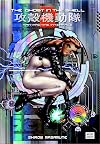
Not a continuation of the story, but a continuation of the same theme and setting. Motoko Aramaki is a hyper-advanced cyborg, a fusion of multiple entities and identities, deploying remotely controlled prosthetic humanoid surrogates around the globe to solve a series of bizarre crimes. There is quite a lot of military technology described, questions on the moral rights of animals (pigs), mentions of Japanese mythologies (Kojikl, amanojaku, etc), and religion (Shinto). In parts it made me show more laugh out loud (the cyborg hurting her head when she dived through the water and hit her head on the river-bed). The quality of art was better than the first volume (and an obvious use of computer graphics). There seems to be no limit for brain expansion in the virtual world, but who exactly is in control?! show less
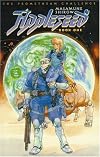
Deunan and Briareos are nomads in the dystopian landscape of post WW3 Earth. While trying to survive in abandoned city contaminated by serious chemical weaponry their paths will cross with Hitomi, mysterious agent from Olympus, de facto new Earth government and unknown mercenary group.
This continues even as they move to Olympus. Their arrival seems to trigger internal conflict between various city fractions and situation is not made more tolerable when Briareos finds out the city secret, show more that majority of population are bioroids, artificial humanoid life forms. Soon they will find themselves in crosshairs of police forces, city paramilitary (respectively run by competing city political forces) and strange force aiming to destroy city's command Gaia, force made up of people brought to city from the desolate areas ( aka rest of planet Earth). Action scenes are excellent, both with Deunan and Briareos taking opposition one on one or combat using battle suits called landmates.
Excellent thriller, and as in every aspiring thriller, not everything is explained in the first book. I can see this is something few readers are mzrking as a bad thing. For me, this is serialization as in case of tv show. You cannot expect that everything will be made clear in the episode 1 of planned several episodes. I am looking forward to follow up books.
Highly recommended to fans of SF, cyberpunk and action thrillers. show less
This continues even as they move to Olympus. Their arrival seems to trigger internal conflict between various city fractions and situation is not made more tolerable when Briareos finds out the city secret, show more that majority of population are bioroids, artificial humanoid life forms. Soon they will find themselves in crosshairs of police forces, city paramilitary (respectively run by competing city political forces) and strange force aiming to destroy city's command Gaia, force made up of people brought to city from the desolate areas ( aka rest of planet Earth). Action scenes are excellent, both with Deunan and Briareos taking opposition one on one or combat using battle suits called landmates.
Excellent thriller, and as in every aspiring thriller, not everything is explained in the first book. I can see this is something few readers are mzrking as a bad thing. For me, this is serialization as in case of tv show. You cannot expect that everything will be made clear in the episode 1 of planned several episodes. I am looking forward to follow up books.
Highly recommended to fans of SF, cyberpunk and action thrillers. show less
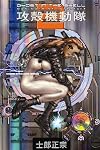
A bit heavy on the soft-core porn (Shirow really needs a girlfriend, or boyfriend, or whatever), but if you can look past the images, there’s a fairly complex, if confusing story here. The artwork is also quite nice, sometimes beautiful, sometimes amusing.
Lists
Awards


You May Also Like


Associated Authors
Statistics
- Works
- 244
- Members
- 5,226
- Popularity
- #4,768
- Rating
- 3.9
- Reviews
- 60
- ISBNs
- 302
- Languages
- 10
- Favorited
- 13