

Tsutomu Nihei
Author of BLAME! Master Edition, 1
About the Author
Image credit: Tsutomu Nihei at Lucca Comics & Games 2015 (Niccolò Caranti - Own work)
Series
Works by Tsutomu Nihei
Tower Dungeon 6 2 copies
Kappa Magazine +, n. 118 1 copy
Kappa Magazine +, n. 100 1 copy
BLAME!²: Chronicle of the Escape from the Megastructure by the Eighth Incarnation of Pcell (2008) 1 copy
シドニアの騎士(2) (アフタヌーンコミックス) 1 copy
シドニアの騎士(1) (アフタヌーンコミックス) 1 copy
BLAME!(1) (アフタヌーンコミックス) 1 copy
NOiSE (アフタヌーンコミックス) 1 copy
シドニアの騎士(3) (アフタヌーンコミックス) 1 copy
BLAME!(2) (アフタヌーンコミックス) 1 copy
APOSIMZ #35 1 copy
Ningyou No Kuni 1 copy
Wolverine Snikt! 1 copy
Abba 1 copy
Associated Works
行き先は特異点 (年刊日本SF傑作選) (創元SF文庫) — Contributor — 1 copy
Tagged
Common Knowledge
- Canonical name
- Nihei, Tsutomu
- Birthdate
- 1971
- Gender
- male
- Nationality
- Japan
- Associated Place (for map)
- Japan
Members
Reviews
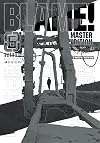
I recently heard the argument that movies aren't really "narrative delivery devices", but rather "vibe delivery devices." Blame! is an excellent example of an artistic work being the latter.
I could explain the broad plot of Blame! if asked to, but I'd have difficulty describing its more intricate details. This is a weird, inhuman world, and the lack of specifics only enhances that strangeness. Still, Nihei is very clearly a student of architecture, and he's able to convey a lot to the reader show more via a silent landscape.
The world of Blame! takes place in an endless, ever-growing city that has long grown past the needs of humans. The architecture here has its own reasons for existing, and anyone or anything that exists within this city is on its own. This series is definitely one of the more interesting fictional worlds I've visited recently. I really appreciate it's eeriness and emptiness. The Master Editions are great because they really showcase Neihi's artwork. I feel modern media has a tendency to over explain things, getting too caught up in lore over storytelling, and I think Blame! works so well precisely because of it's obtuse world building. show less
I could explain the broad plot of Blame! if asked to, but I'd have difficulty describing its more intricate details. This is a weird, inhuman world, and the lack of specifics only enhances that strangeness. Still, Nihei is very clearly a student of architecture, and he's able to convey a lot to the reader show more via a silent landscape.
The world of Blame! takes place in an endless, ever-growing city that has long grown past the needs of humans. The architecture here has its own reasons for existing, and anyone or anything that exists within this city is on its own. This series is definitely one of the more interesting fictional worlds I've visited recently. I really appreciate it's eeriness and emptiness. The Master Editions are great because they really showcase Neihi's artwork. I feel modern media has a tendency to over explain things, getting too caught up in lore over storytelling, and I think Blame! works so well precisely because of it's obtuse world building. show less

I only got wind of BLAME! about twenty years after its first US publication, and then I spent most of a year on the public library wait list to borrow the first volume of the 2016 "Master Edition." It took me most of a week to read it, and I have put a hold request on the next volume.
The main focus of the book is the setting: a "City" of many thousands of "strata," a built environment so large that it seems to lack an exterior. Humans are marginal survivors here, and there are predatory show more post-humans and violently territorial machine creatures. The story follows Kyrii, a human wanderer in quest of the "net terminal gene" that formerly allowed humans access to the City's information infrastructure.
The black and white art communicates two key notions impressively. The first is scale -- cramped cubicles and narrow passages are juxtaposed with enormous shafts, mountainous structures, and yawning abysses. The second is velocity -- contrasting moments of slow progress, still confrontation, and rapid action. Gore and dismemberment are recurring phenomena. Panels are large, hardly ever more than six to a page, and often two or three, with the occasional full two-page image.
Dialogue is spare, and after nearly 400 pages, I don't feel like I know Kyrii well, or even whether I like him. But the book is fascinating. Its mood has the dying earth subgenre's regard for humanity as obsolete, but there's no assurance that it takes place on Earth.
Along with later continuations of the manga, I understand that there have been some transmedia adaptations of BLAME! for the small screen. The visual imagination here really deserves something like the Villeneuve treatment, and I think I will not seek out the adaptations until after reading more of the manga. show less
The main focus of the book is the setting: a "City" of many thousands of "strata," a built environment so large that it seems to lack an exterior. Humans are marginal survivors here, and there are predatory show more post-humans and violently territorial machine creatures. The story follows Kyrii, a human wanderer in quest of the "net terminal gene" that formerly allowed humans access to the City's information infrastructure.
The black and white art communicates two key notions impressively. The first is scale -- cramped cubicles and narrow passages are juxtaposed with enormous shafts, mountainous structures, and yawning abysses. The second is velocity -- contrasting moments of slow progress, still confrontation, and rapid action. Gore and dismemberment are recurring phenomena. Panels are large, hardly ever more than six to a page, and often two or three, with the occasional full two-page image.
Dialogue is spare, and after nearly 400 pages, I don't feel like I know Kyrii well, or even whether I like him. But the book is fascinating. Its mood has the dying earth subgenre's regard for humanity as obsolete, but there's no assurance that it takes place on Earth.
Along with later continuations of the manga, I understand that there have been some transmedia adaptations of BLAME! for the small screen. The visual imagination here really deserves something like the Villeneuve treatment, and I think I will not seek out the adaptations until after reading more of the manga. show less

Another remarkable entry in this cyberpunk epic. As I've mentioned in my previous review, I would love to know more about the everyday lives of these various human tribes that eke out a living in this inhospitable wasteland. The Electro-Fishers are fascinating: the hints that we learn about their ways and culture are captivating. Perhaps it is for the best that we know more. Knowing less and filling in the blanks yourself might be more thrilling than actually knowing. Still, I want to know show more more!
I've read somewhere that Tsutomu Nihei can't draw faces for the life of him in Blame! That's an interesting observation because of course Kyrii's face is strange. His eyes are almost on the opposite sides of his skull. The manner in which his face is drawn is jarring when juxtaposed with the architectural precision their surrounding are drawn with. However, the strangeness of the character's faces becomes rather interesting the more I think about it. Almost all the human(oid) characters encountered are modified, or altered in some ways and the uncanny valley effect of their faces is alienating in a way that drives home their difference. People are permanently altered by their existence in this space, and it's written on their faces. Although, before I get too ahead of myself, it's clear that Tsutomu Nihei really likes drawing contorted and altered facial figures. The Silicon Life and other synthetic beings have very unusual facial features and it might just be something he's doing in Blame! (If I recall, in Kaina of the Great Snow Sea, the character's have "normal" facial features.)
Anyway, I'm enjoying my time in the world of Blame! show less
I've read somewhere that Tsutomu Nihei can't draw faces for the life of him in Blame! That's an interesting observation because of course Kyrii's face is strange. His eyes are almost on the opposite sides of his skull. The manner in which his face is drawn is jarring when juxtaposed with the architectural precision their surrounding are drawn with. However, the strangeness of the character's faces becomes rather interesting the more I think about it. Almost all the human(oid) characters encountered are modified, or altered in some ways and the uncanny valley effect of their faces is alienating in a way that drives home their difference. People are permanently altered by their existence in this space, and it's written on their faces. Although, before I get too ahead of myself, it's clear that Tsutomu Nihei really likes drawing contorted and altered facial figures. The Silicon Life and other synthetic beings have very unusual facial features and it might just be something he's doing in Blame! (If I recall, in Kaina of the Great Snow Sea, the character's have "normal" facial features.)
Anyway, I'm enjoying my time in the world of Blame! show less
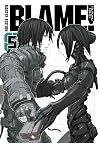
Blame! has always been to some degree a bit routine in all it's chaos and creativity. There are many scenes of Kyrii wandering an architectural dystopia, a deranged wonderland of a frustrated mad scientist. Then either a Safeguard will show up or some Silicon Life and there will be a suitably apocalyptic shootout in which Kyrii will level entire city grids worth of empty buildings. While it can be frustrating that the story doesn't slow down and we get very little of the slice of life world show more building that I admittedly crave, the atmosphere of a crumbling post-apocalyptic metropolis is mesmerizing. This is a really interesting work, and the artwork is extraordinary. I can't imagine how long it must have taken the author to make this, but I certainly am grateful for the effort. There is not a single panel in this entire manga where it feels like Tsutomu Nihei wasn't going all out.
Definitely a singular experience and one to revisit after some reflection. show less
Definitely a singular experience and one to revisit after some reflection. show less
Lists
Awards

You May Also Like


Associated Authors
Statistics
- Works
- 110
- Also by
- 2
- Members
- 5,786
- Popularity
- #4,260
- Rating
- 3.8
- Reviews
- 102
- ISBNs
- 393
- Languages
- 9
- Favorited
- 13
