

Marcia Brown (1) (1918–2015)
Author of Stone Soup: An Old Tale
For other authors named Marcia Brown, see the disambiguation page.
Marcia Brown (1) has been aliased into Marcia Joan Brown.
About the Author
Image credit: Marcia Brown 1918-1915 albany.edu
Works by Marcia Brown
Works have been aliased into Marcia Joan Brown.
Other Folk Tales 1 copy
Associated Works
Works have been aliased into Marcia Joan Brown.
From Sea to Shining Sea: A Treasury of American Folklore and Folk Songs (1993) — Illustrator — 810 copies, 2 reviews
The Wild Swans (1838) — Illustrator, some editions; Illustrator, some editions — 595 copies, 14 reviews
Of Swans, Sugarplums and Satin Slippers: Ballet Stories for Children (1991) — Illustrator, some editions — 234 copies, 2 reviews
The Crocodile and the Ostrich: A Tale from the Akamba of Kenya (1995) — Illustrator, some editions — 105 copies, 5 reviews
Cinderella — Illustrator, some editions — 1 copy
Tagged
Common Knowledge
- Birthdate
- 1918-07-13
- Date of death
- 2015-04-28
- Gender
- female
- Nationality
- USA
- Birthplace
- Rochester, New York, USA
- Place of death
- Laguna Hills, California, USA
- Associated Place (for map)
- USA
Members
Reviews

Taken from the classic Indian collection of fables, the Hitopadesha, Once a Mouse... follows the story of an old hermit, who, seeing a tiny mouse continuously in danger from the other animals, seeks to protect him by changing him into progressively larger animals. Transformed first into a cat, then a dog, and finally into a tiger, the mouse becomes proud - resentful of the hermit's reminder of his humble beginnings - until finally the hermit must take back his gift.
Awarded the Caldecott show more Medal in 1962, Brown's book is illustrated with bold woodcut art, in brown, red and yellow tones, making for a visually engaging picture-book. Billed as a fable that depicts a "tiger's fall from grace," teaching the necessity of humility, I couldn't help reading it as a reflection of man's arrogance, which I strongly suspect was not the original intention. Maybe the error here is not the tiger's, but the hermit's: for seeking to change nature, and fit it to his own ideas of morality. In any case, I think young readers will probably just enjoy the story, rather than seeking to analyze its message. Definitely worth a look, for those readers with an interest in folklore, and fables. show less
Awarded the Caldecott show more Medal in 1962, Brown's book is illustrated with bold woodcut art, in brown, red and yellow tones, making for a visually engaging picture-book. Billed as a fable that depicts a "tiger's fall from grace," teaching the necessity of humility, I couldn't help reading it as a reflection of man's arrogance, which I strongly suspect was not the original intention. Maybe the error here is not the tiger's, but the hermit's: for seeking to change nature, and fit it to his own ideas of morality. In any case, I think young readers will probably just enjoy the story, rather than seeking to analyze its message. Definitely worth a look, for those readers with an interest in folklore, and fables. show less

Based upon Moses K. Nakuina's early twentieth-century telling of this story - published in Hawaiian in 1902, and translated for Marcia Brown by Prof. Dorothy M. Kahananui - Backbone of the King: The Story of Paka'a and His Son Ku is essentially a young adult novelization of this traditional tale, which follows the adventures of three generations of men who serve as kahu iwikuamo‘o, or "backbone" (attendant) to the king, Keawe-nui-a-'Umi.
When Ku-a-Nu'uanu arrives at Kapa'a, on the island of show more Kaua'i, the people there assume that he is a "nothing," - "a wanderer without rank" - and are greatly offended when he marries La'amaomao, daughter of priests. When he departs the island, returning (unbeknownst to the people there) to his duties as kahu iwikuamo‘o to the king, on the island of Hawai'i, they turn their back on La'amaomao, and her son, Paka'a. But the young boy, discovering his true parentage, manages to join the inter-island voyage of Pai'ea, chief of Kaua'i, eventually finding his way to Hawai'i, where he makes himself known to his father, and takes his rightful place at his side. Years later, when jealous rivals supplant Paka'a in the affections of the king, spreading untrue rumors about him, he retreats to the island of Molokaʻi, where he too has a son, Ku-a-Paka'a. Now it is Ku who must fight to regain his (and his father's) rightful place in the world.
Backbone of the King was an engaging tale, full of adventure and magic! Not being familiar with Hawaiian, I found it rather difficult to keep some of the names and terms straight, but luckily there was an extensive glossary at the rear. I was struck, in the course of my reading, by the fact that although the culture depicted seems very male-centered - all the main characters are boys and men, and all the great deeds are performed by males - Paka'a and Ku are able to triumph, not simply through their own cunning, bravery, and honest love (or aloha) for their king, but through the agency of the magical wind gourd that comes to them through their female ancestor. I was also struck by how stratified Hawaiian society was, with lineage being so important in determining worth, and people divided into commoners (even slaves) and chiefs.
I'd like, at some point, to read the original - Moses K. Nakuina's Moolelo Hawaii o Pakaa a me Ku-a-Pakaa, na Kahu Iwikuamoo o Keawenuiaumi, ke Alii o Hawaii, a o na Moopuna hoi a Laamaomao ("The Hawaiian Story of Pakaa and Ku-a-Pakaa, the Personal Attendants of Keawenuiaumi, the Chief of Hawaii, and the Descendants of Laamaomao") - which is available today as The Wind Gourd of La'amaomao: The Hawaiian Story of Paka'a and Kuapaka'a. show less
When Ku-a-Nu'uanu arrives at Kapa'a, on the island of show more Kaua'i, the people there assume that he is a "nothing," - "a wanderer without rank" - and are greatly offended when he marries La'amaomao, daughter of priests. When he departs the island, returning (unbeknownst to the people there) to his duties as kahu iwikuamo‘o to the king, on the island of Hawai'i, they turn their back on La'amaomao, and her son, Paka'a. But the young boy, discovering his true parentage, manages to join the inter-island voyage of Pai'ea, chief of Kaua'i, eventually finding his way to Hawai'i, where he makes himself known to his father, and takes his rightful place at his side. Years later, when jealous rivals supplant Paka'a in the affections of the king, spreading untrue rumors about him, he retreats to the island of Molokaʻi, where he too has a son, Ku-a-Paka'a. Now it is Ku who must fight to regain his (and his father's) rightful place in the world.
Backbone of the King was an engaging tale, full of adventure and magic! Not being familiar with Hawaiian, I found it rather difficult to keep some of the names and terms straight, but luckily there was an extensive glossary at the rear. I was struck, in the course of my reading, by the fact that although the culture depicted seems very male-centered - all the main characters are boys and men, and all the great deeds are performed by males - Paka'a and Ku are able to triumph, not simply through their own cunning, bravery, and honest love (or aloha) for their king, but through the agency of the magical wind gourd that comes to them through their female ancestor. I was also struck by how stratified Hawaiian society was, with lineage being so important in determining worth, and people divided into commoners (even slaves) and chiefs.
I'd like, at some point, to read the original - Moses K. Nakuina's Moolelo Hawaii o Pakaa a me Ku-a-Pakaa, na Kahu Iwikuamoo o Keawenuiaumi, ke Alii o Hawaii, a o na Moopuna hoi a Laamaomao ("The Hawaiian Story of Pakaa and Ku-a-Pakaa, the Personal Attendants of Keawenuiaumi, the Chief of Hawaii, and the Descendants of Laamaomao") - which is available today as The Wind Gourd of La'amaomao: The Hawaiian Story of Paka'a and Kuapaka'a. show less

Three-time Caldecott medalist and six-time Caldecott honoree Marcia Brown retells that most famous of fairy-tales in this lovely picture book from 1954. A loose translation of Charles Perrault's original French story, in which a beautiful and good young maiden named Cinderella is aided by her fairy godmother in attending the prince's ball and in winning her heart's desire, is paired with Brown's own artwork, and the result is a delight, both from a narrative and artistic standpoint...
It is show more not difficult to see why Brown's Cinderella; or, The Little Glass Slipper was awarded the Caldecott Medal in 1955. Her artwork here is lovely, capturing the magic of the story and the changing emotions of the titular heroine, while making use of a beautiful array of colors, and featuring elegantly stylized figures. I don't know how faithful the conclusion is to the Perrault original, having not read that in some time, but I also greatly appreciated the fact that Cinderella forgives her stepsisters, and sees that they are provided for. I've nothing to say against versions in which the stepsisters are punished, but it's also nice to see one that shows the heroine staying true to her kind nature. Recommended to young fairy and folktale lovers, and to any picture book readers who enjoy Cinderella retellings. My favorite in this vein will always be the version done by Evelyn Andreas and Ruth Ives (the standard of my childhood), but this is another that I hold in high regard. show less
It is show more not difficult to see why Brown's Cinderella; or, The Little Glass Slipper was awarded the Caldecott Medal in 1955. Her artwork here is lovely, capturing the magic of the story and the changing emotions of the titular heroine, while making use of a beautiful array of colors, and featuring elegantly stylized figures. I don't know how faithful the conclusion is to the Perrault original, having not read that in some time, but I also greatly appreciated the fact that Cinderella forgives her stepsisters, and sees that they are provided for. I've nothing to say against versions in which the stepsisters are punished, but it's also nice to see one that shows the heroine staying true to her kind nature. Recommended to young fairy and folktale lovers, and to any picture book readers who enjoy Cinderella retellings. My favorite in this vein will always be the version done by Evelyn Andreas and Ruth Ives (the standard of my childhood), but this is another that I hold in high regard. show less
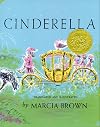
This is a new translation / adaptation of Charles Perrault’s famous story, with wonderful illustrations by Marcia Brown (for which she was awarded the Caldecott Medal).
What I really like about this version of the story is the way that Cinderella is portrayed as a very kind young woman, but clearly not a doormat. She speaks up for herself when it counts. Her stepsisters are never referred to as “ugly” either; rather they are selfish, self-absorbed, and rather hateful towards Cinderella. show more They are as blind to her virtues as they are to their own faults.
The translation also differs from original versions of the story in the way it ends – for the stepsisters. Cinderella, in her goodness, arranges good marriages for them to two lords in the Prince’s Court.
I was fascinated by the technique of Brown’s illustrations. She uses a few pen strokes to suggest a gown, for example, and then a wash of color to complete the image. This lends a rather ethereal, fairy-tale feeling to the drawings; very effective. show less
What I really like about this version of the story is the way that Cinderella is portrayed as a very kind young woman, but clearly not a doormat. She speaks up for herself when it counts. Her stepsisters are never referred to as “ugly” either; rather they are selfish, self-absorbed, and rather hateful towards Cinderella. show more They are as blind to her virtues as they are to their own faults.
The translation also differs from original versions of the story in the way it ends – for the stepsisters. Cinderella, in her goodness, arranges good marriages for them to two lords in the Prince’s Court.
I was fascinated by the technique of Brown’s illustrations. She uses a few pen strokes to suggest a gown, for example, and then a wash of color to complete the image. This lends a rather ethereal, fairy-tale feeling to the drawings; very effective. show less
Lists
Awards


You May Also Like
Associated Authors
Statistics
- Works
- 25
- Also by
- 9
- Members
- 8,980
- Popularity
- #2,676
- Rating
- 3.9
- Reviews
- 415
- ISBNs
- 143
- Languages
- 4
- Favorited
- 1