
Kai-Fu Lee
Author of AI Superpowers: China, Silicon Valley, and the New World Order
About the Author
Kai-Fu Lee was born on December 3, 1961 in Taipei, Taiwan. He earned a B.S. degree in computer science from Columbia University and a Ph.D in computer science from Carnegie Mellon University. In 1988, he completed his doctoral dissertation on Sphinx, the first large-vocabulary, speaker-independent, show more continuous speech recognition system. Lee has written two books on speech recognition and more than 60 papers in computer science. His doctoral dissertation was published in 1988 as a Kluwer monograph, Automatic Speech Recognition: The Development of the Sphinx Recognition System. Together with Alex Waibel, another Carnegie Mellon researcher, Lee edited Readings in Speech Recognition. (Bowker Author Biography) show less
Works by Kai-Fu Lee
2041. Como a inteligencia artificial vai mudar sua vida nas proximas decadas (Em Portugues do Brasil) (2022) 8 copies
My Journey into AI: The Story Behind the Man Who Helped Launch 5 A.I. Companies Worth $25 Billion (2019) 6 copies
Velesili umetne inteligence 1 copy
AI 新世界:中國、矽谷和AI七巨人如何引領全球發展 1 copy
Tagged
Common Knowledge
- Other names
- 李, 開復
李, 开复
Lǐ, Kāifù - Birthdate
- 1961-12-03
- Gender
- male
- Education
- Columbia University (BS|1983|Computer Science)
Carnegie Mellon (PhD|1988|Computer Science) - Occupations
- computer scientist
corporate executive - Organizations
- Apple, Inc
Microsoft Corporation
Silicon Graphics
Google
Sinovation Ventures - Relationships
- Tianmin, Li (father)
- Nationality
- Taiwan
USA - Birthplace
- New Taipei City, Taiwan
- Places of residence
- Oak Ridge, Tennessee, USA
Beijing, China
Members
Reviews
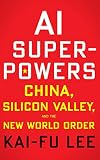
I fail to see why this book gets such high ratings. Yes, it's written in a very readable way. Despite the author's experience in A.I., he never makes it too technical. There are not enough graphic charts, but the ones that are there are very useful.
Unfortunately, all of this is of course not enough to write a positive review. Why not? Well, for starters, there's almost no mention of India. I'm a aware that this book is meant to be a comparison between the two tech giants, but India is up & show more coming, and I believe that it will surpass China very soon. And now, the worst part: this has got to be the most repetitive book I've ever read. I'll give you an example: In chapter 5, The Four Waves of AI, Lee mentions the Chinese company Iflytek a whopping eight times, and this is only on the first two pages!
I still don't understand how I made it through... show less
Unfortunately, all of this is of course not enough to write a positive review. Why not? Well, for starters, there's almost no mention of India. I'm a aware that this book is meant to be a comparison between the two tech giants, but India is up & show more coming, and I believe that it will surpass China very soon. And now, the worst part: this has got to be the most repetitive book I've ever read. I'll give you an example: In chapter 5, The Four Waves of AI, Lee mentions the Chinese company Iflytek a whopping eight times, and this is only on the first two pages!
I still don't understand how I made it through... show less
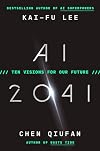
AI 2041: Ten Visions for our Future by Kai-Fu Lee and Chen Quifan is a unique undertaking. AI 2041 seeks to explore the way that AI (Artificial Intelligence) will advance and change over the next twenty years. Both authors have experience in the tech fields (Kai-Fu in particular as he owns and operates a venture capital that focuses on technology). However, after leaving their respective jobs at Google they took very different career routes. Chen has pivoted to become a successful sci-fi show more writer using his knowledge and experience to create realistic stories with a science fiction slant. This book is a combination of their two vocations.
There are 10 short sci-fi pieces written by Chen that delve into different existing (and evolving) technologies powered by AI through a realistic lens. At the end of each story, Kai-Fu discusses in detail why he believes these advances in AI will have sufficiently progressed by the year 2041 to make these stories seem less like science fiction and more like science fact. Some of the topics discussed like deep learning (we're seeing the beginnings of it now with Google Maps following where we've been and making suggestions) and the mechanization of the workforce (this has been happening for years but in twenty years time we could see major industries like medicine, education, and construction almost entirely taken over by AI) have been developing for decades.
Each of the stories was so well-written and the analyses were so fascinating that at times I forgot my absolutely debilitating fear of Artificial Intelligence (until I read the section on autonomous vehicles). This is a great read for fans of sci-fi, technology, or futurology. And it's one of the few short story collections I've read in recent memory where each of the offerings could stand on its own. (And I actually recall more than half of them after finishing it roughly 3 days ago.) 10/10 show less
There are 10 short sci-fi pieces written by Chen that delve into different existing (and evolving) technologies powered by AI through a realistic lens. At the end of each story, Kai-Fu discusses in detail why he believes these advances in AI will have sufficiently progressed by the year 2041 to make these stories seem less like science fiction and more like science fact. Some of the topics discussed like deep learning (we're seeing the beginnings of it now with Google Maps following where we've been and making suggestions) and the mechanization of the workforce (this has been happening for years but in twenty years time we could see major industries like medicine, education, and construction almost entirely taken over by AI) have been developing for decades.
Each of the stories was so well-written and the analyses were so fascinating that at times I forgot my absolutely debilitating fear of Artificial Intelligence (until I read the section on autonomous vehicles). This is a great read for fans of sci-fi, technology, or futurology. And it's one of the few short story collections I've read in recent memory where each of the offerings could stand on its own. (And I actually recall more than half of them after finishing it roughly 3 days ago.) 10/10 show less
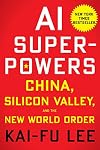
An exceptionally well-crafted, insightful, and captivating exploration of the history and current landscape of artificial intelligence. Kai-Fu Lee masterfully delves into the intricacies of entrepreneurship in China, drawing from his personal experiences to provide an unparalleled perspective. With clarity and depth, the author elucidates the fundamental concepts of AI and deep learning, demystifying their operations and elucidating their vast potential as well as the associated risks.
The show more latter part of the book delves into the potential perils entailed by the profound automation that AI can usher in. Lee presents a compelling array of strategies to preempt and potentially address these challenges, ranging from innovative retraining initiatives to workload reduction measures. Notably, he delves into the intriguing notion of utilizing a Universal Basic Income (UBI) as a tool to mitigate the societal impact of increased automation.
What sets Lee's narrative apart is his unique perspective, shaped by his triumphant battle against cancer. This perspective lends a profound dimension to his insights on AI's implications and its trajectory, in contrast to the often mechanistic and productivity-centric views prevalent in the field. He introduces a visionary model rooted in symbiosis, envisioning a future where AI takes on automation tasks while humans focus on endeavors necessitating empathy, affection, and human connection.
Within this envisioned human-AI symbiosis, Lee introduces the concept of a social stipend, strategically fostering a framework where individuals are incentivized to contribute through volunteering and personal growth. This transformative proposal encapsulates the evolution of societal dynamics that AI can catalyze, fundamentally redefining the traditional contours of work and human interaction.
In summation, Kai-Fu Lee's opus is extraordinary, deftly weaving together history, technology, and human sentiment. Through his unique vantage point, he imparts a compelling narrative that challenges convention and inspires contemplation, illuminating a future where AI and humanity coalesce in harmonious coexistence. show less
Lee has written a readable and informative book that provides the reader with an understanding of the past, present, and future development of artificial intelligence. He describes in detail the work being done in AI in the United States and China—the global leaders in artificial intelligence. He identifies the promises and perils of AI infiltrating all aspects of our lives. It is easy to read the first two-thirds of the book as a wake-up call for America to pay attention to the Chinese show more juggernaut that threatens American economic and technological supremacy. But then Lee makes an unexpected pivot. He shares his personal confrontation with cancer and how it changed his value system. In the last third of the book, Lee outlines how the disruption being caused by AI can be a catalyst for transforming human society. The current trajectory threatens a future with dramatic increases in unemployment and economic inequality, which heighten the likelihood of violent social upheaval. Lee envisions a future where AI technology and human compassion are integrated to create societies characterized by love. This is a book to be read by anyone interested in getting a glimpse of the possible futures that await humanity and who wants to make informed choices about the direction we should take. show less
Lists
Awards


You May Also Like


Associated Authors
Statistics
- Works
- 14
- Members
- 856
- Popularity
- #29,895
- Rating
- 3.6
- Reviews
- 22
- ISBNs
- 39
- Languages
- 10
- Favorited
- 1