
Andrew McAfee
Author of The Second Machine Age: Work, Progress, and Prosperity in a Time of Brilliant Technologies
About the Author
Andrew McAfee is a principal research scientist at the MIT Center for Digital Business. He is the author of several books including Enterprise 2.0: New Collaborative Tools for Your Organization's Toughest Challenges and The Second Machine Age: Work, Progress, and Prosperity in a Time of Brilliant show more Technologies. (Bowker Author Biography) show less
Image credit: From AndrewMcAfee.org
Works by Andrew McAfee
The Second Machine Age: Work, Progress, and Prosperity in a Time of Brilliant Technologies (2014) 886 copies, 25 reviews
Race Against the Machine: How the Digital Revolution is Accelerating Innovation, Driving Productivity, and Irreversibly Transforming Employment and the Economy (2011) 215 copies, 12 reviews
More from Less: The Surprising Story of How We Learned to Prosper Using Fewer Resources―and What Happens Next (2019) 120 copies, 5 reviews
Enterprise 2.0: New Collaborative Tools for Your Organization's Toughest Challenges (2009) 82 copies, 3 reviews
Getting Control of Big Data 1 copy
Do You Have Too Much IT? 1 copy
ARE DROIDS TAKING OUR JOBS? 1 copy
Associated Works
Organizations Don't Tweet, People Do: A Manager's Guide to the Social Web (2011) — Foreword — 26 copies, 1 review
Artificial Intelligence: The Insights You Need from Harvard Business Review (HBR Insights Series) (2019) — Contributor — 20 copies
Tagged
Common Knowledge
- Legal name
- McAfee, Andrew Paul
- Birthdate
- 1967
- Gender
- male
- Education
- Harvard Business School (1999)
Massachusetts Institute of Technology - Occupations
- professor
- Awards and honors
- In 2008 McAfee was named by the editors of the technical publishing house Ziff-Davis in their list of the “100 Most Influential People in IT.”
- Nationality
- USA
- Places of residence
- Cambridge, Massachusetts, USA
- Associated Place (for map)
- Massachusetts, USA
Members
Reviews
Den andra maskinåldern. Arbete, utveckling och välstånd i en tid av briljant teknologi by Erik Brynjolfsson

Vi lever i en tid av snabb teknologisk och framförallt digital utveckling. I min barndom hade min familj ingen dator, verkligen inget internet och inga mobiler. Med åren kom både dator och internet via modem (som ledde till stor frustration för mina föräldrar då telefonräkningarna plötsligt rusade i höjden och linjen konstant var upptagen) och jag minns hur jag fick en mobil i gymnasiet av mina föräldrar för att jag skulle kunna höra av mig när jag reste ner till Göteborg. show more Idag sitter mina föräldrar med surfplattor, datorer, fiberbredband och smarta telefoner och skulle inte klara sig utan dem. Utvecklingen har inte på något sätt stannat utan rusar vidare med "sakernas internet", självkörande bilar och allt mer sofistikerad AI-utveckling. Det är en utveckling som behövs diskuteras för att vi ska kunna förstå vart vi är på väg och det är det som Brynjolfsson och McAfee försöker göra i Den andra maskinåldern.
Att de är stora teknikoptimister kommer fram tydligt i boken. Både vad gällande vad tekniken åstadkommit och vad den kan åstadkomma framöver. Vilket är en ståndpunkt jag delar, men det finns då också en risk att framsteg kan övervärderas. I boken är författarna till exempel väldigt imponerade över de självkörande bilarna (och det är jag med!), men utvecklingen har inte gått så snabbt sedan 2014 när boken skrevs som en kunnat tro.
Författarna gör ett bra jobb med att övergripande och lättfattligt gå igenom de övergripande frågorna vad gällande de närmaste decennierna som brukar diskuteras på området. Den snabba datorkraftsutvecklingen med utgångspunkt i Moores lag, digitaliseringen av information, artificiell intelligens, de ökade ekonomiska klyftorna och risken/chansen för massiv arbetslöshet till följd av automatiseringen av arbetsuppgifter. Två av de tre sista kapitlen ägnas sedan åt att rekommendationer för politiska policyies för framtiden.
Många av de exempel vi tänker på som omvälvande teknologi idag främst riktar sig till slutkonsumenter och inte till produktionen. Jag blev därför glad att författarna tar upp och diskuterar att vi idag i världen ser en avtagande produktivitetsökning (produktiviteten ökar fortfarande varje år, men den saktar ned och ökar inte i närheten av så snabbt som på till exempel 60-talet). Deras svar på detta kontraintuitiva (för mig iaf) faktum är att omvälvande teknologier tar ungefär två decennier att slå igenom i alla delar av samhället och produktionsgrenar. Jag finner inte det svaret så övertygande (har det inte gått två decennier och är inte datorer och nätverk centrala delar av i princip all produktion och alla samhällsfunktioner?), men det är ett försök och de tar upp och diskuterar frågan.
Deras diskussions kring vilka jobb som hotas i första hand av teknologins utveckling tycks mig rimlig. Det är inte enbart manuella arbeten som idag hotas, utan det är alla yrken vars arbetsuppgifter är av det rutinartade slaget. I boken tas speciellt revisorer upp som en yrkeskategori som kan få problem framöver. Deras försvar för arbetets roll i människors liv och deras förslag till policyies som ska kunna bevara en mängd arbeten ser jag dock inte som så värdefulla. Medborgarlön, som författarna är tveksamma till då det inte botar ledan och lasten (men däremot armodet), kanske inte är svaret framöver, men jag har svårt att se att svaret inte kommer ha att göra med att frikoppla människors inkomster från deras löner.
Teknikutvecklingen går snabbt och skulle boken skrivas idag skulle de garanterat ta upp AlphaGos seger över Lee Sedol och diskutera maskininlärning djupare än de gör i boken. Men boken är fortfarande aktuell. Boken är välskriven och lättläst och väl värd att läsa för människor som inte läst eller på annat sätt närmat sig frågan om dagens teknikutveckling och den närmaste framtiden tidigare. För de som redan är inlästa på ämnet hittas inte mycket nytt. Men de två kapitlen med rekommendationer tar upp saker jag inte kommit i kontakt med på andra ställen (sen kan det diskuteras hur bra förslagen är). show less
Att de är stora teknikoptimister kommer fram tydligt i boken. Både vad gällande vad tekniken åstadkommit och vad den kan åstadkomma framöver. Vilket är en ståndpunkt jag delar, men det finns då också en risk att framsteg kan övervärderas. I boken är författarna till exempel väldigt imponerade över de självkörande bilarna (och det är jag med!), men utvecklingen har inte gått så snabbt sedan 2014 när boken skrevs som en kunnat tro.
Författarna gör ett bra jobb med att övergripande och lättfattligt gå igenom de övergripande frågorna vad gällande de närmaste decennierna som brukar diskuteras på området. Den snabba datorkraftsutvecklingen med utgångspunkt i Moores lag, digitaliseringen av information, artificiell intelligens, de ökade ekonomiska klyftorna och risken/chansen för massiv arbetslöshet till följd av automatiseringen av arbetsuppgifter. Två av de tre sista kapitlen ägnas sedan åt att rekommendationer för politiska policyies för framtiden.
Många av de exempel vi tänker på som omvälvande teknologi idag främst riktar sig till slutkonsumenter och inte till produktionen. Jag blev därför glad att författarna tar upp och diskuterar att vi idag i världen ser en avtagande produktivitetsökning (produktiviteten ökar fortfarande varje år, men den saktar ned och ökar inte i närheten av så snabbt som på till exempel 60-talet). Deras svar på detta kontraintuitiva (för mig iaf) faktum är att omvälvande teknologier tar ungefär två decennier att slå igenom i alla delar av samhället och produktionsgrenar. Jag finner inte det svaret så övertygande (har det inte gått två decennier och är inte datorer och nätverk centrala delar av i princip all produktion och alla samhällsfunktioner?), men det är ett försök och de tar upp och diskuterar frågan.
Deras diskussions kring vilka jobb som hotas i första hand av teknologins utveckling tycks mig rimlig. Det är inte enbart manuella arbeten som idag hotas, utan det är alla yrken vars arbetsuppgifter är av det rutinartade slaget. I boken tas speciellt revisorer upp som en yrkeskategori som kan få problem framöver. Deras försvar för arbetets roll i människors liv och deras förslag till policyies som ska kunna bevara en mängd arbeten ser jag dock inte som så värdefulla. Medborgarlön, som författarna är tveksamma till då det inte botar ledan och lasten (men däremot armodet), kanske inte är svaret framöver, men jag har svårt att se att svaret inte kommer ha att göra med att frikoppla människors inkomster från deras löner.
Teknikutvecklingen går snabbt och skulle boken skrivas idag skulle de garanterat ta upp AlphaGos seger över Lee Sedol och diskutera maskininlärning djupare än de gör i boken. Men boken är fortfarande aktuell. Boken är välskriven och lättläst och väl värd att läsa för människor som inte läst eller på annat sätt närmat sig frågan om dagens teknikutveckling och den närmaste framtiden tidigare. För de som redan är inlästa på ämnet hittas inte mycket nytt. Men de två kapitlen med rekommendationer tar upp saker jag inte kommit i kontakt med på andra ställen (sen kan det diskuteras hur bra förslagen är). show less
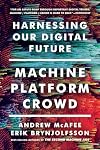
This book is a good run down of commercially disruptive technologies, at least those disruptive as of 2017. Things move so fast that one wonders how long this text will be useful but at the time of reading two years later it still acted as a decent primer.
McAfee and Brynjolfsson are not men to doubt the capitalist paradigm or free markets so they are well into the idea that creative destruction is one of those things we have to live with and that dinosaurs will die and adaptable creatures show more will thrive. Managers, of course, are set up to be heroes.
The book is divided into three parts matching the three starting nouns - machine, platform and crowd. Each part moves steadily and clearly into the more radical end of each model, with (for those who like that sort of thing) end chapter executive summaries and questions for troubled executives.
The 'Machine' covers the rise of machine learning and artificial intelligence and has some tough things to say about the value of human reason. In the end, humans are relegated to being the creatures who command the machines to meet their wants and needs according to their values.
Much of the administrative and professional class is going to be consigned to history, it would seem, leaving a management elite of those who make the value judgments and a working community of personal service providers and those who 'monkey around' (literally) the machines.
Even 'creativity' (so they suggest) will be devolved to machines. While humans are not to be made useless by any means (after all, this is for our benefit), work is going to mean something very different for us within a very few decades.
Needless to say, being market ideologues speaking unto managers and capitalists (or would-be capitalists), the authors have nothing to say on the wider social and cultural consequences of a world of machine-human interaction. One suspects they don't enormously care in this book.
The 'Platform' section is exceptionally useful in explaining, in clear terms and from the perspective of economics, one of the mysteries of the new economy to ordinary folk - precisely how it creates wealth or, rather, how it makes money (which may or may not be the same thing).
The consumer sees a lot of things provided for free - I pay for one newspaper subscription (reluctantly), use ad blockers and restrict streaming to Netflix, Amazon Prime and Spotify so how do I get so much information and entertainment elsewhere for nothing?
I found this valuable enough to know that I will hold on to the book (business books otherwise tend to get recycled out of my library faster than most categories) for quick reference when ever I have to deal with a start up in technology in order to double-check the viability of their business model.
It has to be said that, two years on, with the financial markets beginning to get cold feet about pouring money into platforms like WeWork, one gets the sense that what works on paper may not quite work as the authors expect as projects come up against real world difficulties.
The book is, however, wise to see platforms as disruptive but not exclusive and that 'traditional' businesses (such as hotels in relation to, say, Airbnb) still have many opportunities for adaptation whether into niches or into global segmentation for particular markets.
In the final section ['Crowd'], the authors draw a distinction between the crowd (enabled by the internet) and the core (the traditional hierarchical management centre). This section is largely about corporate organisation and decentralisation.
This reminds me of the last book we reviewed - Niall Ferguson's 'The Square and the Tower' - which explored how networks and hierarchies had played off each other to transform society and culture in history. The crowd/core story is a variant of that tale.
There is an element of 'wisdom of crowds' in this although we are personally suspicious of the long term value of this concept. Lemmings are a crowd and human confabulation and cognitive biases (which make machines more useful than us) can create herd absurdities.
To be fair, the authors are thoroughly sensible on the limits of decentralisation. This makes them very cautious about some of the more outre libertarian economic models. Recent history is tending to prove them right. There is a necessity for some core functions.
Which brings us neatly into the world of bitcoin and blockchain where the authors are still cautious boosters although the last two years has tended to show that these technologies have a long way to go yet before they are truly transformative instead of magic money pits.
The book closes with a question about whether the new technologies will eventually kill off the corporate sector to replace the firm with, say, the collective or the peer-to-peer network or some other form of decentralised organisation and it will be no surprise to hear that they do not think so.
This final and shortest section is worth reading because it is very well argued and plausible within a classic (American) capitalist framework, based on a very articulate exposition of the theory of 'transaction cost economics' and the problem of 'incomplete contracting'.
'Incomplete contracting' (the inability of contracts to cover every eventuality) acts as a check on the 'smart contract' being a total solution for global commerce as opposed to a (possible) solution to particular categories of repeatable contract.
The authors may contradict themselves here insofar as their 'Machine' section implies that AI will be able to make such managerial judgements but we'll let that pass on the basis that they also say there are natural limits to AI comprehension of real world human interactions.
Of course all this depends on a particular concept of property rights but the authors' complacency is certainly justified so long as the American Constitution remains honoured. Even the Corbynista socialists will have trouble unravelling the British bedrock of protective common and statute law.
At the very end, the book is a booster for 'good' managers who are (as all such books tend to do) 'heroised' as the new breed of socially skilled (aka manipulative, let us dare not say sociopathic) directors of persons in a common cause (making more money for people with money).
Taken as a whole, this is an excellent and fair (and not over-enthusiastic) guidebook to the new commercial reality. If it does not deal with social or cultural consequences and is managerialist to the core, it strikes me as well grounded in its economics.
If I have doubts, it is not about the book (which I recommend) but about where the ideology behind the book is leading us - or rather where it thinks it is leading us only to find that humans are remarkably stubborn about not being led except by their own desire, greed and fear.
It is not the 'little things', like the energy consumption of blockchain in an age of middle class neurosis about climate change, that suggest black swans ahead but the slow collapse of people's willingness to take expert or managerial guidance for granted.
I detect a much more volatile humanity, quite capable of switching out of a product or platform and into a new one at surprising speed, machines discredited quickly by single failures (as in the Ethiopian Airlines crash) and social and political resistance to unmanaged effects.
There are signs of techno-hubris. Too many energetic 'geniuses' chasing too many advanced projects. Too little interest in those awkward social and cultural effects and in the psychology of nervous politicians. Too much creative destruction for the market to bear.
Corporate managers manage the delivery of things but not the effects of things so the management of the latter is left to States with increasing problems of administrative capacity and volatile democratic politics. What could go wrong?
The simple business of lobbying for advantage is no longer simple and done behind closed doors. The old 'socialism for corporations' is being exposed to public gaze in the West and managers may well look to 'Chinese' guided democracy as preferable to chaos but not be able to wangle it.
I detect that the manipulations involved in marketing, PR and human resources have created a race of managers who believe their own lies - that they are needed and loved far more than they are - like aristocrats in 1788 who would swear that their peasants adored them.
Just when managers most need the skills outlined so well by McAfee and Brynjolfsson at the end of the book, the crowd communications on platforms may be educating - 'raising the awareness of' - workers and public that those skills may be manipulative and manufactured and so to be resisted.
It may even be that, if we think of the original of socialism as being an ideology of freedom that was actually about bread, shelter and medicine, we are moving towards a variant ideology of needs and wants that is actually about freedom and that freedom is, in fact, resistance to managerialism.
I would be fascinated to see a dissident reverse engineer this text and take it out of the zone of managers meeting needs and wants through the corporate organisation of markets and into a new zone of demands that use the technologies to contain and control managers and administrators.
In fact, as always, my guess is that the coming decades will see an uneasy compromise of networks and hierarchies. The technologies will raise social and other problems. Managers will be run ragged by the complexity of it all. Populations will never quite be clear about what they want.
It is probable that even the mighty FANGS could be brought down to earth and new forms of enterprise emerge and at ever faster speeds. The regulators will be fighting wars on two fronts. Voters will alternate between rage and apathy and it will never be clear which is uppermost.
Above all, survival requires something more than understanding how to manage human beings in an age of machines. It also requires an understanding of actual rather than believed power relations - a recognition of powerlessness or manipulation or exploitation is the very trigger for revolt.
Still, if you are a manager struggling with this new and unstable world, then this book is not a bad basic primer so long as you remember that the theory may not always accord with the brute reality as it unfolds in the future. show less
McAfee and Brynjolfsson are not men to doubt the capitalist paradigm or free markets so they are well into the idea that creative destruction is one of those things we have to live with and that dinosaurs will die and adaptable creatures show more will thrive. Managers, of course, are set up to be heroes.
The book is divided into three parts matching the three starting nouns - machine, platform and crowd. Each part moves steadily and clearly into the more radical end of each model, with (for those who like that sort of thing) end chapter executive summaries and questions for troubled executives.
The 'Machine' covers the rise of machine learning and artificial intelligence and has some tough things to say about the value of human reason. In the end, humans are relegated to being the creatures who command the machines to meet their wants and needs according to their values.
Much of the administrative and professional class is going to be consigned to history, it would seem, leaving a management elite of those who make the value judgments and a working community of personal service providers and those who 'monkey around' (literally) the machines.
Even 'creativity' (so they suggest) will be devolved to machines. While humans are not to be made useless by any means (after all, this is for our benefit), work is going to mean something very different for us within a very few decades.
Needless to say, being market ideologues speaking unto managers and capitalists (or would-be capitalists), the authors have nothing to say on the wider social and cultural consequences of a world of machine-human interaction. One suspects they don't enormously care in this book.
The 'Platform' section is exceptionally useful in explaining, in clear terms and from the perspective of economics, one of the mysteries of the new economy to ordinary folk - precisely how it creates wealth or, rather, how it makes money (which may or may not be the same thing).
The consumer sees a lot of things provided for free - I pay for one newspaper subscription (reluctantly), use ad blockers and restrict streaming to Netflix, Amazon Prime and Spotify so how do I get so much information and entertainment elsewhere for nothing?
I found this valuable enough to know that I will hold on to the book (business books otherwise tend to get recycled out of my library faster than most categories) for quick reference when ever I have to deal with a start up in technology in order to double-check the viability of their business model.
It has to be said that, two years on, with the financial markets beginning to get cold feet about pouring money into platforms like WeWork, one gets the sense that what works on paper may not quite work as the authors expect as projects come up against real world difficulties.
The book is, however, wise to see platforms as disruptive but not exclusive and that 'traditional' businesses (such as hotels in relation to, say, Airbnb) still have many opportunities for adaptation whether into niches or into global segmentation for particular markets.
In the final section ['Crowd'], the authors draw a distinction between the crowd (enabled by the internet) and the core (the traditional hierarchical management centre). This section is largely about corporate organisation and decentralisation.
This reminds me of the last book we reviewed - Niall Ferguson's 'The Square and the Tower' - which explored how networks and hierarchies had played off each other to transform society and culture in history. The crowd/core story is a variant of that tale.
There is an element of 'wisdom of crowds' in this although we are personally suspicious of the long term value of this concept. Lemmings are a crowd and human confabulation and cognitive biases (which make machines more useful than us) can create herd absurdities.
To be fair, the authors are thoroughly sensible on the limits of decentralisation. This makes them very cautious about some of the more outre libertarian economic models. Recent history is tending to prove them right. There is a necessity for some core functions.
Which brings us neatly into the world of bitcoin and blockchain where the authors are still cautious boosters although the last two years has tended to show that these technologies have a long way to go yet before they are truly transformative instead of magic money pits.
The book closes with a question about whether the new technologies will eventually kill off the corporate sector to replace the firm with, say, the collective or the peer-to-peer network or some other form of decentralised organisation and it will be no surprise to hear that they do not think so.
This final and shortest section is worth reading because it is very well argued and plausible within a classic (American) capitalist framework, based on a very articulate exposition of the theory of 'transaction cost economics' and the problem of 'incomplete contracting'.
'Incomplete contracting' (the inability of contracts to cover every eventuality) acts as a check on the 'smart contract' being a total solution for global commerce as opposed to a (possible) solution to particular categories of repeatable contract.
The authors may contradict themselves here insofar as their 'Machine' section implies that AI will be able to make such managerial judgements but we'll let that pass on the basis that they also say there are natural limits to AI comprehension of real world human interactions.
Of course all this depends on a particular concept of property rights but the authors' complacency is certainly justified so long as the American Constitution remains honoured. Even the Corbynista socialists will have trouble unravelling the British bedrock of protective common and statute law.
At the very end, the book is a booster for 'good' managers who are (as all such books tend to do) 'heroised' as the new breed of socially skilled (aka manipulative, let us dare not say sociopathic) directors of persons in a common cause (making more money for people with money).
Taken as a whole, this is an excellent and fair (and not over-enthusiastic) guidebook to the new commercial reality. If it does not deal with social or cultural consequences and is managerialist to the core, it strikes me as well grounded in its economics.
If I have doubts, it is not about the book (which I recommend) but about where the ideology behind the book is leading us - or rather where it thinks it is leading us only to find that humans are remarkably stubborn about not being led except by their own desire, greed and fear.
It is not the 'little things', like the energy consumption of blockchain in an age of middle class neurosis about climate change, that suggest black swans ahead but the slow collapse of people's willingness to take expert or managerial guidance for granted.
I detect a much more volatile humanity, quite capable of switching out of a product or platform and into a new one at surprising speed, machines discredited quickly by single failures (as in the Ethiopian Airlines crash) and social and political resistance to unmanaged effects.
There are signs of techno-hubris. Too many energetic 'geniuses' chasing too many advanced projects. Too little interest in those awkward social and cultural effects and in the psychology of nervous politicians. Too much creative destruction for the market to bear.
Corporate managers manage the delivery of things but not the effects of things so the management of the latter is left to States with increasing problems of administrative capacity and volatile democratic politics. What could go wrong?
The simple business of lobbying for advantage is no longer simple and done behind closed doors. The old 'socialism for corporations' is being exposed to public gaze in the West and managers may well look to 'Chinese' guided democracy as preferable to chaos but not be able to wangle it.
I detect that the manipulations involved in marketing, PR and human resources have created a race of managers who believe their own lies - that they are needed and loved far more than they are - like aristocrats in 1788 who would swear that their peasants adored them.
Just when managers most need the skills outlined so well by McAfee and Brynjolfsson at the end of the book, the crowd communications on platforms may be educating - 'raising the awareness of' - workers and public that those skills may be manipulative and manufactured and so to be resisted.
It may even be that, if we think of the original of socialism as being an ideology of freedom that was actually about bread, shelter and medicine, we are moving towards a variant ideology of needs and wants that is actually about freedom and that freedom is, in fact, resistance to managerialism.
I would be fascinated to see a dissident reverse engineer this text and take it out of the zone of managers meeting needs and wants through the corporate organisation of markets and into a new zone of demands that use the technologies to contain and control managers and administrators.
In fact, as always, my guess is that the coming decades will see an uneasy compromise of networks and hierarchies. The technologies will raise social and other problems. Managers will be run ragged by the complexity of it all. Populations will never quite be clear about what they want.
It is probable that even the mighty FANGS could be brought down to earth and new forms of enterprise emerge and at ever faster speeds. The regulators will be fighting wars on two fronts. Voters will alternate between rage and apathy and it will never be clear which is uppermost.
Above all, survival requires something more than understanding how to manage human beings in an age of machines. It also requires an understanding of actual rather than believed power relations - a recognition of powerlessness or manipulation or exploitation is the very trigger for revolt.
Still, if you are a manager struggling with this new and unstable world, then this book is not a bad basic primer so long as you remember that the theory may not always accord with the brute reality as it unfolds in the future. show less
The Second Machine Age: Work, Progress, and Prosperity in a Time of Brilliant Technologies by Erik Brynjolfsson

Human societies change continually, but the changes tend to be slow and incremental. Genuinely revolutionary changes—sudden, radical breaks with the status quo—are rare in human history. Deeper changes, which dissolve and re-form the foundations of the status quo, are rarer still. We are living, economists Erik Brynjolffson and Andrew McAfee argue, on the verge of one, brought about by the fact that computers have radically increased in power and flexibility while plummeting in size and show more price. The Second Machine Age is their book about it.
The Second Machine Age spends its 260 pages of text (backed by 30 pages of notes) on three interrelated tasks: documenting the imminence of the transformation, sketching its likely effects, and suggesting how individuals and societies can deal with them.
The authors excel at explaining complex ideas clearly, and move with ease from purely technological concepts to purely economic ones. They also have a sharp eye for unexpected comparisons and telling examples: Instagram doing with 20 people what Kodak employed hundreds of thousands to do, or comparing bureaucracies to giant computer systems with human beings as processors. They falter only when they shift, in the third section of the book, from analysis to advice and description to prescription. Here, and only here, their scientific approach to the material—building their argument around powerful explanatory concepts, and taking real-world data seriously—fails them. "Politics," as Bismarck famously said, "is the art of the possible," and their proposed, data-driven policies—offered without regard to the political complexities of implementing them—feel both irrelevant and naïve.
The Second Machine Age is firmly embedded in a tradition of literary techno-optimism that stretches back through the work of Steven Jonhnson and Clay Shirky, Esther Dyson and Nicholas Negroponte, to Vannevar Bush’s famous 1945 essay “As We May Think.” It embodies the virtues of the genre—dealing with the biggest of big ideas, describing exhilarating changes that the reader will (implicitly) live to see, and offering glimpses of the prototypes of tomorrow’s technology—but also reflects the genre's penchant for glossing practical details and downplaying the friction that results when new technologies meet established institutions. It is more effective, and more valuable, as a call to action than as a specific blueprint for action. Its virtues far outweigh its limitations, however, and it is well worth the time—and the careful attention—of anyone interested in computers, the economy, and their deeply intertwined futures.
A longer and more detailed version of this review was published in PopMatters: http://www.popmatters.com/review/180197-the-second-machine-age-by-erik-brynjolff... show less
The Second Machine Age spends its 260 pages of text (backed by 30 pages of notes) on three interrelated tasks: documenting the imminence of the transformation, sketching its likely effects, and suggesting how individuals and societies can deal with them.
The authors excel at explaining complex ideas clearly, and move with ease from purely technological concepts to purely economic ones. They also have a sharp eye for unexpected comparisons and telling examples: Instagram doing with 20 people what Kodak employed hundreds of thousands to do, or comparing bureaucracies to giant computer systems with human beings as processors. They falter only when they shift, in the third section of the book, from analysis to advice and description to prescription. Here, and only here, their scientific approach to the material—building their argument around powerful explanatory concepts, and taking real-world data seriously—fails them. "Politics," as Bismarck famously said, "is the art of the possible," and their proposed, data-driven policies—offered without regard to the political complexities of implementing them—feel both irrelevant and naïve.
The Second Machine Age is firmly embedded in a tradition of literary techno-optimism that stretches back through the work of Steven Jonhnson and Clay Shirky, Esther Dyson and Nicholas Negroponte, to Vannevar Bush’s famous 1945 essay “As We May Think.” It embodies the virtues of the genre—dealing with the biggest of big ideas, describing exhilarating changes that the reader will (implicitly) live to see, and offering glimpses of the prototypes of tomorrow’s technology—but also reflects the genre's penchant for glossing practical details and downplaying the friction that results when new technologies meet established institutions. It is more effective, and more valuable, as a call to action than as a specific blueprint for action. Its virtues far outweigh its limitations, however, and it is well worth the time—and the careful attention—of anyone interested in computers, the economy, and their deeply intertwined futures.
A longer and more detailed version of this review was published in PopMatters: http://www.popmatters.com/review/180197-the-second-machine-age-by-erik-brynjolff... show less
The Second Machine Age: Work, Progress, and Prosperity in a Time of Brilliant Technologies by Erik Brynjolfsson
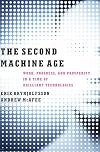
With the proper amounts of bombast and self-promotion, prophecy can be an extremely lucrative field. A lot of books about the future of American economic growth fall into either Stagnation or Singularity camps, trying to show that America's future potential is dismal due to the misguided economic philosophies of the ideological villains of your choice (see the New York Times or the Wall Street Journal's op-ed pages) or simple exhaustion of easy ways to generate sustained growth (see Robert show more Gordon or Tyler Cowen), or is actually spectacular due to the magical properties of game-changing innovation X, Y, or Z (see Ray Kurzweil). In contrast, Brynjolfsson and McAfee's earlier book Race Against the Machine was a sober, data-driven overview of what they thought the likely effects of increased automation on the labor force would be, with interesting case studies and plenty of good data. Its major flaw, in my view, was an ending solutions chapter that spent more time on perennial Silicon Valley wishlist items like reforming the patent system or allowing for more H1-B visas than on engaging with the political process. While those wishlist items haven't gone away, this sequel not only offers a greatly expanded take on their earlier analysis of technological progress, but a broader and more carefully thought-out list of possible solutions to problems that automation will cause for many workers even as the economy as a whole benefits greatly.
The first section of the book is devoted to the three characteristics of modern technological progress: exponential growth, large amounts of digitized information, and constant remixing of old ideas into new ones. From Google's self-driving cars, to Apple's Siri voice recognition system, to IBM's GeoFluent translation software, to IBM's Jeopardy!-beater Watson, and more, it's obvious that while artificial intelligence might have had limited progress for a long time, it's come very far, and further progress seems like it will come much more rapidly. This is the "second half of the chessboard" metaphor from their first book, taken from an Indian story about the inventor of chess, who asked for a seemingly-simple reward for his game from the emperor: one grain of rice on the first square of a chessboard, two on the second, four on the third, eight on the fourth, and so on. The emperor agreed, not realizing that while the amount of rice he'd have to hand out would be fairly manageable for the first half of the chessboard, by the second half he would be in real trouble. A classic example of this is Moore's Law, but in addition to semiconductor density, other measures like energy efficiency, hard drive cost per MB, and supercomputer speed also follow exponential growth patterns.
This allows for truly immense amounts of data to be processed, which enables all sorts of useful stuff that wasn't possible before. An example is Waze, a now Google-owned company which, thanks to large amounts of real-time input from its rapidly growing userbase, shows you the best route around traffic and makes traffic forecasts obsolete. The combination of network effects, lots of data, and the near-zero cost of reproducing or transferring that data, not only ensures that data scientists/analysts looking for hidden insights will have plenty to do, it also means there are plenty of opportunities to go back to old ideas and do something new with them. While plenty of modern innovations seem easy to scoff at - with Waze, for example, surely an app that speeds up my commute by 5 minutes can't really compare to the invention of the internal combustion engine - scientific fields are expanding so quickly that there are plenty of opportunities for many people to make small improvements that eventually add up to large rises in our standard of living.
The second section of the book explores bounty, their word for the value of goods and services this new Revolution has given us, and spread, their term for the distribution of that bounty. For a long time there's been a controversy over the seemingly-negligible part the IT revolution has played in the official measurement of official productivity and other economic statistics - individuals and firms have spent a lot of money on hardware and software, yet that investment, as measured by GDP growth or other measures of output growth per unit of input, has been unimpressive. Brynjolfsson and McAfee are firmly in the camp that holds that technology has improved life, it's just that official measures don't capture that very accurately. They compare the adoption rates of electricity to IT and find interesting similarities in how long it's taken for each to start showing up in the numbers, and also quote the famous Robert F Kennedy line about GDP, that it "measures everything, in short, except that which makes life worthwhile." They list four types of intangibles that won't show up in national accounting statistics: intellectual property, organizational capital, user-generated content, and human capital, and note that all of these have been exploding recently. To take one example, Wikipedia has been a death sentence for traditional encyclopedia makers, yet it's a non-profit website. In conventional GDP statistics, it has destroyed millions, perhaps billions of dollars, and yet it's been an enormous boon to everyone who wants to look something up quickly. Email has been bad for the post office. Skype is bad for phone companies. Music publishers hated Napster. And so forth.
All this consumer surplus is great, but it has consequences for where profits flow. We all enjoy bounty to some degree, but it's not spread very evenly. They use an example from the field of photography:
"While digitization has obviously increased the quantity and convenience of photography, it has also profoundly changed the economics of photography production and distribution. A team of just fifteen people at Instagram created a simple app that over 130 million customers use to share some sixteen billion photos (and counting). Within fifteen months of its founding, the company was sold for over $1 billion to Facebook. In turn, Facebook itself reached one billion users in 2012. It had about 4,600 employees including barely 1,000 engineers.
Contrast these figures with pre-digital behemoth Kodak, which also helped customers share billions of photos. Kodak employed 145,300 people at one point, one-third of them in Rochester, New York, while indirectly employing thousands more via the extensive supply chain and retail distribution channels required by companies in the first machine age. Kodak made its founder, George Eastman, a rich man, but it also provided middle-class jobs for generations of people and created a substantial share of the wealth created in the city of Rochester after company’s founding in 1880. But 132 years later, a few months before Instagram was sold to Facebook, Kodak filed for bankruptcy."
In other words, rather than benefit large numbers of people in many communities through plentiful jobs, profits are flowing increasingly to a few people in a few places like Silicon Valley. Anyone who paid any attention to the 2012 Presidential election is familiar with the notion that median wages have been stagnant or declining for many groups for quite a while, and net wealth has taken a shocking decrease since the Recession in particular:
"Between 1983 and 2009, Americans became vastly wealthier overall as the total value of their assets increased. However, as noted by economists Ed Wolff and Sylvia Allegretto, the bottom 80 percent of the income distribution actually saw a net decrease in their wealth. Taken as a group, the top 20 percent got not 100 percent of the increase, but more than 100 percent. Their gains included not only the trillions of dollars of wealth newly created in the economy but also some additional wealth that was shifted in their direction from the bottom 80 percent. The distribution was also highly skewed even among relatively wealthy people. The top 5 percent got 80 percent of the nation's wealth increase; the top 1 percent got over half of that, and so on for ever-finer subdivisions of the wealth distribution. In an oft-cited example, by 2010 the six heirs of Sam Walton’s fortune, earned when he created Walmart, had more net wealth than the bottom 40 percent of the income distribution in America. In part, this reflects the fact that thirteen million families had a negative net worth."
In English, that means all those Occupy Wall Street slogans about the 99% are more correct than their detractors would like to believe, but the overall picture is (slightly) more complex than "the 1% are stealing everything". Even beyond the decoupling of wages and productivity, there's been a global fall in the labor share of GDP, meaning that wealth is flowing more to owners of capital. In many sectors we now have a superstar economy, where there's enormous demand for a few popular things at the expense of many less-popular things. This entails a shift from returns for absolute performance (meaning that performing at 90% of the level of the best gets you 90% of the return) to returns for relative performance (meaning that no one wants the tenth-best app in whatever field, so you get nothing). This can be partially counteracted by long tail-type economies, which make it possible for relative low-performers to scrape by, but they're not very lucrative because of the power of network effects and technological lock-in. Even if Windows Phone is on paper basically just as good as iOS or Android, no one cares, and though everyone derives some benefit from the ubiquity of smartphones, profits in the industry flow to very few firms, and within those firms, even fewer people.
This shift from normal/Gaussian distributions of wealth and power to 80-20/power-law distributions is profound; Brynjolfsson and McAfee cite Acemoglu and Robinson's work in Why Nations Fail on the relationship between political institutions and economic distributions, and how exclusive political systems that are set up for the convenience of a small elite not only don't grow very fast but are also terrible places to live for the masses. I would have liked to see them address Paul Krugman's points in The Conscience of a Liberal about how political movements can drive and encourage this re-peasantization process, though I can understand their desire to avoid seeming too strongly partisan or ideological. Tyler Cowen's recent Average Is Over was a good example of how to be too ideological in the wrong direction about these same concerns, arguing that this return to the Gilded Age will be much more pleasant than the original Gilded Age. Sure, large numbers of people will be permanently excluded from labor markets and won't be able to meaningfully participate in the political process, but all the cool new technology means that that won't be so bad, or at least not bad enough to get too upset about.
Unfortunately, Brynjolfsson and McAfee's take on the question of what happens when automation starts to put significant numbers of people permanently out of work is more pessimistic. Even though people have scoffed at this vision of technological unemployment for hundreds of years (see the history of the Luddites and the "lump of labor" fallacy), this time could be different. There are three possible mechanisms for destroying jobs in this way: inelastic demand for goods (this could actually be good, as people would be able to voluntarily choose to work less while still producing the same amount of output), too-rapid change (it might simply take too long to re-skill certain types of workers), and severe skill inequality (some people will just never be able to produce value greater than what a machine could do). This new permanent underclass will be subject to the sorts of social pathologies that got people transported to Australia in past eras, but options in the future will obviously be somewhat more limited. Ironically, the kinds of jobs easiest to automate are also the kinds easiest to offshore, so America might get a breather from offshoring and be able to watch and learn from what happens as large-scale automation in companies like Foxconn gets field-tested overseas before coming here. Of course, Freestyle chess, where humans and computers collaborate to accomplish goals, could be a model for the economy as a whole, but it seems more likely that many people will simply be automated out of a job and left to their own devices.
In the third section they have two groups of solutions, of which the first recapitulates much from Race Against the Machine. In the short-term:
1. Teach the children well
- Use MOOCs, which are both cheaper and provide more opportunities for data-driven feedback
- Raise teacher salaries in exchange for more accountability, coupled with longer school days and a longer school year
2. Restart startups
- Startups provide most new net jobs, but the rate of new startup formation is dropping quickly. "Regulations" might be to blame
3. Make more matches
- Do a better job of matching workers to prospective jobs to reduce frictional unemployment as much as possible
4. Support our scientists
- Reform intellectual property laws by lessening absurdly long copyright terms
- Offer more prizes for research goals, to bring in people who don't fit into the regular grant process mold
5. Upgrade infrastructure/human capital
- There's lots of externalities to improving our terrible infrastructure, even beyond arguments about Keynesian stimulus
- Welcome more high-skill immigrants who are currently going to other countries, and also reform the byzantine/broken immigration process
6. Tax wisely
- More Pigovian taxes that tax bad things, like congestion or pollution taxes
- Consider a land tax or a VAT to fund social programs instead of relying on labor taxes
- More taxes on being a superstar, like higher tax brackets
The second group is new, and to my mind more adequate to the scale of the issues raised previously in the book. In the long-term:
- Build on capitalism and unlimited technological progress without abandoning or attempting to fundamentally restrain either
- Consider a Universal Basic Income, to prevent Voltaire's social ills of "boredom, vice, and want"
- Alternatively, consider a Negative Income Tax like a greatly expanded EITC to encourage work
- Find better ways to use the strengths of humans and machines together, as in Amazon's Mechanical Turk
- Bring marginal people into the labor force via the peer economy, e.g. TaskRabbit, Airbnb, Lyft
- Encourage new ideas (a national mutual fund, designate some jobs "human-only", institute "made by people" labeling similar to that for organic foods, use massive federal hiring a la the Civilian Conservation Corps)
Unfortunately they don't offer much in the way of suggestions on how to move these ideas though Washington. Hey, they're nerds, not lobbyists! Well, any book that attempts to grapple with the consequences of something as world-changing as artificial intelligence on a large scale should certainly be able to offer some pointers on how to get the Republican Party to start offering real solutions to problems that don't boil down to tax cuts for the rich. This kind of naivete is unsurprising, yet still disappointing coming from such smart guys. The additional analysis in the first two sections and the broader range of solutions in the third means that this is a much more complete and useful book than its predecessor was, and while I certainly wouldn't say that this is the final word on the possibilities and pitfalls of large-scale automation, it's as good a starting point as you're likely to find for a while. show less
The first section of the book is devoted to the three characteristics of modern technological progress: exponential growth, large amounts of digitized information, and constant remixing of old ideas into new ones. From Google's self-driving cars, to Apple's Siri voice recognition system, to IBM's GeoFluent translation software, to IBM's Jeopardy!-beater Watson, and more, it's obvious that while artificial intelligence might have had limited progress for a long time, it's come very far, and further progress seems like it will come much more rapidly. This is the "second half of the chessboard" metaphor from their first book, taken from an Indian story about the inventor of chess, who asked for a seemingly-simple reward for his game from the emperor: one grain of rice on the first square of a chessboard, two on the second, four on the third, eight on the fourth, and so on. The emperor agreed, not realizing that while the amount of rice he'd have to hand out would be fairly manageable for the first half of the chessboard, by the second half he would be in real trouble. A classic example of this is Moore's Law, but in addition to semiconductor density, other measures like energy efficiency, hard drive cost per MB, and supercomputer speed also follow exponential growth patterns.
This allows for truly immense amounts of data to be processed, which enables all sorts of useful stuff that wasn't possible before. An example is Waze, a now Google-owned company which, thanks to large amounts of real-time input from its rapidly growing userbase, shows you the best route around traffic and makes traffic forecasts obsolete. The combination of network effects, lots of data, and the near-zero cost of reproducing or transferring that data, not only ensures that data scientists/analysts looking for hidden insights will have plenty to do, it also means there are plenty of opportunities to go back to old ideas and do something new with them. While plenty of modern innovations seem easy to scoff at - with Waze, for example, surely an app that speeds up my commute by 5 minutes can't really compare to the invention of the internal combustion engine - scientific fields are expanding so quickly that there are plenty of opportunities for many people to make small improvements that eventually add up to large rises in our standard of living.
The second section of the book explores bounty, their word for the value of goods and services this new Revolution has given us, and spread, their term for the distribution of that bounty. For a long time there's been a controversy over the seemingly-negligible part the IT revolution has played in the official measurement of official productivity and other economic statistics - individuals and firms have spent a lot of money on hardware and software, yet that investment, as measured by GDP growth or other measures of output growth per unit of input, has been unimpressive. Brynjolfsson and McAfee are firmly in the camp that holds that technology has improved life, it's just that official measures don't capture that very accurately. They compare the adoption rates of electricity to IT and find interesting similarities in how long it's taken for each to start showing up in the numbers, and also quote the famous Robert F Kennedy line about GDP, that it "measures everything, in short, except that which makes life worthwhile." They list four types of intangibles that won't show up in national accounting statistics: intellectual property, organizational capital, user-generated content, and human capital, and note that all of these have been exploding recently. To take one example, Wikipedia has been a death sentence for traditional encyclopedia makers, yet it's a non-profit website. In conventional GDP statistics, it has destroyed millions, perhaps billions of dollars, and yet it's been an enormous boon to everyone who wants to look something up quickly. Email has been bad for the post office. Skype is bad for phone companies. Music publishers hated Napster. And so forth.
All this consumer surplus is great, but it has consequences for where profits flow. We all enjoy bounty to some degree, but it's not spread very evenly. They use an example from the field of photography:
"While digitization has obviously increased the quantity and convenience of photography, it has also profoundly changed the economics of photography production and distribution. A team of just fifteen people at Instagram created a simple app that over 130 million customers use to share some sixteen billion photos (and counting). Within fifteen months of its founding, the company was sold for over $1 billion to Facebook. In turn, Facebook itself reached one billion users in 2012. It had about 4,600 employees including barely 1,000 engineers.
Contrast these figures with pre-digital behemoth Kodak, which also helped customers share billions of photos. Kodak employed 145,300 people at one point, one-third of them in Rochester, New York, while indirectly employing thousands more via the extensive supply chain and retail distribution channels required by companies in the first machine age. Kodak made its founder, George Eastman, a rich man, but it also provided middle-class jobs for generations of people and created a substantial share of the wealth created in the city of Rochester after company’s founding in 1880. But 132 years later, a few months before Instagram was sold to Facebook, Kodak filed for bankruptcy."
In other words, rather than benefit large numbers of people in many communities through plentiful jobs, profits are flowing increasingly to a few people in a few places like Silicon Valley. Anyone who paid any attention to the 2012 Presidential election is familiar with the notion that median wages have been stagnant or declining for many groups for quite a while, and net wealth has taken a shocking decrease since the Recession in particular:
"Between 1983 and 2009, Americans became vastly wealthier overall as the total value of their assets increased. However, as noted by economists Ed Wolff and Sylvia Allegretto, the bottom 80 percent of the income distribution actually saw a net decrease in their wealth. Taken as a group, the top 20 percent got not 100 percent of the increase, but more than 100 percent. Their gains included not only the trillions of dollars of wealth newly created in the economy but also some additional wealth that was shifted in their direction from the bottom 80 percent. The distribution was also highly skewed even among relatively wealthy people. The top 5 percent got 80 percent of the nation's wealth increase; the top 1 percent got over half of that, and so on for ever-finer subdivisions of the wealth distribution. In an oft-cited example, by 2010 the six heirs of Sam Walton’s fortune, earned when he created Walmart, had more net wealth than the bottom 40 percent of the income distribution in America. In part, this reflects the fact that thirteen million families had a negative net worth."
In English, that means all those Occupy Wall Street slogans about the 99% are more correct than their detractors would like to believe, but the overall picture is (slightly) more complex than "the 1% are stealing everything". Even beyond the decoupling of wages and productivity, there's been a global fall in the labor share of GDP, meaning that wealth is flowing more to owners of capital. In many sectors we now have a superstar economy, where there's enormous demand for a few popular things at the expense of many less-popular things. This entails a shift from returns for absolute performance (meaning that performing at 90% of the level of the best gets you 90% of the return) to returns for relative performance (meaning that no one wants the tenth-best app in whatever field, so you get nothing). This can be partially counteracted by long tail-type economies, which make it possible for relative low-performers to scrape by, but they're not very lucrative because of the power of network effects and technological lock-in. Even if Windows Phone is on paper basically just as good as iOS or Android, no one cares, and though everyone derives some benefit from the ubiquity of smartphones, profits in the industry flow to very few firms, and within those firms, even fewer people.
This shift from normal/Gaussian distributions of wealth and power to 80-20/power-law distributions is profound; Brynjolfsson and McAfee cite Acemoglu and Robinson's work in Why Nations Fail on the relationship between political institutions and economic distributions, and how exclusive political systems that are set up for the convenience of a small elite not only don't grow very fast but are also terrible places to live for the masses. I would have liked to see them address Paul Krugman's points in The Conscience of a Liberal about how political movements can drive and encourage this re-peasantization process, though I can understand their desire to avoid seeming too strongly partisan or ideological. Tyler Cowen's recent Average Is Over was a good example of how to be too ideological in the wrong direction about these same concerns, arguing that this return to the Gilded Age will be much more pleasant than the original Gilded Age. Sure, large numbers of people will be permanently excluded from labor markets and won't be able to meaningfully participate in the political process, but all the cool new technology means that that won't be so bad, or at least not bad enough to get too upset about.
Unfortunately, Brynjolfsson and McAfee's take on the question of what happens when automation starts to put significant numbers of people permanently out of work is more pessimistic. Even though people have scoffed at this vision of technological unemployment for hundreds of years (see the history of the Luddites and the "lump of labor" fallacy), this time could be different. There are three possible mechanisms for destroying jobs in this way: inelastic demand for goods (this could actually be good, as people would be able to voluntarily choose to work less while still producing the same amount of output), too-rapid change (it might simply take too long to re-skill certain types of workers), and severe skill inequality (some people will just never be able to produce value greater than what a machine could do). This new permanent underclass will be subject to the sorts of social pathologies that got people transported to Australia in past eras, but options in the future will obviously be somewhat more limited. Ironically, the kinds of jobs easiest to automate are also the kinds easiest to offshore, so America might get a breather from offshoring and be able to watch and learn from what happens as large-scale automation in companies like Foxconn gets field-tested overseas before coming here. Of course, Freestyle chess, where humans and computers collaborate to accomplish goals, could be a model for the economy as a whole, but it seems more likely that many people will simply be automated out of a job and left to their own devices.
In the third section they have two groups of solutions, of which the first recapitulates much from Race Against the Machine. In the short-term:
1. Teach the children well
- Use MOOCs, which are both cheaper and provide more opportunities for data-driven feedback
- Raise teacher salaries in exchange for more accountability, coupled with longer school days and a longer school year
2. Restart startups
- Startups provide most new net jobs, but the rate of new startup formation is dropping quickly. "Regulations" might be to blame
3. Make more matches
- Do a better job of matching workers to prospective jobs to reduce frictional unemployment as much as possible
4. Support our scientists
- Reform intellectual property laws by lessening absurdly long copyright terms
- Offer more prizes for research goals, to bring in people who don't fit into the regular grant process mold
5. Upgrade infrastructure/human capital
- There's lots of externalities to improving our terrible infrastructure, even beyond arguments about Keynesian stimulus
- Welcome more high-skill immigrants who are currently going to other countries, and also reform the byzantine/broken immigration process
6. Tax wisely
- More Pigovian taxes that tax bad things, like congestion or pollution taxes
- Consider a land tax or a VAT to fund social programs instead of relying on labor taxes
- More taxes on being a superstar, like higher tax brackets
The second group is new, and to my mind more adequate to the scale of the issues raised previously in the book. In the long-term:
- Build on capitalism and unlimited technological progress without abandoning or attempting to fundamentally restrain either
- Consider a Universal Basic Income, to prevent Voltaire's social ills of "boredom, vice, and want"
- Alternatively, consider a Negative Income Tax like a greatly expanded EITC to encourage work
- Find better ways to use the strengths of humans and machines together, as in Amazon's Mechanical Turk
- Bring marginal people into the labor force via the peer economy, e.g. TaskRabbit, Airbnb, Lyft
- Encourage new ideas (a national mutual fund, designate some jobs "human-only", institute "made by people" labeling similar to that for organic foods, use massive federal hiring a la the Civilian Conservation Corps)
Unfortunately they don't offer much in the way of suggestions on how to move these ideas though Washington. Hey, they're nerds, not lobbyists! Well, any book that attempts to grapple with the consequences of something as world-changing as artificial intelligence on a large scale should certainly be able to offer some pointers on how to get the Republican Party to start offering real solutions to problems that don't boil down to tax cuts for the rich. This kind of naivete is unsurprising, yet still disappointing coming from such smart guys. The additional analysis in the first two sections and the broader range of solutions in the third means that this is a much more complete and useful book than its predecessor was, and while I certainly wouldn't say that this is the final word on the possibilities and pitfalls of large-scale automation, it's as good a starting point as you're likely to find for a while. show less
Lists
Awards


You May Also Like


Associated Authors
Statistics
- Works
- 19
- Also by
- 2
- Members
- 1,634
- Popularity
- #15,723
- Rating
- 3.7
- Reviews
- 50
- ISBNs
- 67
- Languages
- 12
- Favorited
- 1