

Hildegarde H. Swift (1890–1977)
Author of The Little Red Lighthouse and the Great Gray Bridge
About the Author
Works by Hildegarde H. Swift
Tagged
Common Knowledge
- Legal name
- Swift, Hildegarde Hoyt
- Other names
- Hoyt, Hildegarde (birth)
- Birthdate
- 1890-01-10
- Date of death
- 1977-01-10
- Gender
- female
- Education
- Smith College
New York School of Social Work - Nationality
- USA
- Birthplace
- Clinton, New York, USA
- Place of death
- Redlands, California, USA
- Associated Place (for map)
- USA
Members
Reviews

The Little Red Lighthouse stood on the banks of the mighty Hudson River, guiding the boats on that massive waterway as they passed the island of Manhattan. Proud of his work, the lighthouse shone his light at night and sounded his warning bell in the fog, keeping everyone safe. When the Great Gray Bridge is constructed right next to him, our lighthouse finds himself dwarfed, and begins to feel that he has no purpose. But when a tug-boat gets in trouble in the fog, it turns out that the show more lights on the bridge are too high up to be of use to those on the water. The lighthouse is needed after all...
Originally published in 1942, and a classic of American children's literature ever since, The Little Red Lighthouse and the Great Gray Bridge is one of those books I somehow missed reading as a child, and have been meaning to get to as an adult for many years. I have read author Hildegarde H Swift's Newbery Honor book, Little Blacknose: The Story of a Pioneer, but not this one, even though I have lived a few blocks from the eponymous lighthouse and bridge for a number of years. Finally, prompted by the fact that a friend an I will be visiting both this coming weekend, I picked it up. How glad I am that I did. I found Swift's story poignant and her writing lovely, and I found illustrator Lynd Ward's watercolor artwork gorgeously expressive. This is definitely a book that deserves its status as a classic, and is one that I wholeheartedly recommend, to those looking for picture-books about lighthouses, about the need to feel needed, or about the utility of older, more traditional ways of doings things, even when newer ones have been invented. show less
Originally published in 1942, and a classic of American children's literature ever since, The Little Red Lighthouse and the Great Gray Bridge is one of those books I somehow missed reading as a child, and have been meaning to get to as an adult for many years. I have read author Hildegarde H Swift's Newbery Honor book, Little Blacknose: The Story of a Pioneer, but not this one, even though I have lived a few blocks from the eponymous lighthouse and bridge for a number of years. Finally, prompted by the fact that a friend an I will be visiting both this coming weekend, I picked it up. How glad I am that I did. I found Swift's story poignant and her writing lovely, and I found illustrator Lynd Ward's watercolor artwork gorgeously expressive. This is definitely a book that deserves its status as a classic, and is one that I wholeheartedly recommend, to those looking for picture-books about lighthouses, about the need to feel needed, or about the utility of older, more traditional ways of doings things, even when newer ones have been invented. show less
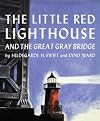
Once upon a time, there was a picture book about a real little red lighthouse. Some time later, well after the book’s publication, when it was announced that the lighthouse would be razed, there was an outpouring of letters from children who had read the book and had grown to love the little beacon. So many letters, in fact, that the decision was reversed, and the lighthouse still stands to this day.
This, then, is the picture book that saved the lighthouse.
Swift has penned a lovely story show more about a very proud and useful lighthouse whose world is turned upside down when it is dwarfed by a gigantic bridge. Although the premise is simple, the story is quite memorable. The book’s text and images both explore the little tower’s very human emotions as it tries to understand itself in its changed environment. There is also room for both empathy and healing, here, and help from an unexpected source. I won’t spoil the ending here, but there it’s wonderful, heartwarming and emotionally satisfying. show less
This, then, is the picture book that saved the lighthouse.
Swift has penned a lovely story show more about a very proud and useful lighthouse whose world is turned upside down when it is dwarfed by a gigantic bridge. Although the premise is simple, the story is quite memorable. The book’s text and images both explore the little tower’s very human emotions as it tries to understand itself in its changed environment. There is also room for both empathy and healing, here, and help from an unexpected source. I won’t spoil the ending here, but there it’s wonderful, heartwarming and emotionally satisfying. show less

This book is more than twice my age. Heck even the reprint I was reading was older than I am. But the story holds up. Even the artwork, ,while dated, still tells the story of the little red lighthouse who thought his proud days of helping boats was over because of the big steel bridge. It makes me wonder if now, almost 80 years later, that lighthouse is still standing?

The first steam locomotive to be operated in the state of New York, and the fourth to be built in the United States (parts of it were cast at the West Point Foundry, in Cold Spring), the DeWitt Clinton - named for the sixth governor of New York State, who was responsible for the construction of the Erie Canal - made its debut in 1831, as part of the Mohawk and Hudson Railroad. With its carriages strung along behind, it is probably not quite what most people have in mind, when they think of show more the steam-powered trains of the nineteenth century, but then, as the sub-title of Hildegarde Hoyt Swift's Little Blacknose makes clear, the DeWitt Clinton was a pioneer.
One of six titles chosen to receive a Newbery Honor, in 1930 - the others include: A Daughter of the Seine: The Life of Madame Roland, Pran of Albania, The Jumping-Off Place, The Tangle-Coated Horse and Other Tales: Episodes from the Fionn Saga, and Vaino: A Boy of New Finland - this brief book is a fictionalized "biography" of the DeWitt Clinton, told from his perspective, and following his story from his early days in the foundry, through the glories of his first exhibition, his years shuttling back and forth between Albany and Schenectady, his retirement to a dusty storeroom, his rehabilitation for the Chicago World's Fair in 1893, and his eventual display in New York City's Grand Central Station.
In between is plenty of anthropomorphic hand-wringing, as DeWitt Clinton alternately resents or triumphs over the horses he replaces, as well as his fellow engine, and eventual friend, John Bull (a locomotive made in England). Ironically, since the conclusion of the tale sees him happily ensconced at Grand Central, and spared the horror of the scrap pile, the real DeWitt Clinton was scrapped, and a replica of him built for the World Fair, and for display at Grand Central. Leaving that aside, while I can see Little Blacknose: The Story of a Pioneer having some interest for train enthusiasts, and New York State history buffs (not to mention Newbery completists like myself), I don't think it is that engaging, in and of itself. I found the narration a little irritating, and just didn't identify that much with the protagonist's trials and tribulations. show less
One of six titles chosen to receive a Newbery Honor, in 1930 - the others include: A Daughter of the Seine: The Life of Madame Roland, Pran of Albania, The Jumping-Off Place, The Tangle-Coated Horse and Other Tales: Episodes from the Fionn Saga, and Vaino: A Boy of New Finland - this brief book is a fictionalized "biography" of the DeWitt Clinton, told from his perspective, and following his story from his early days in the foundry, through the glories of his first exhibition, his years shuttling back and forth between Albany and Schenectady, his retirement to a dusty storeroom, his rehabilitation for the Chicago World's Fair in 1893, and his eventual display in New York City's Grand Central Station.
In between is plenty of anthropomorphic hand-wringing, as DeWitt Clinton alternately resents or triumphs over the horses he replaces, as well as his fellow engine, and eventual friend, John Bull (a locomotive made in England). Ironically, since the conclusion of the tale sees him happily ensconced at Grand Central, and spared the horror of the scrap pile, the real DeWitt Clinton was scrapped, and a replica of him built for the World Fair, and for display at Grand Central. Leaving that aside, while I can see Little Blacknose: The Story of a Pioneer having some interest for train enthusiasts, and New York State history buffs (not to mention Newbery completists like myself), I don't think it is that engaging, in and of itself. I found the narration a little irritating, and just didn't identify that much with the protagonist's trials and tribulations. show less
Lists
Awards


You May Also Like


Associated Authors
Statistics
- Works
- 12
- Members
- 1,744
- Popularity
- #14,746
- Rating
- 4.0
- Reviews
- 21
- ISBNs
- 36