
Philip Ball
Author of Critical Mass: How One Thing Leads to Another
About the Author
Philip Ball is a freelance writer who lives in London. He worked for over twenty years as an editor for Nature, writes regularly in the scientific and popular media, and has authored many books on the interactions of the sciences, the arts, and the wider culture, including, most recently, Serving show more the Reich: The Struggle for the Soul of Physics under Hitler, also published by the University of Chicago Press. show less
Series
Works by Philip Ball
The Devil's Doctor: Paracelsus and the World of Renaissance Magic and Science (2006) 316 copies, 7 reviews
Beyond Weird: Why Everything You Thought You Knew about Quantum Physics Is Different (2018) 282 copies, 14 reviews
The Book of Minds: How to Understand Ourselves and Other Beings, from Animals to AI to Aliens (2022) 106 copies, 1 review
The Modern Myths: Adventures in the Machinery of the Popular Imagination (2021) 89 copies, 6 reviews
Alchemy: An Illustrated History of Elixirs, Experiments, and the Birth of Modern Science (2025) 24 copies
Why Society is a Complex Matter: Meeting Twenty-first Century Challenges with a New Kind of Science (2012) 19 copies
Associated Works
Seeing Further: The Story of Science, Discovery, and the Genius of the Royal Society (2010) — Contributor — 1,155 copies, 19 reviews
The New Science of Strong Materials or Why You Don't Fall through the Floor (1968) — Introduction, some editions — 452 copies, 6 reviews
Time unwrapped : kings place : programme 2018 — Contributor — 1 copy
Tagged
Common Knowledge
- Birthdate
- 1962
- Gender
- male
- Education
- University of Oxford
University of Bristol (PhD, physics) - Occupations
- science writer
- Organizations
- Nature (editor)
- Nationality
- UK
- Places of residence
- London, England, UK
- Map Location
- England, UK
Members
Reviews

This is, I think, the book on quantum mechanics I've been wanting to read for 15 years—though my ability to embrace it may be due to my experience with the less-comprehensive titles I've read in the meantime. Superb, even if I did get snarled once or twice in Ball's explanations of experiments.
Interesting, though, how many shades of Kant and Wittgenstein I kept encountering. I'm not sure if that's because they've greatly influenced quantum physicists, Ball, or if I just saw them because I show more love them so much (in true what-I-measure-affects-what-I-see quantum style).
I also had the thought whilst reading that instead of us measuring the universe, perhaps the universe is measuring us...and trying all the time to tell us what it sees in ways we can comprehend. show less
Interesting, though, how many shades of Kant and Wittgenstein I kept encountering. I'm not sure if that's because they've greatly influenced quantum physicists, Ball, or if I just saw them because I show more love them so much (in true what-I-measure-affects-what-I-see quantum style).
I also had the thought whilst reading that instead of us measuring the universe, perhaps the universe is measuring us...and trying all the time to tell us what it sees in ways we can comprehend. show less
Io adoro Philip Ball, è uno scrittore che sa il fatto suo e scrive di scienza come se fosse un lungo e appassionante romanzo. In italiano, per lo meno, i libri di argomento chimico sono pochi, e questo riesce da solo a coprire molti, molti buchi. Le storie su alcuni degli elementi della tavola periodica sono divertenti, interessanti, talvolta esilaranti, tutte istruttive e, il che non guasta, scritte veramente bene.

Quantum theory, which deals with the world at its smallest-known scale, always gives me the feeling that someone somewhere is cheating, sort of moving the goalposts about to suit themselves. First it means one thing, then it means something else (except when it doesn’t of course), and so on. But I also know that that’s because I haven’t understood it. Beyond Weird is an attempt at setting straight all the misconceptions there are about this subject, and in particular the greatest one show more of all, namely, that things down at the sub-atomic level are “weird”. That’s what “Beyond Weird” means: not “even stranger than weird”, but rather, getting past the idea that it’s weird at all and seeing that, in fact, it’s anything but.
For a start, the writing here is exceptional, so clear and comprehensible it’s almost as if the guy is sitting in a chair opposite you explaining it in person—one of the best pieces of science-writing I’ve come across. It’s non-mathematical, yet goes into real depth (and is up to date too, or 2019 at least). Also, unlike so many other books on the subject, this is not so much an exhaustive round-up of the details, but more about their interpretation overall, how on earth we make some kind of sense of them. Such as: that quantum objects can be both waves and particles; can simultaneously be both here and there; can affect one another instantly across vast distances; and that you can’t observe them without changing them. “Quantum mechanics might seem ‘weird’, but it is not illogical. It’s just that it employs a new and unfamiliar logic. If you can grasp it…then the quantum world may stop seeming weird and become just another place, with different customs and traditions and with its own beautiful internal consistency…”
And above all: “Such ‘paradoxes’ apparently permit the answers Yes and No simultaneously. Whatever we are to make of that, we must surely aspire to do better than shrug and call it ‘weird’.” show less
For a start, the writing here is exceptional, so clear and comprehensible it’s almost as if the guy is sitting in a chair opposite you explaining it in person—one of the best pieces of science-writing I’ve come across. It’s non-mathematical, yet goes into real depth (and is up to date too, or 2019 at least). Also, unlike so many other books on the subject, this is not so much an exhaustive round-up of the details, but more about their interpretation overall, how on earth we make some kind of sense of them. Such as: that quantum objects can be both waves and particles; can simultaneously be both here and there; can affect one another instantly across vast distances; and that you can’t observe them without changing them. “Quantum mechanics might seem ‘weird’, but it is not illogical. It’s just that it employs a new and unfamiliar logic. If you can grasp it…then the quantum world may stop seeming weird and become just another place, with different customs and traditions and with its own beautiful internal consistency…”
And above all: “Such ‘paradoxes’ apparently permit the answers Yes and No simultaneously. Whatever we are to make of that, we must surely aspire to do better than shrug and call it ‘weird’.” show less
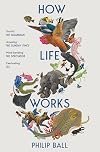
An expansive, enjoyable criticism of conceptual problems in biology. Ball starts with some popular metaphors and models – DNA as blueprint, cell as factory, living systems as machines – and shows how these are all seriously misleading, and why it matters.
There are strange gaps: symbiosis is hardly mentioned, for instance. But the book does a good job of explaining clearly, in nuts and bolts fashion, where and how agency might arise in living systems, without recourse to the taboo spectre show more of teleology.
It gets technical – I might have struggled without a background in microbiology, genetics, and biochemistry – but that complexity is partly the point. Lay readers generally don't have a solid sense of how absurdly complicated cell biology is, and the way Ball's book breaks it down will surely deepen appreciation for just how astonishing even the simplest living creatures are. show less
There are strange gaps: symbiosis is hardly mentioned, for instance. But the book does a good job of explaining clearly, in nuts and bolts fashion, where and how agency might arise in living systems, without recourse to the taboo spectre show more of teleology.
It gets technical – I might have struggled without a background in microbiology, genetics, and biochemistry – but that complexity is partly the point. Lay readers generally don't have a solid sense of how absurdly complicated cell biology is, and the way Ball's book breaks it down will surely deepen appreciation for just how astonishing even the simplest living creatures are. show less
Lists
Awards


You May Also Like


Associated Authors
Statistics
- Works
- 41
- Also by
- 6
- Members
- 6,159
- Popularity
- #3,992
- Rating
- 3.8
- Reviews
- 109
- ISBNs
- 232
- Languages
- 14
- Favorited
- 10


