
Winfred Philipp Lehmann (1916–2007)
Author of Historical Linguistics: An Introduction
About the Author
Works by Winfred Philipp Lehmann
Studies in descriptive and historical linguistics festschrift for Winfred P. Lehmann (1975) 7 copies
Language typology 1987 : systematic balance in language : papers from the Linguistic Typology Symposium, Berkeley, 1-3 December 1987 (1990) — Editor — 3 copies
Language typology 1985 papers from the Linguistic Typology Symposium, Moscow, 9-13 December 1985 (1986) — Editor — 2 copies
A Grammar of Proto-Germanic 2 copies
Associated Works
Ancient Indo-European dialects: Proceedings of the Conference on Indo-European Linguistics held at the University of California,Los Angeles,April 25-27.1963 (1966) — Contributor — 8 copies
Bono Homini Donum : Essays in Historical Linguistics in Memory of J. Alexander Kerns (1981) — Contributor — 7 copies
Studies in diachronic, synchronic, and typological linguistics : festschrift for Oswald Szemerényi on the occasion of his 65th birthday (1979) — Contributor — 6 copies
Proto Indo European: The Archaeology of a Linguistic Problem : Studies in Honor of Marija Gimbutas (1987) — Contributor — 5 copies
Evidence and Counter-Evidence. Essays in Honour of Frederik Kortlandt: Volume 1: Balto-Slavic and Indo-European Linguistics. (Studies in Slavic and General Linguistics) (2008) — Contributor — 5 copies
Language in time and space a Festschrift for Werner Winter on the occasion of his 80th birthday (2003) — Contributor — 5 copies
Papers from the 7th International Conference on Historical Linguistics (1987) — Contributor — 5 copies
Functional approaches to language, culture, and cognition papers in honor of Sydney M. Lamb (2000) — Contributor — 4 copies
First person singular : papers from the Conference on an Oral Archive for the History of American Linguistics (Charlotte, N.C., 9-10 March 1979) (1980) — Contributor — 4 copies
Varia on the Indo-European Past: Papers in Memory of Marija Gimbutas (Journal of Indo-European Studies Monograph Series No. 19) (1997) — Contributor — 4 copies
Early Years in Machine Translation: Memoirs and biographies of pioneers (Studies in the History of the Language Sciences) (2000) — Contributor — 3 copies
Studies in Baltic and Indo-European linguistics : in honor of William R. Schmalstieg (2004) — Contributor — 2 copies
Historical, Indo-European, and lexicographical studies a festschrift for Ladislav Zgusta on the occasion of his 70th birthday (1996) — Contributor — 2 copies
Tagged
Common Knowledge
- Other names
- Lehmann, Winfred Philipp
- Birthdate
- 1916-06-23
- Date of death
- 2007-08-01
- Gender
- male
- Relationships
- Lehmann, Ruth P. M. (spouse)
- Nationality
- USA
- Birthplace
- Surprise, Nebraska, USA
- Place of death
- Austin, Texas, USA
- Associated Place (for map)
- USA
Members
Reviews

As the title says, this is an introduction to the subject of historical linguistics, the discipline that took off when European scholars and administrators like Willam Jones (Chief Judge in Calcutta) observed the similarities and parallels between Sanskrit and its descendats in India wih the classical languages like Greek and Latin, as well as contemporary languages of Europe. In course of time the whole gamut of languages oNorth India, Asia and Europe were classifies into different families show more and sub-families, with the implication that they all branched out from some parent language or bunch of dialects. The initial chapters, which talk of such relationships, are quite appealng, but the going gets a little tougher as the author gets into the details of sound change, grammar change, and so on, taking the European languages as examples. Of course this is a bit dated, although Lehmann is well known as a doyen of Indo-European comparative linguistics. I would have enjoyed it more if he had dwelt more on Indo-Iranian and its relation with Baltic and Slavic, which of course may not have been well researched at the time of this publication. show less
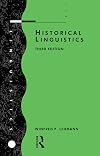
Heavy going for the non-academic reader, but worth the trudge -- though note that this was published in 1993, and there have been important developments in the field since then. The first part of this book is an overview of how research in historical linquistics is carried out: the second part looks at the various ways in which language change occurs.
Still interesting and mostly valid after all these years.
Una muy buena introducción a los problemas de la lingüística histórica, con ejemplos especialmente de lenguas indoeuropeas. Aunque publicado hace 50 años, tiene información muy valiosa. Habrá que complementarlo con tratamientos más contemporáneos.
Lists
You May Also Like


Associated Authors
Statistics
- Works
- 36
- Also by
- 19
- Members
- 509
- Popularity
- #48,720
- Rating
- 4.0
- Reviews
- 4
- ISBNs
- 52
- Languages
- 2