
Jerome J. McGann
Author of The New Oxford Book of Romantic Period Verse
About the Author
A leading scholar in fields ranging from eighteenth century to contemporary literature to the theory of textuality, Jerome McGann is the John Stewart Bryan University Professor at the University of Virginia, and founding fellow of UVA's Institute for Advanced Technology in the Humanities. The show more author or editor of thirty-one other books, McGann is also the Thomas Holloway Professor of Victorian Media and Culture, Royal Holloway College, University of London show less
Image credit: Transliteracies
Works by Jerome J. McGann
A New Republic of Letters: Memory and Scholarship in the Age of Digital Reproduction (2014) 38 copies
The Beauty of Inflections: Literary Investigations in Historical Method and Theory (Clarendon Paperbacks) (1985) 14 copies
The Point Is To Change It: Poetry and Criticism in the Continuing Present (Modern & Contemporary Poetics) (2007) 12 copies
Culture and Language at Crossed Purposes: The Unsettled Records of American Settlement (2022) 2 copies
Byron 1 copy
Associated Works
Lord Byron: The Major Works (Oxford World's Classics) (1986) — Editor, some editions — 888 copies, 4 reviews
TEXT : transactions of the Society for Textual Scholarship. 1, For 1981 (1984) — Contributor — 1 copy
Tagged
Common Knowledge
- Birthdate
- 1937-07-22
- Gender
- male
- Education
- Le Moyne College (B.S.|1959)
Syracuse University (M.A.|1962)
Yale University (Ph.D.|1966) - Occupations
- professor
textual scholar - Organizations
- University of Virginia
Caltech
American Academy of Arts and Sciences
Society for Textual Scholarship (President, 1995–1997)
Society for Critical Exchange (President, 2005-6)
Applied Research in Patacriticism (digital laboratory, founder) - Awards and honors
- Honorary Doctorate (University of Chicago, 1996)
Honorary Doctorate (University of Athens, 2009)
Melville Cane award (1973)
Keats-Shelley Association of America award (1989)
Byron Society of America Distinguished Scholar Award (1989);
Wilbur Cross Medal (1994) (show all 17)
Richard W. Lyman Award (for Distinguished Contributions to Humanities Computing, 2002)
Mellon Foundation Distinguished Achievement Award (2002)
Fulbright Fellow (1965–66)
American Philosophical Society Fellow (1967)
Guggenheim Fellow (1970–71, 1976–77)
NEH grants (1975-76, 1987–89, 2003–2006)
Getty Foundation grant
Delmas Foundation grant
Mellon Foundation grant
University of London. Institute of English Studies senior research fellow (1999- )
University College, London senior research fellow (2000- ) - Short biography
- Jerome John McGann (born July 22, 1937) is an American academic and textual scholar whose work focuses on the history of literature and culture from the late eighteenth century to the present. [from Wikipedia]
- Nationality
- USA
- Associated Place (for map)
- USA
Members
Reviews
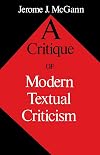
This is a well-written and cogent piece of work. The problem it addresses - how one conceives of the task of the editor as conditioned by how one views authorial composition - is refracted through various scholarly disagreements on editions of specific texts. At the time, for example, there was considerable controversy regarding the Hans Gabler Ulysses (not referenced, but very relevant, and about which McGann has written elsewhere); and the classic example is the presence of two endings to show more Great Expectations. The question of whether one is trying to recover a text reflecting "authorial intention" or something different, conditioned by either/both of a socially mediated agreement regarding a standard text (some versions become iconic, as with Auden's "September 1 1939"), or by a model of composition as collaborative, will not go away with modern texts.
The issues are closely related to the perspective shifts associated with the New Historicism and other forms of theory which stress the social context of and constraints on the author at a different level. McGann's work contributes to what was then (and continues to be) an ongoing debate about the place of the author as the sole composer of a work, or the author's intention as the sole lens through which to see it.
These problems do not tend to arise in textual criticism of older works, precisely because the editor can't get back that far: even recreating an O text, an original base of a tree, is plagued with difficulties. (Be it noted, though, that some MSS traditions where there are several substantive families, as with Piers Plowman, raise similar issues, but more focussed around reception.) show less
The issues are closely related to the perspective shifts associated with the New Historicism and other forms of theory which stress the social context of and constraints on the author at a different level. McGann's work contributes to what was then (and continues to be) an ongoing debate about the place of the author as the sole composer of a work, or the author's intention as the sole lens through which to see it.
These problems do not tend to arise in textual criticism of older works, precisely because the editor can't get back that far: even recreating an O text, an original base of a tree, is plagued with difficulties. (Be it noted, though, that some MSS traditions where there are several substantive families, as with Piers Plowman, raise similar issues, but more focussed around reception.) show less
For most people, textual criticism is a closed book. And this critique, sadly, will close it even further.
Let's define the term: Textual criticism is the attempt to figure out exactly what an author meant to write. For modern authors, it's essentially irrelevant; they turn in their Microsoft Word files and that's that -- the file is the book, except maybe for laying out the margins.
For writers who submitted typed pages, or manuscript copy, this was less true. And as for authors who wrote show more before the invention of printing, it's even less true. For the handful of people who know what textual criticism is, that's probably what they think of first: Trying to reconstruct the text of the Bible, or Chaucer, or Vergil. That is not what this book is about. It is about more recent books, published in the era of printing, when living authors frequently played a role in the publication of their works.
McGann certainly has a point in his argument (which, if I may simplify to the point of absurdity, is that everybody is trying to make textual criticism too simple). Many works have gone through multiple stages -- editions, revisions, high-quality publications and low. Each of these stages has a certain validity. A book which goes through multiple revisions does not have a single state that is "the book."
On the other hand, this idea can be taken too far. There has to be a standard. If someone refers to "Romeo and Juliet, Act V, scene 2, line 44," without specifying the edition, it's possible that two readers will go to different lines!
McGann would have us be aware that there is more to textual criticism than a final product. This is good. But, in struggling through this book, I never saw anything that he offered as an adequate substitute. True, I come from a background of classical textual criticism, not all this new-fangled stuff. But if a textual critic can't figure out where he is going -- well, either the point is too vague to be useful or it needs to be described more clearly. show less
Let's define the term: Textual criticism is the attempt to figure out exactly what an author meant to write. For modern authors, it's essentially irrelevant; they turn in their Microsoft Word files and that's that -- the file is the book, except maybe for laying out the margins.
For writers who submitted typed pages, or manuscript copy, this was less true. And as for authors who wrote show more before the invention of printing, it's even less true. For the handful of people who know what textual criticism is, that's probably what they think of first: Trying to reconstruct the text of the Bible, or Chaucer, or Vergil. That is not what this book is about. It is about more recent books, published in the era of printing, when living authors frequently played a role in the publication of their works.
McGann certainly has a point in his argument (which, if I may simplify to the point of absurdity, is that everybody is trying to make textual criticism too simple). Many works have gone through multiple stages -- editions, revisions, high-quality publications and low. Each of these stages has a certain validity. A book which goes through multiple revisions does not have a single state that is "the book."
On the other hand, this idea can be taken too far. There has to be a standard. If someone refers to "Romeo and Juliet, Act V, scene 2, line 44," without specifying the edition, it's possible that two readers will go to different lines!
McGann would have us be aware that there is more to textual criticism than a final product. This is good. But, in struggling through this book, I never saw anything that he offered as an adequate substitute. True, I come from a background of classical textual criticism, not all this new-fangled stuff. But if a textual critic can't figure out where he is going -- well, either the point is too vague to be useful or it needs to be described more clearly. show less
At 128 pages and with the imprimatur of a major university press, you'd think this would be a densely packed, closely reasoned analytical work, wouldn't you? Well, actually, it has the substance of an interesting blog post, while taking the form of an intellectual strip tease (one enticing promise of fulfillment is offered every page for the first two or three chapters) interspersed with some pretty extreme examples of donnish humor. The point is that, for modern literary productions (i.e. show more post 16th century), one does wrong to try to imagine there's such as thing as "authorial intention", whether an original intention or a final intention, since such concoctions are the consequence of the labors, ministrations and tampering of all sorts of people who have appropriated a certain amount of authority unto themselves, depending upon their role in what is considered the social enterprise of literary publication. Worth considering, of course, but not worth paying money for. Thank God for libraries. show less

Beautiful book. Cover is appropriate for the theme but I would've chosen something other than a male figure just to indulge the visual/imaginary of the reader. Maybe Jason and Medea by J. Waterhouse. Out of 80 or 81, 20 writers are female. Which may represent the true historic social context of the era. The selection is seemly and I felt immersed in the artistic, literary, musical, and intellectual movement of 18th century Europe.
Awards

You May Also Like


Associated Authors
Statistics
- Works
- 36
- Also by
- 15
- Members
- 887
- Popularity
- #28,886
- Rating
- 4.1
- Reviews
- 5
- ISBNs
- 73
- Favorited
- 1