
Robert Solé
Author of The Rosetta Stone
About the Author
Works by Robert Solé
Tagged
Common Knowledge
- Canonical name
- Solé, Robert
- Birthdate
- 1946
- Gender
- male
- Nationality
- France
- Birthplace
- Le Caire, Egypte
- Places of residence
- Rome, Italy
Paris, France - Map Location
- France
Members
Reviews
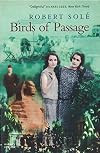
There was always something magnetic about those black Harvill spines (and their Maclehose successors), that still catches my eye when browsing shelves in second-hand bookshops. I picked this one up just before physical bookshops were closed for the latest Covid lockdown, despite knowing nothing about the book or the author, and very little about the community in which it is set, the "Syrian" merchants of Egypt (the family at the book's heart has more complex roots in Lebanon and Greece). It show more is a family story that starts before the first world war and ends after the Suez crisis, telling the story of a community that was increasingly unwelcome in Nasser's new Egypt.
The original French title of the book was "Le Tarbouche", and Georges Batrakani, the patriarch at the heart of the story and grandfather of the narrator, made most of his money by selling tarbooshes. The English title only appears in the final chapter. Much of the book reads like a collection of entertaining and slightly embellished anecdotes, but the portrait Solé paints is wide-ranging and I found the book very interesting. My only real criticism is that the female characters don't get much space. show less
The original French title of the book was "Le Tarbouche", and Georges Batrakani, the patriarch at the heart of the story and grandfather of the narrator, made most of his money by selling tarbooshes. The English title only appears in the final chapter. Much of the book reads like a collection of entertaining and slightly embellished anecdotes, but the portrait Solé paints is wide-ranging and I found the book very interesting. My only real criticism is that the female characters don't get much space. show less
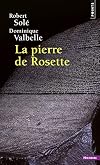
Popular in English as well as in original French, this is the memorable story of the trilingual inscribed stone, millennia old but rediscovered 1799 by the troops of Napoleon in Egypt, which helped decode the hieroglyphs of that ancient culture.
Mostly, it tells of the "meeting" of that one stone with one man, French Jean-Francois Champollion (1790-1832), the main interpreter of the intricate symbol structure & grammar behind the text, & thus known as a "father" of Egyptology. But there are show more important nuances in this book. It appears that far more people than Champollion contributed, & that much more text than one relic was needed for ancient Egypt to speak, once again, to him & to humankind.
Among other contributors to the interpretation, the English (who captured the Rosetta stone & hold it to this day at the British Museum) are justly proud of the versatile Thomas Young, but Scandinavians can take pride in the exceptional & essential earlier contributions of the Danes Fredrik Norden & Jørgen Zoega; of a Germano-Dane, Carsten Niebuhr; & of the Swede JD Akerblad. Decoding the hieroglyphs was, it turns out, a truly European enterprise, a focus of both Enlightenment & romanticism, hotly embraced by the learned community of its time. When Champollion died at 41, prematurely exhausted by his immense toil of insight, precision & rigour, he had scarcely wasted a minute of his short days, yet the hieroglyphs were still not adequately understood. This craved the rest of the 19th Century, & the work is by no means "complete" even today. The solemn idiom, marshaling a painfully elaborate mix of ideographic & phonetic devices, is not like its obvious classical opposite Latin, a more immediate language for us to approach. Even to learn it demands angelic patience from conscientious scholars. From that point of view - & only from that view, because the scope & richness of several thousand years of Egyptian is unfathomably vast - I resolved to stick with polishing my Latin. Not that I'm not otherwise tempted.
The book's authorship is the fertile collaboration of a French-Egyptian writer & intellectual (R Solé), with a full-blooded academic, holder of the Sorbonne's Egyptology professorship (D Valbelle). It strikes the exact measure between highly entertaining narrative & more scholarly, meaty material. Another desirable balance is between East & West, a popular issue these days. Ancient Egypt was neither because it still united both, which surely gives it tremendous force & application toward our own modern destiny.
This is a slim work, read in a few sessions, but it articulates a splendid tale resounding from an archaic, exalted past, as well as from the more recent emergence of scientific Europe. show less
Mostly, it tells of the "meeting" of that one stone with one man, French Jean-Francois Champollion (1790-1832), the main interpreter of the intricate symbol structure & grammar behind the text, & thus known as a "father" of Egyptology. But there are show more important nuances in this book. It appears that far more people than Champollion contributed, & that much more text than one relic was needed for ancient Egypt to speak, once again, to him & to humankind.
Among other contributors to the interpretation, the English (who captured the Rosetta stone & hold it to this day at the British Museum) are justly proud of the versatile Thomas Young, but Scandinavians can take pride in the exceptional & essential earlier contributions of the Danes Fredrik Norden & Jørgen Zoega; of a Germano-Dane, Carsten Niebuhr; & of the Swede JD Akerblad. Decoding the hieroglyphs was, it turns out, a truly European enterprise, a focus of both Enlightenment & romanticism, hotly embraced by the learned community of its time. When Champollion died at 41, prematurely exhausted by his immense toil of insight, precision & rigour, he had scarcely wasted a minute of his short days, yet the hieroglyphs were still not adequately understood. This craved the rest of the 19th Century, & the work is by no means "complete" even today. The solemn idiom, marshaling a painfully elaborate mix of ideographic & phonetic devices, is not like its obvious classical opposite Latin, a more immediate language for us to approach. Even to learn it demands angelic patience from conscientious scholars. From that point of view - & only from that view, because the scope & richness of several thousand years of Egyptian is unfathomably vast - I resolved to stick with polishing my Latin. Not that I'm not otherwise tempted.
The book's authorship is the fertile collaboration of a French-Egyptian writer & intellectual (R Solé), with a full-blooded academic, holder of the Sorbonne's Egyptology professorship (D Valbelle). It strikes the exact measure between highly entertaining narrative & more scholarly, meaty material. Another desirable balance is between East & West, a popular issue these days. Ancient Egypt was neither because it still united both, which surely gives it tremendous force & application toward our own modern destiny.
This is a slim work, read in a few sessions, but it articulates a splendid tale resounding from an archaic, exalted past, as well as from the more recent emergence of scientific Europe. show less
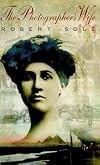
This is my second Robert Solé book - [b:Birds of Passage|1087389|Birds of Passage|Robert Solé|https://i.gr-assets.com/images/S/compressed.photo.goodreads.com/books/1180883389l/1087389._SX50_.jpg|4381276] was a serendipitous find in a second-hand shop that I enjoyed reading earlier in the year, and this book, which in some ways is even better, tells an earlier part of the same family's story, the focus being the late nineteenth century, when British influence in Egypt was growing even show more though Egypt was still nominally part of the Ottoman empire.
The book starts in 1891, when its central character Dora marries Emile Touta, who runs a small photographic studio. Dora takes an interest in the shop that eventually leads her to become a much better photographer than her husband, and the book explores the tensions this creates, alongside the wider political situations in Egypt and Sudan. As in Birds of Passage, I was left wondering how much of this is based on Sole's own family history and how much was invention, but overall it is a very enjoyable read. show less
The book starts in 1891, when its central character Dora marries Emile Touta, who runs a small photographic studio. Dora takes an interest in the shop that eventually leads her to become a much better photographer than her husband, and the book explores the tensions this creates, alongside the wider political situations in Egypt and Sudan. As in Birds of Passage, I was left wondering how much of this is based on Sole's own family history and how much was invention, but overall it is a very enjoyable read. show less
The Rosetta Stone: The Story of the Decoding of Hieroglyphics: The Story of the Decoding of Egyptian Hieroglyphics by Robert Solé
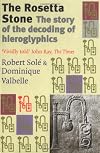
Erudite but engaging. Treads a delicate balance between the discoveries of Young and Champollion.
Awards


You May Also Like


Associated Authors
Statistics
- Works
- 40
- Members
- 578
- Popularity
- #43,350
- Rating
- 3.8
- Reviews
- 15
- ISBNs
- 71
- Languages
- 6
- Favorited
- 1