
William Bonner
Author of Empire of Debt: The Rise of an Epic Financial Crisis
About the Author
Works by William Bonner
Mobs, Messiahs, and Markets: Surviving the Public Spectacle in Finance and Politics (2007) 157 copies, 2 reviews
Financial Reckoning Day: Surviving the Soft Depression of the 21st Century (2003) 76 copies, 2 reviews
Family Fortunes: How to Build Family Wealth and Hold on to It for 100 Years (2012) 55 copies, 1 review
Tagged
Common Knowledge
- Other names
- Bonner, Bill
- Birthdate
- 1948
- Gender
- male
- Occupations
- journalist
- Nationality
- USA
- Associated Place (for map)
- USA
Members
Reviews
Financial Reckoning Day: Surviving the Soft Depression of the 21st Century (Agora Series) by William Bonner
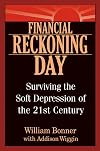
A compelling (though by now dated) history of the modern financial system up to the Greenspan era. W. Bonner demonstrates a knack for establishing panoramic historical perspectives relating to the contemporary financial fiat/fractional reserve banking system.
Also a surprisingly philosophical book. The author frequently reconciles some rather pessimistic political and economic realities with a Stoic or perhaps even Epicurean mentality, as the delightfully bold final lines of the book show more demonstrates.
"Financial Reckoning" is the product of a deep thinker. Bonner is clearly a man grappling with the historical and philosophical implications of the present order's slow but inevitable death. show less
Also a surprisingly philosophical book. The author frequently reconciles some rather pessimistic political and economic realities with a Stoic or perhaps even Epicurean mentality, as the delightfully bold final lines of the book show more demonstrates.
"Financial Reckoning" is the product of a deep thinker. Bonner is clearly a man grappling with the historical and philosophical implications of the present order's slow but inevitable death. show less
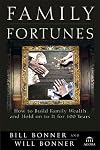
This book has the drawbacks of any book written by people who haven't completely accomplished what they purport to teach: the Bonner family has built family wealth, but has not hung onto it for 100 years... merely a small fraction thereof. But I'm glad they didn't wait another 90 years to write it. Despite some rather questionable opinions (e.g. charity does nobody any good - hey, that sounds familiar: "are there no workhouses?" - wait, actually there aren't), there's a lot to take away from show more this book for anyone who wants to build a strong family and leave a legacy for the future. With some measure of inconsistency the authors stress the importance of keeping a low profile and living under the radar, yet describe their own family situation at some length. It's fortunate for us, again, that they were willing to publicly "out" themselves as a family dynasty in the making. I'm pretty sure most old-money families are quite close-mouthed about the secrets of preserving wealth, which would explain why I've never before seen a book on this theme. One Amazon reviewer lauds the applicability of the book to the American Indian tribal situation: more than just a book about money, it's about building a heritage and passing a common culture to the next generation. show less
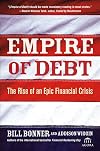
This book has balls. Who else have you heard look to Abraham Lincoln, not as one of the great US Presidents, but as a man that is responsible for the lives lost in the Civil War. None of the other major Western powers needed a war to end slavery - just the USA.
Financial Reckoning Day: Surviving the Soft Depression of the 21st Century (Agora Series) by William Bonner
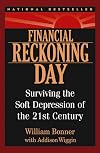
This is one difficult book to review because I am having problems summarizing everything. The concepts are deep; the data is vast.
There are four major themes in the book:
The USA economically speaking in the decade of 2000 is similar to Japan in the decade of 1990. Japan is still trying to get out of the 1990 ruts of recession, a hiccup of a recovery, and then another recession. Japan is still in a hangover over their boom 1980’s when they enjoyed a stock market and a real estate boom. Now show more Japan struggles against deflation – meaning consumers are not purchasing. There was a great boom a decade ago in Japan but for every boom there must an equal and opposite bust. The USA has had a stock market boom and is in a real estate boom. What will happen to the USA in the future?
Second, there has NEVER been a fiat currency (meaning a currency that is backed only by the promise of a government) that has lasted. The dollar is the only known fiat currency that has appreciated against gold over a twenty year period. With a currency backed by gold, it gives the government some restraint. Nowadays, the government literally can just print more money whenever it wants. Unfortunately, the more money it prints, it makes the money in our pocket worth less. There’s a reason that since the invention of money, money has been backed by gold (at times silver). Now we have a government running amok making promises that it won’t be able to keep.
There’s a real estate bust that is ahead of us that will be much worse than the stock market bust. The stock market bust had people lose money who had money. However, when real estate busts, it will be the people who don’t have money that will be hurt. The book laments about the ratio of median income to median housing value and reminds us of Japan’s real estate boom.
Finally, there are stories of past boom/bust stories …. South Sea, Napoleon’s Mississippi, and Waterloo. Each time supporters cry “It’s different this time!” and every time they have ended up being wrong: the Internet, the automobile, the telephone, the telegraph, railroads, airplanes, and even the New World. Wrong, wrong, wrong.
The writers of the book have an email newsletter that I am subscribed to (that’s how I found the book). If nothing else, I think it’s wise to read about other people’s viewpoints – especially if they are rational and they disagree with you. My personal viewpoint on the subject of where the economy will go is beyond the scope of this message. show less
There are four major themes in the book:
The USA economically speaking in the decade of 2000 is similar to Japan in the decade of 1990. Japan is still trying to get out of the 1990 ruts of recession, a hiccup of a recovery, and then another recession. Japan is still in a hangover over their boom 1980’s when they enjoyed a stock market and a real estate boom. Now show more Japan struggles against deflation – meaning consumers are not purchasing. There was a great boom a decade ago in Japan but for every boom there must an equal and opposite bust. The USA has had a stock market boom and is in a real estate boom. What will happen to the USA in the future?
Second, there has NEVER been a fiat currency (meaning a currency that is backed only by the promise of a government) that has lasted. The dollar is the only known fiat currency that has appreciated against gold over a twenty year period. With a currency backed by gold, it gives the government some restraint. Nowadays, the government literally can just print more money whenever it wants. Unfortunately, the more money it prints, it makes the money in our pocket worth less. There’s a reason that since the invention of money, money has been backed by gold (at times silver). Now we have a government running amok making promises that it won’t be able to keep.
There’s a real estate bust that is ahead of us that will be much worse than the stock market bust. The stock market bust had people lose money who had money. However, when real estate busts, it will be the people who don’t have money that will be hurt. The book laments about the ratio of median income to median housing value and reminds us of Japan’s real estate boom.
Finally, there are stories of past boom/bust stories …. South Sea, Napoleon’s Mississippi, and Waterloo. Each time supporters cry “It’s different this time!” and every time they have ended up being wrong: the Internet, the automobile, the telephone, the telegraph, railroads, airplanes, and even the New World. Wrong, wrong, wrong.
The writers of the book have an email newsletter that I am subscribed to (that’s how I found the book). If nothing else, I think it’s wise to read about other people’s viewpoints – especially if they are rational and they disagree with you. My personal viewpoint on the subject of where the economy will go is beyond the scope of this message. show less
Awards

You May Also Like


Associated Authors
Statistics
- Works
- 13
- Members
- 679
- Popularity
- #37,220
- Rating
- 3.6
- Reviews
- 9
- ISBNs
- 44
- Languages
- 4
- Favorited
- 1