
Elie Wiesel (1928–2016)
Author of Night, with the Nobel Peace Prize Acceptance Speech
About the Author
Eliezer "Elie" Wiesel was born in Sighet, Romania on September 30, 1928. In 1944, he and his family were deported along with other Jews to the Nazi death camp Auschwitz. His mother and his younger sister died there. He loaded stones onto railway cars in a labor camp called Buna before being sent to show more Buchenwald, where his father died. He was liberated by the United States Third Army on April 11, 1945. After the war ended, he learned that his two older sisters had also survived. He was placed on a train of 400 orphans that was headed to France, where he was assigned to a home in Normandy under the care of a Jewish organization. He was educated at the Sorbonne and supported himself as a tutor, a Hebrew teacher and a translator. He started writing for the French newspaper L'Arche. In 1948, L'Arche sent him to Israel to report on that newly founded state. He also became the Paris correspondent for the daily Yediot Ahronot. In this capacity, he interviewed the novelist Francois Mauriac, who urged him to write about his war experiences. The result was La Nuit (Night). After the publication of Night, Wiesel became a writer, literary critic, and journalist. His other books include Dawn, The Accident, The Gates of the Forest, The Jews of Silence: A Personal Report on Soviet Jewry, and Twilight. He received a numerous awards and honors for his literary work including the William and Janice Epstein Fiction Award in 1965, the Jewish Heritage Award in 1966, the Prix Medicis in 1969, and the Prix Livre-International in 1980. He received the Nobel Peace Prize in 1986 for his work in combating human cruelty and in advocating justice. He had a leading role in the creation of the United States Holocaust Memorial Museum in Washington, D. C. He died on July 2, 2016 at the age of 87. (Bowker Author Biography) show less
Series
Works by Elie Wiesel
The Trial of God: (as it was held on February 25, 1649, in Shamgorod) (1979) — Author — 413 copies, 7 reviews
Sages and Dreamers: Biblical, Talmudic, and Hasidic Portraits and Legends (1991) 322 copies, 3 reviews
A Passover Haggadah: As Commented Upon by Elie Wiesel and Illustrated by Mark Podwal (1993) 279 copies, 1 review
Wise Men and Their Tales: Portraits of Biblical, Talmudic, and Hasidic Masters (2003) — Author — 171 copies, 1 review
Filled with Fire and Light: Portraits and Legends from the Bible, Talmud, and Hasidic World (1994) 40 copies, 2 reviews
Mijn liefde voor de profeten: portretten en verhalen uit bijbel en midrasj (1986) — Author — 18 copies, 1 review
Telling the Tale : A Tribute to Elie Wiesel on the Occasion of His 65th Birthday - Essays, Reflections, and Poems (1993) 11 copies
Elie Wiesel Reading from His Works; The Gates of Forest; Night; The Song of the Dead; The Jews of Silence. (1988) 2 copies
A voice for humanity 1 copy
Paroles D' Etranger 1 copy
“An evening guest” 1 copy
From Holocaust To Rebirth 1 copy
Two Images, One Destiny 1 copy
Auschwitz and Treblinka: So much violence, so much indifference — Author — 1 copy
Will Soviet Jewry survive? 1 copy
Esau and Jacob 1 copy
Our Jewish Solitude 1 copy
Wiesel Eli 1 copy
Home Before Dark 1 copy
A Song for Hope 1 copy
The Accident {video} 1 copy
Associated Works
The Diary of a Young Girl: The Definitive Edition (1947) — Introduction, some editions — 9,288 copies, 127 reviews
A Lucky Child: A Memoir of Surviving Auschwitz as a Young Boy (2007) — Foreword — 795 copies, 42 reviews
Writers on Writing: Collected Essays from the New York Times (2001) — Contributor — 480 copies, 5 reviews
Imperfect Justice: Looted Assets, Slave Labor, and the Unfinished Business of World War II (0001) — Foreword, some editions — 127 copies, 1 review
The Righteous Among the Nations: Rescuers of Jews During the Holocaust (2007) — Foreword, some editions — 97 copies, 1 review
With Raoul Wallenberg in Budapest: Memories of the War Years in Hungary (1979) — Foreword, some editions — 82 copies, 1 review
Speeches of Note: An Eclectic Collection of Orations Deserving of a Wider Audience (2018) — Narrator, some editions — 75 copies, 1 review
Tikvah: Children's Book Creators Reflect on Human Rights (2001) — Introduction — 66 copies, 1 review
The Holocaust in Romania: The Destruction of Jews and Gypsies Under the Antonescu Regime, 1940-1944 (1995) — Foreword, some editions — 64 copies
Here I Am: Contemporary Jewish Stories from Around the World (1998) — Contributor — 57 copies, 1 review
Great Tours and Detours: The Sophisticated Traveler Series (1985) — Contributor — 35 copies, 1 review
The Encyclopedia of Jewish Life Before and During the Holocaust, Volume I (2001) — Foreword — 25 copies
The Encyclopedia of Jewish Life Before and During the Holocaust, Volume III (2001) — Foreword — 24 copies
The Encyclopedia of Jewish Life Before and During the Holocaust, Volume II (2001) — Foreword — 22 copies
Preventing Genocide: Practical Steps Toward Early Detection and Effective Action (2008) — Foreword — 14 copies
A consuming fire: Encounters with Elie Wiesel and the Holocaust (1979) — Introduction, some editions — 14 copies
The Iaşi Pogrom, June–July 1941: A Photo Documentary from the Holocaust in Romania (2015) — Preface, some editions — 13 copies, 1 review
Charlie Rose with Elie Wiesel; Amy Tan (November 9, 1995) — Contributor — 1 copy
Tagged
Common Knowledge
- Canonical name
- Wiesel, Elie
- Legal name
- Wiesel, Eliezer
- Other names
- A-7713
Wiesel, Élie
Wiesel, Eliezer - Birthdate
- 1928-09-30
- Date of death
- 2016-07-02
- Gender
- male
- Education
- University of Paris
- Occupations
- journalist
writer
professor
novelist
author
memoirist (show all 8)
Holocaust survivor
translator - Organizations
- American Academy of Arts and Letters( [1996])
Boston University
United States Holocaust Memorial Council
Elie Wiesel Foundation for Humanity - Awards and honors
- Nobel Peace Prize (1986)
Presidential Medal of Freedom (1992)
Congressional Gold Medal (1984)
Medal of Liberty (1986)
Dayton Literary Peace Prize's Lifetime Achievement Award (2007)
Norman Mailer Prize (2011) (show all 8)
National Humanities Medal (2009)
Kenyon Review Award for Literary Achievement (2012) - Relationships
- Wiesel, Marion (wife)
Bloch, Sam E. (colleague) - Short biography
- Elie Wiesel was born to a Jewish family in the small town of Sighet in northern Transylvania, then part of Hungary, now Romania. He was still a teenager when he was taken from his home and deported to the Nazi concentration camp at Auschwitz and then to Buchenwald. His memoirs of that experience are unforgettably recorded in NIGHT, which became a worldwide bestseller. Elie Wiesel was Andrew Mellon Professor in the Humanities at Boston University and founding chairman of the United States Holocaust Memorial Council. He won the Nobel Peace Prize in 1986.
- Nationality
- Romania (birth)
- Birthplace
- Sighet, Maramureş County, Romania
Sighet, Romania - Places of residence
- Hungary
Auschwitz, Poland
Buchenwald, Germany
Paris, France
Israel
New York, New York, USA (show all 7)
Sighet, Romania (birth) - Place of death
- Manhattan, New York, USA
- Burial location
- Sharon Gardens Cemetery, Valhalla, New York, USA
- Map Location
- Romania
Members
Reviews
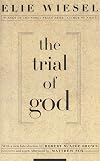
A compelling drama in which a Jewish man who has lost his entire family to a pogrom places God on trial for crimes against humanity. Whilst set in 1649, it is clearly inspired by Wiesel's own experiences in the Holocaust; he explicitly admits that it was based on one of his experiences in Auschwitz, when as a 15-year-old boy he witnessed three senior rabbis reluctantly place their God on trial, and found Him guilty. The play itself, of course, deals with a lot of heavy issues – show more leaving aside the theology for now, it still deals with some horrific stuff. The characters indicting God have suffered the anti-Semitic-motivated murder and gang rape of loved ones, and the ending of the play is chilling. That said, the play is also surprisingly humorous in parts, albeit in a very cynical way (for example, on page 70, as the characters are preparing for the mock trial: "But someone is missing."/"Who is that? The defendant? He's used to it.").
Wiesel covers the weighty theological and philosophical arguments with commendable even-handedness; he has no atheistic or religious agenda. If anything, his message – as affirmed by Robert McAfee Brown and Matthew Fox in their Introduction and Afterword respectively – is a humanist one. Whilst a simplistic summary of the play would be: 'Why does God let bad things happen to good people?', a more nuanced summary would be the one identified by Brown and Fox: that if we cannot get justice from God, we must ensure we strive for it ourselves. God, perhaps, cannot be excused his culpability – and The Trial of God ends agreeably open-ended about this – but if faith cannot mollify us in dark times we must seek a more intelligent and independent response to the struggles and evils of our world. It is a mature and life-affirming message in a play about the bleakest of topics. show less
Wiesel covers the weighty theological and philosophical arguments with commendable even-handedness; he has no atheistic or religious agenda. If anything, his message – as affirmed by Robert McAfee Brown and Matthew Fox in their Introduction and Afterword respectively – is a humanist one. Whilst a simplistic summary of the play would be: 'Why does God let bad things happen to good people?', a more nuanced summary would be the one identified by Brown and Fox: that if we cannot get justice from God, we must ensure we strive for it ourselves. God, perhaps, cannot be excused his culpability – and The Trial of God ends agreeably open-ended about this – but if faith cannot mollify us in dark times we must seek a more intelligent and independent response to the struggles and evils of our world. It is a mature and life-affirming message in a play about the bleakest of topics. show less
"Night," Elie Wiesel's nightmarish account of his experience in the concentration camps at Auschwitz and Buchenwald, challenges the reader to imagine a world in which an entire class of people was marked for extermination. Beginning with his family's removal from their home in Hungary to a ghetto in 1944 and ending with the liberation of Buchenwald just over a year later, Wiesel is unsparing in his descriptions of the horrors of the Holocaust. Separated from most of his family, he clings to show more his father as they endure torture, humiliation, starvation, and exposure at the hands of the SS. He describes in horrific detail the murder of thousands in the crematoria of Auschwitz, as well as the myriad ways in which the Nazis degraded and dehumanized the Jews in an effort to crush their spirit. Wiesel also discusses the loss of his (once deeply held) Jewish faith as he rages at a God who would allow these atrocities to take place.
"Night" doesn't let us off the hook for a second. It ends bleakly, with no hint of redemption—for that, I understand, we have to read the next two volumes in Wiesel's trilogy—and I found myself half-pretending it was fiction just to get through some of the more disturbing passages. But I think the power of the story and the emotions and moral introspection it provokes make it undeniably valuable—even indispensable—as a work of literary nonfiction.
As a teaching tool, the book would lend itself to a multidisciplinary ELA/history unit on World War II or the Holocaust. I also envision discussing it in the context of some of the great questions of moral philosophy, such as the problem of evil. In an honors class of juniors and seniors, the film "Night and Fog" would be an excellent supplementary text to help students visualize the atrocities of the concentration camps. "Night" also has also a wealth of literary elements to excavate, such as foreshadowing, symbolism (fire, bread, night), and "character" arc; in fact, I think the book could be discussed as a work of literature as productively as any novel. show less
"Night" doesn't let us off the hook for a second. It ends bleakly, with no hint of redemption—for that, I understand, we have to read the next two volumes in Wiesel's trilogy—and I found myself half-pretending it was fiction just to get through some of the more disturbing passages. But I think the power of the story and the emotions and moral introspection it provokes make it undeniably valuable—even indispensable—as a work of literary nonfiction.
As a teaching tool, the book would lend itself to a multidisciplinary ELA/history unit on World War II or the Holocaust. I also envision discussing it in the context of some of the great questions of moral philosophy, such as the problem of evil. In an honors class of juniors and seniors, the film "Night and Fog" would be an excellent supplementary text to help students visualize the atrocities of the concentration camps. "Night" also has also a wealth of literary elements to excavate, such as foreshadowing, symbolism (fire, bread, night), and "character" arc; in fact, I think the book could be discussed as a work of literature as productively as any novel. show less
Night by Elie Wiesel
I think what stood out the most to me while reading this was the raw honesty of Wiesel's experience. We don't just see the external brutality of concentration camps; we also get to see how it impacts who the victims became as people, how their inner dialogue changed. This is not a romanticized perspective on the Holocaust. This is from the view of someone who lived it.
Night by Elie Wiesel
“We were masters of nature, masters of the world. We had forgotten everything--death, fatigue, our natural needs. Stronger than cold or hunger, stronger than the shots and the desire to die, condemned and wandering, mere numbers, we were the only men on earth.”
Night is a short book written about the author’s time in the concentration camps as a young teenager. The first chapters show his family in its entirety – mother, father, sisters, himself, and a small reveal about the show more townsfolk, particularly his mentor who returns home with a vicious warning of their impending fate. It’s surprising to me how he is ignored and how the town refuses to think that it could possibly ‘happen to them.’ I suppose this is common human illogical when faced with devastating news – much like a medical diagnosis even if we’ve been leading unhealthy lifestyles. The tragic, inevitable strikes where Elie and his family go to Auschwitz, and he is then separated forever from his mother and sisters.
Being short, naturally the pacing is quick, but this is not meant to be an action-packed novel in any form. It’s instead a clinical retelling of unimaginable horrors and tragedies. The dry tone is a little offsetting, but I think this is the only way the author could tell it and open up about the painful memory. Sometimes becoming clinical is the only way to survive.
What happened to these poor people in Auschwitz and camps near Berlin is horrifying, but I think the most frightening fact this story conveys is how little emotion was left to the individuals placed in the haunting situation. With its bleak detachment, the story shows how they were turned into little more than animals, soulless and without emotion, even when their friends die in front of their eyes, where they begin killing their own fathers and sons for mere food. And wow, were these people starved.
The worst scene, I think, was the end travel. The snow was frightening enough, but the starvation is something hard to imagine. The haunting scene of the son killing his father for the small piece of bread, then being killed himself as he tries to bite into it, is more than unsettling. It all starts with a game where the guards throw bread into the confinement area just to see what would happen and who would kill who for a such a small portion of nourishment.
At a mere 115 pages, the imagery and inner turmoil is potent. There’s nothing enjoyable in reading non-fiction such as this, but it’s important never to forget. Some people comment on the writing style as being dry and with little emotion, as if that were a negative thing (and in fiction it would be), but here it’s done the only way it can be for this particular author and is in no way written poorly.
“For in the end, it is all about memory, its sources and its magnitude, and, of course, its consequences.” show less
Night is a short book written about the author’s time in the concentration camps as a young teenager. The first chapters show his family in its entirety – mother, father, sisters, himself, and a small reveal about the show more townsfolk, particularly his mentor who returns home with a vicious warning of their impending fate. It’s surprising to me how he is ignored and how the town refuses to think that it could possibly ‘happen to them.’ I suppose this is common human illogical when faced with devastating news – much like a medical diagnosis even if we’ve been leading unhealthy lifestyles. The tragic, inevitable strikes where Elie and his family go to Auschwitz, and he is then separated forever from his mother and sisters.
Being short, naturally the pacing is quick, but this is not meant to be an action-packed novel in any form. It’s instead a clinical retelling of unimaginable horrors and tragedies. The dry tone is a little offsetting, but I think this is the only way the author could tell it and open up about the painful memory. Sometimes becoming clinical is the only way to survive.
What happened to these poor people in Auschwitz and camps near Berlin is horrifying, but I think the most frightening fact this story conveys is how little emotion was left to the individuals placed in the haunting situation. With its bleak detachment, the story shows how they were turned into little more than animals, soulless and without emotion, even when their friends die in front of their eyes, where they begin killing their own fathers and sons for mere food. And wow, were these people starved.
The worst scene, I think, was the end travel. The snow was frightening enough, but the starvation is something hard to imagine. The haunting scene of the son killing his father for the small piece of bread, then being killed himself as he tries to bite into it, is more than unsettling. It all starts with a game where the guards throw bread into the confinement area just to see what would happen and who would kill who for a such a small portion of nourishment.
At a mere 115 pages, the imagery and inner turmoil is potent. There’s nothing enjoyable in reading non-fiction such as this, but it’s important never to forget. Some people comment on the writing style as being dry and with little emotion, as if that were a negative thing (and in fiction it would be), but here it’s done the only way it can be for this particular author and is in no way written poorly.
“For in the end, it is all about memory, its sources and its magnitude, and, of course, its consequences.” show less
Lists
Jewish Books (8)
AP Lit (1)
Best War Stories (1)
To Read (1)
Europe (1)
Over-used titles (1)
Translingualism (1)
Unread books (1)
My Library (1)
Holocaust (1)
Read (2)
War Literature (1)
Carole's List (1)
THE WAR ROOM (1)
Writers at Risk (1)
1950s (1)
Nifty Fifties (1)
Non-Fiction (1)
Awards


You May Also Like


Associated Authors
Statistics
- Works
- 131
- Also by
- 39
- Members
- 50,157
- Popularity
- #303
- Rating
- 4.2
- Reviews
- 850
- ISBNs
- 774
- Languages
- 27
- Favorited
- 73


