
Ida M. Tarbell (1857–1944)
Author of The History of the Standard Oil Company
About the Author
Image credit: 1922 photograph
(Library of Congress Prints and Photographs Division,
LC-USZ62-109647)
(Library of Congress Prints and Photographs Division,
LC-USZ62-109647)
Works by Ida M. Tarbell
The life of Abraham Lincoln, drawn from original sources and containing many speeches, letters, and telegrams hitherto unpublished (1900) 74 copies, 1 review
The Life of Abraham Lincoln: Vol. I: Drawn from Original Sources and Containing Many Speeches, Letters and Telegrams (2008) 27 copies
Prize stories from Collier's, 5 volumes — Editor — 1 copy
The Ways of Woman 1 copy
The Mentor, Joan of Arc 1 copy
The Words of Napoleon, Emperor of France, Being Selections From His Addresses and Letters 1 copy, 1 review
The Book of Woman's Power 1 copy
Associated Works
The Lincoln Anthology: Great Writers on His Life and Legacy from 1860 to Now (2008) — Contributor — 172 copies, 1 review
Shaking the Foundations: 200 Years of Investigative Journalism in America (Nation Books) (2003) — Contributor — 45 copies
Tagged
Common Knowledge
- Legal name
- Tarbell, Ida Minerva
- Birthdate
- 1857-11-05
- Date of death
- 1944-01-06
- Gender
- female
- Education
- Allegheny College
- Occupations
- investigative journalist
biographer
magazine editor
magazine owner - Organizations
- McClure's
American Magazine - Nationality
- USA
- Birthplace
- Hatch Hollow, Pennsylvania USA
- Places of residence
- Erie county, Pennsylvania, USA (birth)
Bridgeport, Connecticut, USA (death)
Titusville, Pennsylvania, USA
Meadville, Pennsylvania, USA
Poland, Ohio, USA
Chautauqua, New York, USA (show all 8)
Paris, France
Easton, Connecticut, USA - Place of death
- Bridgeport, Connecticut, USA
- Burial location
- Woodlawn Cemetery, Titusville, Pennsylvania USA
Members
Reviews
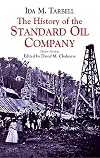
Ida Tarbell was one of the original “muckrakers”. This is a 2003 reprint of a 1966 abridgement of a book originally published in 1904, in which Ida takes on John D. Rockefeller and Standard Oil Company. Tarbell describes the discovery of oil in Pennsylvania (well, the discovery by people of European ancestry; the natives had been using the stuff as lineament for some time) and the “oil boom” (the key was the discovery (1859) that you could drill for oil; early recovery consisted of show more absorbing floating oil with blankets and then squeezing it out). Numerous small outfits appeared and disappeared, collecting oil by one means or another; loading it in barrels, shipping it by wagon teams to a rail head, and eventually to Pittsburgh or Cleaveland. Gradually, however, one of the “outfits” began to gain more and more prominence – Standard Oil Company, headed by John D. Rockefeller. Interestingly enough, Standard Oil didn’t get where it was by directly buying out rivals (although there certainly was some of that), but by ancillary tactics. For example, as a large shipper - Standard Oil was able to arrange rebates on railroad shipments – and, rather astonishingly, “drawbacks” on other oil company’s shipments. A drawback was a rebate paid to Standard oil for the amount of oil a competitor shipped. If the railroad wanted to keep Standard Oil’s business, they needed to pay them for shipping another company’s product. And Standard Oil bribed – well, “paid a consideration” – to shipping agents to report who was shipping what with whom and how much they were paying. Things progressed – Standard Oil eventually solved the problem of having to bribe railroads by simply buying them. Standard Oil blocked the construction of pipelines for oil by refusing to allow them to cross over or under the railroad right-of-way (there was a minor war over this; one pipeline build found a railroad bridge where the railroad didn’t own the land underneath and routed their pipeline there. Railroad employees tore it out. The pipeline company replaced it. The railroad tore it out again. The pipeline company placed armed guard and a couple of shots were fired, but eventually the pipeline was completed – but by then it didn’t matter because Standard Oil had built its own pipeline. Eventually Standard Oil owned about 85% of the oil business in the United States – production, refining, shipment, and distribution. This was finally enough for the United States government to take interest and in 1888 Standard Oil was broken up into regional units. (It didn’t matter that much; Standard Oil of New Jersey still remained one the largest companies in the world).
Ms. Tarbell details – sometimes, perhaps, excessively – numerous other questionable practices by Standard Oil. But she also does a little praising with faint damnation. She notes that Rockefeller was personally abstemious, donated “unostentatiously” to numerous charities, and that Standard Oil company employees were well compensated and generally happy with their jobs. She also notes that Standard Oil as a company was responsible for many advances in the petroleum industry and sciences.
But here’s the kicker – something that Ms. Trabell doesn’t really go into because it was not yet part of her world. When you think of “Standard Oil” what product first comes to mind? But in 1888 when the Standard Oil monopoly was finally broken up, there was not one single internal combustion engine in the world – no automobiles, no Diesels, no heavy oil marine engines. The market Standard Oil was cornering was lamp oil – basically kerosene. (Ms. Tarbell mentions “gasoline” twice, which puzzled me at first, but it turns out that was a small market for gasoline for generating illuminating gas). Standard Oil’s lamp oil was cheaper than whale oil (even at monopoly prices) and was less smokey and less smelly than lard oil.
;
As mentioned, Ms. Tarbell sometimes becomes a little tedious with details. The introduction notes that the full edition had numerous tables and maps which were left out in this abridgement; sometimes this is unfortunate, especially when Tarbell is discussing oil production statistics or mentioning oil producing areas. The most fascinating thing was the extent of the oil industry before automobiles. The introduction, by a retired university professor David Chalmers, is rather dated – Ms. Tarbell is described as absorbing “…feminist ideas … that would keep her unhappily single all her life…”. Well, it was 1966. show less
Ms. Tarbell details – sometimes, perhaps, excessively – numerous other questionable practices by Standard Oil. But she also does a little praising with faint damnation. She notes that Rockefeller was personally abstemious, donated “unostentatiously” to numerous charities, and that Standard Oil company employees were well compensated and generally happy with their jobs. She also notes that Standard Oil as a company was responsible for many advances in the petroleum industry and sciences.
But here’s the kicker – something that Ms. Trabell doesn’t really go into because it was not yet part of her world. When you think of “Standard Oil” what product first comes to mind? But in 1888 when the Standard Oil monopoly was finally broken up, there was not one single internal combustion engine in the world – no automobiles, no Diesels, no heavy oil marine engines. The market Standard Oil was cornering was lamp oil – basically kerosene. (Ms. Tarbell mentions “gasoline” twice, which puzzled me at first, but it turns out that was a small market for gasoline for generating illuminating gas). Standard Oil’s lamp oil was cheaper than whale oil (even at monopoly prices) and was less smokey and less smelly than lard oil.
;
As mentioned, Ms. Tarbell sometimes becomes a little tedious with details. The introduction notes that the full edition had numerous tables and maps which were left out in this abridgement; sometimes this is unfortunate, especially when Tarbell is discussing oil production statistics or mentioning oil producing areas. The most fascinating thing was the extent of the oil industry before automobiles. The introduction, by a retired university professor David Chalmers, is rather dated – Ms. Tarbell is described as absorbing “…feminist ideas … that would keep her unhappily single all her life…”. Well, it was 1966. show less
A great example of muckracking journalism. It helped bring in the age consumer protection and a break-up of anti-competative corporations. Just as relevant today as it was 100 years ago.

Old book that originally belonged to my grandfather. It's a fairly good story about a young boy who knew Abraham Lincoln in Springfield, before he became famous. Interestingly, it was written by Ida Tarbell, the famous "muckraker" (early investigative journalists) who wrote the book on Standard Oil that led to antitrust hearings.

Ida Tarbell, the author here, is most known for writing a series of articles in McClure's magazine called The History of the Standard Oil Company, later issued in book form. That series of articles and the book got her something of a reputation as a muckraker (Now there is a word which is somewhat archaic). She also wrote The Life of Abraham Lincoln, a biography. She was active writing books and articles around the late 1800s and the early 1900s.
I became interested in Elbert Gary for two show more reasons. One, I was employed for a time heading commercial real estate lending by the Gary-Wheaton Bank in Wheaton, DuPage County, Illinois and related banks, it's now part of J.P. Morgan Chase. He was the "Gary" part of the name and a founder of it, along with Jesse Wheaton, a relative by marriage.
The mention of the bank in the book is without name and incidental to the story. Gary and Wheaton did manage the bank successfully through an era when bank runs were common.
And two, one of my father's uncles was a surveyor of Gary, Indiana, named for Elbert Gary, and I have a photograph of several men in front of a tent on a sand dune in northwest Indiana, including my unrecognizable relative. Perhaps it's just family folklore... Gary, Indiana was founded by U.S. Steel as a company town with a large related steel plant.
Gary was quite the entrepreneur being mayor of the town of Wheaton, the co-founder of the bank and instrumental in the founding of U.S. Steel. He also ran the family farm in the area and enlarged it considerably. He was a lawyer and a judge and served government in several capacities and at a high level. Mostly he is known for his work at U.S. Steel as a founder and as the first Chairman.
Tarbell's biography of Gary is glowing about the subject, to say the least. I probably never have read a bio so positive about the subject. Gary's life is nonetheless very interesting and covers many interesting facets of business around the turn of the century. Tarbell had access to Gary's records, letters and other material.
Because of Gary's activities around the founding of and becoming first Chairman of U.S. Steel, he was deeply connected with top level business men and with government people, including the U.S. presidents at the time. He appears to genuinely been a leader of good relations with the men (mostly) working day-to-day at U.S. Steel right up to allowing them in invest in company stock, an unusual "perk" at the time.
Tarbell's biography is interesting, well written and documented and is enjoyable. As stated before, it is a quite glowing biography and that gives me some pause. Much of the positive aspect of the book seems corroborated by letters and other documentation. It provides, I think, a good insight into business in the early part of the 20th century.
As an aside, I bought the book by mail from a used bookseller for about $10, including shipping. The description of the book said that it was "new" which, for a book from 1925, seemed unlikely. When the book arrived it was wrapped in a light tan paper which could well have come from the 1920s and many of the pages, printed on a somewhat rough textured paper, had to be separated before reading. Perhaps I'm not trusting enough.
I have Tarbell's 'The History of the Standard Oil Company and I'm looking forward to reading it. show less
I became interested in Elbert Gary for two show more reasons. One, I was employed for a time heading commercial real estate lending by the Gary-Wheaton Bank in Wheaton, DuPage County, Illinois and related banks, it's now part of J.P. Morgan Chase. He was the "Gary" part of the name and a founder of it, along with Jesse Wheaton, a relative by marriage.
The mention of the bank in the book is without name and incidental to the story. Gary and Wheaton did manage the bank successfully through an era when bank runs were common.
And two, one of my father's uncles was a surveyor of Gary, Indiana, named for Elbert Gary, and I have a photograph of several men in front of a tent on a sand dune in northwest Indiana, including my unrecognizable relative. Perhaps it's just family folklore... Gary, Indiana was founded by U.S. Steel as a company town with a large related steel plant.
Gary was quite the entrepreneur being mayor of the town of Wheaton, the co-founder of the bank and instrumental in the founding of U.S. Steel. He also ran the family farm in the area and enlarged it considerably. He was a lawyer and a judge and served government in several capacities and at a high level. Mostly he is known for his work at U.S. Steel as a founder and as the first Chairman.
Tarbell's biography of Gary is glowing about the subject, to say the least. I probably never have read a bio so positive about the subject. Gary's life is nonetheless very interesting and covers many interesting facets of business around the turn of the century. Tarbell had access to Gary's records, letters and other material.
Because of Gary's activities around the founding of and becoming first Chairman of U.S. Steel, he was deeply connected with top level business men and with government people, including the U.S. presidents at the time. He appears to genuinely been a leader of good relations with the men (mostly) working day-to-day at U.S. Steel right up to allowing them in invest in company stock, an unusual "perk" at the time.
Tarbell's biography is interesting, well written and documented and is enjoyable. As stated before, it is a quite glowing biography and that gives me some pause. Much of the positive aspect of the book seems corroborated by letters and other documentation. It provides, I think, a good insight into business in the early part of the 20th century.
As an aside, I bought the book by mail from a used bookseller for about $10, including shipping. The description of the book said that it was "new" which, for a book from 1925, seemed unlikely. When the book arrived it was wrapped in a light tan paper which could well have come from the 1920s and many of the pages, printed on a somewhat rough textured paper, had to be separated before reading. Perhaps I'm not trusting enough.
I have Tarbell's 'The History of the Standard Oil Company and I'm looking forward to reading it. show less
Lists
Awards


You May Also Like


Associated Authors
Statistics
- Works
- 46
- Also by
- 5
- Members
- 581
- Popularity
- #43,162
- Rating
- 3.8
- Reviews
- 9
- ISBNs
- 72
- Languages
- 2


