
Theo Ellsworth
Author of Capacity
Series
Works by Theo Ellsworth
Capacity #6 1 copy
Play Overlord #1 1 copy
Associated Works
Nursery Rhyme Comics: 50 Timeless Rhymes from 50 Celebrated Cartoonists (2011) — Illustrator — 227 copies, 27 reviews
The Graphic Canon of Crime & Mystery, Vol. 1: From Sherlock Holmes to A Clockwork Orange to Jo Nesbø (2017) — Illustrator — 38 copies, 2 reviews
Tagged
Common Knowledge
- Birthdate
- 20th century
- Gender
- male
- Nationality
- USA
- Associated Place (for map)
- USA
Members
Reviews

Nota Bene: This is a very long review for a middle grade graphic novel, or indeed, any novel, because award-winning author Dara Horn incorporates so many layers of meaning in her books they end up being like ten books in one, at least! And every one of those layers adds to the delight of the reading experience. I try to pay homage to at least some of them, in order to increase the reader’s enjoyment, admiration, and respect, but feel free to skip (way) down to the evaluation and rating.
On show more a superficial level this is a very humorous account of family chaos during a holiday.
It relates the story of the celebration by a Jewish family of a Passover Seder, which commemorates the exodus of Jews from ancient Egypt after their escape from slavery (as recounted in the Book of Exodus in the Bible), and it explains the rituals of a Seder in detail. Thus in a meta way, it also functions as a haggadah, which is the booklet used during the Seder to retell the story of the Exodus and guide participants through the rituals.
[There is no “set” Haggadah - different versions are geared toward different religious denominations; local cultures; the concerns and interests of different generations and age groups; toward highlighting different art work; or featuring different themes. However, as Jonathan Safran Foer wrote about hagaddahs in 2012 for the New York Times, “of the 7,000 known versions, not to mention the countless homemade editions, there is one that is used more than all others combined. Since 1932, the Maxwell House Haggadah — as in the coffee company — has dominated American Jewish ritual.” That haggadah was dreamed up by the coffee corporation and a Jewish advertising executive and distributed for free with each purchased can of coffee.]
But there are more layers to Horn’s book. It has a touch of Dickens’s Christmas Carol, lots of lessons about Jewish history, even echoes of Dante’s Inferno, and it is all told in a way that echoes the Seder’s traditional closing song, “Chad Gadya” or “One Little Goat.”
(Chad Gadya is a cumulative song, one with a simple verse structure that builds upon itself by repeating a phrase with progressive additions. The repetition and rhythm make such songs popular for kids.)
For example, Chad Gadya begins:
“One kid that father bought for two zuzim.
Then came a cat and ate the kid that father bought for two zuzim.
Then came a dog and bit the cat that ate the kid that father bought for two zuzim.
Then came a stick and beat the dog that bit the cat that ate the kid that father bought for two zuzim.”
…and so on. This device is used to set up the action in the book, when the afikomen is lost.
The afikomen is the middle of three pieces of matzah on the Seder table, the unleavened bread representing how Jews had to flee before their bread had time to rise. As an article in Vox explains:
“Relatively early in the Seder, the afikomen is broken in two pieces; the bigger piece is then wrapped in a napkin and hidden somewhere in the house. Some Jews see this as symbolic of the ultimate redemption from suffering, which comes at the end of the Seder; some see it as a reference to the Passover sacrifice that used to be offered at the ancient temple in Jerusalem; and some see it as a reminder that the poor must always set something aside for the next meal, or a reminder that there’s always more to discover in life than what we know. For any kids at the table, though, it’s a game: after the meal, they’re sent running to hunt for the hidden afikomen. It’s sort of like hide-and-seek, but with religious significance. The kids bring it back to the table and everyone shares a bite — sometimes after giving the child who found it a small reward, like a piece of candy.”
In Horn’s telling, the afikomen was hidden, but different family members kept switching the hiding places. Finally the baby ran off with it and seemingly threw it into a black hole out in the universe; in any event, the baby can’t talk and no one could find the afikomen. Because it was missing, they could not perform the Seder-ending ritual of opening the door for the hoped-for appearance of Prophet Elijah.
[In Jewish tradition, Elijah has had a number of roles making him a desired Passover guest, including the herald of the Messiah, miracle worker, healer, and promoter of social justice and welfare. At the seder, a chair is always left empty for Elijah and a special cup of wine is poured at the place set for him, just in case he comes. Most young children harbor anticipation the entire meal that this could be the time he appears!]
In any event, opening the door for Elijah is a ritual reserved for the Seder’s conclusion, so the family in this story can’t end the seder, and are stuck there for six months!
After six months had passed, the doorbell finally rang. It was was not Elijah, however, but rather a talking goat. He explained: “I’m the scapegoat. You know, the one everybody blames for their problems.” The young boy who is narrating exclaims, “Wait a minute. I do know who you are! You’re the goat from that song at the very end of the seder - Chad Gadya!”
(He added: “To be honest, I was just guessing about who this goat was. I don’t know a whole lot of goats. But it was nice to have someone new to talk to after six months.”)
The goat told the boy about a Tel:
“A Tel is a human-made hill. Formed out of the ruins of different periods of civilization one piled on top of another. The earliest layers are at the very bottom and the most recent ones are at the top. The night of the Seder is like a Tel. All the Seders that ever happened in the past, before this one - they’re all here, underneath yours.”
Here, Horn was undoubtedly inspired by her own perception of the Seder, as she explains in an introduction:
“The Passover Seder . . . is a night devoted to the memory of the Exodus from Egypt, but this memory is transmitted by a strange kind of reenactment, in which the process of re-creating that night - the story of how previous generations observed this anniversary, the details of how each ritual or song or prayer came to be included - is itself also part of the reenactment. The result is that it’s not only a commemoration of the Exodus, but a commemoration of a commemoration. On the night of the Seder as a child, I would sit at a crowded dining table and suddenly realize that the room I was in was actually a lighted box at the top of a tower of other lighted boxes, that there were thousands of years’ worth of earlier Seders underneath mine, going back down through time to the original Seder the night before the Exodus.”
Back to the story, the goat claimed it retrieved the afikomen from the wormhole and hid it in one of those seders in the past, and if the boy made a door, the goat would help him search for it by guiding him down through the layers of old seders (much like Virgil guided Dante).
Together they went back through space/time to see other seders and find the afikomen. They started at the boy’s dad’s seder in Russia in 1981 when it was illegal to celebrate Jewish holidays so it was done in secret. Back they traveled, visiting his great-grandma’s seder in Poland 1943. Because this was during the Holocaust when Jews were prevented from practicing Judaism, this seder also took place secretly, in an underground bunker during the first night of the Warsaw Ghetto Uprising.
[As the online Jewish Virtual Library explains, "The Holocaust refers to the period from January 30, 1933 - when Adolf Hitler became chancellor of Germany - to May 8, 1945, when the war in Europe officially ended. During this time, Jews in Europe were subjected to progressively harsher persecution that ultimately led to the murder of 6,000,000 Jews (1.5 million of these being children) and the destruction of 5,000 Jewish communities. These deaths represented two-thirds of European Jewry and one-third of all world Jewry."]
[For those who are interested, a Holocaust survivor spoke about the last Passover in the Warsaw Ghetto, here.]
Deeper still they traveled, taking a shortcut through some old Haggadahs. They passed through sections of the Haggadah that refer to the Four Children, who feature in the middle of a seder: the wise, the wicked, the simple, and the one who doesn’t know how to ask. The inclusion of this section in the Haggadah, as in the story, is a teaching device from the Talmud (the written body of Jewish civil and ceremonial law) about ways to approach the world.
The boy thought he was like the Wise Child in the Haggadah, but the goat disputed him: “Have you really listened to the people around you? What was your Great-Grandma’s life like? .. Why is tonight different from all other nights?” Then the boy saw the Wicked Child, whom he identified as his sister. Again, the goat argued with him, challenging him to broaden his perspective: “Without her, you probably wouldn’t even realize rules can be broken. . . . A truly wise older brother would be encouraging her to use her evil powers for good.” They moved on to the Simple Child, whom the boy thought was like his little brother. The goat explained how his simplicity equated with kindness. Finally, they came to the Child Who Doesn’t Know How to Ask, or, as the boy saw it, his baby sister. Again after a short conversation the goat issued judgment: “Who’s living a more joyful existence? You or her? Hmm?”
Next they encountered the Medieval Rabbi Don Isaac Abarbanel, who wrote books about the Haggadah - “a book about a book about a book” the boy said deprecatingly. The goat countered: “Why not? People love to revisit old stories over and over again and come up with new things to say about them. It’s human nature.”
The boy still didn’t get why it mattered, so the goat took him to see Nachman of Bratslav (1772-1810). Nachman explained (as he famously wrote): “. . . the Exodus from Egypt is still occurring inside of every human being, in every era, in every year, in every day.”
That just baffled the boy more, so the goat took him to see other famous figures from Jewish history, from whom he discovered that in every era, Jews had to fight discrimination and often hide their seder commemorations. Rav and Shmuel from the 3rd Century made a more significant point: they claimed the story of enslavement was not only about physical slavery but very importantly, about internalizing deprecatory assessments of the Jews. The fictional Rav noted:
“The Exodus isn’t complete if the Pharaoh of Egypt still rules your mind. If oppressive forces dictate your thinking, you’re still enslaved. The exodus has to happen in your mind, every day.”
I.e., to summarize Nachman and Rav, the story of Passover is a journey of liberation, from both external and internal constraints; from prejudice; from fear; from greed; from turning away from morality; and from valorizing the individual over the community. The seder emphasizes the importance of all of this, and is done in the context of a communal ceremony.
Then the goat had an epiphany of sorts and remembered where it left the afikomen: with its rabbi friends from 2nd Century Ancient Israel. One of them was the famous Rabbi Akiva. During their seder the rabbis were also thinking about fighting injustice, by plotting a revolt against the Roman Empire. Thus it was ever so….
The goat told the boy he hid the afikomen under one of their shields, but it turned out the Prophet Elijah moved it. They had to go back all the way to the Very First Seder. Down they went to a hut where an Israelite family was having their last supper before escaping from slavery in Egypt. The afikomen was there, but closing the story’s circle, a baby at that first seder picked up the afikomen and threw it out into the worm hole. The goat advised to boy to go after it; he jumped, and managed to catch it. He found himself back home, where he was greeted by the Invisible Immortal Prophet Elijah, who followed him inside for his cup of wine. Everyone sang “One Little Goat,” and the Seder was *finally* over.
Evaluation: While Horn calls this is a book for young readers, I (most decidedly not young anymore) was delighted from the very first page. Not only is the story so fun and richly layered, but the chaotic family celebration seemed like an accurate description of Every Seder Ever Celebrated! And it’s so cleverly told.
But more than the “fun” aspect, Horn has a critical lesson to impart: the story of Passover should remind us of what it is like to be “the other” and to be persecuted for no other reason than which family you were born into or where you worship. It emphasizes the importance of tolerance for all people, all of whom have the right to survive. As God said, according to the Bible, after parting the Red Sea for the escaping Israelites, “Do not mistreat or oppress a foreigner, for you were foreigners in Egypt.” Recapitulating the story every year makes the point that the story of liberation is ongoing, as is the quest for tolerance, freedom, and justice for everyone.
The whimsical drawings by Theo Ellsworth add immeasurably to the text. They reminded me very much of work by Roz Chast, and perfectly illustrate the frazzled mayhem in large families along with their anxiety, warmth, joy, love.
Evaluation: A must-have for any Jewish family, as well as anyone who loves graphic novels or just loves stories that all full of humor and lots of fun. Just for middle graders? Absolutely not! Highly recommended for all ages! show less
On show more a superficial level this is a very humorous account of family chaos during a holiday.
It relates the story of the celebration by a Jewish family of a Passover Seder, which commemorates the exodus of Jews from ancient Egypt after their escape from slavery (as recounted in the Book of Exodus in the Bible), and it explains the rituals of a Seder in detail. Thus in a meta way, it also functions as a haggadah, which is the booklet used during the Seder to retell the story of the Exodus and guide participants through the rituals.
[There is no “set” Haggadah - different versions are geared toward different religious denominations; local cultures; the concerns and interests of different generations and age groups; toward highlighting different art work; or featuring different themes. However, as Jonathan Safran Foer wrote about hagaddahs in 2012 for the New York Times, “of the 7,000 known versions, not to mention the countless homemade editions, there is one that is used more than all others combined. Since 1932, the Maxwell House Haggadah — as in the coffee company — has dominated American Jewish ritual.” That haggadah was dreamed up by the coffee corporation and a Jewish advertising executive and distributed for free with each purchased can of coffee.]
But there are more layers to Horn’s book. It has a touch of Dickens’s Christmas Carol, lots of lessons about Jewish history, even echoes of Dante’s Inferno, and it is all told in a way that echoes the Seder’s traditional closing song, “Chad Gadya” or “One Little Goat.”
(Chad Gadya is a cumulative song, one with a simple verse structure that builds upon itself by repeating a phrase with progressive additions. The repetition and rhythm make such songs popular for kids.)
For example, Chad Gadya begins:
“One kid that father bought for two zuzim.
Then came a cat and ate the kid that father bought for two zuzim.
Then came a dog and bit the cat that ate the kid that father bought for two zuzim.
Then came a stick and beat the dog that bit the cat that ate the kid that father bought for two zuzim.”
…and so on. This device is used to set up the action in the book, when the afikomen is lost.
The afikomen is the middle of three pieces of matzah on the Seder table, the unleavened bread representing how Jews had to flee before their bread had time to rise. As an article in Vox explains:
“Relatively early in the Seder, the afikomen is broken in two pieces; the bigger piece is then wrapped in a napkin and hidden somewhere in the house. Some Jews see this as symbolic of the ultimate redemption from suffering, which comes at the end of the Seder; some see it as a reference to the Passover sacrifice that used to be offered at the ancient temple in Jerusalem; and some see it as a reminder that the poor must always set something aside for the next meal, or a reminder that there’s always more to discover in life than what we know. For any kids at the table, though, it’s a game: after the meal, they’re sent running to hunt for the hidden afikomen. It’s sort of like hide-and-seek, but with religious significance. The kids bring it back to the table and everyone shares a bite — sometimes after giving the child who found it a small reward, like a piece of candy.”
In Horn’s telling, the afikomen was hidden, but different family members kept switching the hiding places. Finally the baby ran off with it and seemingly threw it into a black hole out in the universe; in any event, the baby can’t talk and no one could find the afikomen. Because it was missing, they could not perform the Seder-ending ritual of opening the door for the hoped-for appearance of Prophet Elijah.
[In Jewish tradition, Elijah has had a number of roles making him a desired Passover guest, including the herald of the Messiah, miracle worker, healer, and promoter of social justice and welfare. At the seder, a chair is always left empty for Elijah and a special cup of wine is poured at the place set for him, just in case he comes. Most young children harbor anticipation the entire meal that this could be the time he appears!]
In any event, opening the door for Elijah is a ritual reserved for the Seder’s conclusion, so the family in this story can’t end the seder, and are stuck there for six months!
After six months had passed, the doorbell finally rang. It was was not Elijah, however, but rather a talking goat. He explained: “I’m the scapegoat. You know, the one everybody blames for their problems.” The young boy who is narrating exclaims, “Wait a minute. I do know who you are! You’re the goat from that song at the very end of the seder - Chad Gadya!”
(He added: “To be honest, I was just guessing about who this goat was. I don’t know a whole lot of goats. But it was nice to have someone new to talk to after six months.”)
The goat told the boy about a Tel:
“A Tel is a human-made hill. Formed out of the ruins of different periods of civilization one piled on top of another. The earliest layers are at the very bottom and the most recent ones are at the top. The night of the Seder is like a Tel. All the Seders that ever happened in the past, before this one - they’re all here, underneath yours.”
Here, Horn was undoubtedly inspired by her own perception of the Seder, as she explains in an introduction:
“The Passover Seder . . . is a night devoted to the memory of the Exodus from Egypt, but this memory is transmitted by a strange kind of reenactment, in which the process of re-creating that night - the story of how previous generations observed this anniversary, the details of how each ritual or song or prayer came to be included - is itself also part of the reenactment. The result is that it’s not only a commemoration of the Exodus, but a commemoration of a commemoration. On the night of the Seder as a child, I would sit at a crowded dining table and suddenly realize that the room I was in was actually a lighted box at the top of a tower of other lighted boxes, that there were thousands of years’ worth of earlier Seders underneath mine, going back down through time to the original Seder the night before the Exodus.”
Back to the story, the goat claimed it retrieved the afikomen from the wormhole and hid it in one of those seders in the past, and if the boy made a door, the goat would help him search for it by guiding him down through the layers of old seders (much like Virgil guided Dante).
Together they went back through space/time to see other seders and find the afikomen. They started at the boy’s dad’s seder in Russia in 1981 when it was illegal to celebrate Jewish holidays so it was done in secret. Back they traveled, visiting his great-grandma’s seder in Poland 1943. Because this was during the Holocaust when Jews were prevented from practicing Judaism, this seder also took place secretly, in an underground bunker during the first night of the Warsaw Ghetto Uprising.
[As the online Jewish Virtual Library explains, "The Holocaust refers to the period from January 30, 1933 - when Adolf Hitler became chancellor of Germany - to May 8, 1945, when the war in Europe officially ended. During this time, Jews in Europe were subjected to progressively harsher persecution that ultimately led to the murder of 6,000,000 Jews (1.5 million of these being children) and the destruction of 5,000 Jewish communities. These deaths represented two-thirds of European Jewry and one-third of all world Jewry."]
[For those who are interested, a Holocaust survivor spoke about the last Passover in the Warsaw Ghetto, here.]
Deeper still they traveled, taking a shortcut through some old Haggadahs. They passed through sections of the Haggadah that refer to the Four Children, who feature in the middle of a seder: the wise, the wicked, the simple, and the one who doesn’t know how to ask. The inclusion of this section in the Haggadah, as in the story, is a teaching device from the Talmud (the written body of Jewish civil and ceremonial law) about ways to approach the world.
The boy thought he was like the Wise Child in the Haggadah, but the goat disputed him: “Have you really listened to the people around you? What was your Great-Grandma’s life like? .. Why is tonight different from all other nights?” Then the boy saw the Wicked Child, whom he identified as his sister. Again, the goat argued with him, challenging him to broaden his perspective: “Without her, you probably wouldn’t even realize rules can be broken. . . . A truly wise older brother would be encouraging her to use her evil powers for good.” They moved on to the Simple Child, whom the boy thought was like his little brother. The goat explained how his simplicity equated with kindness. Finally, they came to the Child Who Doesn’t Know How to Ask, or, as the boy saw it, his baby sister. Again after a short conversation the goat issued judgment: “Who’s living a more joyful existence? You or her? Hmm?”
Next they encountered the Medieval Rabbi Don Isaac Abarbanel, who wrote books about the Haggadah - “a book about a book about a book” the boy said deprecatingly. The goat countered: “Why not? People love to revisit old stories over and over again and come up with new things to say about them. It’s human nature.”
The boy still didn’t get why it mattered, so the goat took him to see Nachman of Bratslav (1772-1810). Nachman explained (as he famously wrote): “. . . the Exodus from Egypt is still occurring inside of every human being, in every era, in every year, in every day.”
That just baffled the boy more, so the goat took him to see other famous figures from Jewish history, from whom he discovered that in every era, Jews had to fight discrimination and often hide their seder commemorations. Rav and Shmuel from the 3rd Century made a more significant point: they claimed the story of enslavement was not only about physical slavery but very importantly, about internalizing deprecatory assessments of the Jews. The fictional Rav noted:
“The Exodus isn’t complete if the Pharaoh of Egypt still rules your mind. If oppressive forces dictate your thinking, you’re still enslaved. The exodus has to happen in your mind, every day.”
I.e., to summarize Nachman and Rav, the story of Passover is a journey of liberation, from both external and internal constraints; from prejudice; from fear; from greed; from turning away from morality; and from valorizing the individual over the community. The seder emphasizes the importance of all of this, and is done in the context of a communal ceremony.
Then the goat had an epiphany of sorts and remembered where it left the afikomen: with its rabbi friends from 2nd Century Ancient Israel. One of them was the famous Rabbi Akiva. During their seder the rabbis were also thinking about fighting injustice, by plotting a revolt against the Roman Empire. Thus it was ever so….
The goat told the boy he hid the afikomen under one of their shields, but it turned out the Prophet Elijah moved it. They had to go back all the way to the Very First Seder. Down they went to a hut where an Israelite family was having their last supper before escaping from slavery in Egypt. The afikomen was there, but closing the story’s circle, a baby at that first seder picked up the afikomen and threw it out into the worm hole. The goat advised to boy to go after it; he jumped, and managed to catch it. He found himself back home, where he was greeted by the Invisible Immortal Prophet Elijah, who followed him inside for his cup of wine. Everyone sang “One Little Goat,” and the Seder was *finally* over.
Evaluation: While Horn calls this is a book for young readers, I (most decidedly not young anymore) was delighted from the very first page. Not only is the story so fun and richly layered, but the chaotic family celebration seemed like an accurate description of Every Seder Ever Celebrated! And it’s so cleverly told.
But more than the “fun” aspect, Horn has a critical lesson to impart: the story of Passover should remind us of what it is like to be “the other” and to be persecuted for no other reason than which family you were born into or where you worship. It emphasizes the importance of tolerance for all people, all of whom have the right to survive. As God said, according to the Bible, after parting the Red Sea for the escaping Israelites, “Do not mistreat or oppress a foreigner, for you were foreigners in Egypt.” Recapitulating the story every year makes the point that the story of liberation is ongoing, as is the quest for tolerance, freedom, and justice for everyone.
The whimsical drawings by Theo Ellsworth add immeasurably to the text. They reminded me very much of work by Roz Chast, and perfectly illustrate the frazzled mayhem in large families along with their anxiety, warmth, joy, love.
Evaluation: A must-have for any Jewish family, as well as anyone who loves graphic novels or just loves stories that all full of humor and lots of fun. Just for middle graders? Absolutely not! Highly recommended for all ages! show less
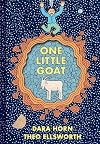
A Passover retelling unlike any other, in which "the wise child's" youngest sister throws the Afikoman into a void in space-time and the family seder can't end until it's found. Fortunately, a goat (the scapegoat) shows up to guide the eldest son through Passovers throughout history in a search for the missing matzah, in order to bring their seder to an end - and get him to start asking better questions.
Together, they visit the boy's parents' childhood seders, his grandmother in the Warsaw show more ghetto, and various famous Jewish sages, all the way back to the very first Passover - and, of course, back to the future, when the boy has a better understanding of why his father makes such a big deal of holidays, and why his mother keeps having children.
The art is black and white; I found it a bit difficult on the eyes but it's effective in conveying the story.
Quotes
If you've ever been to a Passover Seder, you know that they feel like they last forever. It's a holiday celebrating freedom, but you are stuck at that table for a very long time. (ch. 1, p. 1)
"What made you think this was going to be a safe adventure?" (Goat to Wise Child, ch. 3)
"How do you know what you don't know if you never ask questions?" (Goat to Wise Child, ch. 4)
"By celebrating Passover tonight, we are passing this memory forward to future generations." (Shmuel, Babylonia, 3rd century, ch. 4) show less
Together, they visit the boy's parents' childhood seders, his grandmother in the Warsaw show more ghetto, and various famous Jewish sages, all the way back to the very first Passover - and, of course, back to the future, when the boy has a better understanding of why his father makes such a big deal of holidays, and why his mother keeps having children.
The art is black and white; I found it a bit difficult on the eyes but it's effective in conveying the story.
Quotes
If you've ever been to a Passover Seder, you know that they feel like they last forever. It's a holiday celebrating freedom, but you are stuck at that table for a very long time. (ch. 1, p. 1)
"What made you think this was going to be a safe adventure?" (Goat to Wise Child, ch. 3)
"How do you know what you don't know if you never ask questions?" (Goat to Wise Child, ch. 4)
"By celebrating Passover tonight, we are passing this memory forward to future generations." (Shmuel, Babylonia, 3rd century, ch. 4) show less
I don't have a particular interest in Passover or Judaism, but my college magazine has a regular listing of recent books by alumni, and this was the first time I noticed a graphic novel included there so I thought I'd give it a go. (Must! Read! All! Graphic! Novels!)
An educational children's book about a religious holiday with alternative comix-style art didn't seem promising at first, but this loopy time travel story drew me in with its sassy talking goat and hapless protagonist. With his show more family trapped in seder limbo, it is up to the oldest son to crash through portals through space and time in search of the symbolic piece of matzah that will free them all.
A history lesson becomes a fun, twisty, bizarre adventure with a heart. Surprising and rousing. show less
An educational children's book about a religious holiday with alternative comix-style art didn't seem promising at first, but this loopy time travel story drew me in with its sassy talking goat and hapless protagonist. With his show more family trapped in seder limbo, it is up to the oldest son to crash through portals through space and time in search of the symbolic piece of matzah that will free them all.
A history lesson becomes a fun, twisty, bizarre adventure with a heart. Surprising and rousing. show less
The young protagonist of this graphic novel quips that Passover is “a holiday celebrating freedom, but you are stuck at that table for a very long time.”
But our frustrated protagonist — who jokingly refers to himself as the Wise Child — doesn’t know the half of it. When his baby sister loses the Afikomen (a hidden piece of matzah), it looks like the family may never be able to end this Seder! After all, it’s already been six months!
Cue the titular goat. He’s the scapegoat from show more the Seder song. This talking goat takes the Wise Child on a tour of Seders Past in a wonderful twist. I suspect Jews will love this book, but as a goy I did, too, proving you don’t have to be Jewish to love One Little Goat.
In the interest of full disclosure, I received this book from NetGalley, W.W. Norton & Co. and Norton Young Readers in exchange for an honest review. show less
But our frustrated protagonist — who jokingly refers to himself as the Wise Child — doesn’t know the half of it. When his baby sister loses the Afikomen (a hidden piece of matzah), it looks like the family may never be able to end this Seder! After all, it’s already been six months!
Cue the titular goat. He’s the scapegoat from show more the Seder song. This talking goat takes the Wise Child on a tour of Seders Past in a wonderful twist. I suspect Jews will love this book, but as a goy I did, too, proving you don’t have to be Jewish to love One Little Goat.
In the interest of full disclosure, I received this book from NetGalley, W.W. Norton & Co. and Norton Young Readers in exchange for an honest review. show less
Awards

You May Also Like


Associated Authors
Statistics
- Works
- 14
- Also by
- 11
- Members
- 272
- Popularity
- #85,117
- Rating
- 3.8
- Reviews
- 8
- ISBNs
- 14
- Languages
- 1
- Favorited
- 1