
Charles Burns (1) (1955–)
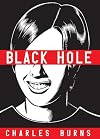
Author of Black Hole
For other authors named Charles Burns, see the disambiguation page.
About the Author
Image credit: Charles Burns by Charles Burns
Series
Works by Charles Burns
Charles Burns's Black Hole: The Fantagraphics Studio Edition (The Fantagraphics Studio Edition) (2017) 10 copies
Johnny 23 6 copies
Black Hole #12 [of 12] 5 copies
Permagel 4 copies
Unwholesome Love 2 copies
Buzz #2 1 copy
Black Hole #s 5-12 1 copy
Black Hole #s 1-4 1 copy
Close Your Eyes 1 copy
Fuse #2 1 copy
Fuse #5 1 copy
Associated Works
The Ten-Cent Plague: The Great Comic-Book Scare and How It Changed America (2008) — Cover artist, some editions — 910 copies, 28 reviews
An Anthology of Graphic Fiction, Cartoons, and True Stories (2000) — Contributor — 385 copies, 3 reviews
Raw Vol. 2, No. 1: Open Wounds from the Cutting Edge of Commix (1989) — Contributor — 208 copies, 2 reviews
An Anthology of Graphic Fiction, Cartoons, and True Stories: v. 2 (2008) — Contributor — 169 copies, 2 reviews
Raw No. 6: The Graphix Magazine That Overestimates the Taste of the American Public (1984) — Contributor — 14 copies
Holland Animation Film Festival : Catalogus = Catalogue [1994] — Cover artist — 1 copy
Tagged
Common Knowledge
- Canonical name
- Burns, Charles
- Birthdate
- 1955-09-27
- Gender
- male
- Occupations
- cartoonist
illustrator - Relationships
- Moore, Susan (wife)
- Nationality
- USA
- Birthplace
- Washington, D.C., USA
- Places of residence
- Washington, D.C., USA
Philadelphia, Pennsylvania, USA
Seattle, Washington, USA - Associated Place (for map)
- USA
Members
Reviews
Well, reading the Avengers book and then this after Understanding Comics definitely helped me realize how much more craft went into this one. In particular, I'm afraid that whenever I read comics from now on I'll be obsessively checking the panel transitions. Oh well.
This is a freaky story about a sexually-transmitted disease in 1970's Seattle that is turning kids into shambling monstrosities who live out in the woods, and how they feel about that. It hits all the angles you want it to hit - show more changing bodies, self-loathing, taking control of your own life - and would come across as a kind of combination Anastasia novel/Young Werther/That '70s Show if it weren't for the total weirdness of what's happening. The disease manages to be disturbing without being horrific, and it made me wish Burns had treated it a bit (a bit) more realistically - like, I get that this is a psychological story about teens, and the disease is just an externalization of their confusions and fears and the oh-so-jaded, used-up feeling that only a 17-year-old who's done some drugs in an unwise manner and been involved in ill-considered sexual practices and had to get up to a filthy house and wished they could go home to mother knows. (God, it's nice to be a grownup. You go from "Nobody knows the trouble I've seen" to "Everybody knows, so let's speak of pleasant things.")
Anyway, I got into this, and that's why I wished Burns had given us some more background, made the disease and the world more realistic - not, like CDC men, but a bit of explanation. But I understand wh that might have compromised the mental realityof the images and the weirdness, and that's a more interesting reality anyway, and so I am content. Also, I really like how the first thing any teen does in these stories when they get happy or sad or, like, gassy or whatever is to go straight to the beach or the forest. We here on the west coast have a powerful ally in keeping ourselves spiritually fed - that being nature, of course - and I suspect that our consumption of pharmaceutical mood stabilizers lags correspondingly. Cascadia! show less
This is a freaky story about a sexually-transmitted disease in 1970's Seattle that is turning kids into shambling monstrosities who live out in the woods, and how they feel about that. It hits all the angles you want it to hit - show more changing bodies, self-loathing, taking control of your own life - and would come across as a kind of combination Anastasia novel/Young Werther/That '70s Show if it weren't for the total weirdness of what's happening. The disease manages to be disturbing without being horrific, and it made me wish Burns had treated it a bit (a bit) more realistically - like, I get that this is a psychological story about teens, and the disease is just an externalization of their confusions and fears and the oh-so-jaded, used-up feeling that only a 17-year-old who's done some drugs in an unwise manner and been involved in ill-considered sexual practices and had to get up to a filthy house and wished they could go home to mother knows. (God, it's nice to be a grownup. You go from "Nobody knows the trouble I've seen" to "Everybody knows, so let's speak of pleasant things.")
Anyway, I got into this, and that's why I wished Burns had given us some more background, made the disease and the world more realistic - not, like CDC men, but a bit of explanation. But I understand wh that might have compromised the mental realityof the images and the weirdness, and that's a more interesting reality anyway, and so I am content. Also, I really like how the first thing any teen does in these stories when they get happy or sad or, like, gassy or whatever is to go straight to the beach or the forest. We here on the west coast have a powerful ally in keeping ourselves spiritually fed - that being nature, of course - and I suspect that our consumption of pharmaceutical mood stabilizers lags correspondingly. Cascadia! show less

With Sugar Skull, Charles Burns' Last Look set of graphic novels is finished, though without ending. There is some significant closure, chiefly with an explanation for Doug's head wound and his breakup with Sarah. This third volume introduces the contemporary Doug who has been reminiscing in the earlier ones, well after the creation of his portal fantasy alter-ego, who is now identified as Johnny. Neither character is given satisfaction by the final pages, nor are they brought back show more together.
Discordians familiar with the Law of Fives know that the recurring "23" in these books could mean pretty much anything, but I suppose it is intended to reference the twenty-three human chromosome pairs, and thus generational descent. In Sugar Skull, we find Doug contemplating both ancestry (his father, never his occluded mother) and posterity. Or perhaps 23 is to indicate the twenty-third pair, and thus sexual difference. Johnny remains alienated at best from any female manifestations, despite his obsessive attraction to them.
I borrowed these books from the public library: X-ed Out first, and then The Hive and Sugar Skull together. Despite the fact that they were initially published over a four- or five-year span, I think it would be best to have all three volumes on hand when reading any of them. There are recurrent images and references that made me want to review the first book, especially its opening pages, as I finished reading the last. show less
Discordians familiar with the Law of Fives know that the recurring "23" in these books could mean pretty much anything, but I suppose it is intended to reference the twenty-three human chromosome pairs, and thus generational descent. In Sugar Skull, we find Doug contemplating both ancestry (his father, never his occluded mother) and posterity. Or perhaps 23 is to indicate the twenty-third pair, and thus sexual difference. Johnny remains alienated at best from any female manifestations, despite his obsessive attraction to them.
I borrowed these books from the public library: X-ed Out first, and then The Hive and Sugar Skull together. Despite the fact that they were initially published over a four- or five-year span, I think it would be best to have all three volumes on hand when reading any of them. There are recurrent images and references that made me want to review the first book, especially its opening pages, as I finished reading the last. show less
I feel like I need to take a cold shower after finishing this. It was so dark, despondent and creepy. The illustrations and plot are fantastic though. The 70's were an idyllic time to live if you were a white teenager in suburbia. That is unless you contracted a weird sexually transmitted "bug" that morphed some body deformity. It could be a tail, boils, webbed hands, an extra mouth, shedding skin; it's different for every person. The spread is slow, but it's totally alienating. The shame is show more all consuming and soon there is nothing to but live in the woods with other afflicted teenagers. There is no hope, no cure, no prevention, and no awareness. This graphic novel is shown through the eyes of several teenagers who have it or will soon contract it. It's dark, weird, and so messed up. It's very nihilistic and unique. I have a lot of thoughts about this book, but I'm not entire sure how to write them out. Read with an open mind and always use a rubber. show less
Before I started Black Hole, I knew that it was about a mysterious plague that affects teenagers. I suppose I was expecting strange occurrences and a sense of growing horror as people begin to realise what is happening. But in fact, when the book starts, the plague is already there: an established fact of life. The teenagers are just being teenagers - copping off with each other, getting stoned, trying to figure out what to do with their lives - with the plague as just another of the shadows show more that hangs over them.
I found this quite difficult to read. Both the grotesqueness of the plague symptoms, and the awfulness of being a teenager, were made much more immediate and disturbing by the fact that they were depicted in images rather than words. (The style of the drawings, monochrome and usually with heavy black backgrounds, and the often grotesque dream sequences, add to the overall grimness - it's not one of those books that you start looking at and instantly want to read).
That said, since finishing it, I have kept going back to look through it, and noticed new things. It is certainly a book with a lot of impact. This all sounds like faint praise. It's not meant to be: I think this is a good book. It's just that you need to know what you are getting into. show less
I found this quite difficult to read. Both the grotesqueness of the plague symptoms, and the awfulness of being a teenager, were made much more immediate and disturbing by the fact that they were depicted in images rather than words. (The style of the drawings, monochrome and usually with heavy black backgrounds, and the often grotesque dream sequences, add to the overall grimness - it's not one of those books that you start looking at and instantly want to read).
That said, since finishing it, I have kept going back to look through it, and noticed new things. It is certainly a book with a lot of impact. This all sounds like faint praise. It's not meant to be: I think this is a good book. It's just that you need to know what you are getting into. show less
Lists
Awards


You May Also Like


Associated Authors
Statistics
- Works
- 72
- Also by
- 26
- Members
- 5,618
- Popularity
- #4,417
- Rating
- 3.8
- Reviews
- 155
- ISBNs
- 176
- Languages
- 16
- Favorited
- 3
