
Chester Brown (1) (1960–)
Author of Louis Riel: A Comic-Strip Biography
For other authors named Chester Brown, see the disambiguation page.
About the Author
Image credit: Chester Brown, at the 2009 Toronto Word on the Street festival [source: Tabercil at Wikipedia]
Series
Works by Chester Brown
Yummy Fur #22 5 copies
Ed the Happy Clown - A Serialized Reprinting of Chester Brown's First Graphic Novel (Issue 1 of 9) (2004) 3 copies
Ed the Happy Clown (issue 6 of 9) 3 copies
Ed The Happy Clown #9 3 copies
ed the happy clown #8 of 9 2 copies
ed the happy clown #7 of 9 2 copies
ed the happy clown #3 of 9 2 copies
Mind Games 1 copy
Ed The Happy Clown #05 1 copy
Associated Works
An Anthology of Graphic Fiction, Cartoons, and True Stories (2000) — Contributor — 385 copies, 3 reviews
An Anthology of Graphic Fiction, Cartoons, and True Stories: v. 2 (2008) — Contributor — 169 copies, 2 reviews
Drawn & Quarterly: Twenty-five Years of Contemporary Cartooning, Comics, and Graphic Novels (2015) — Contributor — 150 copies, 5 reviews
Ladies of the Night: Short Stories by Maggie McNeill (2014) — Cover artist, some editions — 3 copies
Tagged
Common Knowledge
- Birthdate
- 1960-05-16
- Gender
- male
- Organizations
- Libertarian Party of Canada
- Awards and honors
- Harvey Award (Cartoonist, 1990)
- Short biography
- Chester William David Brown, born in 1960, grew up in Chateauguay, Quebec.
- Nationality
- Canada
- Birthplace
- Montréal, Québec, Canada
- Places of residence
- Montréal, Québec, Canada
Toronto, Ontario, Canada - Associated Place (for map)
- Canada
Members
Discussions
Louis Riel paperback - caveat emptor in Comics (August 2006)
Reviews
Mary wept over the feet of Jesus : prostitution and religious obedience in the Bible : a "graphic novel" containing adaptations of certain Biblical stories by Chester Brown
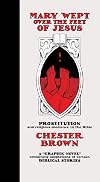
Chester Brown gets me every time. I'm pretty well hooked after two panels and his newest book, a treatise on prostitution and obedience in the Bible is no exception. His sparse artistic style and script, grounded in rich research, captures so much emotional expression and contradictory elements that really brings to life how gd weird the Bible can be; and how much can be learned from scripture when the reader goes against the grain of popular biblical teaching.
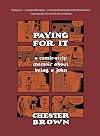
Chester Brown's paean to the joys of prostitution (hiring them, not being one; I suspect if he wrote from the latter point of view this would have been a very different book) is sort of an odd experience. The narrative was engrossing, believe it or not, and Chester is a more appealing character than he really should be, considering that he seems emotionally detached from everything and everyone in the world. But Brown's philosophy feels ill thought-out even though he goes on and on and ON show more about it; while he purports to weigh the pros and cons at great (and I do mean great) length, he never seems to wind up saying much. He works hard to dress up his maunderings on prostitution and turn them into a Platonic disquisition on the nature of love and the morality of the sex trade, but they really don't add up to anything more than "I think prostitution is a really good idea because I enjoy hiring prostitutes because it's a lot better than romance or monogamy." Well, ok, if you say so, brah!
Brown also elides over a lot of stuff that made me do a triple take. For example, in one sequence, he's having sex with a prostitute who keeps saying "Ow! Ow! Ow!" and who, according to Brown, appears to be in pain. She tells him that he isn't hurting her, but it's obvious that he is. He thinks to himself, "It's kind of a turn-on to me that she's in pain, but still, I think I'll cut this session short" or words to that effect. This experience gives him no pause whatsoever, even though it suggests that she might be unwilling or exploited, or both. Other than noting that her pain is turning him on, though (blecch), he doesn't appear to give it a second thought, other than to note that she probably isn't involved in human trafficking because, um, well, it's not clear why. Maybe because her accent is Canadian?
And whether he means to or not, Brown dehumanizes the prostitutes he portrays, as he never shows their faces or any of their physical features. The reader sees them mostly from behind, and he draws them all the same: thin with long dark hair. Brown claims that he used this technique to protect the women's privacy. Yeah, right -- because Brown's artistic technique has such verisimilitude. Give me a break. Brown's photo is in the back of the book, and I would never in a million years have recognized him if I had only seen his own drawings of himself; he draws himself as a generic dude with an oval head and glasses. So he couldn't have drawn the women in a similarly generic way? Anyone who's read Scott McCloud's "Understanding Comics" is going to see Brown's explanation for the rationalization really is.
Brown also spends the better part of the story deriding romantic love and monogamy, dismissing them as, among other things, "possessive love." Fine -- that's not necessarily an indefensible position. But by the end of the book, he's involved in -- you guessed it -- a monogamous relationship with one of the women he hired. He indulges in another paragraphs-long expostulation to explain this fact away -- something about how he's not a jealous person so it's different when he does it -- but his handwaving doesn't do much to obviate the fact that he's basically just revealed that the entire book is more or less an exercise in hypocrisy.
And finally, anyone who says he has "respect and affection" for Dave Sim has just lost me entirely.
So, three stars because I was riveted in the way I'd be riveted by a cobra about to strike, but I'll admit I kind of hate myself for it. show less
Brown also elides over a lot of stuff that made me do a triple take. For example, in one sequence, he's having sex with a prostitute who keeps saying "Ow! Ow! Ow!" and who, according to Brown, appears to be in pain. She tells him that he isn't hurting her, but it's obvious that he is. He thinks to himself, "It's kind of a turn-on to me that she's in pain, but still, I think I'll cut this session short" or words to that effect. This experience gives him no pause whatsoever, even though it suggests that she might be unwilling or exploited, or both. Other than noting that her pain is turning him on, though (blecch), he doesn't appear to give it a second thought, other than to note that she probably isn't involved in human trafficking because, um, well, it's not clear why. Maybe because her accent is Canadian?
And whether he means to or not, Brown dehumanizes the prostitutes he portrays, as he never shows their faces or any of their physical features. The reader sees them mostly from behind, and he draws them all the same: thin with long dark hair. Brown claims that he used this technique to protect the women's privacy. Yeah, right -- because Brown's artistic technique has such verisimilitude. Give me a break. Brown's photo is in the back of the book, and I would never in a million years have recognized him if I had only seen his own drawings of himself; he draws himself as a generic dude with an oval head and glasses. So he couldn't have drawn the women in a similarly generic way? Anyone who's read Scott McCloud's "Understanding Comics" is going to see Brown's explanation for the rationalization really is.
Brown also spends the better part of the story deriding romantic love and monogamy, dismissing them as, among other things, "possessive love." Fine -- that's not necessarily an indefensible position. But by the end of the book, he's involved in -- you guessed it -- a monogamous relationship with one of the women he hired. He indulges in another paragraphs-long expostulation to explain this fact away -- something about how he's not a jealous person so it's different when he does it -- but his handwaving doesn't do much to obviate the fact that he's basically just revealed that the entire book is more or less an exercise in hypocrisy.
And finally, anyone who says he has "respect and affection" for Dave Sim has just lost me entirely.
So, three stars because I was riveted in the way I'd be riveted by a cobra about to strike, but I'll admit I kind of hate myself for it. show less
Paying for It is both a memoir and an extended conversation, argument, about the role of prostitution in society. Brown makes a convincing argument and renders his experience in a way that isn't particularly flattering to him, but honest and clear, which are attributes that need to be brought into conversations about sex work.
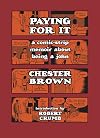
Brown is sincere in not believing himself a misogynist, and certainly doesn't wish any of the sex workers he's been with ill, but I think there are a few problems that make me unable to swallow his imagined libertarian sex-trade utopia. They basically fall into two categories: 1) they only work if we assume all people are completely rational economic actors who never hurt beyond bearing or do stuff not in their interest (he basically doesn't talk about pimping, to take only the top of the show more problem pile); 2) his broader social arguments are always rooted in how he treats the women he pays to have sex with, which makes me suspicious; and 3) you can't tell a story like this by anonymizing the women, ever. I get the need to obscure some of their identities--in that case tell it as fiction. This seems more like self defense, more like "see? I'm okay! I was nice to her!" Which is problematic both for the personalizing reason in 2) and for the depersonalizing reason in 3). I don't think it's ever the john's place to tell the sex worker's story--but then, my definition of exploitation is clearly broader than Brown's, and while I don't think we can outlaw people performing acts not in the best interest of their happiness/health/safety, I do think we can work together to create a happy/healthy/safe society--whereas Brown seems ultimately like a sexual Hobbesian, who doesn't believe in love and thinks they chose their medicine as part of having the protection of a socioeconomic niche. In the end, too much of this feels like he's just looking for an excuse to tell you about the women he paid to have sex with, like a clammy older drunk. show less
Lists
Awards


You May Also Like


Associated Authors
Statistics
- Works
- 76
- Also by
- 16
- Members
- 3,010
- Popularity
- #8,476
- Rating
- 3.5
- Reviews
- 75
- ISBNs
- 86
- Languages
- 8
- Favorited
- 10
