
Peter Godfrey-Smith
Author of Other Minds: The Octopus, the Sea, and the Deep Origins of Consciousness
About the Author
Peter Godfrey-Smith is Professor of Philosophy at Harvard University.
Image credit: Peter Godfrey-Smith reads from his book "Other Minds" at Adelaide Writers Week 2018
Works by Peter Godfrey-Smith
Other Minds: The Octopus, the Sea, and the Deep Origins of Consciousness (2016) 2,443 copies, 77 reviews
Living on Earth: Forests, Corals, Consciousness, and the Making of the World (2024) 163 copies, 1 review
Associated Works
Tagged
Common Knowledge
- Canonical name
- Godfrey-Smith, Peter
- Birthdate
- 1965
- Gender
- male
- Education
- University of California, San Diego (Ph.D|Philosophy|1991)
University of Sydney (BA|1987) - Occupations
- professor of philosophy
philosopher of science
scuba diver - Organizations
- University of Sydney
City University of New York
Harvard University
Australian National University
Stanford University - Awards and honors
- Lakatos Award (2010)
American Philosophical Society (2022) - Agent
- Sarah Chalfant
- Nationality
- Australia
- Birthplace
- Sydney, Australia
- Places of residence
- Sydney, New South Wales, Australia
San Diego, California, USA - Associated Place (for map)
- Australia
Members
Reviews
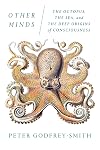
This book turned me into an cephalopod nerd in the course of a single week. These creatures are so amazingly fascinating, and this book really does them justice. And, of course, as the title suggests, this book isn't just about cephalopods; it's about how they evolved, the intelligence that they've evolved, and how the differences between them and us can teach us about consciousness, both in ourselves, and in species very different from us. This is some deep, complicated stuff, and though show more this book challenged me in some of the more esoteric parts, I was engaged throughout, and learned a whole bunch, and had opinions on all of it by the end. Also there's a section about the evolutionary reason for why we age that was absolutely fascinating.
I never thought that I would feel so emotionally connected to cephalopods, but here we are. They're smart, they can recognize individual human beings, and apparently have strong opinions on us; there have been octopuses that would shoot water at anyone new who visited their lab, and other octopuses that would shoot water only at one specific person that they'd developed a strong dislike for. What's worse, by the time I finished the book, I had come to the realization that they're truly tragic figures. They can change color on a whim, and often display complex patterns on their skin that seem to mirror what's going on in their head, but they are colorblind. They can express what's going on in their heads on their skin, but can't see all of their skin, so the pictures on their skin haven't become an inward loop in their head like our voices have become in ours. Worst of all, they're the smartest animal on their entire branch of evolution, but they only live for two years before they start to spontaneously fall apart. They have so much going on in their strange, alien, brains, but they only live to mate once, and then fade away. It's incredibly moving, and only makes me love their strangeness, intelligence, and independence even more.
If you can't tell, I loved this book. I would definitely recommend it to anyone--unless, like one of my podcast co-hosts, octopuses freak you out. Then maybe skip this one? But I dare anyone to not be charmed by Charles, the octopus who absolutely refused to take part in a lever-pulling experiment, and instead broke the lever, pulled overhead lights down into his cage, and shot water at everyone.
This review first appeared on my blog. show less
I never thought that I would feel so emotionally connected to cephalopods, but here we are. They're smart, they can recognize individual human beings, and apparently have strong opinions on us; there have been octopuses that would shoot water at anyone new who visited their lab, and other octopuses that would shoot water only at one specific person that they'd developed a strong dislike for. What's worse, by the time I finished the book, I had come to the realization that they're truly tragic figures. They can change color on a whim, and often display complex patterns on their skin that seem to mirror what's going on in their head, but they are colorblind. They can express what's going on in their heads on their skin, but can't see all of their skin, so the pictures on their skin haven't become an inward loop in their head like our voices have become in ours. Worst of all, they're the smartest animal on their entire branch of evolution, but they only live for two years before they start to spontaneously fall apart. They have so much going on in their strange, alien, brains, but they only live to mate once, and then fade away. It's incredibly moving, and only makes me love their strangeness, intelligence, and independence even more.
If you can't tell, I loved this book. I would definitely recommend it to anyone--unless, like one of my podcast co-hosts, octopuses freak you out. Then maybe skip this one? But I dare anyone to not be charmed by Charles, the octopus who absolutely refused to take part in a lever-pulling experiment, and instead broke the lever, pulled overhead lights down into his cage, and shot water at everyone.
This review first appeared on my blog. show less

My public library had several copies of this recent book on the shelf, and the sexy title makes it easy to imagine why. Author Peter Godfrey-Smith is a professor of philosophy and a scuba diver, and he draws on both of these backgrounds, as well as related research in ethology and evolutionary biology. The main question addressed by the book is the nature of octopus consciousness: Does it exist, and how does it resemble and differ from ours? As Godfrey-Smith points out, of all of the animals show more we know with complex active nervous systems, the octopus is perhaps the most genealogically alien from us. Yet by virtue of its aquatic character, it is closer to our shared origins of life and consciousness than we are.
A surprising and gratifying element of this book is the discussion of the evolutionary basis of senescence. It turns out that this topic is highly apposite, since hardly any of the big cephalopod species discussed in this book have an ordinary lifespan of more than two years. The result is a strange paradox for human investigators who think of elaborate brains and nervous systems as being concerned with experience and memory. An octopus doesn't have time to acquire much of a life history.
Another apparent paradox has to do with the dramatic ability of the octopus (and even more so, its remote cousin the cuttlefish) to change its color. Although these creatures have camera-style eyes like humans do, they lack the optical equipment that allows vertebrates to visually distinguish color. The resolution to the enigma seems to have to do with the ways in which they may use their skin, rather than their eyes, to sense the colors in their environments.
The author's notes to the main text are given as end notes, indexed by page number. They are not called out in the body text itself, although they would be read most usefully with the material that they annotate. They do contain source references, but are mostly explanation and useful digression for issues simplified in the main text. I scanned them quickly at the end of reading the book, and I was irritated that they weren't footnotes, where I would have been sure to read with profit the ones most interesting to me. It's ironic that at a time when digital typesetting makes footnotes easy to produce, book marketing evidently forbids them.
The final chapter of Other Minds is "Octopolis," discussing an apparently unique para-social environment inhabited by octopuses off of eastern Australia, and this concludes with some environmentalist reflections on the perilous state of the oceans. Since this book was written in 2016, a second Australian octopus city ("Octlantis") has been discovered, and the evidence of human destruction of the oceans has become more stark. In particular, marine ecosystems are being ravaged by heat waves and the accumulation of plastics at previously unsuspected depths. show less
A surprising and gratifying element of this book is the discussion of the evolutionary basis of senescence. It turns out that this topic is highly apposite, since hardly any of the big cephalopod species discussed in this book have an ordinary lifespan of more than two years. The result is a strange paradox for human investigators who think of elaborate brains and nervous systems as being concerned with experience and memory. An octopus doesn't have time to acquire much of a life history.
Another apparent paradox has to do with the dramatic ability of the octopus (and even more so, its remote cousin the cuttlefish) to change its color. Although these creatures have camera-style eyes like humans do, they lack the optical equipment that allows vertebrates to visually distinguish color. The resolution to the enigma seems to have to do with the ways in which they may use their skin, rather than their eyes, to sense the colors in their environments.
The author's notes to the main text are given as end notes, indexed by page number. They are not called out in the body text itself, although they would be read most usefully with the material that they annotate. They do contain source references, but are mostly explanation and useful digression for issues simplified in the main text. I scanned them quickly at the end of reading the book, and I was irritated that they weren't footnotes, where I would have been sure to read with profit the ones most interesting to me. It's ironic that at a time when digital typesetting makes footnotes easy to produce, book marketing evidently forbids them.
The final chapter of Other Minds is "Octopolis," discussing an apparently unique para-social environment inhabited by octopuses off of eastern Australia, and this concludes with some environmentalist reflections on the perilous state of the oceans. Since this book was written in 2016, a second Australian octopus city ("Octlantis") has been discovered, and the evidence of human destruction of the oceans has become more stark. In particular, marine ecosystems are being ravaged by heat waves and the accumulation of plastics at previously unsuspected depths. show less

Having really enjoyed the author's previous book on matters of consciousness and being, I was really looking to reading this follow-up. Was I satisfied? Yes, as Godfrey-Smith lays out, step by step, his sense of how consciousness and sentience gradually came into being as a result of having to cope with a wider environment. Still, the author is at his best when informed by his experiences as an active naturalist, as the portions dealing with terrestrial animals seem a little pat by show more comparison. Godfrey-Smith ends this book with a plea for a little more appreciation of the capabilities of a wide variety of creatures, some skepticism that we are anywhere near creating artificial consciousness, and the final point that, if sentience is a more widespread quality then we thought a generation or so ago, then the special capability of humanity might be imagination. At least one more book dealing with these themes seems to be forthcoming and I hope that it's as good as this one. show less
Rating: 3.5* of five
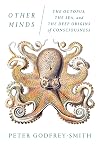
A deeply (!) enjoyable look at cephalopod minds, not brains but minds, in parallel to our own mammalian ones. I was absolutely enthralled by the author's discoveries made at a site he calls "Octopolis," a community of octopuses on the seafloor near Sydney, Australia.
One of the most interesting facets of the book to me was its explanation, in terms of existing evolutionary thought, of how and why cephalopods, animals that live a single mating cycle on average, developed show more the astoundingly complex signaling behaviors and apparent cognitive abilities they have. It's a wonderful and involving story.
That makes this sound like a four-and-a-half star book, doesn't it? I'm not going to beat about the bush, it would have been had it not wandered waaay too far down the human-mind-brain-consciousness rabbit hole without reaching any sort of conclusion that felt solid. In the space of this book, just over 200 pages of text plus index and notes, there is no chance that this could occur. So say "listen, there's about a bajillion petaflops of data I can't begin to pretend to digest for you, but here in 500 words is what *I* want you to know so you can see where I'm going with the parts about cephalopods."
The glossy-magazine version, in other words, would've served this book better and been less simultaneously overinforming and underrepresenting a hugely complex and contentious area of human-consciousness study. But I recommend reading the book because damn it feels good to learn about something unique from someone so warm, wise, and witty as Peter Godfrey-Smith. show less
A deeply (!) enjoyable look at cephalopod minds, not brains but minds, in parallel to our own mammalian ones. I was absolutely enthralled by the author's discoveries made at a site he calls "Octopolis," a community of octopuses on the seafloor near Sydney, Australia.
One of the most interesting facets of the book to me was its explanation, in terms of existing evolutionary thought, of how and why cephalopods, animals that live a single mating cycle on average, developed show more the astoundingly complex signaling behaviors and apparent cognitive abilities they have. It's a wonderful and involving story.
That makes this sound like a four-and-a-half star book, doesn't it? I'm not going to beat about the bush, it would have been had it not wandered waaay too far down the human-mind-brain-consciousness rabbit hole without reaching any sort of conclusion that felt solid. In the space of this book, just over 200 pages of text plus index and notes, there is no chance that this could occur. So say "listen, there's about a bajillion petaflops of data I can't begin to pretend to digest for you, but here in 500 words is what *I* want you to know so you can see where I'm going with the parts about cephalopods."
The glossy-magazine version, in other words, would've served this book better and been less simultaneously overinforming and underrepresenting a hugely complex and contentious area of human-consciousness study. But I recommend reading the book because damn it feels good to learn about something unique from someone so warm, wise, and witty as Peter Godfrey-Smith. show less
Lists
el (1)
Awards


You May Also Like


Associated Authors
Statistics
- Works
- 8
- Also by
- 2
- Members
- 3,716
- Popularity
- #6,814
- Rating
- 3.8
- Reviews
- 93
- ISBNs
- 80
- Languages
- 12
- Favorited
- 1