
Epictetus
Author of Enchiridion
About the Author
Epictetus (A.D. 55-A.D. 135) taught in Rome until the year 94, when Emperor Domitian banished philosophers from the city. In exile, he established his school of philosophy where his distinguished students included Marcus Aurelius, author of the Meditations.
Disambiguation Notice:
Name in Greek: Ἐπίκτητος. Also known as Epictetus, Epiktetos, Epiktet, Epicteto
Image credit: wikimedia commons
Works by Epictetus
The Apology, Phaedo and Crito of Plato / The Golden Sayings of Epictetus / The Meditations of Marcus Aurelius (1909) 1,657 copies, 4 reviews
The Meditations of Marcus Aurelius and the Enchiridion of Epictetus (1999) — Author — 213 copies, 3 reviews
Britannica Great Books: Lucretius, Epictetus, Marcus Aurelius, Plotinus (1952) — Author; Contributor — 29 copies
Manual de Epicteto. A arte de viver melhor - Edicao Bilingue (Em Portugues do Brasil) (2019) 24 copies
The Teaching of Epictetus Being the 'Encheiridion of Epictetus,' with Selections from the 'Dissertations' and 'Fragments' (2015) 21 copies
Works (Greek) 14 copies
Kendisinin Efendisi Olmayan Hiç Kimse Özgür Değildir: 2000 Yıllık Huzurlu Yaşama Rehberi (Turkish Edition) (2019) 13 copies
The Teachings of a Stoic: Selected Discourses and the Encheiridion (Collins Classics) (2024) 9 copies
The Essential Writings 9 copies
El arte de ser libre: Un manual de sabiduría clásica para una vida estoica y feliz (Spanish Edition) (2020) 7 copies, 1 review
Selected Discourses - The Wisdom of Epictetus: The Stoic Classic (Capstone Classics) (2024) 6 copies
Selections from the Discourses of Epictetus — Author — 5 copies
The Meditations Of Marcus Aurelius Antoninus: With The Manual Of Epictetus And A Summary Of Christian Morality (2009) 4 copies
Box Grandes Mestres do Estoicismo 4 copies
THE DISCOURSES OF EPICTETUS. Translated by P. E. Matheson. Illustrated by Hans Erni. (1968) 4 copies
The Works of Epictetus - His Discourses, in Four Books, the Enchiridion, and Fragments. (1890) 4 copies
The Wild Duck By Ibsen, the Manual By Epictetus, the Canterbury Tales By Chaucer (Great Books Foundation, Set Five, Volume One) (1966) 4 copies
Handbüchlein der Moral: Griechisch/Deutsch (Reclams Universal-Bibliothek) (1992) — Author — 3 copies
Manual de Epicteto 3 copies
The Essential Writings 3 copies
The Works of Epictetus. Vol II 3 copies
The Discourses of Epictetus and the Enchiridion (Royal Collector's Edition) (Case Laminate Hardcover with Jacket) (2020) 3 copies
The Works of Epictetus. Vol I 2 copies
Anleitung zum glücklichen Leben griechisch - deutsch = Encheiridion (Handbuch der Moral) (2011) 2 copies
The Enchiridion by Epictetus 2 copies
Short Works 2 copies
Epicteti manuale et sententiæ 2 copies
Discourse of Epictetus : Selections 2 copies
De Kolleges van Epictetus 2 copies
The Discourses 2 copies
Epictetus: Complete Works 2 copies
Selections from the Discourses of Epictetus, with the Encheiridion /c[translated by] George Long (2010) 1 copy
The Manual For Living 1 copy
Nghệ thuật sống 1 copy
Manual estoico de vida: Una guía definitiva para alcanzar la serenidad (Spanish Edition) (2024) 1 copy
MANUAL DE VIDA 1 copy
Il manuale, Le dissertazioni 1 copy
Manuel d'Épictète: Nouvelle Traduction Française, (Éd.1878) (Philosophie) (French Edition) (2012) 1 copy
Pensées et Entretiens 1 copy
Diatribe, Manuale, Frammenti 1 copy
Complete Works of Epictetus 1 copy
Umetnost življenja 1 copy
Diatribe 1 copy
Manuál 1 copy
Düşünceler ve Sohbetler 1 copy
Il manuale di Epitteto 1 copy
Hver er sinnar gæfu smiður 1 copy
Handbüchlein der Ethik 1 copy
Handbüchlein der Lebenskunst 1 copy
Handbüchlein der Moral. 1 copy
The discourses and manual : together with fragments ... / Epictetus ; tr. by P. E. Matheson 1 copy, 1 review
Sayings of Epictetus 1 copy
EPICTETUS Moral Discourses 1 copy
Handbüchlein der Moral und Unterredungen — Composer — 1 copy
Handbüchlein der Ethik 1 copy
Entretiens II 1 copy
The Moral Discourses of Epictetus. Translated by Elizabeth Carter. (Edited by W. H. D. Rouse.) 1 copy
L'Enchiridion / Epitteto 1 copy
Discourses, The: Books 1-4 1 copy
The price of tranquility 1 copy
Das Buch vom geglückten Leben : du willst Philosoph sein? ; mach dich darauf gefasst, dass man dich auslacht (2007) 1 copy
The Discourses. Book I 1 copy
Selections from the Thoughts of Marcus Aurelius Antoninus, Emperor of Rome, and The Discourses of Epictetus (1881) 1 copy
The Enchiridion, or manual, of Epictetus. Translated from the Greek. Carefully corrected. (2010) 1 copy
The Encheiridon of Epictetus 1 copy
ARTI I TË JETUARIT 1 copy
MÁXIMAS 1 copy
As máximas de Epicteto (tradução) (Coleção Filosofia à Maneira Clássica) (Portuguese Edition) (2014) 1 copy
O Grande Livro da Costura 1 copy
Manual - Epicteto 1 copy
Handbook of Epictetus (HPC Philosophical Classics Series) by Epictetus published by Hackett Pub Co (1983) (1983) 1 copy
Epictetus his morals, with Simplicius his comment. Made English from the Greek, by George Stanhope 1 copy
Selections from Epictetus 1 copy
Fragments 1 copy
Epictete, Entretiens vol. 2 1 copy
Epictete, Entretiens vol. 3 1 copy
Epictete, Entretiens vol. 4 1 copy
Nghệ thuật sống 1 copy
Associated Works
Britannica Great Books of the Western World Volume 12 Lucretius, Epictetus, Marcus Aurelius (1952) — Contributor — 261 copies
The Stoic and Epicurean philosophers; the complete extant writings of Epicurus, Epictetus, Lucretius, Marcus Aurelius (1940) 241 copies, 2 reviews
The Moral Life: An Introductory Reader in Ethics and Literature (1999) — Contributor — 202 copies, 2 reviews
Stoic Six Pack - Meditations of Marcus Aurelius and More: The Complete Stoic Collection (2014) — Contributor — 71 copies
The Delphian Course : Part Three : Greek Drama, Philiosopy and Literature, the Story of Rome (1913) — Contributor — 8 copies
Tagged
Common Knowledge
- Canonical name
- Epictetus
- Legal name
- Ἐπίκτητος
- Birthdate
- c. 55
- Date of death
- c. 135
- Gender
- male
- Occupations
- slave
philosopher
teacher - Relationships
- Musonius Rufus, Gaius (teacher)
Arrian (student) - Nationality
- Greece
Roman Empire - Birthplace
- Pamukkale, Turkey
- Places of residence
- Rome
Nicopolis, Greece - Place of death
- Nicopolis, Greece
- Map Location
- Greece
Roman Empire - Disambiguation notice
- Name in Greek: Ἐπίκτητος.
Also known as Epictetus, Epiktetos, Epiktet, Epicteto
Members
Discussions
WISDOM OF MARCUS AURELIUS & SAYINGS OF EPICTETUS in Easton Press Collectors (April 2023)
Epictetus thread ... in Challenge: Loeb Classical Library (November 2014)
Reviews
Today's entry in Ryan Holiday's The Daily Stoic reads: "There is hardly an idea in Stoic philosophy that wouldn't be immediately agreeable to a child". This is how I feel about Epictetus' The Discourses. It all seems like so much common sense once argued in the written word. The Discourses is a transcription of Epictetus' various lectures, recorded by his student, Arrian. Once, my lectures on political economy were transcribed for an entire semester for a hearing-impaired student, and I show more recall reading my spoken words with a sense of awe: how was it that I could speak such things but could not readily put these same ideas on paper? It is a powerful way to record ideas. The parallels between Epictetus' Stoicism and Christianity, especially the New Testament, are remarkable. Many of the key gospel sayings are apparent in Epictetus' work. This is not a new discovery - many have demonstrated the links between Stoicism and the Abrahamic religions, with Thomas Aquinas apparently quoting Epictetus in City of God - but some links remain confusing. For instance, Epictetus constantly refers to "god" (as opposed to "God"), but he is not always referring to Zeus (except were the name Zeus is used explicitly). The absence of the other Greek and Roman gods gives me the impression (managing one's "impressions" is a large part of Stoic philosophy) that Epictetus was a monotheist. I have discovered links between the Stoics and Ralph Waldo Emerson, but there is a difference that is worthy of further investigation, which requires a study of Kant. Epictetus' "god" is "immanent", meaning: "being within the limits of possible experience and knowledge". This contrasts with Emerson's "transcendent" God, where "transcendence" is defined in the Kantian sense as "being beyond the limits of of all possible experience and knowledge". I find the distinction between the Transcendentalists and the Stoics to be somewhat difficult to comprehend. For Emerson, God was in each of us individually, but what was in us was also part of a greater God that we all shared. If the Stoics' immanent god is wholly within our experience, as in, one's "acting in accordance with nature", or, to put it another way, one's "acting in accordance with god" - or otherwise suffering the consequences which include unhappiness, to the point where suicide, not through personal trauma, but for one's inability to act in accordance with nature, is a legitimate Stoic "opt out" action - but at the same time, being human necessarily means sharing fellowship in accordance with nature, then is this not Transcendentalist? Clearly, a thorough reading of Kant is required to comprehend this distinction. Yet Epictetus provides, for me, the most thorough understanding of Stoic philosophy. It is probably necessary to have a firm grasp on the ideas of Heraclitus, the works of Homer, and at least a working knowledge of Epicurus and the Cynics, but otherwise, The Discourses comes close to a practical religious handbook. I mean this in the sense that The Handbook (Enchiridion) is like an overview of Stoic thought, whereas The Discourses fills in the spiritual dimensions of the philosophy. I have often cringed when reading Atheistic and science-reifying comments about religion, but Epictetus does no such thing. It is apparent that faith and reason are not incompatible, and Nietzsche was right in that "God is dead and we killed Him". I have often met academic colleagues who will state that racism has no place in Academe, in that it has no basis in reason; yet applying the same argument to religion is a bridge too far. Epictetus makes it clear that faith and reason go hand in hand, in that first principles of Stoic philosophy require an understanding that acting in accordance with god (or God, does it matter?) requires faith in the existence of a god, which without would mean that philosophy is built on shifting sands, in that if God does not exist then there is no meaning to life. To be sure, to cling dogmatically to any one interpretation of the first-principle god would be to challenge the philosophy built upon it, but if one were seeking to apply faith and reason in one sitting, then The Discourses is the most comprehensible philosophy to do just that. And this, to me, makes The Discourses one of the most useful, insightful, and edifying books I have ever read. show less

These times in which we now live demand normal daily functioning, combined with active resistance to viciously regressive political forces, in a chaotic atmosphere of propaganda and violence. For some this state of being is nothing new, but for white left-wingers in the UK and US, I suspect it’s largely novel and shocking. Personally, I find the current state of things (which I dread to think of as a new normal) horrifying and depressing, as I discussed in this review. Amongst other coping show more mechanisms, I’m finding thoughtful non-fiction helpful. Stoic philosophy seemed appropriate in part because it is one of the roots of cognitive behavioural therapy (CBT). This ancestry was often evident while I read; Epictetus demonstrates a sophisticated understanding of psychology many centuries before such a discipline existed.
It was interesting to read Epictetus as an atheist. Central to his Stoic teaching is the need to resign yourself, ideally in a joyful spirit, to all that outside your control. Epictetus assigns this realm to God/the gods/Zeus, effectively interchangeable terms. When applying this to myself, I experimented with reading God as fate, destiny, chaos, and simply the universe. Since I don’t specifically believe in a preordained fate or destiny, I was most comfortable interpreting what’s outside my control broadly as ‘shit that happens’. I don’t think that anyone or anything is in control, but things happen nonetheless. If anything, I think this atheist reading strengthens Epictetus’ arguments. If there is no God deciding your way in life, all the more reason to carefully contemplate your impressions and actions. Railing against the chaos of the universe is no more helpful than condemning the capriciousness of God or gods.
I went through Epictetus at approximately half my usual reading speed, as I am unaccustomed to philosophy and wanted to understand it as best I could. The experience was rewarding. Epictetus has much to say about freedom and a good life that resonates today. It’s tempting to see Stoicism as passive and fatalistic, but I came to consider that a function of modern individualism and impatience. Epictetus makes it clear that Stoic philosophy is not something you read in a book, or a fashion choice (he specifically complains about hipsters dressing ‘philosophically’!), but an integral part of daily life. To simplify, he seems to say that you should live a good life insofar as you can: consider all your behaviour carefully, be content with what you have, accept that all things are fleeting, and quietly set a good example rather than evangelising. This, it seems, will bring you true freedom and happiness. The term Stoic has become synonymous with uncomplaining suffering, which isn’t really what Epictetus advocates. He suggests that you aim not to suffer at all, to accept what is outside your control and be happy about the little that is within it. He does accept this is very difficult, perhaps impossible for many, and he struggles himself. Which doesn’t mean, he argues, that everyone shouldn’t aspire to it:
Diogenes the Cynic and Socrates are the two most often cited by Epictetus as good examples to follow, both men he describes as humble, ascetic, and unafraid to speak unwanted truths to power. I found this comment arresting:
In addition to personal ethical endeavour, Epictetus talks of humans (just men, inevitably) as citizens, going to so far as to lecture on how antisocial it is not to keep yourself clean. I liked this part:
Stoicism thus refutes passivity, as it makes clear that the good citizen should be prepared to stand up for what is good and right, if necessary dying for it. Discourse 2.10 asks you to ‘consider who you are’ and then lists the three most important answers: a human being, a citizen of the world, a son, and a brother. Each of these roles requires certain standards of behaviour; Epictetus is arguing for civic virtue as well as personal disregard of material possessions and other worldly benefits.
The elements of CBT can be found most specifically in two dialogues: 3.8 on training yourself to deal with impressions (the cognitive) and 2.18 on the cultivation of habits (the behavioural). Both of these approaches are very helpful in dealing with distress: the first involves stepping back from your feelings to analyse and try to alter them, the second cultivating behaviours that calm your mind. Epictetus is aspiring beyond the alleviation of distress, of course, towards true freedom and happiness. He describes the former vividly:
That certainly seems like something worth aspiring to. Perhaps more immediately applicable was the commentary on reading in discourse 4.4, in which Epictetus points out that reading should be for a purpose: to help you live better. Thus time spent outside books is an opportunity to put into practise all that you’ve read. I think he has a good point there, although I greatly enjoy a bit of escapist reading. I also sympathise with his dislike of having a body, which is after all a real drag:
Interjections like this prevent the reader becoming tired of Epictetus’ lecturing style, which often sounds a lot like browbeating to the unaccustomed ear. I found the whole book both thought-provoking and accessible, undoubtedly aided by the relative informality of the translation style. (The notes at the end were terribly stolid, however.) There is definitely something to be said for Stoicism, for focusing on what you can do rather than what you can’t, for cultivating a healthy mind (and leaving the body to itself), for disregarding material things and accepting that nothing lasts. I was reminded of the recently-read novel [b:Stoner|166997|Stoner|John Williams|http://images.gr-assets.com/books/1320600716s/166997.jpg|1559207], which concerns a man with definite Stoic tendencies but much more concern for his family roles than any wider civic responsibility.
I will end this rambling review with my two favourite quotes from the book, the first found in the Handbook:
The second, a delightfully gothic epigram, I found amongst the Fragments:
Am I alone in finding that curiously comforting? I recommend Epictetus as a boost to mental fortitude when the daily news seems determined crush your peace of mind. show less
It was interesting to read Epictetus as an atheist. Central to his Stoic teaching is the need to resign yourself, ideally in a joyful spirit, to all that outside your control. Epictetus assigns this realm to God/the gods/Zeus, effectively interchangeable terms. When applying this to myself, I experimented with reading God as fate, destiny, chaos, and simply the universe. Since I don’t specifically believe in a preordained fate or destiny, I was most comfortable interpreting what’s outside my control broadly as ‘shit that happens’. I don’t think that anyone or anything is in control, but things happen nonetheless. If anything, I think this atheist reading strengthens Epictetus’ arguments. If there is no God deciding your way in life, all the more reason to carefully contemplate your impressions and actions. Railing against the chaos of the universe is no more helpful than condemning the capriciousness of God or gods.
I went through Epictetus at approximately half my usual reading speed, as I am unaccustomed to philosophy and wanted to understand it as best I could. The experience was rewarding. Epictetus has much to say about freedom and a good life that resonates today. It’s tempting to see Stoicism as passive and fatalistic, but I came to consider that a function of modern individualism and impatience. Epictetus makes it clear that Stoic philosophy is not something you read in a book, or a fashion choice (he specifically complains about hipsters dressing ‘philosophically’!), but an integral part of daily life. To simplify, he seems to say that you should live a good life insofar as you can: consider all your behaviour carefully, be content with what you have, accept that all things are fleeting, and quietly set a good example rather than evangelising. This, it seems, will bring you true freedom and happiness. The term Stoic has become synonymous with uncomplaining suffering, which isn’t really what Epictetus advocates. He suggests that you aim not to suffer at all, to accept what is outside your control and be happy about the little that is within it. He does accept this is very difficult, perhaps impossible for many, and he struggles himself. Which doesn’t mean, he argues, that everyone shouldn’t aspire to it:
”And you, are you free?” the man asks.
By the gods, I want to be and pray to be, but I’m not yet able to look my masters in the face, I still attach value to my poor body, and take care to keep it whole and sound, despite the fact that it isn’t so. But I can show you a free man, to save from having to search any longer for an example. Diogenes was free.
Diogenes the Cynic and Socrates are the two most often cited by Epictetus as good examples to follow, both men he describes as humble, ascetic, and unafraid to speak unwanted truths to power. I found this comment arresting:
Only, consider at what price you’re willing to sell your power of choice. If nothing else, make sure, man, that you don’t sell it cheap. But what is great and exceptional is perhaps the province of others, of Socrates and people of that kind.
In addition to personal ethical endeavour, Epictetus talks of humans (just men, inevitably) as citizens, going to so far as to lecture on how antisocial it is not to keep yourself clean. I liked this part:
...If you consider yourself as a human being and as a part of some whole, it may be in the interest of the whole that you should now fall ill, now embark on a voyage and be exposed to danger, now suffer poverty, and perhaps even die before your time. Why do you resent this, then? Don’t you know that in isolation a foot is no longer a foot, and that you likewise will no longer be a human being? What, then, is a human being? A part of a city, first of all that which is made up of gods and human beings, then that which is closest to us and which we call a city, which is a microcosm of the universal city.
Stoicism thus refutes passivity, as it makes clear that the good citizen should be prepared to stand up for what is good and right, if necessary dying for it. Discourse 2.10 asks you to ‘consider who you are’ and then lists the three most important answers: a human being, a citizen of the world, a son, and a brother. Each of these roles requires certain standards of behaviour; Epictetus is arguing for civic virtue as well as personal disregard of material possessions and other worldly benefits.
The elements of CBT can be found most specifically in two dialogues: 3.8 on training yourself to deal with impressions (the cognitive) and 2.18 on the cultivation of habits (the behavioural). Both of these approaches are very helpful in dealing with distress: the first involves stepping back from your feelings to analyse and try to alter them, the second cultivating behaviours that calm your mind. Epictetus is aspiring beyond the alleviation of distress, of course, towards true freedom and happiness. He describes the former vividly:
So accordingly, that person who doesn’t allow himself to be overpowered by pleasure, or by suffering, or by glory, or by wealth, and who is capable, whenever he thinks fit, of spitting his entire miserable body into some tyrant’s face and taking his leave - to what can such a man still be a slave, to whom can he still be subject?
That certainly seems like something worth aspiring to. Perhaps more immediately applicable was the commentary on reading in discourse 4.4, in which Epictetus points out that reading should be for a purpose: to help you live better. Thus time spent outside books is an opportunity to put into practise all that you’ve read. I think he has a good point there, although I greatly enjoy a bit of escapist reading. I also sympathise with his dislike of having a body, which is after all a real drag:
At any rate, we love our body and take care of it, the most unpleasant and foulest of all things. [...] In truth, it is amazing that we should love something for which we have to perform so many services day after day. I stuff this sack here, and then I empty it; what could be more tedious? But I have to serve God; and for that reason, I stay here and put up with having to wash this poor wretched body of mine, and feed it, and shelter it.
Interjections like this prevent the reader becoming tired of Epictetus’ lecturing style, which often sounds a lot like browbeating to the unaccustomed ear. I found the whole book both thought-provoking and accessible, undoubtedly aided by the relative informality of the translation style. (The notes at the end were terribly stolid, however.) There is definitely something to be said for Stoicism, for focusing on what you can do rather than what you can’t, for cultivating a healthy mind (and leaving the body to itself), for disregarding material things and accepting that nothing lasts. I was reminded of the recently-read novel [b:Stoner|166997|Stoner|John Williams|http://images.gr-assets.com/books/1320600716s/166997.jpg|1559207], which concerns a man with definite Stoic tendencies but much more concern for his family roles than any wider civic responsibility.
I will end this rambling review with my two favourite quotes from the book, the first found in the Handbook:
Never say about anything, ‘I’ve lost it,’ but rather, ‘I’ve given it back’. Your child has died? It has been given back. Your wife has died? She has been given back. ‘My farm has been taken from me’. Well, that too has been given back. ‘Yes, but the man who took it is a rogue’. What does it matter to you through what person the one who gave it to you demanded it back? So long as he entrusts it to you, take care of it as something that isn’t your own, as travellers treat an inn.
The second, a delightfully gothic epigram, I found amongst the Fragments:
You’re a little soul carrying a corpse around.
Am I alone in finding that curiously comforting? I recommend Epictetus as a boost to mental fortitude when the daily news seems determined crush your peace of mind. show less
If I had to recommend one of the classic Stoic authors to someone new to the subject, it would be Epictetus. Many contemporary works on Stoicism are largely restatements of what Epictetus said with greater force and clarity thousands of years ago. Marcus Aurelius himself was greatly influenced by Epictetus, as confirmed in the Meditations.
This edition includes the Discourses (the four books that survived of the original eight), some fragments, and the Handbook. These were all written by show more Epictetus’s student Arrian, as Epictetus never wrote anything down himself. The Discourses are purported to be the literal transcription of Epictetus’s lectures while the Handbook is a summary of the ethical precepts found within the Discourses. The Handbook is the quickest route to practicing Stoicism right away, and should probably be read first before diving into the Discourses.
The underlying theme of the Handbook is progressive ethical self-improvement through daily practice. Through the concept of dichotomy of control, the Stoic learns to use reason to manage desire, handle adversity, and build character. While Stoicism cannot be “mastered,” with continual practice and reflection the Stoic can achieve tranquility and intellectual freedom while coming to see that virtue is the only true good within our complete control.
If I was setting about to learn Stoicism over again, I would read Epictetus first before moving on to Marcus Aurelius and Seneca and then to the more modern works. And this particular edition is probably the best modern translation available. show less
This edition includes the Discourses (the four books that survived of the original eight), some fragments, and the Handbook. These were all written by show more Epictetus’s student Arrian, as Epictetus never wrote anything down himself. The Discourses are purported to be the literal transcription of Epictetus’s lectures while the Handbook is a summary of the ethical precepts found within the Discourses. The Handbook is the quickest route to practicing Stoicism right away, and should probably be read first before diving into the Discourses.
The underlying theme of the Handbook is progressive ethical self-improvement through daily practice. Through the concept of dichotomy of control, the Stoic learns to use reason to manage desire, handle adversity, and build character. While Stoicism cannot be “mastered,” with continual practice and reflection the Stoic can achieve tranquility and intellectual freedom while coming to see that virtue is the only true good within our complete control.
If I was setting about to learn Stoicism over again, I would read Epictetus first before moving on to Marcus Aurelius and Seneca and then to the more modern works. And this particular edition is probably the best modern translation available. show less
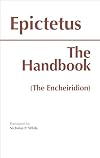
Stoics are weird. And I'm kinda surprised so many people reviewed this book as some amazing bit of timeless philosophy.
The Handbook is just that, a handbook. An ancient Roman self-help book from the Stoic perspective. Some of the the advice still holds true, things like:
- don't doddle and miss your boat, a literal boat, not a figurative one
- know that there are things in your power and things beyond your power, don't confuse them
- do be disciplined in your undertakings and don't show more procrastinate
Good stuff right? Unfortunately that is pretty much all of the advice he gives that still holds true. The rest doesn't make sense unless you live in ancient Rome and the world is innately perfect and harmonious and magical even when shitty things happen. This seems to be the gaping hole in Stoic philosophy, the conviction that the universe was perfect and harmonious despite evidence to the contrary. When shitty things happen to you, according to the Stoics, they aren't really shitty, they just seem shitty because you have let yourself become out of sync with the universe. Your wife and child died? Well of course they did! That's the nature of the universe, you should have expected it and accepted it. You're a slave? Well that's just how it is, you can't very well expect to be free can you? Just try to get used to it.
This is the backbone of Epictetus' advice, lowering your expectations so that they coincide with the course your life is probably going to take anyway. No one ever rocked the boat or overcame great odds based on Stoic philosophy. Throw in some quick advice about how to respond to omens and when you should and shouldn't see a fortune teller and that's about it. Well, that and advising you to be as boring as possible, not hanging out with non philosophers, not talking at all if you can help it, not swearing but frowning to show your disapproval when others do and certainly not having sex if you can avoid it. Stoics sure tried their darnedest to live boring, unremarkable lives.
But ol' Epictetus wasn't a completetwat wet blanket. He understood that there are somethings you just can't live without.
"Take what has to do with the body to the point of bare need, such as food, drink, clothing, house, household slaves, and cut out everything that is for reputation and luxury."
Timeless, no?
Ultimately this is a quick, fairly amusing read, but I certainly wouldn't take it too seriously. show less
The Handbook is just that, a handbook. An ancient Roman self-help book from the Stoic perspective. Some of the the advice still holds true, things like:
- don't doddle and miss your boat, a literal boat, not a figurative one
- know that there are things in your power and things beyond your power, don't confuse them
- do be disciplined in your undertakings and don't show more procrastinate
Good stuff right? Unfortunately that is pretty much all of the advice he gives that still holds true. The rest doesn't make sense unless you live in ancient Rome and the world is innately perfect and harmonious and magical even when shitty things happen. This seems to be the gaping hole in Stoic philosophy, the conviction that the universe was perfect and harmonious despite evidence to the contrary. When shitty things happen to you, according to the Stoics, they aren't really shitty, they just seem shitty because you have let yourself become out of sync with the universe. Your wife and child died? Well of course they did! That's the nature of the universe, you should have expected it and accepted it. You're a slave? Well that's just how it is, you can't very well expect to be free can you? Just try to get used to it.
This is the backbone of Epictetus' advice, lowering your expectations so that they coincide with the course your life is probably going to take anyway. No one ever rocked the boat or overcame great odds based on Stoic philosophy. Throw in some quick advice about how to respond to omens and when you should and shouldn't see a fortune teller and that's about it. Well, that and advising you to be as boring as possible, not hanging out with non philosophers, not talking at all if you can help it, not swearing but frowning to show your disapproval when others do and certainly not having sex if you can avoid it. Stoics sure tried their darnedest to live boring, unremarkable lives.
But ol' Epictetus wasn't a complete
"Take what has to do with the body to the point of bare need, such as food, drink, clothing, house, household slaves, and cut out everything that is for reputation and luxury."
Timeless, no?
Ultimately this is a quick, fairly amusing read, but I certainly wouldn't take it too seriously. show less
Lists
Awards


You May Also Like


Associated Authors
Statistics
- Works
- 312
- Also by
- 13
- Members
- 10,552
- Popularity
- #2,256
- Rating
- 4.0
- Reviews
- 107
- ISBNs
- 496
- Languages
- 21
- Favorited
- 26