
Josephine Nobisso
Author of The Weight of a Mass: A Tale of Faith
About the Author
Works by Josephine Nobisso
Tagged
Common Knowledge
- Birthdate
- 1953-02-09
- Gender
- female
- Education
- State University of New York, New Paltz
Universita' di Urbino - Places of residence
- Bronx, New York, USA
Mastic Beach, New York, USA
Quiogue, New York, USA - Associated Place (for map)
- New York, USA
Members
Reviews
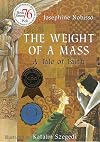
This story, based on an article in a religious newsletter, has a fiercely non-believing baker spurn a poor widow's request for a crust of bread in exchange for saying a mass in his honor. When he puts a sliver of paper saying "one mass" on one side of his scale, not all the goods in his shop are heavy enough to balance his scale.
SPOILER: When he offers her everything, she just takes a slice of bread. Asked why she didn't take more, she explains to the baker, "You see, my friend---like show more you---I, too, do not know the weight of a Mass." The pictures are yummy, setting the scene in late 19th century Europe. Although this is a story about faith and miracles---and an inspiring one---the author's postscript refers to it as an "original fairy tale." I like that the conclusion provokes you to think more: what does the widow mean by her comment? Why is the baker so angry? (There are hints in the story.) Are there similarities between the widow and the baker? show less
SPOILER: When he offers her everything, she just takes a slice of bread. Asked why she didn't take more, she explains to the baker, "You see, my friend---like show more you---I, too, do not know the weight of a Mass." The pictures are yummy, setting the scene in late 19th century Europe. Although this is a story about faith and miracles---and an inspiring one---the author's postscript refers to it as an "original fairy tale." I like that the conclusion provokes you to think more: what does the widow mean by her comment? Why is the baker so angry? (There are hints in the story.) Are there similarities between the widow and the baker? show less

Based on a story that Josephine Nobisso read in The Spirit of Medjugorje newsletter, The Weight of a Mass is an original fairy-tale intended to illustrate the significance of Mass, in the Catholic tradition, and the importance of attendance, for the faithful. The story of a miracle, it follows events in an unnamed kingdom, where the king's upcoming marriage to a neighboring queen is expected to be sparsely attended, because the ceremony is to be held in the cathedral, and the king's subjects show more have grown "cold and careless," in their religious observances. But when a humble beggar woman asks for a piece of bread at the local baker's - the very baker who created the king's wedding cake - in exchange for her evening Mass, which she offers to say for him, his scorn for her, and for the Mass, leads to an unexpected occurrence. For although he piles all of his baked goods on one side of his scale, the tiny piece of paper on which he has written "one mass," outweighs it all...
Although not a Catholic, and decidedly not a believer in the idea that religious ritual is necessary for spiritual sustenance and/or a relationship with the divine, I appreciated Nobisso's story, which - at the very least - highlights the fact that the spiritual realm has more "weight," despite being intangible, than many more material concerns. I'm not really the right audience for The Weight of a Mass, which I picked up, not because of its subject matter, but because the illustrator's work has been recommended to me. A Hungarian artist, Katalín Szegedí is a talented woman, and I appreciated her mixed media illustrations here, with their appealing blend of painting and collage, and wish that her work were more readily available in the states. So far, I have only been able to obtain this, and Nobisso and Szegedí's other joint venture, Take It to the Queen: A Tale of Hope.
Recommended to anyone looking for engaging children's stories that teach Catholic values, as well as to anyone interested in Katalín Szegedí's work. show less
Although not a Catholic, and decidedly not a believer in the idea that religious ritual is necessary for spiritual sustenance and/or a relationship with the divine, I appreciated Nobisso's story, which - at the very least - highlights the fact that the spiritual realm has more "weight," despite being intangible, than many more material concerns. I'm not really the right audience for The Weight of a Mass, which I picked up, not because of its subject matter, but because the illustrator's work has been recommended to me. A Hungarian artist, Katalín Szegedí is a talented woman, and I appreciated her mixed media illustrations here, with their appealing blend of painting and collage, and wish that her work were more readily available in the states. So far, I have only been able to obtain this, and Nobisso and Szegedí's other joint venture, Take It to the Queen: A Tale of Hope.
Recommended to anyone looking for engaging children's stories that teach Catholic values, as well as to anyone interested in Katalín Szegedí's work. show less

When a powerful king dreams that the only woman worthy of being his queen will be born in a particular village, he does everything he can to ensure that the village prospers, reserving all manner of blessings for its residents, and promising his son as a future leader of its council. But when the long expected queen is finally united with the king, the villagers begin to forget the source of their blessings, even going so far as to attack the young prince when - true to his word - the king show more sends him to them. Undermined by greed and distrust, the village is soon in ruins. Is it too late for the people to learn the error of their ways, or do they dare to hope for mercy? In the end, they must "take it to the Queen."
I imagine that, as a non-Catholic, I'm probably one of the few readers to approach Josephine Nobisso's Take It To the Queen with less of an interest in its narrative - intended as a theological allegory explaining (and celebrating) the Virgin Mary's role as intercessor for the sinful - than the illustrations by Hungarian artist Katalín Szegedí. I have a great interest in international children's literature, and a friend who reads Hungarian had recommended Szegedí's work (thanks, Katri!), so I was very happy to run across this title. I am glad to be able to report that I was not disappointed! The illustrations here are lovely, an engaging mix of painted and collage elements. I really liked the fact that they managed to be beautiful, without being "sweet."
All in all, I'm happy to have read this, although I think it is a book that will be of interest primarily to young Catholics, and the adults in their lives. Mary's place in "salvific" history isn't really a casual topic, so I don't see this as having a wider audience, save for those (like me) with an interest in the artist's work.
**Note to adult readers using this book with children: If, like me, you are reading the paperback edition of Take It To the Queen, be sure to look under the cover-flaps (front and rear) for the author's detailed notes on the symbolism of this story, and accompanying illustrations. show less
I imagine that, as a non-Catholic, I'm probably one of the few readers to approach Josephine Nobisso's Take It To the Queen with less of an interest in its narrative - intended as a theological allegory explaining (and celebrating) the Virgin Mary's role as intercessor for the sinful - than the illustrations by Hungarian artist Katalín Szegedí. I have a great interest in international children's literature, and a friend who reads Hungarian had recommended Szegedí's work (thanks, Katri!), so I was very happy to run across this title. I am glad to be able to report that I was not disappointed! The illustrations here are lovely, an engaging mix of painted and collage elements. I really liked the fact that they managed to be beautiful, without being "sweet."
All in all, I'm happy to have read this, although I think it is a book that will be of interest primarily to young Catholics, and the adults in their lives. Mary's place in "salvific" history isn't really a casual topic, so I don't see this as having a wider audience, save for those (like me) with an interest in the artist's work.
**Note to adult readers using this book with children: If, like me, you are reading the paperback edition of Take It To the Queen, be sure to look under the cover-flaps (front and rear) for the author's detailed notes on the symbolism of this story, and accompanying illustrations. show less

John Blair was a railway porter on the St. Paul and Duluth Railroad. At 1:55 in the afternoon of 1 September 1894 his southbound train left Duluth and drove straight into the firestorm in the vicinity of Hinckley, Minnesota. Approximately a mile from Hinckley his train stopped and took on an estimated 3-400 refugees fleeing the fire. With the way blocked by the firestorm his engineer slammed the train into reverse and headed back towards Skunk Lake where everyone left the train and took show more refuge in the shallow, muddy, water. It was John Blair who saw to the needs and concerns of the passengers under his care both during the run to Skunk Lake and the disembarkation on its shores. His heroism was noted by passengers and crew (See “The Hinckley Fire” by McDermott and Anderson for direct quotes and Under a Flaming Sky for a more detailed description of his efforts) and this children’s book is an excellent written and illustrated history of his efforts on that horrible day. Even though it is classed as a children’s book it is good read for adults and I would recommend it to readers of all ages. show less
Awards


You May Also Like


Associated Authors
Statistics
- Works
- 19
- Members
- 1,321
- Popularity
- #19,458
- Rating
- 4.2
- Reviews
- 15
- ISBNs
- 47
- Languages
- 4