

Brian Floca
Author of Locomotive
About the Author
Brian Floca was born and raised in Temple, Texas. He graduated from Brown University and received his MFA from the School of Visual Arts. Brian Floca is the author and illustrator of Locomotive, winner of the 2014 Caldecott Medal. He has also written and illustrated Moonshot: The Flight of Apollo show more 11, Lightship, The Racecar Alphabet, and Five Trucks. He is the illustrator of the Poppy Stories series, by Avi; Ballet for Martha: Making Appalachian Spring, by Jan Greenberg and Sandra Jordan; Kate Messner's Marty McGuire novels; and Lynne Cox's forthcoming Elizabeth, Queen of the Seas. His books have received four Robert F. Sibert Honor awards, an Orbis Pictus Award, an Orbis Pictus Honor, a silver medal from the Society of Illustrators, and have twice been selected for The New York Times' annual 10 Best Illustrated Books list. (Bowker Author Biography) show less
Image credit: Credit: Larry D. Moore, 2007 Texas Book Festival, Austin, Texas
Works by Brian Floca
Associated Works
Billy and the Rebel: Based on a True Civil War Story (2005) — Illustrator, some editions — 93 copies
Tagged
Common Knowledge
- Gender
- male
- Education
- Brown University. School of Fine Arts (MFA|1991)
- Occupations
- illustrator (children's literature)
children's book author - Nationality
- USA
- Birthplace
- Temple, Texas, USA
- Places of residence
- New York, New York, USA
- Associated Place (for map)
- USA
Members
Reviews

Breathtakingly beautiful, effortlessly informative, and intensely engaging, Brian Floca's Locomotive is a work of picture-book history that deserves all the accolades that it has won, from the Caldecott Medal it received for the artwork, to the Robert F. Sibert Honor it was awarded for content. The story of the building of the transcontinental railroad, which was built east from the Pacific coast by the Central Pacific Railroad Company, and built west from Omaha by the Union Pacific show more Railroad, its main text imagines the very first journey undertaken by rail passengers, after the line met at Promontory Summit in 1869, and the line was completed.
The poetic text here builds the sense of excitement that passengers would have felt, taking that historic journey, and captures the changing beauty of the various landscapes through which they would have passed. The artwork captures the hot and backbreaking work that went into both building and running such a rail line. The decorative endpapers, and an extensive afterword give more information, providing maps (in the case of endpapers), and more details about how the railroad impacted native peoples. I really appreciated the fact that Locomotive was a celebration of an important achievement in American history, one that had a huge impact on our development as a nation, but that the "not so nice" bits of that history were also included, for those wanting more in-depth information. All in all, I really enjoyed this one, and think it would make an excellent introduction to the topic of the railroads in American history, and how the transcontinental railroad changed the face of the nation and the course of history. show less
The poetic text here builds the sense of excitement that passengers would have felt, taking that historic journey, and captures the changing beauty of the various landscapes through which they would have passed. The artwork captures the hot and backbreaking work that went into both building and running such a rail line. The decorative endpapers, and an extensive afterword give more information, providing maps (in the case of endpapers), and more details about how the railroad impacted native peoples. I really appreciated the fact that Locomotive was a celebration of an important achievement in American history, one that had a huge impact on our development as a nation, but that the "not so nice" bits of that history were also included, for those wanting more in-depth information. All in all, I really enjoyed this one, and think it would make an excellent introduction to the topic of the railroads in American history, and how the transcontinental railroad changed the face of the nation and the course of history. show less
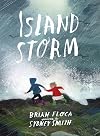
American author Brian Floca and Canadian illustrator Sydney Smith team up in this evocative, atmospheric picture book about two children out in a storm. Holding hands, and continually urging one another on, the pair make their way down a gravel road to the shore, observing and feeling the great booming waves, before proceeding along the shore road into town, where they see all the usually-busy places familiar to them, now emptied of people and bracing for the onslaught. At the first crack of show more thunder, the pair goes running for home, through the dark and scary woods, all the way to a welcome and a reprimand from their waiting mother. Safe inside, they pass the night in their beds, waking to a fresh new world...
Having enjoyed a number of other books from both Floca—a talented artist and illustrator, who has won the Caldecott Medal and many other honors—and Smith—himself an award-winning artist and recipient of the Hans Christian Andersen Award, as well as an occasional author—I picked up Island Storm with every expectation of enjoyment. I was not disappointed, finding the poetic text involving and emotionally resonant, and the artwork perfectly attuned to the story, capturing all of its excitement, tension, terror and joy. I have vivid memories of rushing outside into storms as a girl—dancing in the rain, reveling in the boom of the thunder and crack of lightning—and Floca's simple but powerful text captures that joy, that sense of wildness and freedom. Smith's artwork, created in watercolor and gouache, is mostly dark-toned, with flashes of light and color, perfectly capturing the rain-soaked world around these questing children. Recommended to anyone seeking picture books about the allure of storms, as well as to fellow admirers of these two picture book creators. show less
Having enjoyed a number of other books from both Floca—a talented artist and illustrator, who has won the Caldecott Medal and many other honors—and Smith—himself an award-winning artist and recipient of the Hans Christian Andersen Award, as well as an occasional author—I picked up Island Storm with every expectation of enjoyment. I was not disappointed, finding the poetic text involving and emotionally resonant, and the artwork perfectly attuned to the story, capturing all of its excitement, tension, terror and joy. I have vivid memories of rushing outside into storms as a girl—dancing in the rain, reveling in the boom of the thunder and crack of lightning—and Floca's simple but powerful text captures that joy, that sense of wildness and freedom. Smith's artwork, created in watercolor and gouache, is mostly dark-toned, with flashes of light and color, perfectly capturing the rain-soaked world around these questing children. Recommended to anyone seeking picture books about the allure of storms, as well as to fellow admirers of these two picture book creators. show less
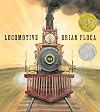
Brian Floca takes the reader on an immersive journey from Omaha to Sacramento on America's first transcontinental railroad. It reads as verse, with playful language full of onomatopoeia for a fully engaging experience. Detailed illustrations give readers a lot to look at and contemplate. Learn more about the history and creation of the railroad on the front and back covers, as well as the author's note, which also discusses the enormous and irreversible changes the railroad had on the show more nation, including the Native tribes whose lands it bisected. show less

Author/illustrator Brian Floca, who won a Caldecott Medal for his picture-book Locomotive, delivers a highly alliterative alaphabetic celebration of racecars in this entertaining title. Each page features a different letter - for example: "Eyes in the audience, each open and eager, expecting excitement (enduring exhaust)" for the letter E - as the overarching 'story' builds toward the excitement of the race's conclusion.
Although not a racing fan myself, I think The Racecar Alphabet will have show more great appeal to young children who are, or who are fascinated by cars and other vehicles in general. It's a well-constructed text, one that highlights the alphabet while also presenting a sequential depiction, not just of a race, but of the evolution of the racecar over time. The artwork, done in watercolor, captures the changing structures of these speeding vehicles, and the changing venues in which they have raced over the years. Recommended to anyone looking for alphabet books featuring cars and/or racing, as well as to young racing fans interested in the history of their sport. The decorative end-papers, which depict racecars over time, will be a particularly welcome bonus for the latter. show less
Although not a racing fan myself, I think The Racecar Alphabet will have show more great appeal to young children who are, or who are fascinated by cars and other vehicles in general. It's a well-constructed text, one that highlights the alphabet while also presenting a sequential depiction, not just of a race, but of the evolution of the racecar over time. The artwork, done in watercolor, captures the changing structures of these speeding vehicles, and the changing venues in which they have raced over the years. Recommended to anyone looking for alphabet books featuring cars and/or racing, as well as to young racing fans interested in the history of their sport. The decorative end-papers, which depict racecars over time, will be a particularly welcome bonus for the latter. show less
Lists
4th Grade Books (1)
Awards


You May Also Like


Associated Authors
Statistics
- Works
- 9
- Also by
- 22
- Members
- 3,868
- Popularity
- #6,551
- Rating
- 4.0
- Reviews
- 257
- ISBNs
- 60
- Languages
- 5
- Favorited
- 1