
Louis Untermeyer (1885–1977)
Author of The Golden Books Family Treasury of Poetry
About the Author
Louis Untermeyer was born in 1885 in New York City. He was a poet, anthologist, and editor. Untermeyer was known for his wit and his love of puns. For a while, he held Marxist beliefs, writing for magazines such as The Masses. He advocated that the U.S. should stay out of World War 1. After the show more suppression of that magazine by the U.S. government, he joined The Liberator, published by the Workers Party of America. Later he wrote for the independent socialist magazine The New Masses. He was a co-founder of "The Seven Arts," a poetry magazine that is credited for introducing many new poets, including Robert Frost. In 1950, Untermeyer was a panelist during the first year of the What's My Line? television quiz program. According to Bennett Cerf, Untermeyer would sign virtually any piece of paper that someone placed in front of him, and Untermeyer inadvertently signed a few Communist proclamations. He was named during the hearings by the House Committee on Un-American Activities investigating communist subversion. At that point, the producers told Untermeyer that he had to leave the television series. The controversy surrounding Untermeyer led to him being blacklisted by the television industry. Louis Untermeyer was the author or editor of close to 100 books, from 1911 until his death in 1977. Many of his books and his other memorabilia are preserved in a special section of the Lilly Library at Indiana University. Schools used his Modern American and British poetry books widely, and they often introduced college students to poetry. (Bowker Author Biography) show less
Image credit: English: American writer, poet, literary critic, and editor Louis Untermeyer (1885-1977)
Series
Works by Louis Untermeyer
The Golden Treasury of Children's Literature Set (1972) — Editor; Contributor — 247 copies, 4 reviews
A treasury of laughter,: Consisting of humorous stories, poems, essays, tall tales, jokes, boners, epigrams, memorable quips, and devastating crushers, (1946) — Editor — 174 copies, 1 review
Makers of the modern world; the lives of ninety-two writers, artists, scientists, statesmen, inventors, philosophers, composers, and other creators who formed the pattern of our… (1955) 54 copies, 1 review
An Anthology of the New England Poets from Colonial Times to the Present Day; (1948) 23 copies, 1 review
The Golden Treasury of Children's Literature Volume 04: Old Friends and Lasting Favorites (1962) — Editor — 13 copies
Treasury of Great Humor; Including Wit, Whimsy and Satire from the Remote Past to the Present. (1972) 12 copies
The New Adam 3 copies
Great Poems from Chaucer to Whitman 3 copies
Roses 2 copies
The Fireside Book of Verse 2 copies
"---and Other Poets," 2 copies
Robert Frost's Poetry 1 copy
Your lucky stars 1 copy
American Poems 1 copy
Words of Wisdom 1 copy
The Book of Living Verse 1 copy
A critical anthology 1 copy
Lift Up Your Heart 1 copy
The Boy and the Wolf {poem} 1 copy
The Heart 1 copy
First Love, a Lyric Sequence 1 copy
Hopi Indian Cradle Song 1 copy
New songs for new voices 1 copy
Labyrinth of Love 1 copy
Westwind Songs 1 copy
Play In Poetry: The Henry Ward Beecher Lectures Delivered at Amherst College October, 1937 (1979) 1 copy
Ten Brothers {poem} 1 copy
Barchester Towers 1 copy
Associated Works
Alice's Adventures in Wonderland / Through the Looking-Glass (1865) — Introduction, some editions — 29,559 copies, 317 reviews
The Complete Poetry of Edgar Allan Poe (Signet Classics) (1978) — Editor, some editions — 2,015 copies, 18 reviews
The Love Poems of Elizabeth And Robert Browning (1994) — Editor, some editions — 253 copies, 1 review
The Charge of the Light Brigade (1854) — Editor & Introduction, some editions — 81 copies, 4 reviews
Published and Perished: Memoria, Eulogies, and Remembrances of American Writers (2002) — Contributor — 41 copies, 1 review
The Complete Household Tales of Jakob and Wilhelm Grimm (Volume II) (1962) — Editor, some editions — 4 copies
Saturday Review of Literature, Volume IX Number 38: Saturday, April 8, 1933 — Contributor — 1 copy
The Reviewer, Volume III, Numbers 1-12 (April 1922-July 1923) — Contributor — 1 copy
The Reviewer, Volume II, Numbers 1-6 (October 1921-March 1922) — Contributor — 1 copy
The Reviewer, Volume I, Numbers 1-12 (April-August 1921) — Contributor — 1 copy
McBride's Magazine, September 1915 — Contributor — 1 copy
Tagged
Common Knowledge
- Birthdate
- 1885-10-01
- Date of death
- 1977-12-18
- Gender
- male
- Education
- left high school without graduating
- Occupations
- poet
critic
editor - Awards and honors
- U.S. Poet Laureate, 1961-1963
American Academy of Arts and Letters (Literature ∙ 1941) - Short biography
- "Untermeyer ... continued to be active in campaigning for left-wing causes and as a result the FBI had been collecting a file of his activities. His name was also mentioned during the House of Un-American Activities Committee investigation into communist subversion. This was brought to the attention of the television industry and in 1951 Untermeyer was sacked from the television show and was blacklisted. Like many left-wing artists during this period, Untermeyer became a victim of McCarthyism.
"In his autobiography, Timebends - A Life (1987), Arthur Miller, explained how Untermeyer responded to this victimization: 'Louis went back to his apartment. Normally we ran into each other in the street once or twice a week or kept in touch every month or so, but I no longer saw him in the neighborhood or heard from him. Louis didn't leave his apartment for almost a year and a half. An overwhelming and paralyzing fear had risen him. More than a political fear, it was really that he had witnessed the tenuousness of human connection and it had left him in terror. He had always loved a lot and been loved, especially on the TV program where his quips were vastly appreciated, and suddenly, he had been thrown into the street, abolished.'"
Married four times, to Jean, Virginia, Esther, then Bryna. - Nationality
- USA
- Birthplace
- New York, New York, USA
- Place of death
- Newtown, Connecticut, USA
- Map Location
- New York, USA
Members
Reviews
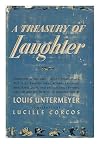
This was a thrift-store pickup, mainly due to the interesting period artwork within. The most important thing about it, I guess, would be if I found it at least somewhat funny or not. I may have chuckled once maybe twice in the reading. To be honest most of the humor is definitely dated (it is from 1946 after all). However, a lot of the humor is based on the premise that women talk a lot and are emotional, men are the opposite. One example being A Pair of Sexes by Franklin P. Adams. A man show more talks on the phone in Part I which is a single line of dialogue. In Part II it's a woman on the phone and goes on for almost two pages. Basically, a visual joke when looking at the text. The intended effect the author was probably hoping for was that the reader would stop partways into the female dialogue and chuckle not having to continue but seeing the length. The effect on me was simply a sigh and a little anger at the (long dead) author for wasting my precious time.
Another premise that is "of its time" is humor aimed at immigrant and Jewish stereotypes with only a couple of bits of actual racist humor rearing its ugly head. The n-word does show up once (its "less" potent variant shows up about twice elsewhere) but I cannot remember which story, I hit that word and just skipped the story (most of these things just blend together into an antiquated mush really). Note that most, maybe all, of the authors whose work appears in this collection were born in the 19th-century and long dead by the time this book was published.
There are extracts from other (better) books such as a section on Mark Twain with The Celebrated Jumping Frog of Calaveras County reprinted in full with extracts from Tom Sawyer (Tom Whitewashes the Fence) and Roughing It. There is also a bit from Uncle Remus by Joel Chandler Harris (The Wonderful Tar Baby Story) and multiple episodes drawn from other novels and longer pieces.
Despite these hurdles I did find a few stories that I enjoyed reading. These would be: The Obituary Poet by Max Adeler (here's where I laughed), The Elephant Cutlet by Ludwig Bemelmans, the poem To a Small Boy Standing on My Shoes While I Am Wearing Them by Ogden Nash, Butch Minds the Baby by Damon Runyon, Casey at the Bat by Ernest Lawrence Thayer (hey it is a classic though I always picture Disney's cartoon while reading it), The Secret Life of Walter Mitty by James Thurber, and I did enjoy The Art of Insult Or, The Devastating Crusher section along with Edward Lear's Limericks and the More Limericks section.
Overall, it wasn't a bad buy for two bucks. There are a few bits of classic humor buried in here but overall it's stuff that has less aged badly rather than having been utterly left behind in the ashes of history. Even some of the daily life references were very alien to me. It also contains stories not just with the previously mentioned flaws but many are also very dialogue-heavy and written in very dense colloquialisms (Haw-haw, they speak funny, pfft) both of these things I hate with an overriding passion (I avoided the O.Henry section, besides I've read both the omnibus volumes of his work so I've paid my dues).
So, would I recommend this book to anybody? Not really. There's probably text from novels and other books that are hard or nearly impossible to find now and it suited my purpose for some light reading but the stuff I thought was a good read can be had elsewhere with more consistent quality in the text for the most part. show less
Another premise that is "of its time" is humor aimed at immigrant and Jewish stereotypes with only a couple of bits of actual racist humor rearing its ugly head. The n-word does show up once (its "less" potent variant shows up about twice elsewhere) but I cannot remember which story, I hit that word and just skipped the story (most of these things just blend together into an antiquated mush really). Note that most, maybe all, of the authors whose work appears in this collection were born in the 19th-century and long dead by the time this book was published.
There are extracts from other (better) books such as a section on Mark Twain with The Celebrated Jumping Frog of Calaveras County reprinted in full with extracts from Tom Sawyer (Tom Whitewashes the Fence) and Roughing It. There is also a bit from Uncle Remus by Joel Chandler Harris (The Wonderful Tar Baby Story) and multiple episodes drawn from other novels and longer pieces.
Despite these hurdles I did find a few stories that I enjoyed reading. These would be: The Obituary Poet by Max Adeler (here's where I laughed), The Elephant Cutlet by Ludwig Bemelmans, the poem To a Small Boy Standing on My Shoes While I Am Wearing Them by Ogden Nash, Butch Minds the Baby by Damon Runyon, Casey at the Bat by Ernest Lawrence Thayer (hey it is a classic though I always picture Disney's cartoon while reading it), The Secret Life of Walter Mitty by James Thurber, and I did enjoy The Art of Insult Or, The Devastating Crusher section along with Edward Lear's Limericks and the More Limericks section.
Overall, it wasn't a bad buy for two bucks. There are a few bits of classic humor buried in here but overall it's stuff that has less aged badly rather than having been utterly left behind in the ashes of history. Even some of the daily life references were very alien to me. It also contains stories not just with the previously mentioned flaws but many are also very dialogue-heavy and written in very dense colloquialisms (Haw-haw, they speak funny, pfft) both of these things I hate with an overriding passion (I avoided the O.Henry section, besides I've read both the omnibus volumes of his work so I've paid my dues).
So, would I recommend this book to anybody? Not really. There's probably text from novels and other books that are hard or nearly impossible to find now and it suited my purpose for some light reading but the stuff I thought was a good read can be had elsewhere with more consistent quality in the text for the most part. show less

This has been one of my favorite poetry collections for more than forty years. A book that I turn to again and again to revisit old favorite poems or to discover new ones. I cannot praise Louis Untermeyer highly enough for his ability to select the best poems and to succinctly introduce each poet. The breadth of this collection competes with its quality and encourages the reader to keep returning. It is an essential volume for any poetry lover but also for those who are not sure if poetry is show more worth reading. A small investment of time with this volume will answer that question with a resounding yes. show less

These poems, enchanting when I was young, but insipid when I was 20, have somehow become enchanting again. Perhaps its the grandchild sitting on my lap this time -- or maybe its that this selection of poetry stands up to the passing of time.
A concise treasury of great poems, English and American from the foundations of the English spirit to the outstanding po by Louis Untermeyer
This book, along with my high school senior English teacher Philip McFarland, changed my life. Before senior year, I was contemptuous of poetry. Mr. McFarland took a few poems and went through them line by line, and I saw beauty where before I had seen only alien lines, and learned to give poems a chance. Well, you probably haven't the luck of having Mr. McFarland as a teacher, but you might be able to get hold of a copy of this book.
The book is approachable for the non-poetry-lover because show more it has short accounts of the lives of the poets. The poems are inserted into the middle of the accounts, with comments making the poems more accessible. The poets are in chronological order, which, combined with biographical accounts, gives the book a feeling of being an easy history of poetry rather than a book of poems.
The poems are well chosen; years after high school, I read Futility by Wilfred Owen elsewhere, loved it, and was amazed to discover that it had been sitting in the Concise Treasury all along. show less
The book is approachable for the non-poetry-lover because show more it has short accounts of the lives of the poets. The poems are inserted into the middle of the accounts, with comments making the poems more accessible. The poets are in chronological order, which, combined with biographical accounts, gives the book a feeling of being an easy history of poetry rather than a book of poems.
The poems are well chosen; years after high school, I read Futility by Wilfred Owen elsewhere, loved it, and was amazed to discover that it had been sitting in the Concise Treasury all along. show less
Lists
Awards

You May Also Like


Associated Authors
Statistics
- Works
- 180
- Also by
- 46
- Members
- 5,721
- Popularity
- #4,318
- Rating
- 4.0
- Reviews
- 58
- ISBNs
- 166
- Languages
- 2
- Favorited
- 3