
Randall R. Freisinger
Author of Nostalgia's Thread: Ten Poems on Norman Rockwell Paintings
Works by Randall R. Freisinger
Tagged
Common Knowledge
- Birthdate
- 1942-02-06
- Gender
- male
- Nationality
- USA
- Associated Place (for map)
- USA
Members
Reviews
Poet Randall Freisinger takes us back in time with Nostalgia's Thread. His contemplations on ten different Norman Rockwell pieces are an interesting way of revisiting the America of the 1940s, 1950s, and early 1960s. Norman Rockwell was not an artist; he was an illustrator. One cannot say Freisinger is not a poet, but he does have a strong historian's bent. In his exploration of American history, he returns us not only to simpler times, but also to changing points in American culture. His show more poetic voyage beginning with a coming-of-age moment and ending with a glimpse of what may - or may not - lie ahead at the end of life, takes the reader full cycle.
Freisinger should be commended for his idea of using Rockwell as the stepping off point for his poetry. Although Rockwell has been mocked often as a sham artist, he was a real person, and his illustrations were the only "art" that some Americans knew during the time when weekly news magazines played a large part in Americans' participation with the world around them.
We feel ourselves growing up (or growing up all over again) in reading Freisinger's poems, remembering youth, insecurity, war, women's changing roles in society, and the civil rights movement. Although Freisinger's words are strong, and the book is meant to be about his poetry, it would have enhanced the book if small thumbnail reproductions of Rockwell's illustrations had been included. That way, we could have enjoyed two unique Americans. show less
Freisinger should be commended for his idea of using Rockwell as the stepping off point for his poetry. Although Rockwell has been mocked often as a sham artist, he was a real person, and his illustrations were the only "art" that some Americans knew during the time when weekly news magazines played a large part in Americans' participation with the world around them.
We feel ourselves growing up (or growing up all over again) in reading Freisinger's poems, remembering youth, insecurity, war, women's changing roles in society, and the civil rights movement. Although Freisinger's words are strong, and the book is meant to be about his poetry, it would have enhanced the book if small thumbnail reproductions of Rockwell's illustrations had been included. That way, we could have enjoyed two unique Americans. show less
 This review was written for LibraryThing Early Reviewers.
I once read that the test of a good poem was if one took time to read it aloud to a friend. I did exactly that; I read it to my grandmother, a huge Rockwell fan. I read "Christmas Homecoming" to her. This is a wonderful small collection (10 poems) of poems that work on their own, apart from the visual reference of the paintings. I enjoyed the tapestry of allusions and evocative images: her sturdy shoes resting on the spine of Mein Kampf. I found reading the poem to my grandmother was a show more rewarding exercise, but when I was finished she simply said, "I don't get it." Of course, she went on to explain that she didn't get how these functioned as poems since they didn't rhyme. The stretching narrative of the poems may be lost on those who like to simply gaze at Rockwell's paintings and wistfully yearn for nostalgia. I am not necessarily a fan of Rockwell or the era he represents, but I enjoy the challenge of responding to art with another genre, and this book did not disappoint. show less
This review was written for LibraryThing Early Reviewers.[Please note: Regrettably reviews in LibraryThing do not retain the spacing or typography of lines of poetry, making it hard to read them or visualize them on the page.]
As a collector of rare books, who also loves poetry, I must begin this review with a confession. Before I read a single word of a book, even its title or the author’s name, I may be attracted by its physical presence: the way it feels in my hand, the way it looks to my eye, the way its pages ripple against my fingertips, show more the way its cover invites my response. A well-made book is like a small piece of sculpture or china or woodcraft. It communicates with its weight, its shape, its texture, its size, the printer’s selection of paper and font and ink, the design of its cover, and its artful use of white space and placement of text. A library of well-made books is an art gallery, and before one is a reader one is a viewer, a holder.
So when this little book slipped out of the cardboard carton into my hands, I must admit, the first word I looked for, the first word I read was the name of the publisher: Hol Art Books. Even their logo acted as a keyhole, inviting my attention. Of the many disservices to poetry perpetrated by our culture, especially our schools and universities, one serious one is introducing students to poetry by saddling them with big, heavy tomes called anthologies – too heavy to scan, to skim, to hold and read, too impersonal and pompous to be at all inviting, obviously a product of modern industrialization not an artifact created by and for human hands and eyes. A tomb, not a tome. This book looks and feels the way a fine book of poetry should look and feel. Already I’m won over. It reminds me of Wendell Berry’s The Wheel (and other titles, from North Point Press in San Francsico),
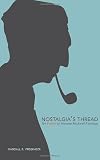
The cover, featuring a silhouette of Norman Rockwell, his pipe dangling from his moth, is printed in muted colors, blue and soft brown on crisp, stiff boards that fit well in the hand. When I selected the book, not having seen it, I had expected it to come with four-color illustrations, probably fairly slick reprints of Rockwell’s art. So the gentle paper, the soft, subtle design, and the strictly black and white copy were a surprise. Already the design said to me, “This isn’t going to be poetry about the painter’s art; it’s going to be poetry about the experience of the art – the viewer/writer’s feelings, thoughts, memories, questions, intuitions. Now, admittedly, the title, Nostalgia’s Thread, should have suggested the same thing. But the words had glided right by me. I had been overwhelmed by the aura of the subtitle, Ten Poems on Norman Rockwell Paintings. Norman Rockwell is a name that leaps past one’s thoughtful response to the celebrity of the person, to stereotypical critiques and technicolor images. By the way, the only color on the cover of this book is one small word in the subtitle printed in bright red: Poems. That’s where the color is going to be, in the poetry, not in illustrations from the painter’s well-known work. (The only flaw in the design of the book, in my opinion, is the spine, which is also red. The book is so thin it’s hard to read the words on the spine anyway, so the red on red printing make them almost invisible, and the blue of the front cover bleeds over onto the spine. It’s a minor complaint, but the little book will easily get lost on library or booksellers’ shelves.)
Later, on the last page of text, I learn that Hol Art is “an independent press, dedicated to publishing and promoting exceptional writing on visual art – classic works of art criticism and history, artist texts and biographies, foreign literature in translation, and the best of contemporary writing.” For more about its unique model of publishing, one can consult holartbooks.com on the internet. But that information came to me later; at first I was simply enjoying the work itself.
So, impressed as I was with the feel of the book in my hands, I read the first poem with apprehension. Could it live up? Would it? What would my experience of “The Discovery (1956)” be? The epigraph to the poem likewise leaves me uncertain: “The kids in Norman Rockwell’s America always grow up.” I had to think about that a minute. To me, one of the joys of Rockwell’s art is that he is willing to let kids be kids, to capture them as they are or, perhaps more frequently, as we remember ourselves to have been. They are almost never posed as young adults, and when they are, they are obviously uncomfortable. They wiggle and squirm. You can read their resistance in their eyes, their mouths, their elbows, their feet. But I needn’t have worried. The first two lines of the poem get it just right:
You stand aghast in your pajamas, just a boy
of seven or eight, your feet cold even on the carpeted floor. . .
Already you’re a kid again, or to be more precise, you are yourself remembering what it was like to be a kid, just exactly the way you do when you grow older, especially when you enter Norman Rockwell’s world. The first few lines get it just right.
. . . your back turned to your father’s dresser, the one
on top of which each night he places the mysterious
contents of his trouser pockets, the loose change and keys
and lucky silver dollar and other things you think
might offer clues to the world of work he goes to
when he leaves the house at dawn five mornings a week.
All one sentence – what the rhetorician Francis Christiansen called a cumulative sentence, each phrase or clause, adding more details to the simple base clause, “You stand in your pajamas.” Yet the long, run-on lines capture the rhythm just right: not quite a sense of breathlessness, but ordinary literal language (cold feet, loose change, other things, five mornings a week) raised just one slight level in intensity (stand aghast, mysterious contents, clues to the world of work). Strictly avoided are poetic artificialities, such as rhymes, alliteration, consonance, assonance, and yet a subtle repetition of sounds, speaking directly to the ear, not to the conscious mind: all those s’s crisply hissing (aghast, pajamas, seven, father’s dresser, places the mysterious/ contents of his trouser pockets, loose ,silver, things, clues, goes, leaves the house) and the occasional liquid l’s (loose change, lucky silver dollar, clues to the world). I quote these lines and do this somewhat pedantic analysis because I want to show how the poems match the style of Rockwell’s art, yet maintain their own character: language that appears very ordinary and yet is subtly suggestive and sibilant, likewise subject matter and ideas that simply reflect everyday reality (a barefoot kid in his father’s room), yet that provoke you and just barely let you glimpse wonder, even wisdom (a sense of curiosity, a slight allusion to mystery, a glimpse of a world beyond the ordinary world, a hint of the imagination).
You have to read all this poem, as well as others in the collection, to see how these initial commonplace experiences are lifted to literary peaks and then delve in the depths of sentiment, of nostalgia. In this one, the seven-year-old has done a little bit of sneaking and discovered that his father is the real Santa Claus. This leads into an extended metaphor, one that we all accept quite naturally, that’s almost but not quite trite: life is a drama in which we play our roles. First, he father played Santa; the the kid had to pretend for a few more years that he didn’t know. Those are among the many roles one must play in a lifetime.
. . . And you have stayed in character
all these years, even when you’ve botched
more than your share of the lines.
So the poet works with our memories, our everyday experience, our common expectations, and in so doing he earns the right to just one or two heightened perceptions or deepened insights in each poem.
At the end of the first “paragraph” of this poem, he lifts us to this elegant metaphor: “innocence is little more than a brief overture / to the operatic entanglements of loss.” (See that metaphor soar into “overture to the operatic entanglements”? Hear those s’s and l’s rise to a climax in “entanglements of loss”?)
Now I must make one other reviewer’s confession. As I was experiencing this poem, enjoyed its literal meaning and its careful craftsmanship, I began to wonder about the poet: Randall R. Freisinger, retired from Michigan Technical University. That rang a bell. As it turns out, he is (or was ) Randy Freisinger, a graduate student I knew at the University of Missouri many years ago, then a director of the Missouri Writing Project for teachers for two years before I assumed leadership of the project in the late 1970s. Of course, I had lost track of him. I never knew that he was a poet nor had I read any of his previously published poems. Nor would I have recognized the young Randy in the older, bald man pictured at the back of the book. Even so, of course, I read the rest of the poems with yet another dimension. For example, in one he refers to “others protesting / in from of the Student Union” at the time of the Kent State riots. Probably I was one of those “others,” one not being loaded into a bus and taken off to police headquarters. No, I was the one standing there, thoughtful, having just returned from his father’ s funeral, one who permitted students in his class in British Romantic Poetry to miss class without being reprimanded or having their grades lowered, an action that in itself carried the risk of having one’s tenure questioned or one’s salary lowered for not carrying out university policy.
In Rockwell paintings, one sometimes finds oneself. Watching others at an art gallery looking at Rockwell paintings, one sometimes finds oneself, or imagines oneself at another time or in other circumstances. As it turns out the paintings – and the poems – are not artifacts, “realistic” works of art, but they evoke experiences for the viewers who behold them, readers who hold them in their hands and read them silently, imaginatively.
“Discovery (1956)” is a well-made poem, not unlike the well-made book in which it is published or some of the well-made paintings hanging in a gallery in the Norman Rockwell Museum in Stockbridge, Massachusetts. Moving on through the collection of ten poems, one discovers other levels of interest, of artistry – in the selection of paintings to focus on in the poems, in the perspective taken toward each painting, in the arrangement of the poems one after another in the book. The first poem, for instance, reenacts Rockwell’s artistic method in the language of poetry. The second one, “Girl at Mirror (1954),” steps back and acknowledges that Rockwell’s work has hardly been admired by professional artists and art critics. It imagines the response of a woman who had studied art in college; she had come to the gallery prepared “not to like what people of taste she knew / disdained.” And, sure enough, she finds her share of “rustic rubes / in antic poses, do-good Boy Scouts and / avuncular barbers and tomboys with black / eyes and . . . FDR’s Four Freedoms.” But she finds something more for herself, within herself. The very next poem goes back to that tomboy in “Girl with Black Eye (1953),” taking her as seriously as she takes herself, perhaps a little more seriously. The next one is, indeed, from the Four Freedoms:
And just as a painting invites you to step into
its frame and complete its story, so do those
who stand before a work of art in still and silent
witness.
But, in this one, the poet goes one step further, reading himself in his own memories, “protesting / in front of the Student Union.”
And the collection keeps going. In the next poem, “The Runaway (1958),” the poet steps outside the paintings, outside the gallery, and captures yet another image: an unidentified aging man standing before a urinal in a restaurant, looking at (what else?) a Rockwell painting hanging above the urinal, the well-known and often reproduced painting of the runaway boy and smiling cop seated in a diner. Is the aging man the poet? Or some aspect of the poet? One wonders.
The poet continues with fictitious viewers of Rockwell paintings, first person accounts of persons likely to question the sentiment in the paintings: a Southern racist viewing integration, a wounded Vietnam vet in 1968 viewing a college kid's coming home for Christmas in 1948, a man who married his best friend's widow viewing the innocence of "After the Prom (1957)," and finally a senile women in a in "assistant care" viewing Rosie the Riveter.
The final poem in the collection is indeed a final poem. As the note explains, “Artist Facing Blank Canvas II is an imaginative creation based on the original 1938 painting, Artist Facing Blank Canvas, and on the 1960 painting Triple Self-Portrait. . . . The epigraph for this poem is Rockwell’s comment about the 1938 painting.” In this macabre fantasy, the deceased Rockwell is now attempting to do a portrait of Death himself. The epigraph to the poem: “In agony of soul this cover was done.” But, no, this is not the only poem in the collection to deal with death. In fact, looking backward, one discovers they all do. In one way or another.
In the extended metaphor that lasts to the very end of the first poem, “Discovery (1956),” the drama is just about over; all the roles have been played, the set is crumbling bit by bit and the lights are blinding, but the final curtain refuses to fall. Then “what you long for / most of all is one last graceful exit.” That poem might be seen as a prologue to the whole collection, and that phrase – the final one in this poem – the theme of them all. That phrase, when I first read it, lifted me out of any sense of complacency. It reaches for the height of the poet’s craft and the depths of his insight.
I received this book in the mail on a dark, rainy, cold Monday. Before the day was over I had read the whole collection, some of the poems more than once, and had written this review. Foe me, that requires well-made poems in a well-made book. Indeed. show less
As a collector of rare books, who also loves poetry, I must begin this review with a confession. Before I read a single word of a book, even its title or the author’s name, I may be attracted by its physical presence: the way it feels in my hand, the way it looks to my eye, the way its pages ripple against my fingertips, show more the way its cover invites my response. A well-made book is like a small piece of sculpture or china or woodcraft. It communicates with its weight, its shape, its texture, its size, the printer’s selection of paper and font and ink, the design of its cover, and its artful use of white space and placement of text. A library of well-made books is an art gallery, and before one is a reader one is a viewer, a holder.
So when this little book slipped out of the cardboard carton into my hands, I must admit, the first word I looked for, the first word I read was the name of the publisher: Hol Art Books. Even their logo acted as a keyhole, inviting my attention. Of the many disservices to poetry perpetrated by our culture, especially our schools and universities, one serious one is introducing students to poetry by saddling them with big, heavy tomes called anthologies – too heavy to scan, to skim, to hold and read, too impersonal and pompous to be at all inviting, obviously a product of modern industrialization not an artifact created by and for human hands and eyes. A tomb, not a tome. This book looks and feels the way a fine book of poetry should look and feel. Already I’m won over. It reminds me of Wendell Berry’s The Wheel (and other titles, from North Point Press in San Francsico),
The cover, featuring a silhouette of Norman Rockwell, his pipe dangling from his moth, is printed in muted colors, blue and soft brown on crisp, stiff boards that fit well in the hand. When I selected the book, not having seen it, I had expected it to come with four-color illustrations, probably fairly slick reprints of Rockwell’s art. So the gentle paper, the soft, subtle design, and the strictly black and white copy were a surprise. Already the design said to me, “This isn’t going to be poetry about the painter’s art; it’s going to be poetry about the experience of the art – the viewer/writer’s feelings, thoughts, memories, questions, intuitions. Now, admittedly, the title, Nostalgia’s Thread, should have suggested the same thing. But the words had glided right by me. I had been overwhelmed by the aura of the subtitle, Ten Poems on Norman Rockwell Paintings. Norman Rockwell is a name that leaps past one’s thoughtful response to the celebrity of the person, to stereotypical critiques and technicolor images. By the way, the only color on the cover of this book is one small word in the subtitle printed in bright red: Poems. That’s where the color is going to be, in the poetry, not in illustrations from the painter’s well-known work. (The only flaw in the design of the book, in my opinion, is the spine, which is also red. The book is so thin it’s hard to read the words on the spine anyway, so the red on red printing make them almost invisible, and the blue of the front cover bleeds over onto the spine. It’s a minor complaint, but the little book will easily get lost on library or booksellers’ shelves.)
Later, on the last page of text, I learn that Hol Art is “an independent press, dedicated to publishing and promoting exceptional writing on visual art – classic works of art criticism and history, artist texts and biographies, foreign literature in translation, and the best of contemporary writing.” For more about its unique model of publishing, one can consult holartbooks.com on the internet. But that information came to me later; at first I was simply enjoying the work itself.
So, impressed as I was with the feel of the book in my hands, I read the first poem with apprehension. Could it live up? Would it? What would my experience of “The Discovery (1956)” be? The epigraph to the poem likewise leaves me uncertain: “The kids in Norman Rockwell’s America always grow up.” I had to think about that a minute. To me, one of the joys of Rockwell’s art is that he is willing to let kids be kids, to capture them as they are or, perhaps more frequently, as we remember ourselves to have been. They are almost never posed as young adults, and when they are, they are obviously uncomfortable. They wiggle and squirm. You can read their resistance in their eyes, their mouths, their elbows, their feet. But I needn’t have worried. The first two lines of the poem get it just right:
You stand aghast in your pajamas, just a boy
of seven or eight, your feet cold even on the carpeted floor. . .
Already you’re a kid again, or to be more precise, you are yourself remembering what it was like to be a kid, just exactly the way you do when you grow older, especially when you enter Norman Rockwell’s world. The first few lines get it just right.
. . . your back turned to your father’s dresser, the one
on top of which each night he places the mysterious
contents of his trouser pockets, the loose change and keys
and lucky silver dollar and other things you think
might offer clues to the world of work he goes to
when he leaves the house at dawn five mornings a week.
All one sentence – what the rhetorician Francis Christiansen called a cumulative sentence, each phrase or clause, adding more details to the simple base clause, “You stand in your pajamas.” Yet the long, run-on lines capture the rhythm just right: not quite a sense of breathlessness, but ordinary literal language (cold feet, loose change, other things, five mornings a week) raised just one slight level in intensity (stand aghast, mysterious contents, clues to the world of work). Strictly avoided are poetic artificialities, such as rhymes, alliteration, consonance, assonance, and yet a subtle repetition of sounds, speaking directly to the ear, not to the conscious mind: all those s’s crisply hissing (aghast, pajamas, seven, father’s dresser, places the mysterious/ contents of his trouser pockets, loose ,silver, things, clues, goes, leaves the house) and the occasional liquid l’s (loose change, lucky silver dollar, clues to the world). I quote these lines and do this somewhat pedantic analysis because I want to show how the poems match the style of Rockwell’s art, yet maintain their own character: language that appears very ordinary and yet is subtly suggestive and sibilant, likewise subject matter and ideas that simply reflect everyday reality (a barefoot kid in his father’s room), yet that provoke you and just barely let you glimpse wonder, even wisdom (a sense of curiosity, a slight allusion to mystery, a glimpse of a world beyond the ordinary world, a hint of the imagination).
You have to read all this poem, as well as others in the collection, to see how these initial commonplace experiences are lifted to literary peaks and then delve in the depths of sentiment, of nostalgia. In this one, the seven-year-old has done a little bit of sneaking and discovered that his father is the real Santa Claus. This leads into an extended metaphor, one that we all accept quite naturally, that’s almost but not quite trite: life is a drama in which we play our roles. First, he father played Santa; the the kid had to pretend for a few more years that he didn’t know. Those are among the many roles one must play in a lifetime.
. . . And you have stayed in character
all these years, even when you’ve botched
more than your share of the lines.
So the poet works with our memories, our everyday experience, our common expectations, and in so doing he earns the right to just one or two heightened perceptions or deepened insights in each poem.
At the end of the first “paragraph” of this poem, he lifts us to this elegant metaphor: “innocence is little more than a brief overture / to the operatic entanglements of loss.” (See that metaphor soar into “overture to the operatic entanglements”? Hear those s’s and l’s rise to a climax in “entanglements of loss”?)
Now I must make one other reviewer’s confession. As I was experiencing this poem, enjoyed its literal meaning and its careful craftsmanship, I began to wonder about the poet: Randall R. Freisinger, retired from Michigan Technical University. That rang a bell. As it turns out, he is (or was ) Randy Freisinger, a graduate student I knew at the University of Missouri many years ago, then a director of the Missouri Writing Project for teachers for two years before I assumed leadership of the project in the late 1970s. Of course, I had lost track of him. I never knew that he was a poet nor had I read any of his previously published poems. Nor would I have recognized the young Randy in the older, bald man pictured at the back of the book. Even so, of course, I read the rest of the poems with yet another dimension. For example, in one he refers to “others protesting / in from of the Student Union” at the time of the Kent State riots. Probably I was one of those “others,” one not being loaded into a bus and taken off to police headquarters. No, I was the one standing there, thoughtful, having just returned from his father’ s funeral, one who permitted students in his class in British Romantic Poetry to miss class without being reprimanded or having their grades lowered, an action that in itself carried the risk of having one’s tenure questioned or one’s salary lowered for not carrying out university policy.
In Rockwell paintings, one sometimes finds oneself. Watching others at an art gallery looking at Rockwell paintings, one sometimes finds oneself, or imagines oneself at another time or in other circumstances. As it turns out the paintings – and the poems – are not artifacts, “realistic” works of art, but they evoke experiences for the viewers who behold them, readers who hold them in their hands and read them silently, imaginatively.
“Discovery (1956)” is a well-made poem, not unlike the well-made book in which it is published or some of the well-made paintings hanging in a gallery in the Norman Rockwell Museum in Stockbridge, Massachusetts. Moving on through the collection of ten poems, one discovers other levels of interest, of artistry – in the selection of paintings to focus on in the poems, in the perspective taken toward each painting, in the arrangement of the poems one after another in the book. The first poem, for instance, reenacts Rockwell’s artistic method in the language of poetry. The second one, “Girl at Mirror (1954),” steps back and acknowledges that Rockwell’s work has hardly been admired by professional artists and art critics. It imagines the response of a woman who had studied art in college; she had come to the gallery prepared “not to like what people of taste she knew / disdained.” And, sure enough, she finds her share of “rustic rubes / in antic poses, do-good Boy Scouts and / avuncular barbers and tomboys with black / eyes and . . . FDR’s Four Freedoms.” But she finds something more for herself, within herself. The very next poem goes back to that tomboy in “Girl with Black Eye (1953),” taking her as seriously as she takes herself, perhaps a little more seriously. The next one is, indeed, from the Four Freedoms:
And just as a painting invites you to step into
its frame and complete its story, so do those
who stand before a work of art in still and silent
witness.
But, in this one, the poet goes one step further, reading himself in his own memories, “protesting / in front of the Student Union.”
And the collection keeps going. In the next poem, “The Runaway (1958),” the poet steps outside the paintings, outside the gallery, and captures yet another image: an unidentified aging man standing before a urinal in a restaurant, looking at (what else?) a Rockwell painting hanging above the urinal, the well-known and often reproduced painting of the runaway boy and smiling cop seated in a diner. Is the aging man the poet? Or some aspect of the poet? One wonders.
The poet continues with fictitious viewers of Rockwell paintings, first person accounts of persons likely to question the sentiment in the paintings: a Southern racist viewing integration, a wounded Vietnam vet in 1968 viewing a college kid's coming home for Christmas in 1948, a man who married his best friend's widow viewing the innocence of "After the Prom (1957)," and finally a senile women in a in "assistant care" viewing Rosie the Riveter.
The final poem in the collection is indeed a final poem. As the note explains, “Artist Facing Blank Canvas II is an imaginative creation based on the original 1938 painting, Artist Facing Blank Canvas, and on the 1960 painting Triple Self-Portrait. . . . The epigraph for this poem is Rockwell’s comment about the 1938 painting.” In this macabre fantasy, the deceased Rockwell is now attempting to do a portrait of Death himself. The epigraph to the poem: “In agony of soul this cover was done.” But, no, this is not the only poem in the collection to deal with death. In fact, looking backward, one discovers they all do. In one way or another.
In the extended metaphor that lasts to the very end of the first poem, “Discovery (1956),” the drama is just about over; all the roles have been played, the set is crumbling bit by bit and the lights are blinding, but the final curtain refuses to fall. Then “what you long for / most of all is one last graceful exit.” That poem might be seen as a prologue to the whole collection, and that phrase – the final one in this poem – the theme of them all. That phrase, when I first read it, lifted me out of any sense of complacency. It reaches for the height of the poet’s craft and the depths of his insight.
I received this book in the mail on a dark, rainy, cold Monday. Before the day was over I had read the whole collection, some of the poems more than once, and had written this review. Foe me, that requires well-made poems in a well-made book. Indeed. show less
This review was written for LibraryThing Early Reviewers.Anticipating a book of poems inspired by Norman Rockwell prints, I was trying to imagine how the poems were going to avoid sentimentality. He had no problems. In some poems he even directly addressed the low art, sentimental sugar sweet reputation of the Rockwell print. Essentially he used the Rockwell prints as images of the world presented and promised to that generation born in the mid 1900's and then juxtaposed that with the world as they found it in adulthood. In some cases there's show more anger, others sadness, others more wistfulness at the contrast. I was impressed with the concept. I enjoyed all the poems but most particularly, Girl at Mirror, Freedom of Speech, The Runaway, and Artist Facing Blank Canvas II show less
This review was written for LibraryThing Early Reviewers.Statistics
- Works
- 2
- Members
- 28
- Popularity
- #471,396
- Rating
- 3.6
- Reviews
- 20
- ISBNs
- 2
