
Scott Atran
Author of In Gods We Trust: The Evolutionary Landscape of Religion
About the Author
Scott Atran is a director of research in anthropology at the National Center for Scientific Research in Paris, France. He is also a research associate and visiting professor in psychology and public policy at the University of Michigan, a Presidential Scholar in sociology at John Jay College of show more Criminal Justice, and cofounder of ARTIS Research and Risk Modeling. His books include In Gods We Trust: The Evolutionary Landscape of Religion. show less
Image credit: EDU BAYER
Works by Scott Atran
Talking to the Enemy: Faith, Brotherhood, and the (Un)Making of Terrorists (2010) 121 copies, 5 reviews
Cognitive Foundations of Natural History: Towards an Anthropology of Science (Msh) (1986) 49 copies, 1 review
Associated Works
What Is Your Dangerous Idea? Today's Leading Thinkers on the Unthinkable (2007) — Contributor — 668 copies, 8 reviews
Tagged
Common Knowledge
- Birthdate
- 1952-02-06
- Gender
- male
- Education
- Columbia University (BA)
Johns Hopkins University (MA)
Columbia University (PhD) - Nationality
- France
USA - Birthplace
- New York, New York, USA
- Associated Place (for map)
- New York, USA
Members
Reviews
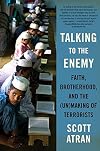
The first half of this book is exceptionally good. It offers rare and insightful ethnographic descriptions of his encounters with terrorists, and helps us to understanding what they think. His argument, in a nutshell, is that "People, including terrorists, don't simply die for a cause; they die for each other, especially their friends." Religious conviction plays a role, but is rarely determinative when compared with cohorts of friends and relatives moving together for a common goal, like a show more fraternity. For that reason reasoned arguments about theology is pointless.
The second half of the book focuses on discussions of more theoretical topics such as the evolutionary significance of religion (drawing upon Atran's earlier works). While interesting, they seem almost peripheral to the central argument of this book. Since it comes in at over 500 pages, some of this could have been condensed and more intimately connected to the core thesis, for a tighter (and slimmer) tome.
I don't give it higher marks because his story ends in 2010, before the rise of ISIS. The changes that represent don't seem to be well anticipated by Atran, who focuses on Al Qaeda, and thus the book has a dated feel. For that reason this work benefits from being paired with more recent efforts, such as Graeme Wood's The Way of the Strangers: Encounters with the Islamic State. Although journalistic and not anthropological, and definitely opinionated, it shares with Talking to the Enemy an interest in letting the actors speak for themselves. show less
The second half of the book focuses on discussions of more theoretical topics such as the evolutionary significance of religion (drawing upon Atran's earlier works). While interesting, they seem almost peripheral to the central argument of this book. Since it comes in at over 500 pages, some of this could have been condensed and more intimately connected to the core thesis, for a tighter (and slimmer) tome.
I don't give it higher marks because his story ends in 2010, before the rise of ISIS. The changes that represent don't seem to be well anticipated by Atran, who focuses on Al Qaeda, and thus the book has a dated feel. For that reason this work benefits from being paired with more recent efforts, such as Graeme Wood's The Way of the Strangers: Encounters with the Islamic State. Although journalistic and not anthropological, and definitely opinionated, it shares with Talking to the Enemy an interest in letting the actors speak for themselves. show less
Atran has written a rambling, sprawling book. While its core involves anthropological study of radical Islamist militant groups, it touches on sociobiology, the history of human conflict and counter-terror policy. While Atran simplistically treats some of these side issues, the book does a good job looking in detail at the character of the members of al Qaeda and other terrorist groups. For people who have read Marc Sageman's work, Atran's book provides ample evidence to support Sageman's show more self-radicalization thesis (which is unsurprising since Atran and Sageman collaborated over the past decade).
As a strategist, I cannot let Atran's treatment of Clausewitz pass without comment. Extrapolating from a single out-of-context Clausewitz quote ("war is the continuation of policy with other means"), Atran uses Clausewitz as foil for his argument against the rationality of warfare. As serious readers of Clausewitz know, however, he was very much aware of the non-rational elements that play in warfare. Clausewitz's fascinating trinity, for example, places this issue front and center: of the three elements of war's chameleon character, only one is reason and the other two are emotion (primordial violence, hatred and enmity) and chance. Thus, Atran's conclusion is correct - individuals are often motivated to fight by other factors than as part of a coolly calculated policy - but he is wildly incorrect that this somehow invalidates Clausewitz. show less
As a strategist, I cannot let Atran's treatment of Clausewitz pass without comment. Extrapolating from a single out-of-context Clausewitz quote ("war is the continuation of policy with other means"), Atran uses Clausewitz as foil for his argument against the rationality of warfare. As serious readers of Clausewitz know, however, he was very much aware of the non-rational elements that play in warfare. Clausewitz's fascinating trinity, for example, places this issue front and center: of the three elements of war's chameleon character, only one is reason and the other two are emotion (primordial violence, hatred and enmity) and chance. Thus, Atran's conclusion is correct - individuals are often motivated to fight by other factors than as part of a coolly calculated policy - but he is wildly incorrect that this somehow invalidates Clausewitz. show less
Scott Atran has some interesting research to share, along with a heavy dose of professional chauvinism. This is a book dedicated to the proposition that exposing the social contexts from which violent extremists emerge will ultimately create a means to defeat them. To this end, Atran provides a detailed synopsis of his work with various criminals, terrorists, and their sympathizers (along with the familial and social networks that support them). The great revelation of this research seems to show more be that ideologically motivated suicide bombers are, in fact, psychologically normal. Too, there are consistencies in the anthropological profiles of suicidal extremists across cultural boundaries.
There is good sense in this, and I'm grateful that Atran has written a book to address some misconceptions about the psychological, social, and religious characteristics of individual terrorists. However, the notion that this understanding will itself provide some kind of panacea in the quest for peace is either naive or arrogant; either way it is not convincing. The discussion of sacred values near the end of the book does a great deal to move Atran's argument forward, but he unfortunately gets sidetracked by fanciful political ideas (e.g., Sarah Palin as a conduit for Alexis de Tocqueville) and only a marginal interest in the history of suicide terrorism as a military tactic rather than as a sociological phenomenon.
The writing is lucid and concise, if at times a bit difficult (for a mono-cultural American anglophile, the blizzard of Indonesian and Arabic names is relentless and often impossible to remember from one page to the next). Atran takes the opportunity to perpetuate his feud with Sam Harris (and other prominent anti-religious intellectuals), which is amusing... but not particularly enlightening. Attacking what he seems to view as the "new atheist's" weakest arguments isn't exactly the most compelling way to build his own. Ultimately, this is a worthwhile addition to the ongoing dialogue about terrorism; but gleaning the insights Atran offers isn't an effortless enterprise. show less
There is good sense in this, and I'm grateful that Atran has written a book to address some misconceptions about the psychological, social, and religious characteristics of individual terrorists. However, the notion that this understanding will itself provide some kind of panacea in the quest for peace is either naive or arrogant; either way it is not convincing. The discussion of sacred values near the end of the book does a great deal to move Atran's argument forward, but he unfortunately gets sidetracked by fanciful political ideas (e.g., Sarah Palin as a conduit for Alexis de Tocqueville) and only a marginal interest in the history of suicide terrorism as a military tactic rather than as a sociological phenomenon.
The writing is lucid and concise, if at times a bit difficult (for a mono-cultural American anglophile, the blizzard of Indonesian and Arabic names is relentless and often impossible to remember from one page to the next). Atran takes the opportunity to perpetuate his feud with Sam Harris (and other prominent anti-religious intellectuals), which is amusing... but not particularly enlightening. Attacking what he seems to view as the "new atheist's" weakest arguments isn't exactly the most compelling way to build his own. Ultimately, this is a worthwhile addition to the ongoing dialogue about terrorism; but gleaning the insights Atran offers isn't an effortless enterprise. show less
Talking to the Enemy: Violent Extremism, Sacred Values, and What it Means to Be Human by Scott Atran
Excellent analysis of what makes a terrorist and how to stop it happening, based on a comprehensive evidence base. A cataclysmic critique of current mainstream policy approaches. Insightful case studies and clear coherent conclusions offering a way forward.
At one point distracted by an unnecessary discussion of religion and atheism, leaving only a brief survey of practical recommendations for solutions and positive action, which could have been expanded.
At one point distracted by an unnecessary discussion of religion and atheism, leaving only a brief survey of practical recommendations for solutions and positive action, which could have been expanded.
Lists
You May Also Like


Associated Authors
Statistics
- Works
- 7
- Also by
- 1
- Members
- 496
- Popularity
- #49,830
- Rating
- 3.8
- Reviews
- 9
- ISBNs
- 23
- Languages
- 1
- Favorited
- 1