

Michael K. Frith
Author of Because a Little Bug Went Ka-Choo!
About the Author
Series
Works by Michael K. Frith
Alligator 1 copy
Associated Works
Prehistoric Monsters Did the Strangest Things (1974) — Illustrator, some editions — 168 copies, 2 reviews
Tagged
Common Knowledge
- Canonical name
- Frith, Michael K.
- Legal name
- Frith, Michael Kingsbury
- Birthdate
- 1941-07-08
- Gender
- male
- Nationality
- UK
- Birthplace
- Hamilton, Bermuda
- Map Location
- Bermuda
Members
Reviews

Featuring such classics as Rodin’s The Smooch and da Vinci’s Mona Moi, Miss Piggy’s Kermitage Collection, is truly full of wonders. Included in this book is a map of the entire museum and notes from Piggy herself on the various pieces. She even gives advice on how to collect truly great art.
This book is worth it for the art alone. Trust me on this. However, Miss Piggy’s descriptions of the artwork, and what is most important to her regarding art (if she’s in it or not, usually) is show more also incredibly entertaining. show less
This book is worth it for the art alone. Trust me on this. However, Miss Piggy’s descriptions of the artwork, and what is most important to her regarding art (if she’s in it or not, usually) is show more also incredibly entertaining. show less
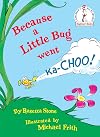
An alternate title for this book could quite well be 'Chaos Theory for Kids' or more aptly 'The Butterfly Effect for Kids'. This little book pretty much outlines the idea behind the Butterfly Effect: the theory that if a butterfly flaps its wings in China it causes a hurricane in Miami. Okay, this book is not that extreme, but because a little bug sneezed it created a chain of events which resulted in a boat sinking, a helicopter crashing, a farmer running around the city with a bucket on show more his head, and a policeman crashing against a rock.
Another way we could look at this book would be 'Cause and Effect for kids' meaning that for every action there is an equal and opposite reaction, though the reactions in this book are not necessarily equal, but rather compounding upon compounding until such a time as all hell breaks loose, and this is all because a little bug sneezed. I wonder if fans of this book sit in their science classes and when the teacher asks then to explain the theory of cause and effect whether a cheeky kid will put his hand up and say 'is it because a little bug went ka-choo?'
The other thing that caught my attention was that I discovered that this book was written by Rosetta Stone. What, The Rosetta Stone? I didn't know that the Rosetta Stone was an author, but I wonder if it is actually a pen name. I wonder if Rosetta Stone uses that name because the Rosetta Stone actually taught us how to read Ancient Egyptian and as such the modern Rosetta Stone is not only teaching children to read, but also teaching them to understand the complexities of modern science? There are many questions, and not enough answers – maybe there is a Dr Suess book out there that will help me understand that as well? show less
Another way we could look at this book would be 'Cause and Effect for kids' meaning that for every action there is an equal and opposite reaction, though the reactions in this book are not necessarily equal, but rather compounding upon compounding until such a time as all hell breaks loose, and this is all because a little bug sneezed. I wonder if fans of this book sit in their science classes and when the teacher asks then to explain the theory of cause and effect whether a cheeky kid will put his hand up and say 'is it because a little bug went ka-choo?'
The other thing that caught my attention was that I discovered that this book was written by Rosetta Stone. What, The Rosetta Stone? I didn't know that the Rosetta Stone was an author, but I wonder if it is actually a pen name. I wonder if Rosetta Stone uses that name because the Rosetta Stone actually taught us how to read Ancient Egyptian and as such the modern Rosetta Stone is not only teaching children to read, but also teaching them to understand the complexities of modern science? There are many questions, and not enough answers – maybe there is a Dr Suess book out there that will help me understand that as well? show less
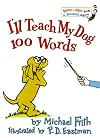
A boy talks about all the words he'll teach his dog. He wants to teach his dog 100 words, to be exact. As the story goes on, the boy provides the reader with the number of words that have been mentioned so far. The reader never sees his face--only his arms and legs. He wants his dog to be the smartest one and wants the adults to praise them. He wants to be proud and do something exciting with his furry companion. The ending of the book reveals that the boy plans to wait until next year to show more teach his dog 100 words, and he says all of this while relaxing by a tree with his pup.
I liked this story, even though it is simple. Sometimes it is nice to read a simple book, especially in times of anxiety or stress. I also liked the element of mystery in the book where the reader cannot see what the boy looks like. Maybe this element is a good one because then, the reader cannot be biased based on physical traits of the protagonist. I also thought it is funny that the boy says he will do all of these things next year. At the end where he is relaxing, the reader can understand that some things can wait and that the little things around you are to be cherished in the moment. show less
I liked this story, even though it is simple. Sometimes it is nice to read a simple book, especially in times of anxiety or stress. I also liked the element of mystery in the book where the reader cannot see what the boy looks like. Maybe this element is a good one because then, the reader cannot be biased based on physical traits of the protagonist. I also thought it is funny that the boy says he will do all of these things next year. At the end where he is relaxing, the reader can understand that some things can wait and that the little things around you are to be cherished in the moment. show less
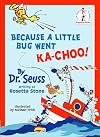
I don't know exactly what it is about this book, but it is one of my favorites that I read when I was going through these little books I picked up from the library...
It was just funny to see all the "chaos" one little bugs sneeze caused! And it made me wonder if some of the crazy things that have happened in this world, like a pebble hitting the windshield, could be because of a little bug sneezing...Now, I know, that's just crazy..but hey, who knows right? lol
I just found this book to be so show more much fun to read and extra cute! I just might have to try to find it so I can buy it for my 4 y/o nephew! Along with a few others... :-)
Oh, The Thinks You Can Think review and Explanation of why I picked these up show less
It was just funny to see all the "chaos" one little bugs sneeze caused! And it made me wonder if some of the crazy things that have happened in this world, like a pebble hitting the windshield, could be because of a little bug sneezing...Now, I know, that's just crazy..but hey, who knows right? lol
I just found this book to be so show more much fun to read and extra cute! I just might have to try to find it so I can buy it for my 4 y/o nephew! Along with a few others... :-)
Oh, The Thinks You Can Think review and Explanation of why I picked these up show less
Lists
You May Also Like


Associated Authors
Statistics
- Works
- 42
- Also by
- 5
- Members
- 6,006
- Popularity
- #4,099
- Rating
- 3.4
- Reviews
- 31
- ISBNs
- 51
- Languages
- 2
- Favorited
- 1