
Charlene Schurch
Author of Sensational Knitted Socks
About the Author
Image credit: via Martingale
Series
Works by Charlene Schurch
Mostly Mittens: Traditional Knitting Patterns from Russia's Komi People (1998) 291 copies, 3 reviews
Tagged
Common Knowledge
- Canonical name
- Schurch, Charlene
- Legal name
- Schurch, Charlene Tompkins
- Birthdate
- 1950-08-02
- Gender
- female
- Education
- Hunter College
- Nationality
- USA
- Associated Place (for map)
- USA
Members
Reviews

Part of the charm of this knitting book is the author’s research of the Nomi people and their history of textile ornamentation. It is just a brief taste of their history, but it is a wonderful addition to the book.
The introduction to the patterns contains a Basic Guidelines section, with an introduction of the yarn and needles used. There are several pages of instructions on how to use the charts and general mitten crafting. The actual patterns are only written in chart form, but that show more allows room for 35 beautiful and unique designs. There are also four knitted hat patterns, three caps and one Fez-style hat.
The patterns are rated as intermediate to expert, but that may be due to learning the general shape along with yarn and needle management. If you can knit socks using the double pointed needles and can use more than one color yarn, these patterns should be no problem.
I am going to start on Mitten 17, which is a two color pattern with a third color added in a duplicate stitch (embroidered in). I suspect it will be as addictive as sock knitting! show less
The introduction to the patterns contains a Basic Guidelines section, with an introduction of the yarn and needles used. There are several pages of instructions on how to use the charts and general mitten crafting. The actual patterns are only written in chart form, but that show more allows room for 35 beautiful and unique designs. There are also four knitted hat patterns, three caps and one Fez-style hat.
The patterns are rated as intermediate to expert, but that may be due to learning the general shape along with yarn and needle management. If you can knit socks using the double pointed needles and can use more than one color yarn, these patterns should be no problem.
I am going to start on Mitten 17, which is a two color pattern with a third color added in a duplicate stitch (embroidered in). I suspect it will be as addictive as sock knitting! show less

I really like the way this book is organized. Technical sections explain basic techniques: The book starts with an introduction, specialty socks, instructions for using the book, needle techniques, and custom socks.
There are 11 basic sock patterns: four-stitch patterns, four-stitch patterns for narrow and wide heels, five-stitch patterns, six-stitch patterns with even instep and heel flap, six-stitch patterns with uneven instep and heel flap, eight-stitch patterns, ten-stitch patterns, show more twelve-stitch patterns, six-stitch stranded patterns, six-stitch tessellated patterns, ten-stitch mosaic patterns. Most of these patterns include instructions for working top down or toe up.
There are no traditional patterns that walk the user through step by step. Instead each basic patterns contains tables for each component of the sock. You find your gauge and size in the table, and work the basic instructions on the resulting number of stitches from the table. This makes most of the patterns adjustable to any gauge from 5 to 10 stitches per inch. I have always preferred this type of "choose your own journey" approach over individual patterns.
After the 11 basic patterns, general instructions are provided for heel flap/gusset and short row heels; several different toe shapes; cast on and toe finishing options for top down socks; cast on and bind off options for toe up socks; troubleshooting common problems. Tables are provided for gauge and needle sizes; yardage yields; yarn quantity requirements; size charts for children, women, and men; and a list of abbreviations used in the book. A stitch dictionary at the end provides texture and color patterns that can be substituted into the basic sock patterns.
Limitations: This book was first published in 2007, so it does not include some innovations that came later. For example, the needle techniques section includes 4 DPs, 5 DPs, and 2 circulars, but not magic loop. Toe up methods do not include Judy's Magic cast on, and bind off methods do not include Jeny's Surprisingly Stretchy Bind Off (JSSBO). And the gauge ranges in the patterns end at 10 stitches per inch. Depending on the knitter's individual gauge, that may not be adequate for light fingering weight yarn. Except for the gauge issue, instructions for these other techniques are readily available from other sources. show less
There are 11 basic sock patterns: four-stitch patterns, four-stitch patterns for narrow and wide heels, five-stitch patterns, six-stitch patterns with even instep and heel flap, six-stitch patterns with uneven instep and heel flap, eight-stitch patterns, ten-stitch patterns, show more twelve-stitch patterns, six-stitch stranded patterns, six-stitch tessellated patterns, ten-stitch mosaic patterns. Most of these patterns include instructions for working top down or toe up.
There are no traditional patterns that walk the user through step by step. Instead each basic patterns contains tables for each component of the sock. You find your gauge and size in the table, and work the basic instructions on the resulting number of stitches from the table. This makes most of the patterns adjustable to any gauge from 5 to 10 stitches per inch. I have always preferred this type of "choose your own journey" approach over individual patterns.
After the 11 basic patterns, general instructions are provided for heel flap/gusset and short row heels; several different toe shapes; cast on and toe finishing options for top down socks; cast on and bind off options for toe up socks; troubleshooting common problems. Tables are provided for gauge and needle sizes; yardage yields; yarn quantity requirements; size charts for children, women, and men; and a list of abbreviations used in the book. A stitch dictionary at the end provides texture and color patterns that can be substituted into the basic sock patterns.
Limitations: This book was first published in 2007, so it does not include some innovations that came later. For example, the needle techniques section includes 4 DPs, 5 DPs, and 2 circulars, but not magic loop. Toe up methods do not include Judy's Magic cast on, and bind off methods do not include Jeny's Surprisingly Stretchy Bind Off (JSSBO). And the gauge ranges in the patterns end at 10 stitches per inch. Depending on the knitter's individual gauge, that may not be adequate for light fingering weight yarn. Except for the gauge issue, instructions for these other techniques are readily available from other sources. show less
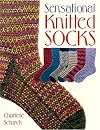
I was a little lukewarm about this book on first reading, but I've tried out a few of the patterns and it's decidedly a really good resource. My favorite thing about it is it opens up sock knitting as the pallet it really is. It's extremely easy to play with texture or color work in a sock format and Ms. Schurch really emphasizes that.
This is a great book with tons of patterns. It's the book I *finally* learned to knit socks from, after many false starts with other "beginner" patterns. That said, it's probably not the easiest book for an absolute beginner, and it's probably most appealing to someone like me who LOVES lists and dictionaries and "systematic" tour-de-force-y things.
My one complaint is that I believe the author doesn't figure negative ease into her sizes (so socks will fit snugly). I am still trying to show more figure out how to get these socks to fit just as I want. But it's a very useful book overall. show less
My one complaint is that I believe the author doesn't figure negative ease into her sizes (so socks will fit snugly). I am still trying to show more figure out how to get these socks to fit just as I want. But it's a very useful book overall. show less
You May Also Like


Associated Authors
Statistics
- Works
- 8
- Members
- 2,945
- Popularity
- #8,683
- Rating
- 4.2
- Reviews
- 21
- ISBNs
- 15
- Favorited
- 1