
Luis de Góngora (1561–1627)
Author of The Solitudes
About the Author
Image credit: Painting by Velazquez
Works by Luis de Góngora
Poesias: Romances, Letrillas, Redondillas. Decimas. Sonetos, Soledades, Polifemo y Galatea, Panegirico, Poesias sueltas (Spanish Edition) (2014) 3 copies
Poesia: Soledades, Fabula de Polifemo y Galatea, Panegirico al duque de Lerma y otros poemas (Temas de Espana) (1981) 3 copies
Bloemlezing uit zijn werk 2 copies
Poemas esenciales 2 copies
Poesía 2 copies
Antología Poética 2 copies
Obras completas 2 copies
Clásicos Ebro. Poesía 1 copy
Sonetos 1 copy
Sonetti funebri 1 copy
Poesias 1 copy
Sonetos 1 copy
Poesía 1 copy
OBRA COMPLETA 1 copy
Poesía Barroca 1 copy
Sonnets 1 copy
Obras completas 1 copy
Antología poética 1 copy
Sonetti 1 copy
Le solitudini e altre poesie 1 copy
Poesía 1 copy
Poesías 1 copy
I sonetti 1 copy
Romances y letrillas 1 copy
En un pastoral albergue 1 copy
Antología poética. Poesía 1 copy
Da Góngora e da Mallarmé 1 copy
Poesías selectas 1 copy
Poemas y Sonetos 1 copy
Ángel Pariente 1 copy
Antología poética 1 copy
Associated Works
World Poetry: An Anthology of Verse from Antiquity to Our Time (1998) — Contributor — 496 copies, 2 reviews
Tagged
Common Knowledge
- Legal name
- Góngora y Argote, Luis de
- Birthdate
- 1561-07-11
- Date of death
- 1627-05-23
- Gender
- male
- Education
- University of Salamanca
- Occupations
- poet
- Nationality
- Spain
- Birthplace
- Cordoba, Spain
- Places of residence
- Cordoba, Spain (birth|death)
- Place of death
- Cordoba, Spain
- Associated Place (for map)
- Cordoba, Spain
Members
Reviews
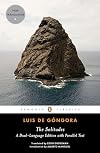
I came across ‘The Solitudes’ by searching the library catalogue for books by Alberto Manguel, my favourite non-fiction author. He wrote the introduction to this edition and I trust his taste, so decided to read a 17th century poem I’d never heard of. It was a good decision, as ‘The Solitudes’ is an extraordinary experience. Given the length, I expected a narrative poem, however there is no story to be found here. Instead, the reader finds an absolute plethora of sensuous show more description as a shipwreck survivor wanders about beautiful countryside. The natural world and romantic love are the main focus of dizzying metaphors that meld classical mythology with nature. Gongora loves crystals and nymphs from Greek myth, both of which recur constantly. Although I often had little idea what he was talking about, I enjoyed the overwhelming sumptuousness of everything. The shipwrecked man’s surroundings seemed vividly hyperreal, as if each tree and blade of grass concealed mystical significance. A favourite passage:
Unusually, I didn’t feel compelled to read this particular poem aloud. The pleasure was in the imagery rather than the assonance, I think. The translator comments that the rhyme in the original Spanish couldn’t readily be reproduced in English. I agree with her that rhyme is probably easier to achieve in Spanish than English in general. Actually, this poem made me wish I could read Spanish, not for the first time. Mapping words to their translations was rather fun, although I didn't attempt it systematically. (Sadly, the only Spanish I know is some swearing.)
Although I thought the translation was beautifully done, I sometimes found fault with the explanatory notes. Most are very helpful, as it often not remotely obvious what Gongora is referring to. Some seemed unnecessary - Sisyphus and Bacchus are pretty well known, right? On the other hand, I had to look up some words that weren’t explained. Lustrum was new to me, for instance; apparently it means a period of five years. The inclusion of obscure words fitted well with the density of allusions to minor mythical figures, though, and my knowledge of mythology has definitely been enhanced. Now I know who Pomona is and where the cornucopia came from. Thus ‘The Solitudes’ was an informative as well as dreamily sensuous poetic experience. show less
The first flies, frosting the waves;
the second, in an indolent motion meets
the sea, whose white-coloured foam
makes of its dark slender prow
the bright resplendent throat
of an august Coya, empress of Peru,
to whom the Southern Sea rendered each hour
one hundred strands of pearls.
The morning dried no more of Aurora’s tears
shed on black violets
than the pearls, fleeting but beautiful pearls
overridden and crushed by
the cutwater in vain show.
Unusually, I didn’t feel compelled to read this particular poem aloud. The pleasure was in the imagery rather than the assonance, I think. The translator comments that the rhyme in the original Spanish couldn’t readily be reproduced in English. I agree with her that rhyme is probably easier to achieve in Spanish than English in general. Actually, this poem made me wish I could read Spanish, not for the first time. Mapping words to their translations was rather fun, although I didn't attempt it systematically. (Sadly, the only Spanish I know is some swearing.)
Although I thought the translation was beautifully done, I sometimes found fault with the explanatory notes. Most are very helpful, as it often not remotely obvious what Gongora is referring to. Some seemed unnecessary - Sisyphus and Bacchus are pretty well known, right? On the other hand, I had to look up some words that weren’t explained. Lustrum was new to me, for instance; apparently it means a period of five years. The inclusion of obscure words fitted well with the density of allusions to minor mythical figures, though, and my knowledge of mythology has definitely been enhanced. Now I know who Pomona is and where the cornucopia came from. Thus ‘The Solitudes’ was an informative as well as dreamily sensuous poetic experience. show less

I’ve been reading this collection of poetry by Góngora before bed and when I have a few spare minutes here and there. It’s structured more or less chronologically, with the early, more straightforward poetry of Góngora giving way to the intricate hyperbaton (I definitely had to look that word up) that makes his later works so difficult to unravel. I really liked the early, more straightforward romances and letrillas, and I can also handle his confusing and jumbled phrases of when they show more come together in a sonnet. It’s like an intricate little puzzle, where you really have to work to unravel the words and place them in their conventional order, in the end getting a nice image of a beautiful girl, a rose or the city of Madrid. The surprising thing is that the language makes so much sense, when at times it seems so nonsensically jumbled. On the other hand, I really struggle and get bored when reading his longer poems, like the Soledades and Fábula de Prometeo y Galatea. I finally gave up on Prometeo y Galatea, in part because the editor of my edition decided not to include prose explanations of the poem in the footnotes (arguing that the reader by this point would be familiar enough with Góngora to be able to unravel the poem on their own). I read a bit, and was able to sort out the opening stanzas, but it was just too much work; if I ever find myself with a lot of time on my hands and nothing but a book of Góngora’s poetry at my disposal, I’ll definitely try to read it in its entirety, probably writing it out in my own words for reference.
The introductory study to this edition was informative, and explained how, despite earlier academic divisions between early Góngora (Prince of Light) and late Góngora (Prince of Darkness), there are a lot of doubts as to the actual chronology that suggest that he was perhaps writing intricate, hyperbaton-filled poems earlier in his career than previously thought. One of the appendices also has a bit of the poetic back-and-forth between Góngora and Quevedo, which I enjoyed as well. I wish there were more of Quevedo’s attacks on Góngora, because it’s clear that Góngora’s style was ripe for parody, and I would be amused to read more of the poems of his greatest enemy in the arts. Maybe that would be out of place in this book, though, considering it is an anthology of Góngora, not of Quevedo.
And, in the end, I am pleased by his career arc as presented here. I like artists whose work gets more and more difficult to comprehend as their careers go on (as long as they have the talent to make it work), and I admire his relentless pursuit of complexity in poetry. My favorite genre of music is rap, and I like to compare poets to rappers. Góngora provides an interesting case, and it’s been difficult to find an adequate rap comparison as I read Góngora’s poetry. I think that De la Soul’s first three albums illustrate a similar trajectory, from a more basic and straightforward language with creative yet fairly conventional images, to their lyrically dense and difficult-to-understand third album, Buhloone Mindstate. They kind of backed off, though, into a more straightforward and accessible strain of well-produced New York hip-hop. If they’d kept going, they might have produced some lyrics to rival Góngora’s Soledades. Wu-Tang, through their incorporation of such a wide panorama of film, musical and criminal slang influences into a re-imagination of their Staten Island home as Shaolin, are similarly difficult to unravel at times. It’s a little different, though, because the complexity is more in language and less in form. There are Ghostface Killah songs that are incredibly inventive in their language, but he’s not playing around with the form nearly as much as Góngora with his hyperbaton. However, I think that Ghostface, Raekwon, GZA and some of the other more intellectually-minded members of the Wu have the potential to go that way in the future. Considering their success at appealing to certain sectors of rap fans, which allows them to continue to sell out shows at small venues around the country, perhaps they could be inspired to experiment more and more with complex forms. And maybe somebody like Lil’ Wayne will decide to head way out in left field to avoid the plight of Jay-Z and Busta Rhymes-type rappers, whose lameness increases proportionally with their age as they continue to prop up the same tired gangster/rich businessman personas year after year.
I think that I remember reading that Góngora inspired a lot of bad poetry written in imitation of his style. I also see how so many people have disliked what he has done with the language. I enjoy reading his poetry, and I like spending a little time on one of his sonnets figuring out how he’s managed to construct a 14-line poem that actually makes sense despite its strange order. I always say that I want to read more poetry (although maybe I should give myself more credit for a life of immersion in rap music), and maybe I’ll find reasons to dislike this sort of exercise as I become more of an expert on the different ways that poems have been written. show less
The introductory study to this edition was informative, and explained how, despite earlier academic divisions between early Góngora (Prince of Light) and late Góngora (Prince of Darkness), there are a lot of doubts as to the actual chronology that suggest that he was perhaps writing intricate, hyperbaton-filled poems earlier in his career than previously thought. One of the appendices also has a bit of the poetic back-and-forth between Góngora and Quevedo, which I enjoyed as well. I wish there were more of Quevedo’s attacks on Góngora, because it’s clear that Góngora’s style was ripe for parody, and I would be amused to read more of the poems of his greatest enemy in the arts. Maybe that would be out of place in this book, though, considering it is an anthology of Góngora, not of Quevedo.
And, in the end, I am pleased by his career arc as presented here. I like artists whose work gets more and more difficult to comprehend as their careers go on (as long as they have the talent to make it work), and I admire his relentless pursuit of complexity in poetry. My favorite genre of music is rap, and I like to compare poets to rappers. Góngora provides an interesting case, and it’s been difficult to find an adequate rap comparison as I read Góngora’s poetry. I think that De la Soul’s first three albums illustrate a similar trajectory, from a more basic and straightforward language with creative yet fairly conventional images, to their lyrically dense and difficult-to-understand third album, Buhloone Mindstate. They kind of backed off, though, into a more straightforward and accessible strain of well-produced New York hip-hop. If they’d kept going, they might have produced some lyrics to rival Góngora’s Soledades. Wu-Tang, through their incorporation of such a wide panorama of film, musical and criminal slang influences into a re-imagination of their Staten Island home as Shaolin, are similarly difficult to unravel at times. It’s a little different, though, because the complexity is more in language and less in form. There are Ghostface Killah songs that are incredibly inventive in their language, but he’s not playing around with the form nearly as much as Góngora with his hyperbaton. However, I think that Ghostface, Raekwon, GZA and some of the other more intellectually-minded members of the Wu have the potential to go that way in the future. Considering their success at appealing to certain sectors of rap fans, which allows them to continue to sell out shows at small venues around the country, perhaps they could be inspired to experiment more and more with complex forms. And maybe somebody like Lil’ Wayne will decide to head way out in left field to avoid the plight of Jay-Z and Busta Rhymes-type rappers, whose lameness increases proportionally with their age as they continue to prop up the same tired gangster/rich businessman personas year after year.
I think that I remember reading that Góngora inspired a lot of bad poetry written in imitation of his style. I also see how so many people have disliked what he has done with the language. I enjoy reading his poetry, and I like spending a little time on one of his sonnets figuring out how he’s managed to construct a 14-line poem that actually makes sense despite its strange order. I always say that I want to read more poetry (although maybe I should give myself more credit for a life of immersion in rap music), and maybe I’ll find reasons to dislike this sort of exercise as I become more of an expert on the different ways that poems have been written. show less

Libros de Matias y Carmen. Ed. Orbis - Historia de la Literatura española. Vol. 67

Lists
Awards


You May Also Like


Associated Authors
Statistics
- Works
- 104
- Also by
- 3
- Members
- 906
- Popularity
- #28,310
- Rating
- 4.1
- Reviews
- 18
- ISBNs
- 147
- Languages
- 6
- Favorited
- 4

