

Chris Lowney
Author of Heroic Leadership: Best Practices from a 450-Year-Old Company That Changed the World
About the Author
Chris Lowney, a former Jesuit, was named a managing director of J.P. Morgan Co. while still in his thirties and held senior positions in New York, Tokyo, Singapore, and London before leaving the firm in 2001. He is the author of the best-selling Heroic Leadership: Best Practices from a 450-year-Old show more Company That Changed the World. Lowney lives in New York. Visit his Web site at www.chrislowney.com show less
Works by Chris Lowney
Heroic Leadership: Best Practices from a 450-Year-Old Company That Changed the World (1999) — Author — 322 copies, 7 reviews
A Vanished World: Muslims, Christians, and Jews in Medieval Spain (2005) — Author — 228 copies, 3 reviews
Vivir heroicamente: Las Prácticas De La Compañía De Jesús Que Cambiaron El Mundo (Spanish Edition) (2014) 1 copy
Tagged
Common Knowledge
- Gender
- male
- Occupations
- Jesuit priest
historian - Nationality
- USA
- Associated Place (for map)
- USA
Members
Reviews
Heroic Leadership: Best Practices from a 450-Year-Old Company That Changed the World by Chris Lowney
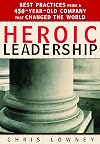
Chris Lowney has a unique background among business authors. A former Jesuit seminarian, Lowney went on to become a managing director of J.P. Morgan & Co in New York, Tokyo, Singapore and London.
He brings these two worlds together in "Heroic Leadership" in which he looks to the early history of the Jesuits for leadership lessons.
Lowney focuses on the Jesuits’ sense of nuestro modo de proceder — loosely translated as “our way of doing things” — arguing that the early Jesuits were show more successful not because they executed a preexisting plan, but because they shared a common set of values and beliefs that helped them adapt in new cultures and situations.
Lowney mines these values — self-awareness, ingenuity, love, and heroism — to illumine that work of leading organizations.
I love Lowney’s use of stories to illustrate the principles of leadership and his love of the Jesuits is palpable throughout the book. "Heroic Leadership" is an easy read that will be immediately applicable to leaders of any stripe. show less
He brings these two worlds together in "Heroic Leadership" in which he looks to the early history of the Jesuits for leadership lessons.
Lowney focuses on the Jesuits’ sense of nuestro modo de proceder — loosely translated as “our way of doing things” — arguing that the early Jesuits were show more successful not because they executed a preexisting plan, but because they shared a common set of values and beliefs that helped them adapt in new cultures and situations.
Lowney mines these values — self-awareness, ingenuity, love, and heroism — to illumine that work of leading organizations.
I love Lowney’s use of stories to illustrate the principles of leadership and his love of the Jesuits is palpable throughout the book. "Heroic Leadership" is an easy read that will be immediately applicable to leaders of any stripe. show less
Heroic Leadership: Best Practices from a 450-Year-Old Company That Changed the World by Chris Lowney
I just finished reading the book Heroic Leadership: Best Practices from a 450 Year-Old Company that Changed the World by Chris Lowney. Lowney reminded me why I've always admired the Jesuits and also made me think more clearly about exactly what it is that I admire in them.
In an amazing book, Lowney outlines four basic principles for leadership: self-awareness, ingenuity, love, and heroism. On the surface, the book looks like one of those inane books like The Leadership Secrets of Attila the show more Hun or Robert E. Lee on Leadership or something like that. But this book is decidedly not of that sort.
First of all, Attila and Robert E. Lee were, when all is said and done, pretty pathetic failures. The Jesuits, by contrast, have been remarkably successful as a group. But more importantly, Lowney give one a remarkably humane approach to leadership that is designed for the whole person. As such, it is very different than most leadership books.
He does a nice job outlining Jesuit history and showing how the four principles have been applied over the years. As I see it, their ideals are remarkably suitable for our world today. Lowney stresses that Jesuits are rooted in their principles and ideals, but reflective enough to understand that one must be flexible to compromise on non-essential points. For examples, he cites de Nobili and Ricci, Jesuits sent to live among the people of India and China. Both men remained devout Jesuits but were able to appreciate local customs and cultures. It is a principled ability to navigate in the world and remember what is truly important.
As we move ahead in education, these are principles I think all educators would be well to remember. Let's remember what's essential about education, but also be willing to forgo customs, habits, and traditions that don't compromise our principles.
I recognize that the Jesuits don't have a spotless record in all things and in fact the very term "Jesuitical" is not used in praise. Nonetheless, I think Lowney shows that whatever their shortcomings have been, they have also been resilient enough and principled enough to make a real difference in the world. He also does a good job of "secularizing" the Jesuits' leadership principles so that it applies to people beyond the Catholic world. show less
In an amazing book, Lowney outlines four basic principles for leadership: self-awareness, ingenuity, love, and heroism. On the surface, the book looks like one of those inane books like The Leadership Secrets of Attila the show more Hun or Robert E. Lee on Leadership or something like that. But this book is decidedly not of that sort.
First of all, Attila and Robert E. Lee were, when all is said and done, pretty pathetic failures. The Jesuits, by contrast, have been remarkably successful as a group. But more importantly, Lowney give one a remarkably humane approach to leadership that is designed for the whole person. As such, it is very different than most leadership books.
He does a nice job outlining Jesuit history and showing how the four principles have been applied over the years. As I see it, their ideals are remarkably suitable for our world today. Lowney stresses that Jesuits are rooted in their principles and ideals, but reflective enough to understand that one must be flexible to compromise on non-essential points. For examples, he cites de Nobili and Ricci, Jesuits sent to live among the people of India and China. Both men remained devout Jesuits but were able to appreciate local customs and cultures. It is a principled ability to navigate in the world and remember what is truly important.
As we move ahead in education, these are principles I think all educators would be well to remember. Let's remember what's essential about education, but also be willing to forgo customs, habits, and traditions that don't compromise our principles.
I recognize that the Jesuits don't have a spotless record in all things and in fact the very term "Jesuitical" is not used in praise. Nonetheless, I think Lowney shows that whatever their shortcomings have been, they have also been resilient enough and principled enough to make a real difference in the world. He also does a good job of "secularizing" the Jesuits' leadership principles so that it applies to people beyond the Catholic world. show less
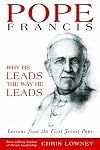
From choosing to live in a simple apartment instead of the papal palace to washing the feet of men and women in a youth detention center, Pope Francis’s actions contradict behaviors expected of a modern leader. Chris Lowney, a former Jesuit seminarian turned Managing Director for JP Morgan & Co., shows how the pope’s words and deeds reveal spiritual principles that have prepared him to lead the Church and influence our world—a rapidly-changing world that requires leaders who value the show more human need for love, inspiration, and meaning.
Drawing on interviews with people who knew him as Father Jorge Bergoglio, SJ, Lowney challenges assumptions about what it takes to be a great leader. In so doing, he reveals the “other-centered” leadership style of a man whose passion is to be with people rather than set apart. Lowney offers a stirring vision of leadership to which we can all aspire in our communities, churches, companies, and families. show less
Drawing on interviews with people who knew him as Father Jorge Bergoglio, SJ, Lowney challenges assumptions about what it takes to be a great leader. In so doing, he reveals the “other-centered” leadership style of a man whose passion is to be with people rather than set apart. Lowney offers a stirring vision of leadership to which we can all aspire in our communities, churches, companies, and families. show less

A little dry in some parts, and a little rambling in others, it ultimately gives the reader a clear window into the world of al-Andalus. It sparked my desire to study the period further.
Awards

You May Also Like


Associated Authors
Statistics
- Works
- 16
- Members
- 778
- Popularity
- #32,713
- Rating
- 4.1
- Reviews
- 11
- ISBNs
- 45
- Languages
- 6