
Margaret Grieve (1858–1941)
Author of A Modern Herbal
About the Author
Image credit: A picture of Maude Grieve taken in the early 1900s.
Works by Margaret Grieve
Tagged
Common Knowledge
- Legal name
- Grieve, Sophia Emma Magdalene (Neé Law)
- Other names
- Grieve, Margaret
Grieve, Maud
Grieve, M.
Grieve, Sophia Emma Magdalene
Law, Sophia Emma Magdalene (birth name) - Birthdate
- 1858-05-04
- Date of death
- 1941-12-21
- Gender
- female
- Occupations
- herbalist
writer - Short biography
- Sophie Emma Magdalene Grieve known as Maud. Born 4 May 1858 75 Upper Street, Islington, London. Died 21 December 1941 Royston, Hertfordshire. Herbalist, plants women, writer. Lived in Chalfont St Peter, Bucks, from 1906 to 1938 where she created a perennial nursery. At the outbreak of the First World War she turned the nursery into a herb farm to address the shortage of supplies of vital medicinal plants. She was a founder member of the short lived National Herb Growing Association and later president of The British Guild of Herb Growers During the war she also started The Whins Medicinal and Commercial Herb School. After the war she continued her work promoting the benefits of herbs, writing over three hundred pamphlets or monographs on individual plants. These were edited by Hilda Leyel and were the main source of information in what has become Maud’s legacy A Modern Herbal which was published 1931
- Nationality
- UK
- Birthplace
- 75 Upper Street, Islington, London
- Places of residence
- Chalfont St. Peter in Buckinghamshire, England
- Place of death
- Royston, Hertfordshire
Members
Reviews
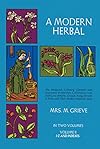
I was fortunate enough to find both this and volume 2 for a very cheap price at a used bookstore. The price was more than worth it. Discusses the medicinal, culinary, cosmetic and economic properties of a large variety of herbs, beginning with aconite and ending in the H's. The materia medicas have been broken into 2 parts, but the full index is available in both versions. Strangely enough, above the index on each page it doesn't say list of plants, but lists of plates. If anyone could show more explain this to me, I'd appreciate it.
Overall a very worthy reference aide. Not the one I turn to the most but one I do use quite a bit. Information is not spared on herbs, and each gets at least a page, with tiny text. Sometimes an old poem or piece from an ancient Materia Medica is given as a treat, such as with Culpeper and Gerard. There really aren't many recipes and formulas in these books but the ones given can be useful. For instance, apple butter, Almond butter, Almond milk etc ( much is written on almonds )
I especially enjoyed all the folklore details included here, very nice in rich history. Diagrams adorn many pages, in black and white, all helping the old feel appeal.
A great choice for reference materials, now considered classics show less
Overall a very worthy reference aide. Not the one I turn to the most but one I do use quite a bit. Information is not spared on herbs, and each gets at least a page, with tiny text. Sometimes an old poem or piece from an ancient Materia Medica is given as a treat, such as with Culpeper and Gerard. There really aren't many recipes and formulas in these books but the ones given can be useful. For instance, apple butter, Almond butter, Almond milk etc ( much is written on almonds )
I especially enjoyed all the folklore details included here, very nice in rich history. Diagrams adorn many pages, in black and white, all helping the old feel appeal.
A great choice for reference materials, now considered classics show less
A Modern Herbal (Volume 1, A-H): The Medicinal, Culinary, Cosmetic and Economic Properties, Cultivation and Folk-Lore of Herbs, Grasses, Fungi, Shrubs & Trees with Their Modern Scientific Uses by Margaret Grieve
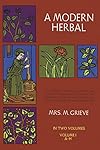
I was fortunate enough to find both this and volume 2 for a very cheap price at a used bookstore. The price was more than worth it. Discusses the medicinal, culinary, cosmetic and economic properties of a large variety of herbs, beginning with aconite and ending in the H's. The materia medicas have been broken into 2 parts, but the full index is available in both versions. Strangely enough, above the index on each page it doesn't say list of plants, but lists of plates. If anyone could show more explain this to me, I'd appreciate it.
Overall a very worthy reference aide. Not the one I turn to the most but one I do use quite a bit. Information is not spared on herbs, and each gets at least a page, with tiny text. Sometimes an old poem or piece from an ancient Materia Medica is given as a treat, such as with Culpeper and Gerard. There really aren't many recipes and formulas in these books but the ones given can be useful. For instance, apple butter, Almond butter, Almond milk etc ( much is written on almonds )
I especially enjoyed all the folklore details included here, very nice in rich history. Diagrams adorn many pages, in black and white, all helping the old feel appeal.
A great choice for reference materials, now considered classics show less
Overall a very worthy reference aide. Not the one I turn to the most but one I do use quite a bit. Information is not spared on herbs, and each gets at least a page, with tiny text. Sometimes an old poem or piece from an ancient Materia Medica is given as a treat, such as with Culpeper and Gerard. There really aren't many recipes and formulas in these books but the ones given can be useful. For instance, apple butter, Almond butter, Almond milk etc ( much is written on almonds )
I especially enjoyed all the folklore details included here, very nice in rich history. Diagrams adorn many pages, in black and white, all helping the old feel appeal.
A great choice for reference materials, now considered classics show less
A Modern Herbal (Volume 1, A-H): The Medicinal, Culinary, Cosmetic and Economic Properties, Cultivation and Folk-Lore of Herbs, Grasses, Fungi, Shrubs & Trees with Their Modern Scientific Uses by Margaret Grieve
This is a classic reference. Technically, a lot of the information is outdated, but it's great for the historical perspective of the use of many herbs.
A Modern Herbal: The Medicinal, Culinary, Cosmetic, and Economic Properties, Cultivation, and Folklore of Herbs, Grasses, Fungi, Shrubs, and Trees with All Their Modern Scientific Uses by M Grieve

When I first became interested in herbs fifty years ago, a very knowledgeable lady who was about the age I am now told me “what you need is Grieve’s Modern Herbal”. It has taken me all the intervening time to add it to my shelf, I am ashamed to say. It remains the classic text.
You May Also Like


Associated Authors
Statistics
- Works
- 8
- Members
- 1,295
- Popularity
- #19,822
- Rating
- 4.5
- Reviews
- 11
- ISBNs
- 22
