

Robert Baden-Powell (1857–1941)
Author of Scouting for Boys
About the Author
Disambiguation Notice:
Robert Stephenson Smyth Baden-Powell, 1st Baron Baden-Powell (1857-1941), British general, writer, and founder of the Scouting Movement
Image credit: Courtesy of the NYPL Digital Gallery (image use requires permission from the New York Public Library)
Series
Works by Robert Baden-Powell
Aids to Scoutmastership: A Handbook for Scoutmasters on the Theory of Scout Training (With Pamplet) (1992) 25 copies, 1 review
Eclaireurs, un manuel pour former de bons citoyens en leur apprenant a vivre en plein air (1932) 5 copies
Pfadfinder 3 copies
HIl Ilibro dei capi: sussidi per il capo nello scautismo: con illustrazioni dell'Autore (2006) 3 copies
A caminho do triunfo 2 copies
Life's Snags and how to meet them 2 copies
Pour devenir un homme 2 copies
The Baden-Powell Birthday Book, compiled by M. Hall from the writings of Robert Baden-Powell, etc (Windsor Birthday Books.) (1964) 2 copies
Aids to scouting for NCOs and men: The book that started the world-wide scouting movement (1994) 2 copies
Panākumu tekās : grāmata par dzīvi 2 copies
A handbook for brownies 2 copies
Das Wolfsbuch 1 copy
Cidadao do mundo 1 copy
Giocare il gioco: 750 citazioni tratte dagli scritti del fondatore del movimento scout (1997) 1 copy
Een verkenning in Afrika 1 copy
Spejderliv 1 copy
Le Livre des Louveteaux 1 copy
Franchis l'ostacle 1 copy
Glück auf die Lebensfahrt 1 copy
Pfadfinderführer 1 copy
la strada verso il successo 1 copy
Skavting dli͡a khlopt͡siv : pidruchnyk vyshkolu na dobrykh hromadi͡an cherez z͡hytti͡a sered pryrody 1 copy
Den lille Spejderbog 1 copy
Schnelltraining für den Krieg – Das britische Ausbildungmanual von Sir Robert Baden-Powell – SPARTANAT Red Book 7 (2025) 1 copy
How girls can help 1 copy
Associated Works
Tagged
Common Knowledge
- Legal name
- Baden-Powell, Robert Stephenson Smyth
Baden-Powell, 1st Baron - Birthdate
- 1857-02-22
- Date of death
- 1941-01-08
- Gender
- male
- Occupations
- soldier (British Army)
Chief Scout of the World
officer (British Army)
writer - Organizations
- Boy Scouts
- Relationships
- Burnham, Frederick Russell (friend)
Baden-Powell, Lady Olave (wife)
Baden-Powell, Agnes (sister)
Baden-Powell, Warrington (brother)
Baden-Powell, Heather (daughter)
Haig-Brown. Roderick (godson) - Nationality
- England
UK - Birthplace
- Paddington, London, England, UK
- Place of death
- Nyeri, Kenya
- Burial location
- Kenya
- Disambiguation notice
- Robert Stephenson Smyth Baden-Powell, 1st Baron Baden-Powell (1857-1941), British general, writer, and founder of the Scouting Movement
- Associated Place (for map)
- Paddington, London, England, UK
Members
Reviews
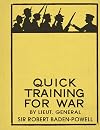
I love primary sources. I know there's a place for the pre-digested historical summaries that come from universities, but for me there is nothing quite as good as a book or diary that comes from the very era that is being studied. So consequently it should come as not surprise that I very much enjoyed QUICK TRAINING FOR WAR.
Baden-Powell published QUICK TRAINING FOR WAR when WWI broke out, and he meant the book to be used by new officers. Thus he writes then about esprit de corp, and about show more the FOUR C'S. The latter being Courage, Common Sense, Cunning, and Cheerfulness. In addition he discusses more technical approaches to war, including but not limited to, Trenching and Sand bag Defenses, and cavalry training.
When it comes to the leadership sections, I particularly enjoyed the stories he used to illustrate his examples. I don't know if he made them up, but we can assume that they were included because he felt there was truth in them.
I remember an officer who was a bit of a martinet, who, by his cursing and punishing the men, had roused amongst them a thorough hatred of himself; but he was plucky, there was not doubt whatever of that. One morning when ordered on an expedition with his force, he formed the men up and said, "I know you hate me, and you mean to shoot me in the back at the first opportunity. All I can advise you is not to do so just yet. We have a got a rough time before us to-day, and it wants a bold push. If you stick to me I'll take you through. You can shoot me as much as you like afterwards."
In addition, there are juicy little bits that he shares with us. They express common sentiment in a way that an academic's summary probably couldn't do justice to:
No one will deny that in drill and drill-book lore the German is far ahead of the Belgian; yet the elan and intelligence of the latter render him an equally good soldier.
As for the technical areas of the book, they aren't overly drawn out. I found the bits about trench construction oddly engaging. Considering what is coming in France it's at once interesting and horrifying.
And because I'm not a student of WWI, I was excessively delighted to learn about things like cholera belts. Cholera Belts are an entirely ridiculous thing, by the way. A bit a silk or flannel meant to keep the humid damp away from the body's mid-region. It was supposed to keep the wearer healthy. As if cholera could be defeated by a reduction of humidity.
*****
QUICK TRAINING FOR WAR is an enjoyable read that is not taxing in length. There are all sorts of things to learn. The author shares his discussions with the German Emperor and quotes Ulysses S. Grant and Nogi. There are diagrams that explain techniques and strategies. And there are good stories.
(read as ebook. review copy) show less
Baden-Powell published QUICK TRAINING FOR WAR when WWI broke out, and he meant the book to be used by new officers. Thus he writes then about esprit de corp, and about show more the FOUR C'S. The latter being Courage, Common Sense, Cunning, and Cheerfulness. In addition he discusses more technical approaches to war, including but not limited to, Trenching and Sand bag Defenses, and cavalry training.
When it comes to the leadership sections, I particularly enjoyed the stories he used to illustrate his examples. I don't know if he made them up, but we can assume that they were included because he felt there was truth in them.
I remember an officer who was a bit of a martinet, who, by his cursing and punishing the men, had roused amongst them a thorough hatred of himself; but he was plucky, there was not doubt whatever of that. One morning when ordered on an expedition with his force, he formed the men up and said, "I know you hate me, and you mean to shoot me in the back at the first opportunity. All I can advise you is not to do so just yet. We have a got a rough time before us to-day, and it wants a bold push. If you stick to me I'll take you through. You can shoot me as much as you like afterwards."
In addition, there are juicy little bits that he shares with us. They express common sentiment in a way that an academic's summary probably couldn't do justice to:
No one will deny that in drill and drill-book lore the German is far ahead of the Belgian; yet the elan and intelligence of the latter render him an equally good soldier.
As for the technical areas of the book, they aren't overly drawn out. I found the bits about trench construction oddly engaging. Considering what is coming in France it's at once interesting and horrifying.
And because I'm not a student of WWI, I was excessively delighted to learn about things like cholera belts. Cholera Belts are an entirely ridiculous thing, by the way. A bit a silk or flannel meant to keep the humid damp away from the body's mid-region. It was supposed to keep the wearer healthy. As if cholera could be defeated by a reduction of humidity.
*****
QUICK TRAINING FOR WAR is an enjoyable read that is not taxing in length. There are all sorts of things to learn. The author shares his discussions with the German Emperor and quotes Ulysses S. Grant and Nogi. There are diagrams that explain techniques and strategies. And there are good stories.
(read as ebook. review copy) show less

This book is a reprint of the original 1908 text of 'Scouting for Boys', complete with illustrations, but with notes, bibliography and an introduction by Elleke Boehmer; it is, in short, Scouting for Scholars. The editor's purpose is to present the text not as a subject of curiosity but rather as a primary document that can help us to understand the hopes and aspirations of those who cared passionately about the British Empire during its high noon, the first decade of the twentieth show more century.
Robert Baden-Powell, the hero of Mafeking - who got the whole Scouting movement under way with this book - was the right person in the right place at the right time and with the right ideas. The Boy Scouts turned out to be one of the most successful mass movements ever, and Scouting for Boys, which went through numerous editions, was second only to the Bible for popularity. Even read on its own terms it offers a fascinating insight into the kind of world that young boys inhabited one hundred years ago, and what kind of things it was deemed important and salutary that they should know: how to stop a runaway horse, how to remove a manhole cover so as to free someone overcome by sewer gas, what to do on happening upon a suicide cutting his own throat. Boys were obviously considered far more robust then: Baden-Powell advocates introducing greater realism to first-aid practices by the use of real sheep's blood (available from your local butcher). Much of what he suggests would probably be illegal today, since part of his purpose was to inculcate the importance of doing one's duty in the face of danger, regardless of the consequences to oneself; thus he commends the boy who dives head-first into a river without carrying out any kind of survey or risk assessment beforehand. Clearly, avoiding being sued was not a paramount concern of the pioneers of Scouting.
However, the book is even more interesting when Boehmer's introduction and notes are taken on board, for these draw out the basic concerns about society that Scouting was supposed to remedy. These were, firstly, that good citizenship was in decline, and (a common trope at the time) the lesson of Roman history was that enthusiastic and participatory citizenship was necessary for the maintenance of Empire: hence the subtitle of the book - "A Handbook for Instruction in Good Citizenship". Secondly, the Boer War had demonstrated pretty conclusively that the physical condition of British youth had actually declined during the second half of the nineteenth century, a circumstance that imperilled the ability of the armed forces to recruit in sufficient numbers. This decline in physical condition was largely attributed to lack of fresh air and exercise, poor food, and ignorance of the basic tenets of hygiene; factors that Baden-Powell was certain that Scouting could address. These issues, and others such as the reasons for the movement's extraordinary international popularity, are fully explored in the introduction and commented upon in the notes; and the editor also includes Baden-Powell's short diatribe on the perils of masturbation that the publisher insisted should be omitted from the first edition.
Such topics should capture the attention of anyone interested in the social history of the period, even someone who has never been remotely interested in Scouting as an activity; and Boehmer and the publishers are therefore to be thanked for producing such an accessible edition of this classic text. show less
Robert Baden-Powell, the hero of Mafeking - who got the whole Scouting movement under way with this book - was the right person in the right place at the right time and with the right ideas. The Boy Scouts turned out to be one of the most successful mass movements ever, and Scouting for Boys, which went through numerous editions, was second only to the Bible for popularity. Even read on its own terms it offers a fascinating insight into the kind of world that young boys inhabited one hundred years ago, and what kind of things it was deemed important and salutary that they should know: how to stop a runaway horse, how to remove a manhole cover so as to free someone overcome by sewer gas, what to do on happening upon a suicide cutting his own throat. Boys were obviously considered far more robust then: Baden-Powell advocates introducing greater realism to first-aid practices by the use of real sheep's blood (available from your local butcher). Much of what he suggests would probably be illegal today, since part of his purpose was to inculcate the importance of doing one's duty in the face of danger, regardless of the consequences to oneself; thus he commends the boy who dives head-first into a river without carrying out any kind of survey or risk assessment beforehand. Clearly, avoiding being sued was not a paramount concern of the pioneers of Scouting.
However, the book is even more interesting when Boehmer's introduction and notes are taken on board, for these draw out the basic concerns about society that Scouting was supposed to remedy. These were, firstly, that good citizenship was in decline, and (a common trope at the time) the lesson of Roman history was that enthusiastic and participatory citizenship was necessary for the maintenance of Empire: hence the subtitle of the book - "A Handbook for Instruction in Good Citizenship". Secondly, the Boer War had demonstrated pretty conclusively that the physical condition of British youth had actually declined during the second half of the nineteenth century, a circumstance that imperilled the ability of the armed forces to recruit in sufficient numbers. This decline in physical condition was largely attributed to lack of fresh air and exercise, poor food, and ignorance of the basic tenets of hygiene; factors that Baden-Powell was certain that Scouting could address. These issues, and others such as the reasons for the movement's extraordinary international popularity, are fully explored in the introduction and commented upon in the notes; and the editor also includes Baden-Powell's short diatribe on the perils of masturbation that the publisher insisted should be omitted from the first edition.
Such topics should capture the attention of anyone interested in the social history of the period, even someone who has never been remotely interested in Scouting as an activity; and Boehmer and the publishers are therefore to be thanked for producing such an accessible edition of this classic text. show less
This is a small book, almost a pamphlet, was written for men in Britain joining in the Great War. This is by no means a soldier's manual, but a book for those joining up and something to ease the anxiousness of joining the military. I remember getting a similar book in the 1980s when I joined the Marines. What is really striking about the book is how wrong it could be for World War I. Baden-Powell (of Boy Scout fame) based much of the information from the Boer War. There is still talk of show more calvary attacks and small protected trenches-- C and S trenches. Called "Common Sense" trenches they were named after the shape trenches. Little did Baden-Powell know just how extensive the trench system would become in the war and it had little to do with common sense. There is some good personal advice in the book particularly about hygiene and confidence.
As a historical document, Quick Training for War demonstrates how ill-prepared in scope and scale the nations of Europe were for the war that developed. Wars never go as planned, but World War I proved to be a war that no one's plans were executed as expected, and that, in itself, created a huge tragedy.
No star rating because it is a historical document. show less
As a historical document, Quick Training for War demonstrates how ill-prepared in scope and scale the nations of Europe were for the war that developed. Wars never go as planned, but World War I proved to be a war that no one's plans were executed as expected, and that, in itself, created a huge tragedy.
No star rating because it is a historical document. show less
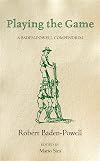
Enlightening and entertaining anthology of excerpts from the writings of Robert Baden-Powell. Playing the Game is arranged in roughly chronological order, and is divided between autobiographical anecdotes and the story (and theory) of scouting. The excerpts are interleaved with inspirational quotes, which would make an excellent book on their own. While this book is a treasure trove for the reader, its organisation can sometimes seem haphazard. As with all compendiums of this sort, there is show more a degree of repetition; this is particularly apparent in the final part of the book dealing with Baden-Powell's work for world peace. Despite this, Playing the Game is a welcome overview of and introduction to the writings of an extraordinary man, and liberally illustrated with B-P's own drawings. show less
Lists
Awards

You May Also Like


Associated Authors
Statistics
- Works
- 105
- Also by
- 2
- Members
- 874
- Popularity
- #29,293
- Rating
- 3.5
- Reviews
- 15
- ISBNs
- 122
- Languages
- 10
- Favorited
- 1

