
T. D. Harding
Author of Better Chess for Average Players
About the Author
Works by T. D. Harding
Associated Works
Tagged
Common Knowledge
- Legal name
- Harding, Timothy David
- Other names
- HARDING, Timothy David
HARDING, Tim - Birthdate
- 1948-05-06
- Gender
- male
- Education
- University of Dublin (PhD|History)
- Occupations
- chess
- Awards and honors
- Candidate Master
- Nationality
- United Kingdom
- Birthplace
- London, England, UK
- Places of residence
- Dublin, Ireland
- Associated Place (for map)
- London, England, UK
Members
Reviews

This book took me approximately forever to read. The prose style is clear and accessible; there's just so very much information, and I was trying to appreciate it all at one go, interminably extended, as it turned out. Even so, I have not yet not much explored the appendices (of which the most entertaining promises to be Appendix VI on "The Career of Mephisto," a chess pseudo-automaton sometimes operated by the player Isidor Gunsberg). Each biography contains an assortment of chess games show more actually played by the player under study, usually with annotations. I am a mediocre player myself, though I enjoy the game, and working through even a quarter to a third of these, as I think I did, hugely added to the time that I spent with this book. Beyond the diagrams for games, the book is extensively illustrated in black and white with photo and sketch portraits, and reproductions of primary documents.
Eminent Victorian Chess Players embraces a wealth of detail. The editorial apparatus is bracingly thorough, including multiple indices. The included games are all indexed by opening! The ten players treated are Evans, Staunton, Loewenthal, Bird, Skipworth, Steinitz, Blackburne, Zuckertort, Burn, and Gunsberg. Each of the biographies is a considerable work, reflecting extensive research. Although providing ample biographical context in each case, these are accounts of the men as players, teachers, and organizers of chess, with details on their other employment and their family lives all as a background to their chess accomplishments. Author Harding presumes the reader's knowledge and appreciation of the 20th-century game, and in the course of these biographies he provides many perspectives on the 19th-century chess milieu, with some intimations of how it differed from what came later. In particular, he traces the development of a British chess culture over the period studied.
The volume is a significant work of chess history, exhibiting at every turn the fruits of original research. I would recommend it without reservation to those with an interest in this particular field. show less
Eminent Victorian Chess Players embraces a wealth of detail. The editorial apparatus is bracingly thorough, including multiple indices. The included games are all indexed by opening! The ten players treated are Evans, Staunton, Loewenthal, Bird, Skipworth, Steinitz, Blackburne, Zuckertort, Burn, and Gunsberg. Each of the biographies is a considerable work, reflecting extensive research. Although providing ample biographical context in each case, these are accounts of the men as players, teachers, and organizers of chess, with details on their other employment and their family lives all as a background to their chess accomplishments. Author Harding presumes the reader's knowledge and appreciation of the 20th-century game, and in the course of these biographies he provides many perspectives on the 19th-century chess milieu, with some intimations of how it differed from what came later. In particular, he traces the development of a British chess culture over the period studied.
The volume is a significant work of chess history, exhibiting at every turn the fruits of original research. I would recommend it without reservation to those with an interest in this particular field. show less
 This review was written for LibraryThing Early Reviewers.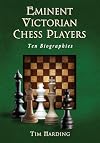
This book is much more interesting than the title suggests. I'm sure that's a hard sell to whoever may be reading this, but Harding does an excellent job of balancing the two interested parties that are likely to read this. First, those simply interested in biographies. Harding provides a lot of fascinating details about the disparate individuals who became chess masters in the Victorian era. And secondly, those interested in chess itself. There are a number of unique chess techniques show more identified in this book, with detailed descriptions. These often outdated strategies, wouldn't work against any high level chess player, but for most amateur players, the vast majority of players, these will improve your game.
Harding has put a lot of time and dedication to researching an accurate and interesting set of ten biographies of individuals skilled at arguably the greatest game ever created. So if any part of that boring sounding title is something you are interested in, you won't be disappointed by this book. show less
Harding has put a lot of time and dedication to researching an accurate and interesting set of ten biographies of individuals skilled at arguably the greatest game ever created. So if any part of that boring sounding title is something you are interested in, you won't be disappointed by this book. show less
This review was written for LibraryThing Early Reviewers.Victorian England was a fertile time for chess. Early on, games were mostly played between amateurs in pubs and coffee houses. By the end of the century, British chess was organized into clubs, with professional chess masters regularly winning international tournaments and claiming the world champion title. Names like Evans, Steinitz, Bird, and Staunton - ones any chess player who's studied even a bit would know - all came from this era. Harding's book gives fascinating biographical sketches show more of ten of these, with important games sprinkled in.
As I said, these were fascinating characters. Evans didn't just invent his eponymous opening, he also invented the system of lights used on sea vessels world-wide to allow safer navigation. Steinitz was a strange one who eventually left for America To get away from the backlash against him. The community was characterized by squabbles and competition - all making for fun reading!
Recommended for chess fans. Others may not find it so interesting. show less
As I said, these were fascinating characters. Evans didn't just invent his eponymous opening, he also invented the system of lights used on sea vessels world-wide to allow safer navigation. Steinitz was a strange one who eventually left for America To get away from the backlash against him. The community was characterized by squabbles and competition - all making for fun reading!
Recommended for chess fans. Others may not find it so interesting. show less
This review was written for LibraryThing Early Reviewers.Harding mixes in biography with each player's chess activities, emphasizing competitive play (tournaments & matches), brief discussion of any innovations in strategy, and the player's role as author of regular columns or books on chess. It's impressive how many regular features on chess there were in the Victorian age, and several players here made their living (if meagre) from these as well as appearances at chess clubs or salons (simultaneous displays, blindfold displays, consultation show more games between clubs or countries).
Harding introduced me to some basic terminology, and general insights such as the fact that positional play was relatively rare at this time, in favour of combination play and gambits. Apparently a common approach to a game was to try a known gambit: the typical response was to oppose it through a known refutation ("decline the gambit"), but if not then the outcome comes down to execution of the gambit or taking advantage of mistakes on either side. In some cases, players would try their hand at variations, or perhaps develop a novel approach (as noted here by the Evans Gambit). On top of this enters considerations of psychology, knowing what type of gambit rattles one's opponent, or perhaps whether it's advantageous to prolong the play in order to wear them out mentally. Many of the masters here evidently had a mental database of gambits and how to respond to them, and also basics on combination play to attempt to exploit weaknesses.
Not much time is devoted here to the finer points of strategy, except as evident in the annotated games (here presented in algebraic notation). That's understandable, but I'm at a severe disadvantage. I especially liked the Steinetz chapter as here Harding provided the most commentary on strategy and basic chess (but not much here, either).
I found myself wanting an animated form of game notation, so I would be able to see the play unfold, rather than build a mental picture of the board as described in the notation. Clearly chess enthusiasts are accustomed to that demand on them, and I suspect many databases or chess programs have such a feature.
Harding provides a good bit of background into Victorian London, at least that part visited by gentlemen; and the class consciousness evident in the friction between amateur (gentleman) players and professional players from the middle class. The nationalist chauvanism was evident, as well.
I've read several times that baseball's statistical archives are unmatched, but I wonder if anyone with a grounding in both baseball and chess has ever passed judgement. The foundation for a solid database in chess exists in the annotation of games. Undoubtedly important facts are not recorded (perhaps time of day the game played; particulars of the board or playing environment; Edo rating of the players for the year the game is played) but most if not all the essentials are there, and metrics could be devised based upon these, much like in sabremetrics.
An intriguing sub-theme is that of the chess automaton. Harding focuses upon Mephisto, as Gunsberg evidently was a key operator, but also outlines further detail in an appendix.
I need to follow this up with a readable book on chess fundamentals. And of course, play some chess. show less
Harding introduced me to some basic terminology, and general insights such as the fact that positional play was relatively rare at this time, in favour of combination play and gambits. Apparently a common approach to a game was to try a known gambit: the typical response was to oppose it through a known refutation ("decline the gambit"), but if not then the outcome comes down to execution of the gambit or taking advantage of mistakes on either side. In some cases, players would try their hand at variations, or perhaps develop a novel approach (as noted here by the Evans Gambit). On top of this enters considerations of psychology, knowing what type of gambit rattles one's opponent, or perhaps whether it's advantageous to prolong the play in order to wear them out mentally. Many of the masters here evidently had a mental database of gambits and how to respond to them, and also basics on combination play to attempt to exploit weaknesses.
Not much time is devoted here to the finer points of strategy, except as evident in the annotated games (here presented in algebraic notation). That's understandable, but I'm at a severe disadvantage. I especially liked the Steinetz chapter as here Harding provided the most commentary on strategy and basic chess (but not much here, either).
I found myself wanting an animated form of game notation, so I would be able to see the play unfold, rather than build a mental picture of the board as described in the notation. Clearly chess enthusiasts are accustomed to that demand on them, and I suspect many databases or chess programs have such a feature.
Harding provides a good bit of background into Victorian London, at least that part visited by gentlemen; and the class consciousness evident in the friction between amateur (gentleman) players and professional players from the middle class. The nationalist chauvanism was evident, as well.
I've read several times that baseball's statistical archives are unmatched, but I wonder if anyone with a grounding in both baseball and chess has ever passed judgement. The foundation for a solid database in chess exists in the annotation of games. Undoubtedly important facts are not recorded (perhaps time of day the game played; particulars of the board or playing environment; Edo rating of the players for the year the game is played) but most if not all the essentials are there, and metrics could be devised based upon these, much like in sabremetrics.
An intriguing sub-theme is that of the chess automaton. Harding focuses upon Mephisto, as Gunsberg evidently was a key operator, but also outlines further detail in an appendix.
I need to follow this up with a readable book on chess fundamentals. And of course, play some chess. show less
This review was written for LibraryThing Early Reviewers.You May Also Like


Associated Authors
Statistics
- Works
- 76
- Also by
- 1
- Members
- 707
- Popularity
- #35,839
- Rating
- 3.6
- Reviews
- 13
- ISBNs
- 68
- Languages
- 2
- Favorited
- 2

