

Claude M. Steele
Author of Whistling Vivaldi: How Stereotypes Affect Us and What We Can Do (Issues of Our Time)
About the Author
Image credit: "Claude Steele - TeachAIDS Interview" from the Flickr account of the TeachAIDS organization.
Works by Claude M. Steele
Whistling Vivaldi: How Stereotypes Affect Us and What We Can Do (Issues of Our Time) (2010) 837 copies, 29 reviews
Young, Gifted, and Black: Promoting High Achievement among African-American Students (2003) — Contributor — 118 copies, 2 reviews
Associated Works
Tagged
Common Knowledge
- Legal name
- Steele, Claude Mason
- Birthdate
- 1946-01-01
- Gender
- male
- Education
- Hiram College (B.A., Psychology)
Ohio State University (M.A., Social Psychology)
Ohio State University (Ph.D., Social Psychology and Statistical Psychology) - Relationships
- Steele, Dorothy M. (wife)
Steele, Shelby (brother) - Nationality
- USA
- Birthplace
- Chicago, Illinois, USA
- Associated Place (for map)
- Illinois, USA
Members
Reviews
Whistling Vivaldi: How Stereotypes Affect Us and What We Can Do (Issues of Our Time) by Claude M. Steele
Women worry about the stereotype that men are better at math. African-Americans worry about the stereotype of lesser academic achievement. Whites worry about the stereotype of lesser athletic ability, or that Asians supposedly are better at math. Men going into an empathetic profession worry about stereotypes of lesser empathy. And so on. Social psycologist Claude Steele calls these stereotype threats, and just the anxiety they create can severely impede performance, as confirmed in a show more truckload of social experiments.
"There is truly inspirational news here: evidence that often small, feasible things done to reduce these threats in schools and classrooms can dramatically reduce the racial and gender achievement gaps that so discouragingly characterize our society."
I found this book absolutely fascinating. It discloses truths that get lost under unreasoning and misleading emotion, provides insights and information I never would have thought of, and demonstrates the healthy effects of the kinds of "small, feasible things" he mentions on people's performances in their preferred fields, and on their relating to each other. I'm grateful to Ellen for her great review of this book. It deserves widespread attention.
Something as simple as reminding "test takers of identities that counter the relevant stereotype" before a test has been shown to have a significant positive, measurable impact on test results. The one requisite: the person must care about his/her performance. We also learn that anxiety over stereotype threats actually activates non-performing parts of the brain - it literally causes the brain to use its capabilities in a non-productive way. And we'll virtually all claim, and believe, that we're not experiencing that anxiety when, in fact, we are.
Counseling in certain ways can cause dramatic change; expressing company policy in certain ways can make even a non-diverse company attractive to diverse candidates. Whites who are unconsciously chary of discussing racial issues with blacks become more open (and physically move their chairs closer!) when the exchange is framed as a learning experience. (Other positive framing cues didn't work, but that did).
This is an important book, and it's heartening that the studies described are being conducted all over the world, with results continuing to confirm the insights and productive strategies described by Claude Steele. show less
"There is truly inspirational news here: evidence that often small, feasible things done to reduce these threats in schools and classrooms can dramatically reduce the racial and gender achievement gaps that so discouragingly characterize our society."
I found this book absolutely fascinating. It discloses truths that get lost under unreasoning and misleading emotion, provides insights and information I never would have thought of, and demonstrates the healthy effects of the kinds of "small, feasible things" he mentions on people's performances in their preferred fields, and on their relating to each other. I'm grateful to Ellen for her great review of this book. It deserves widespread attention.
Something as simple as reminding "test takers of identities that counter the relevant stereotype" before a test has been shown to have a significant positive, measurable impact on test results. The one requisite: the person must care about his/her performance. We also learn that anxiety over stereotype threats actually activates non-performing parts of the brain - it literally causes the brain to use its capabilities in a non-productive way. And we'll virtually all claim, and believe, that we're not experiencing that anxiety when, in fact, we are.
Counseling in certain ways can cause dramatic change; expressing company policy in certain ways can make even a non-diverse company attractive to diverse candidates. Whites who are unconsciously chary of discussing racial issues with blacks become more open (and physically move their chairs closer!) when the exchange is framed as a learning experience. (Other positive framing cues didn't work, but that did).
This is an important book, and it's heartening that the studies described are being conducted all over the world, with results continuing to confirm the insights and productive strategies described by Claude Steele. show less
Well-constructed and example-driven, CHURN focuses on the mental acrobatics caused by decades of social stereotypes and harmful ideologies, particularly racism. These are the "What if I'm not good enough?" "How will this make me look?" or "Do I belong here?" questions anyone with anxiety can relate to, but on a grander scale based on how someone is grouped by society, not by who they are as individuals. "Churning" can affect someone's self-worth, opportunity and potential. It can also be show more applied to the other end of the spectrum, stunting action from those who want to aide the cause but fixate on how the help will be perceived by those oppressed. Steele argues that the fight to close disparity gaps needs to include psychological support, beginning with small, achievable interventions- active listening, establishing trust and recognizing the effects of generational trauma - rather than through expensive and seemingly impossible reform plans. CHURN is not a lecture but an invitation. Easily digestible and offering actionable steps to take now - today - to make a difference. show less
Whistling Vivaldi: How Stereotypes Affect Us and What We Can Do (Issues of Our Time) by Claude M. Steele
This should be required reading for every educator in the U.S. and perhaps beyond. Steele, an eminent social psychologist at Stanford University (now at UC-Berkeley), described his research into stereotype thread and its impact on students' performance in a variety of situations. While much of the research focuses on the impact of stereotype threat on women in math-related fields and African-Americans in academic settings more broadly, I appreciated that some of his team's research has show more focused on the affect of stereotype threat on white students faced with interacting with black students regarding a racially-charged topic. The white students are also subject to stereotype threat in their desire not to be judged as racially insensitive; this confirms the broad applicability of the research without undermining the observation that, on average, it is not white students who face adverse identity contingencies in academic settings on a day-to-day basis.
He offers ways to address stereotype threat such as encouraging students engaging in intercultural dialogue to adopt a learning attitude, and teachers can create this by using learning objectives and clearly stating that learning IS the objective (reassuring students that they won't be judged based on stereotypes about their group has no positive impact at all), and that mistakes are to be expected. He also outlines some implications for mentors as well as for educational institutions for minimizing the cues that activate stereotype threat for students in negatively stereotyped groups.
And remember, this varies on context -- as a white woman I am vulnerable to stereotype threat based on my gender in some but not all situations and this depends, in part, on which of my identities is made salient in a particular situation.
I listened to this as an audiobook and found it engaging, thought-provoking, and enjoyable. I also recommend it for anyone interested in the process of social psychological research as the descriptions of the experiments and the thinking that surrounded them was fascinating and took me back to my early graduate school days. show less
He offers ways to address stereotype threat such as encouraging students engaging in intercultural dialogue to adopt a learning attitude, and teachers can create this by using learning objectives and clearly stating that learning IS the objective (reassuring students that they won't be judged based on stereotypes about their group has no positive impact at all), and that mistakes are to be expected. He also outlines some implications for mentors as well as for educational institutions for minimizing the cues that activate stereotype threat for students in negatively stereotyped groups.
And remember, this varies on context -- as a white woman I am vulnerable to stereotype threat based on my gender in some but not all situations and this depends, in part, on which of my identities is made salient in a particular situation.
I listened to this as an audiobook and found it engaging, thought-provoking, and enjoyable. I also recommend it for anyone interested in the process of social psychological research as the descriptions of the experiments and the thinking that surrounded them was fascinating and took me back to my early graduate school days. show less
Whistling Vivaldi: How Stereotypes Affect Us and What We Can Do (Issues of Our Time) by Claude M. Steele
Steele's book should be considered essential reading for anyone who seriously reflects on social identity in today's world. It is a strenuous and comprehensive evaluation of the scientific exploration that has been accomplished in this area. It also serves as a professional memoir for the author. Steele is careful to note that no one is free of bias, not even himself. Yet we can strive to make up for such human deficits through scientific probing into the unknown. While keeping in mind that show more at the root of identity an unknown factor may eventually foist all of our efforts at comprehension, Steele stoically pushes forward towards his ideal of progress and reform. Running on the hypothesis that stereotypes negatively effect the performance of high-achieving students in academic settings, Steele takes his reader on an exploration of the effects of stereotype threat. Stereotype threat is a subset of what Steele calls, "identity contingencies". These contingencies are based on an individual's sense of belonging to a group. When an individual believes that their liberties are hampered by one of these contingencies found in the social setting, this concern begins to impede the mental functioning of the individual (defined by working memory, ability to perform tasks, and a sense of self-esteem). A negative reaction to identity contingencies may be sparked by the slightest suggestion from the environment, usually spiraling into a vicious cycle of torment and stress. Although Steele only measures the effects caused by temporary stereotype threat, he acknowledges that the effects of stereotype threat on a long-term basis could be physically damaging to health. To add weight to this idea, he enlists the "John Henryism" hypothesis of Sherman James.
Steele's experimental conclusions suggest a solution to the problem of minority student underachievement: through changing a small part of the academic learning environment (the cues) minorities can be led to feel a sense of "identity safety". Although other cues also effect the performance of a ability-stereotyped students, like critical mass, Steele is optimistic that cues can be manipulated for desired positive outcomes. While he acknowledges that there are some things that we simply cannot change overnight, historical repercussions that continue to threaten our society, we must "err in the direction of urging greater trust, rather than greater vigilance" (p. 164).
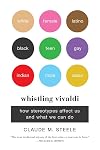
My only criticism of this book is that the cover and title do not adequately convey the scope of information contained in the book. They under/over-estimate the topics covered in the book. When I first saw the cover I expected this book to engage the entire palette of color-coded stereotypes in the cover-image. To my disappointment, the book had nothing in depth to say about the stereotypes of Latinos, Indians, Gays, Males, or Teens. There was a brief discussion on stereotypes of old age, which could be used to contrast with stereotypes of youth, yet no real discussion on this topic. The groups that were of primary concern were white and black Males (cognitive ability, athletics), females (math ability), and Asians (math ability). The title was also misleading. The author's message is that "whistling Vivaldi" is not enough to effect widespread change, when arising in the mind of a stereotyped student. It is not the responsibility of victims of stereotype threat, but that of their mentors and leaders to alter the cues and make performance environments identity safe for stereotyped students. In this sense, "whistling Vivaldi", can also be the solution, when suggested by a mentor. If every suggestion is a deception, then every compulsion is an adaptation to a contingency. At this level, the logic of this whole experimental journey into identity gets a bit murky, yet this is where discussion needs to start. We would also have to journey outside the realm of social psychology to approach these mysteries. show less
Steele's experimental conclusions suggest a solution to the problem of minority student underachievement: through changing a small part of the academic learning environment (the cues) minorities can be led to feel a sense of "identity safety". Although other cues also effect the performance of a ability-stereotyped students, like critical mass, Steele is optimistic that cues can be manipulated for desired positive outcomes. While he acknowledges that there are some things that we simply cannot change overnight, historical repercussions that continue to threaten our society, we must "err in the direction of urging greater trust, rather than greater vigilance" (p. 164).
My only criticism of this book is that the cover and title do not adequately convey the scope of information contained in the book. They under/over-estimate the topics covered in the book. When I first saw the cover I expected this book to engage the entire palette of color-coded stereotypes in the cover-image. To my disappointment, the book had nothing in depth to say about the stereotypes of Latinos, Indians, Gays, Males, or Teens. There was a brief discussion on stereotypes of old age, which could be used to contrast with stereotypes of youth, yet no real discussion on this topic. The groups that were of primary concern were white and black Males (cognitive ability, athletics), females (math ability), and Asians (math ability). The title was also misleading. The author's message is that "whistling Vivaldi" is not enough to effect widespread change, when arising in the mind of a stereotyped student. It is not the responsibility of victims of stereotype threat, but that of their mentors and leaders to alter the cues and make performance environments identity safe for stereotyped students. In this sense, "whistling Vivaldi", can also be the solution, when suggested by a mentor. If every suggestion is a deception, then every compulsion is an adaptation to a contingency. At this level, the logic of this whole experimental journey into identity gets a bit murky, yet this is where discussion needs to start. We would also have to journey outside the realm of social psychology to approach these mysteries. show less
Lists
You May Also Like


Associated Authors
Statistics
- Works
- 5
- Also by
- 4
- Members
- 967
- Popularity
- #26,625
- Rating
- 3.8
- Reviews
- 33
- ISBNs
- 7