
Elisabeth Hauptmann (1897–1973)
Author of The Threepenny Opera
About the Author
Image credit: via fembio.org
Works by Elisabeth Hauptmann
H. 12 = Versuche 27/32. 1 copy
Associated Works
Methuen Student Editions : Brecht : The threepenny opera {Manheim/Willet} : 2015 (2015) — Translator of Gay's original; Translator of Gay original — 41 copies
Tagged
Common Knowledge
- Canonical name
- Hauptmann, Elisabeth
- Legal name
- Hauptmann, Elisabeth Flora Charlotte
- Other names
- Lane, Dorothy
Diestelhorst, Josefine
Ux, Catherine - Birthdate
- 1897
- Date of death
- 1973
- Gender
- female
- Occupations
- Schriftstellerin
translator
playwright
editor
librettist
freelance writer (show all 7)
teacher - Organizations
- Berliner Ensemble
- Awards and honors
- Lessing-Preis der DDR (1961)
- Relationships
- Brecht, Berthold (Kollege)
Dessau, Paul (husband) - Short biography
- Elisabeth Hauptmann was born in Peckelsheim, Westphalia, Germany to an American mother, and a German father who was a physician. She was initially tutored at home by her mother Josefine with her two siblings, learning English at a very young age. From 1912 to 1918, she trained as a teacher and worked in a school in Linde in 1918-1922. In 1922, she worked as a secretary for poet and writer Herman George Scheffauer in Berlin. There she met Berthold Brecht and began collaborating with him on his works in 1924, originally as his editor and translator. At the same time, she was a freelance writer, contributing short stories to magazines. She become co-author of The Threepenny Opera, writing the majority of the text as well as providing a German translation of John Gay's The Beggar's Opera, on which the musical play was based. She reportedly wrote at least half of the opera The Rise and Fall of the City of Mahagonny, but was not credited. She was the main text author of the musical Happy End (1929) under the pseudonym Dorothy Lane. When the Nazi regime rose to power in 1933, Brecht left Germany for Denmark. Hauptmann visited him there and was arrested after her return to Germany. After her release, she moved to Paris and in 1934 left for the USA. She lived in New York City, then with her sister in St. Louis, and worked as a high school teacher. In 1941, she returned to New York, and married German composer and conductor Paul Dessau in 1948. She went back to Europe in 1949 and was divorced from Dessau in 1952. In 1954, she became a playwright at Brecht's theatrical company Berliner Ensemble in East Berlin. After his death in 1956, she published his works at the Suhrkamp publishing house. In 1961, Hauptmann received the Lessing Prize from the Ministry of Culture of East Germany. In 1977, a collection of her works was published under the title Julia ohne Romeo (Julia without Romeo).
- Nationality
- Duitsland
- Birthplace
- Peckelsheim, Preußen
Peckelsheim, Willebadessen, Nordrhein-Westfalen, Deutschland (heute) - Places of residence
- Berlin, Germany
St. Louis, Missouri, USA
New York, New York, USA - Place of death
- Berlin, Berlin, Deutschland
- Burial location
- Dorotheenstädtischer Friedhof, Berlin, Deutschland
- Associated Place (for map)
- USA
Members
Reviews
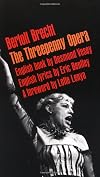
Brecht, Bertolt. The Threepenny Opera. 1928. Translated by Desmond I. Vesey and Eric Bentley. Foreword by Lotte Lenya. Grove Press, 1994.
Reviewers of The Threepenny Opera often mention its indictment of capitalism. Certainly, Brecht’s notes and “Tips” to actors suggest that is part of what he was after. He also says that he wanted to distance the audience from the action and characters to encourage it to respond intellectually to what it was seeing. Certainly, one could stage the play show more as an anti-capitalist rant, but the play offers so many levels of satire and parody, that to do so undersells. Its source, John Gay’s Beggar’s Opera, was a satire of Italian opera. Threepenny was billed not as an opera or a musical but as a “play with music.” The hero, Macheath, is aware that he is a pop star, and comes out singing his own pop anthem, “Mack the Knife.” Jenny, originally played by composer Kurt Weill’s wife, Lotte Lenya, appears as a character in “Mack the Knife” and is the heroine of her own fantasy in the play’s other pop hit, “Pirate Jenny,” a.k.a. “The Black Freighter.” Besides the aesthetic parody, gender roles get attention, just as they did in the Gay original. Characters seem aware that they are playing to the audience, showing off their skillfulness at greed, crime, and seduction. We can enjoy it all, without ever thinking of capitalism. 4 stars. show less
Reviewers of The Threepenny Opera often mention its indictment of capitalism. Certainly, Brecht’s notes and “Tips” to actors suggest that is part of what he was after. He also says that he wanted to distance the audience from the action and characters to encourage it to respond intellectually to what it was seeing. Certainly, one could stage the play show more as an anti-capitalist rant, but the play offers so many levels of satire and parody, that to do so undersells. Its source, John Gay’s Beggar’s Opera, was a satire of Italian opera. Threepenny was billed not as an opera or a musical but as a “play with music.” The hero, Macheath, is aware that he is a pop star, and comes out singing his own pop anthem, “Mack the Knife.” Jenny, originally played by composer Kurt Weill’s wife, Lotte Lenya, appears as a character in “Mack the Knife” and is the heroine of her own fantasy in the play’s other pop hit, “Pirate Jenny,” a.k.a. “The Black Freighter.” Besides the aesthetic parody, gender roles get attention, just as they did in the Gay original. Characters seem aware that they are playing to the audience, showing off their skillfulness at greed, crime, and seduction. We can enjoy it all, without ever thinking of capitalism. 4 stars. show less
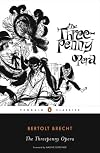
Brecht's complex critique of capitalism. Not unlike the Sopranos or The Wire, Brecht offers us a view of disenfranchised members of society who use the tools of capitalism to further their personal success (on the black market). The farce of it (or the tragedy?) is that capitalism is prima facie morally bankrupt, and that corporate entities are nothing but a conglomeration of Mack the Knives. Knaves all of them; exploiting one another to preserve their personal security.
Or is it only those who have the money who can enter the land of milk and honey?
There were stirrings when I read in David Simon's Homicide about the West Baltimore murders which didn't merit a line in the newspaper. Homo Sacer, Agamben
Perhaps a phrase in the Sebald poem offered a subtle nudge to this reluctant reader. Perhaps it was an image of Ho Chi Minh in Fredrik Logevall's seminal Embers of War-- the thin, proud leader speaking to a congress of the French Communist Party, all of them show more white, bloated and indifferent?
All those flickering images from Pabst's film--it is a shock that I didn't reach for this play before. The 18C play of John Gray is drenched in Brecht's mordant wit adapted, embellished and reborn with grim musings on sexuality and patriotism, emerging strident and timeless. show less
There were stirrings when I read in David Simon's Homicide about the West Baltimore murders which didn't merit a line in the newspaper. Homo Sacer, Agamben
Perhaps a phrase in the Sebald poem offered a subtle nudge to this reluctant reader. Perhaps it was an image of Ho Chi Minh in Fredrik Logevall's seminal Embers of War-- the thin, proud leader speaking to a congress of the French Communist Party, all of them show more white, bloated and indifferent?
All those flickering images from Pabst's film--it is a shock that I didn't reach for this play before. The 18C play of John Gray is drenched in Brecht's mordant wit adapted, embellished and reborn with grim musings on sexuality and patriotism, emerging strident and timeless. show less
A must-read -- and I think a definite performance piece. The message is still scarily relevant. If you think Brecht is dated, I dare you read this play for its portrayal of poverty, crime, manipulation, abuse and all sorts of other themes that look rather familiar right now. Not to mention the great songs by Weill.
Lists
Awards


You May Also Like
Associated Authors
Statistics
- Works
- 4
- Also by
- 6
- Members
- 1,860
- Popularity
- #13,837
- Rating
- 3.8
- Reviews
- 22
- ISBNs
- 55
- Languages
- 9
- Favorited
- 1