
Klyne Snodgrass
Author of The NIV Application Commentary: Ephesians
About the Author
Klyne R. Snodgrass (PhD, University of St. Andrews) is professor emeritus of New Testament studies at North Park Theological Seminary and formerly served as editor of Ex Auditu: An International Journal of the Theological Interpretation of Scripture. He has written several books, including the show more influential Stories with Intent: A Comprehensive Guide to the Parables of Jesus, winner of a Christianity Today Book Award. show less
Image credit: Wm. B Eerdmans Publishing
Works by Klyne Snodgrass
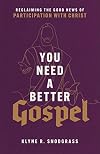
You Need a Better Gospel: Reclaiming the Good News of Participation with Christ (2022) 50 copies, 1 review
The Parable of the Wicked Tenants: An Inquiry into Parable Interpretation (Wissenschaftliche Untersuchungen Zum Neuen Testament) (1983) 6 copies
Ex Auditu - Volume 26: An International Journal of Theological Interpretation of Scripture (2011) 3 copies
Ex Auditu: An International Journal of Theological Interpretation of Scripture (Idolatry of Security) (2009) 2 copies
Ex Auditu. Volume 31, An international journal of theological interpretation of scripture (2016) 1 copy
Associated Works
Jesus and the Restoration of Israel: A Critical Assessment of N.T. Wright's Jesus and the Victory of God (1999) — Contributor — 216 copies
Tagged
Common Knowledge
- Canonical name
- Snodgrass, Klyne
- Legal name
- Snodgrass, Klyne Ryland
- Birthdate
- 1944-12-28
- Gender
- male
- Nationality
- USA
- Places of residence
- Tennessee, USA
- Associated Place (for map)
- Tennessee, USA
Members
Reviews
You Need a Better Gospel: Reclaiming the Good News of Participation with Christ by Klyne R. Snodgrass
One of the results of the “Christendom” experience over the past 2,000 years has been the intellectualization of the faith. Many sought to communicate Christianity in terms of an argument or philosophical system, and ever since there has been a strong temptation to make Christianity all about ideas and disputing about doctrines.
What was originally synthesized and philosophized in Christianity then went through the Enlightenment, and the result has sometimes been a perspective of show more Christianity as information acquisition and distribution. In theory there is an expectation of behavioral change, but what really proves important to many people is to have the right information and disseminate the right information. All kinds of lapses in behavior can somehow be justified and rationalized; but the moment anything about that information gets challenged, disputed, or questioned, then look out.
Think about how “the Gospel” gets characterized: almost entirely in terms of ideas, knowledge acquisition and distribution, and disputation thereof.
While the Gospel has always involved ideas, doctrines, and information acquisition and distribution, the Gospel has always involved far more than this. And Klyne Snodgrass does well at showing an important dimension of the Gospel often lost in this flattening process in You Need a Better Gospel: Reclaiming the Good News of Participation With Christ (galley received as part of early review program, but full book read).
In short, Snodgrass is highlighting the pervasive theme of “participation” throughout the Old Testament, in the Gospels, and in Paul’s letters and other letters. The Gospel was never meant to be just about information. The Gospel represents the story of what God has accomplished so that Christians can jointly participate in His work in/with Him and with one another.
If one has not been attuned to the theme of participation in Scripture, then this book will provide an excellent opportunity to have one’s eyes opened to how frequently and pervasively the authors of Scripture speak to and expect the participation of the believer in the life and work of God. The Gospel is a clarion call to do something: to follow in the ways of Jesus and well embody Him.
The author should be commended as a Protestant and coming to these conclusions, since the “faith only” over-emphasis inherent in Protestantism has led to the functional idolization of belief and faith and comparative disregard and contempt for participation and work. He is always welcome to check out the Restoration side of the pool.
The author and I agree on concerns about the language of theosis/deification; the author mentions perichoresis and Jesus’ prayer in John 17:20-23. I continue to emphasize, and encourage emphasis, on the story of Scripture as God’s revelation of the perichoretic relational unity within God and God’s desire for perichoretic relational unity with people and among people. Participation works quite well as a significant emphasis within this theme: when we belong to God and His people, we participate in the life and work of God and His people. If we are not participating in the work and life of God and His people, we functionally manifest a lack of involvement with God and His family, and the Scriptures attest to a prospect of terror in judgment if we meet the Lord in that condition.
This is an encouraging work for correcting unwise dogmatic and doctrinal emphasis, and a good attempt at getting back to a much more relational based understanding of what God is all about in Christ through the Spirit. show less
What was originally synthesized and philosophized in Christianity then went through the Enlightenment, and the result has sometimes been a perspective of show more Christianity as information acquisition and distribution. In theory there is an expectation of behavioral change, but what really proves important to many people is to have the right information and disseminate the right information. All kinds of lapses in behavior can somehow be justified and rationalized; but the moment anything about that information gets challenged, disputed, or questioned, then look out.
Think about how “the Gospel” gets characterized: almost entirely in terms of ideas, knowledge acquisition and distribution, and disputation thereof.
While the Gospel has always involved ideas, doctrines, and information acquisition and distribution, the Gospel has always involved far more than this. And Klyne Snodgrass does well at showing an important dimension of the Gospel often lost in this flattening process in You Need a Better Gospel: Reclaiming the Good News of Participation With Christ (galley received as part of early review program, but full book read).
In short, Snodgrass is highlighting the pervasive theme of “participation” throughout the Old Testament, in the Gospels, and in Paul’s letters and other letters. The Gospel was never meant to be just about information. The Gospel represents the story of what God has accomplished so that Christians can jointly participate in His work in/with Him and with one another.
If one has not been attuned to the theme of participation in Scripture, then this book will provide an excellent opportunity to have one’s eyes opened to how frequently and pervasively the authors of Scripture speak to and expect the participation of the believer in the life and work of God. The Gospel is a clarion call to do something: to follow in the ways of Jesus and well embody Him.
The author should be commended as a Protestant and coming to these conclusions, since the “faith only” over-emphasis inherent in Protestantism has led to the functional idolization of belief and faith and comparative disregard and contempt for participation and work. He is always welcome to check out the Restoration side of the pool.
The author and I agree on concerns about the language of theosis/deification; the author mentions perichoresis and Jesus’ prayer in John 17:20-23. I continue to emphasize, and encourage emphasis, on the story of Scripture as God’s revelation of the perichoretic relational unity within God and God’s desire for perichoretic relational unity with people and among people. Participation works quite well as a significant emphasis within this theme: when we belong to God and His people, we participate in the life and work of God and His people. If we are not participating in the work and life of God and His people, we functionally manifest a lack of involvement with God and His family, and the Scriptures attest to a prospect of terror in judgment if we meet the Lord in that condition.
This is an encouraging work for correcting unwise dogmatic and doctrinal emphasis, and a good attempt at getting back to a much more relational based understanding of what God is all about in Christ through the Spirit. show less
This book contained much more information than I personally needed. It was incredibly researched and the author is about as thorough as can be.
Having said that, the book was very helpful and the summaries and applications for each parable were GREAT!
Having said that, the book was very helpful and the summaries and applications for each parable were GREAT!

You cannot explain why these documents are included in the Bible by simply saying God gave them to us.
Helpful summary, Summaries, Analysis
Awards

You May Also Like


Associated Authors
Statistics
- Works
- 27
- Also by
- 3
- Members
- 1,477
- Popularity
- #17,386
- Rating
- 4.1
- Reviews
- 7
- ISBNs
- 38
- Languages
- 5
- Favorited
- 1